
Automated penetration testing uses agentic software pipelines to discover, exploit and validate security weaknesses at a scale and speed no manual engagement can match, producing reproducible evidence for triage and continuous integration. Its value lies in repeatable coverage between full assessments, not in replacing the human judgement required for complex business-logic flaws. Security teams should deploy it as a continuous layer that feeds, rather than substitutes for, expert-led penetration testing.
TL;DR:
- Automated pen testing focuses on hypothesis-driven attack sequences, producing reproducible evidence for validation rather than relying on pattern matching.
- Its effectiveness depends on strict controls like reproducibility gates, scope verification, and human review to prevent false positives and unvalidated findings.
- Deployment choices between self-hosted BYOK and SaaS affect data custody, with regulated sectors favoring self-hosting for legal proof and compliance reasons.
- Using automated testing for CI/CD, continuous exposure monitoring, and incident response offers rapid, repeatable insights, but complex business-logic flaws remain hard for automation to detect reliably.
- Validated findings must meet high standards of evidence preservation and review if they are to be used in legal, regulatory, or forensic investigations.
Table of Contents
- What automated pen testing is and how agentic workflows operate
- Core capabilities and what you get back from a run
- Strengths, limitations and the controls that keep results trustworthy
- Deployment models: self-hosted BYOK versus SaaS, and what it means for your data
- Building a pilot: implementation and adoption checklist for security teams
- How automated findings hold up as forensic evidence
- Where automated testing fits best in your security programme
- Where to go deeper before you pilot
- The overlooked gap between automated coverage and legal-grade proof
- Get expert support when automated findings need to hold up
- Sources
What automated pen testing is and how agentic workflows operate
Automated penetration testing has moved well beyond the signature-matching scanners of a decade ago. The current generation runs as an agentic pipeline: software agents that plan, act, observe results and revise their approach, much as a human tester would, but at machine speed and without fatigue.
A typical run follows five stages. Reconnaissance maps the target’s exposed surface. Hypothesis formation proposes a specific, testable claim, such as “this login endpoint is vulnerable to credential stuffing because it has no rate limiting.” Exploit attempts test that hypothesis directly, rather than firing every payload in a library at every endpoint. Validation confirms the result is real and repeatable. Reporting packages the finding with the evidence needed to act on it.
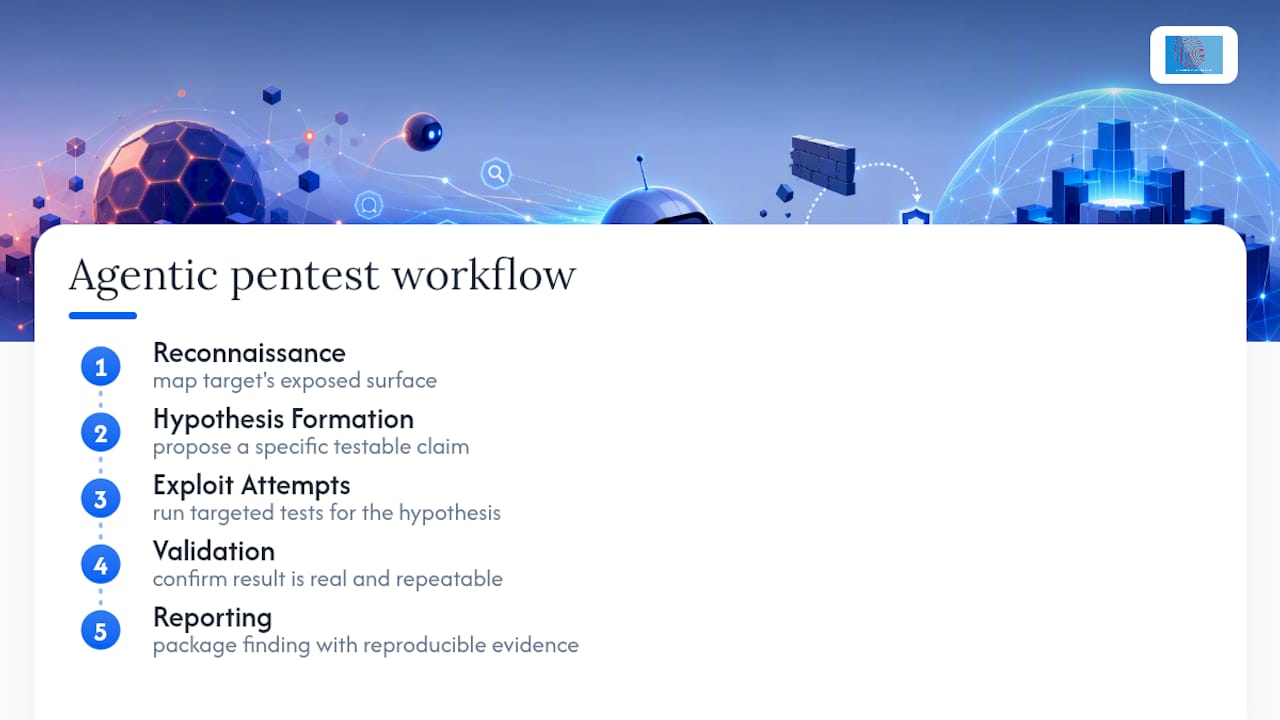
This hypothesis-driven approach is the single biggest architectural shift separating modern tools from older vulnerability scanners. Instead of pattern-matching against known signatures and flooding a report with maybes, the agent forms a specific claim and either proves or discards it. Open-source projects such as Fennec build their entire workflow around this principle, requiring reproducible evidence before a finding is ever surfaced to a human reviewer.
Underneath the workflow sit distinct agent roles, often described as Scout, Analyst, Exploiter and Reporter. The Scout handles discovery and fingerprinting. The Analyst correlates findings and proposes hypotheses. The Exploiter runs targeted attack sequences. The Reporter writes up the chain of evidence. Coordinating these roles requires memory that survives across steps, commonly implemented as a pentest task tree: a structured, persistent record of what has been tried, what succeeded, and what remains open. Architecture analysis of this task tree pattern shows why session persistence matters so much for multi-step attack chains, where a vulnerability only becomes exploitable after three or four earlier steps have already succeeded.
Underneath the agentic layer, orchestration still relies on established tooling: Nmap for port scanning, httpx for web probing, sqlmap for injection testing, and various fuzzers for input validation. What has changed is the reasoning layer stitching these tools together. Large language models or dedicated orchestrators now decide which tool to run next, interpret the output, and adjust strategy, a job that used to require a human at the keyboard reading scan results line by line.
Core capabilities and what you get back from a run
Security teams evaluating automated pen testing tools should judge them on concrete outputs, not marketing claims about “AI-powered coverage.” Five capability areas define what a genuinely useful platform delivers.
Reconnaissance and attack-surface mapping at scale. A capable tool enumerates subdomains, live hosts, open ports and running services across an entire estate in a fraction of the time a manual scoping exercise takes. Technology fingerprinting identifies frameworks, CMS platforms and library versions, which matters because outdated components are still one of the most common entry points attackers exploit. OWASP Nettacker demonstrates this well as a modular open-source example, chaining reconnaissance modules with vulnerability checks and credential testing while explicitly restricting itself to authorised targets.
Vulnerability detection, correlation and de-duplication. Raw scan output is noisy. A well-built pipeline correlates findings across tools, so a single misconfigured header does not generate five duplicate tickets from five different scanners. This is where the earlier hypothesis-driven design pays off: correlation happens before a finding is reported, not after an analyst has already spent an hour triaging near-identical alerts.
Exploit validation with reproducible evidence. This is the capability that separates a trustworthy platform from a noisy one. Rather than flagging a “potential” SQL injection, the tool captures the exact request, payload and response that proves exploitability. Some tools, including pentest-ai, describe this as producing “proof capsules”: machine-replayable artefacts that let a second party reproduce the exact exploitation sequence and confirm the claim independently, rather than trusting a text description.

Attack-chain construction and prioritisation. Individual low-severity findings often become critical when chained. An exposed staging subdomain plus a default credential plus an internal API with no authentication can add up to full compromise. Automated platforms that maintain a task tree across the engagement can surface these chains, and prioritise remediation around the combination rather than the individual weak link.
Typical outputs security teams should expect include:
- Structured findings in JSON or SARIF for direct ingestion into issue trackers and CI pipelines
- Human-readable HTML or PDF reports for stakeholders who need narrative context
- Raw request/response evidence attached to each validated finding
- A prioritised remediation list ordered by exploitability and business impact, not just CVSS score
- An audit trail of what was tested, what passed, and what could not be validated
Independent evaluation backs the case for this architecture: USENIX Security 2024’s assessment of PentestGPT recorded an 80% task completion rate against evaluated targets, compared with 47% for an unstructured GPT-4 baseline attempting the same tasks. The gap is the difference between a model reasoning freely and an agent working through a structured, task-tree-backed methodology.
Strengths, limitations and the controls that keep results trustworthy
Automated pen testing earns its place in a security programme on three strengths: coverage frequency, gating in CI/CD pipelines, and repeatable baselines that make regressions visible immediately rather than at the next annual assessment. A tool that runs nightly against your staging environment will catch a newly introduced authentication bypass within hours, not months.
It has real limits too. Business-logic vulnerabilities, the kind that require understanding what a workflow is supposed to do before you can spot where it goes wrong, remain difficult for automated agents to reason about reliably. A tool can tell you an API endpoint accepts unauthenticated requests; it struggles to tell you that a discount code stacking bug lets a customer checkout for a fraction of the intended price. The other risk, flagged repeatedly by practitioners working with AI-driven platforms, is fabricated or unvalidated findings: an agent reporting a vulnerability with confidence that does not survive a second look, highlighting the importance of cutting-edge bot attack defense in SaaS security. Practitioner feedback gathered alongside the PentestGPT evaluation identifies false positives and fabrication as the top operational concern with AI-powered pentesting, ahead of cost or speed.
Three controls reduce that risk to a manageable level:
- Hypothesis validation gates. No finding should reach a human reviewer’s queue without passing a reproducibility check, meaning the platform has actually re-run the exploit and confirmed the result, not just generated a plausible-sounding description.
- Pre-flight and scope verification. Every automated run needs an explicit, signed-off scope boundary before execution starts. Running exploit attempts against infrastructure that was never authorised is a legal and contractual problem, not just a technical one.
- Human-in-the-loop review before remediation tickets are raised. A security engineer should sample and verify a percentage of validated findings before they enter the remediation queue, particularly for anything touching production authentication or payment flows.
Pro Tip: Set a minimum reproducibility threshold before you trust a finding enough to open a ticket for it. If a tool cannot show you the exact request and response that proves exploitability, treat the result as a lead for manual follow-up, not a confirmed vulnerability.
Deployment models: self-hosted BYOK versus SaaS, and what it means for your data
Where an automated pentest platform runs, and who has access to the evidence it generates, is as important a decision as which platform you choose. Two models dominate, and they suit different risk profiles.
Self-hosted deployment with bring-your-own-key (BYOK) execution keeps everything, including API tokens, target data and captured evidence, inside your own infrastructure. Nothing is sent to a third-party telemetry pipeline. This matters enormously for chain-of-custody purposes: if a finding might ever support a legal investigation or a regulatory disclosure, you need to be able to show exactly where the evidence lived at every stage. Guidance from practitioners in high-compliance environments consistently favours self-hosted, BYOK-friendly tooling for regulated sectors and any engagement involving sensitive client data, precisely because it avoids the question of whether a vendor’s servers ever touched the evidence.
SaaS platforms trade some of that control for genuine operational convenience. Managed orchestration means you are not maintaining infrastructure, scaling compute for large scans, or patching the platform itself. Service-level agreements give you a contractual commitment on uptime and support response. For organisations without dedicated platform engineering resource, this is often the pragmatic choice, provided the vendor’s data handling terms are scrutinised carefully.
Before committing to either model, work through a short governance checklist:
- Does the platform offer a local or no-telemetry execution mode, and is it genuinely offline or merely “opt-out”?
- What is the data retention policy for captured evidence, credentials and scan artefacts?
- Are encryption standards documented for data at rest and in transit, and do they meet your existing compliance baseline?
- Does the vendor contract specify exactly where data is processed and stored, including any subprocessors?
- Can findings be exported in open formats (JSON, SARIF) so you are not locked into a proprietary reporting tool?
For sensitive environments, including anything that might later require expert witness testimony, treating evidence handling as a governance decision rather than a procurement afterthought avoids painful retrofitting later.
Building a pilot: implementation and adoption checklist for security teams
Adopting automated pen testing works best as a staged pilot, not a wholesale replacement of existing processes. Rushing straight to production-wide continuous scanning without proving reliability first is how teams end up drowning in unvalidated findings.
Start with selection criteria that actually predict day-to-day usefulness:
- Proof-based validation. Does the platform show its working, with request and response pairs, rather than asserting a vulnerability exists?
- Integration depth. Can it push findings directly into your existing issue tracker and CI/CD pipeline without a manual export step?
- Configurability. Can you define custom playbooks and depth presets, rather than being locked into one fixed scan profile?
- Evidence quality and export formats. Does output meet the standard you would need if a finding ever became relevant to a legal or regulatory matter?
Once you have shortlisted a platform, run a genuine pilot rather than a demo:
- Define a tightly scoped, explicitly authorised test environment, ideally staging rather than production for the first cycle
- Run the tool at its “turbo” or lightweight depth preset first to establish a fast baseline, before escalating to balanced or deep profiles
- Require a human reviewer to sample and manually replay a percentage of reported proofs-of-concept before accepting them as confirmed
- Track false-positive rate and time-to-validate as your two core pilot metrics, not just the raw number of findings generated
Build an operational runbook around the pilot’s results. Route validated findings into a triage queue with defined remediation SLAs tied to severity. Set an explicit escalation trigger: any finding that suggests a business-logic flaw, rather than a technical misconfiguration, gets handed to a manual pentest team rather than left in the automated queue. Guidance on CI/CD integration patterns recommends exactly this split: quick or turbo modes for pull-request checks where speed matters most, and balanced or deep profiles reserved for nightly or scheduled runs, with builds failing only on findings that have actually been verified and are replayable, never on raw or unconfirmed output.
Common integration points once the pilot proves out include automated checks on pull requests before merge, nightly full-surface scans feeding a dashboard your security team reviews each morning, continuous external exposure monitoring for anything internet-facing, and augmenting incident response by rapidly re-testing a suspected entry point while a live investigation is under way. Teams building a full internal methodology alongside this rollout often find it useful to reference a structured penetration testing process that shows where automated checks slot into a broader assessment lifecycle.
How automated findings hold up as forensic evidence
At Computerforensicslab, automated pentest output crosses our desk most often when it stops being a security ticket and becomes the starting point of an investigation, a suspected breach, an insider threat case, or a dispute where a client needs to prove exactly how a system was compromised. The gap between “the scanner flagged it” and “this evidence will survive cross-examination” is where our forensic discipline earns its keep.
We treat an automated finding the way we treat any digital artefact: it needs a documented chain of custody from the moment it is captured. That means recording exactly which tool generated it, under what authorisation, with what configuration, and whether the underlying proof, the request and response pair, the payload, the timestamped log, was preserved in its original form or altered in the reporting layer. A finding with a genuine reproducibility gate behind it, of the kind reputable open-source penetration testing tools now build in by default, is dramatically easier to carry into a legal or regulatory context than a narrative claim with no underlying proof.
Before we ever accept an automated result as an investigative lead, we replay it independently, verify the evidence trail is intact, and confirm scope and authorisation were properly documented before the scan ran. That discipline is what separates a useful lead from a liability.
Where automated testing fits best in your security programme
Automated pen testing earns its keep fastest in a handful of recurring scenarios rather than as a blanket replacement for scheduled assessments.
- Pre-merge and CI/CD checks: fast, lightweight scan modes catch obvious regressions before code reaches production, without slowing developers down.
- Continuous external exposure monitoring: internet-facing assets change constantly, and a nightly automated sweep catches new exposure between formal assessments.
- Pre-red-team smoke testing: running an automated pass before a scheduled manual engagement clears out the low-hanging fruit, so expensive expert time focuses on genuinely hard problems.
- Incident response augmentation: re-testing a suspected entry point quickly during a live investigation, rather than waiting for a scheduling slot.
Where to go deeper before you pilot
The USENIX Security 2024 evaluation of PentestGPT is worth reading in full if you want the methodology behind the task-completion figures rather than the headline number alone. For a hands-on feel of hypothesis-driven agentic design, the Fennec README and OWASP Nettacker’s documentation are both credible starting points for a local, BYOK trial against a staging environment.
Before you commit budget, work through a short checklist: confirm scope and written authorisation, choose a depth preset appropriate to the environment, decide how evidence will be exported and retained, and set a human review cadence for validated findings. Our guide to automated penetration testing tools covers deployment considerations for regulated UK organisations in more depth.
The overlooked gap between automated coverage and legal-grade proof
Most guidance on automated pen testing stops at the technical pipeline, recon, exploitation, reporting, and treats the output as the finish line. That is the wrong endpoint. A validated finding is the start of a chain of custody question, not the end of a testing exercise, and too few security teams plan for what happens if that finding ever needs to hold up outside a Slack channel.
The conventional advice to “just automate more of the pipeline” also undersells how much the false-positive problem still depends on human judgement. Reproducibility gates help enormously, but a gate is only as good as the reviewer checking it, and we have seen validated-looking findings unravel under a second look far more often than vendors like to admit.
If there is one priority worth acting on first, it is this: decide, before you ever run a scan, what standard of evidence a finding needs to meet if it becomes legally or contractually significant. Build your tooling choice, your deployment model and your review process around that standard from day one, rather than retrofitting it after an incident forces the question.
— Computer
Get expert support when automated findings need to hold up
Automated pen testing tells you where the exposure is; Computerforensicslab tells you whether the evidence behind it will survive scrutiny in court, in a regulatory review, or in a boardroom dispute. Where a validated finding turns into a genuine incident, a disputed breach, or grounds for litigation, our forensic team picks up exactly where the automated pipeline leaves off, preserving chain of custody, independently verifying exploitation evidence, and producing reports built to expert witness standard rather than internal ticket standard. That distinction matters the moment a finding stops being an engineering problem and becomes a legal one.
If your team has automated results that may need forensic validation or expert testimony, get in touch through our digital forensic investigations service to discuss next steps.
Sources
- USENIX Security 2024 appendix — PentestGPT evaluation
- Fennec AI — open-source agentic pentesting README