A computer forensic specialist recovers, verifies and explains digital evidence so it can be used in legal, corporate or law enforcement investigations. The role is built around four linked stages: acquisition, examination, analysis and reporting. Specialists work across law enforcement units, legal teams, private forensic labs and corporate security departments, moving between highly technical tasks and plain-language reporting for courts and clients.
TL;DR:
- Specialists image devices with write blockers, analyze forensic copies rather than originals, and document each transfer to protect evidence integrity and courtroom admissibility.
- A degree is not the only route; apprenticeships, technician roles, and targeted certifications can help, but documented practice and sample reports show practical ability.
- Police and routine lab roles may offer steadier schedules, while corporate incident response can involve on call work during breaches and field evidence collection.
- Labs hash forensic images at acquisition and before analysis, then preserve originals and working copies in logged storage alongside reports and recovered artifacts.
Table of Contents
- What a computer forensic specialist does day to day
- Skills, knowledge and competencies employers expect
- Qualifications and routes into digital forensics
- Where specialists work, typical pay and working hours
- Career progression and specialisms
- How a professional digital forensics lab maintains standards
- Our view on what makes a strong entry-level candidate
- How we can support your next step in digital forensics
- FAQ
- Sources
What a computer forensic specialist does day to day
Daily work follows the four phases set out in INTERPOL’s global guidelines for digital forensics laboratories: acquisition (creating a forensic image of a device), examination (extracting and carving relevant files), analysis (building a timeline and interpreting findings) and reporting (presenting conclusions clearly enough for legal use). A specialist might spend a morning imaging a seized laptop with a write blocker, an afternoon carving deleted files from unallocated disk space, and the following day reconstructing a timeline of user activity.
Case types vary widely and shape the daily workload:
- Cybercrime investigations, including hacking and unauthorised access.
- Fraud and financial misconduct involving falsified records or hidden transactions.
- Intellectual property theft, often involving departing employees and cloud storage.
- Harassment or threatening communications across messaging platforms.
- Internal misconduct cases requiring discreet, defensible evidence handling.
Routine lab tasks include evidence bagging, applying write blockers before any access, and running imaging hardware to capture exact, unaltered copies of storage media. Field triage, used when a quick read of a live system is needed, differs from post-mortem analysis, which happens later in a controlled lab setting on a forensic image rather than the original device, as guidance for first responders sets out.
Skills, knowledge and competencies employers expect
Employers look for a working knowledge of operating system internals, file systems, basic networking and hashing for integrity verification, the kind of core knowledge that CISA’s cyber defence forensics analyst role description sets out alongside skills in bit-level analysis. Tool familiarity spans several categories: imaging and triage software, mobile extraction platforms, malware analysis environments and network forensics suites.
Beyond the technical side, three further skill groups matter:
- Evidence documentation that stands up to legal scrutiny, including clear chain of custody records.
- Report writing that translates technical findings into language a court can follow.
- Composure when giving evidence or answering cross-examination in court.
Soft skills round out the profile: attention to detail, discretion with sensitive material, and the ability to work within a team that includes lawyers, investigators and IT staff.
Pro Tip: Keep a structured lab notebook of practice exercises and sample reports, and try a few digital forensics capture-the-flag challenges. Both give you concrete evidence of competence before you have a job title.
Qualifications and routes into digital forensics
Several routes lead into the field, and none is the only one. A computer science, cybersecurity or digital forensics degree with modules in programming, operating systems, databases and networking gives a strong technical base. Apprenticeships and entry-level technician roles offer a hands-on alternative, often combined with placements or volunteering in IT support or evidence handling. Short courses and vendor certifications in imaging tools, mobile extraction or malware analysis add credibility, particularly when chosen to match the specialism you want.
A practical plan for building a portfolio:
- Learn the basics: operating systems, file systems and command-line tools.
- Practise hands-on with publicly available forensic images and open-source tools.
- Seek lawful lab work or supervised placements to apply skills on real cases.
- Produce documented, well-structured sample reports that mirror professional output.
Working through these steps in order gives you something concrete to show an employer rather than a list of courses alone.
Where specialists work, typical pay and working hours
Computer forensic specialists work across several sectors, each with a different rhythm:
- Police and law enforcement digital forensics units, often with structured shift patterns.
- Private forensic labs serving legal and corporate clients on a case-by-case basis.
- Law firms and legal departments needing in-house technical support.
- Corporate incident response teams handling breaches and internal investigations.
Most work happens in an office or lab setting, though field attendance for evidence seizure and on-call incident response are common, particularly in corporate and law enforcement roles. Pay varies by sector, seniority and region, with private sector and consultancy roles generally commanding higher rates than entry-level public sector positions. On-call incident response work can mean irregular hours during active breaches, which is worth weighing against the steadier pace of routine casework.
Career progression and specialisms
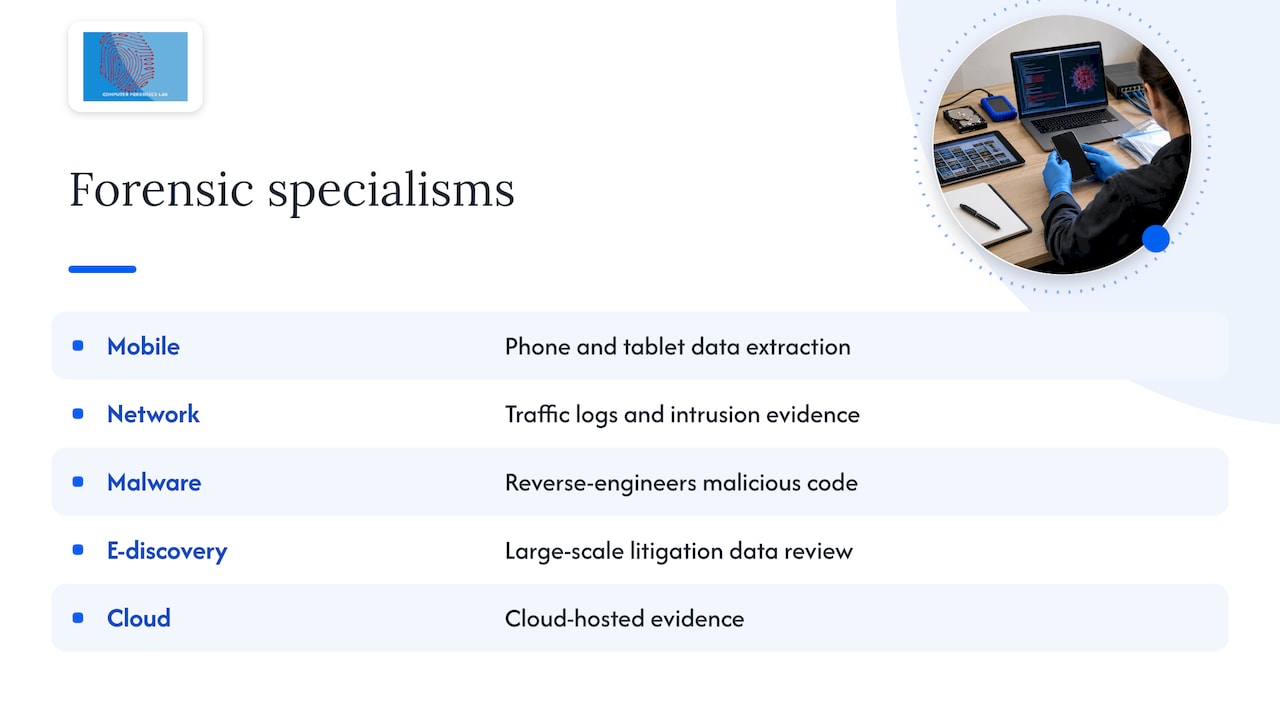
Most specialists start in general casework before narrowing into a specialism. Mobile forensics focuses on extracting and interpreting data from phones and tablets. Network forensics examines traffic logs and intrusion evidence. Malware analysis reverse-engineers malicious code to understand its behaviour. E-discovery and cloud forensics handle large-scale data review for litigation and cloud-hosted evidence respectively.
Progression typically moves from examiner to senior examiner, then into consultancy, expert witness work or team management, with digital forensics investigators often taking on broader case oversight as they advance. Senior roles are distinguished by the ability to defend methodology under cross-examination and manage complex, multi-device cases. Demonstrating a specialism is best done through a documented case log, supervised casework in that area, and, where possible, published write-ups of methodology.
How a professional digital forensics lab maintains standards
Professional labs follow the same backbone: acquisition, examination, analysis and reporting, with evidence preservation built into every stage, as both INTERPOL’s guidelines and NIST’s guidance on digital evidence preservation set out. Chain of custody records, hashing and imaging are not formalities; they are what allows a court to trust that evidence has not been altered since seizure.
Evidence preservation and chain of custody require documented imaging, secure storage and integrity checks to protect admissibility.
Typical lab deliverables include:
- A verified forensic image, hashed on acquisition and again before analysis.
- Extracted artefacts such as file listings, timelines and recovered data.
- A written expert report structured for legal use.
- Secure, logged storage of both originals and working copies.
We apply these same principles in our own casework, maintaining strict evidence logs and secure chain of custody procedures, and our reports are built to the structure courts expect, as covered in our guidance on expert witness reports.
Our view on what makes a strong entry-level candidate
We look for candidates who can show practical lab experience rather than certificates alone, who understand the legal weight of lawful evidence handling, and who can explain a technical finding in plain English. Students and career-changers do best when they combine a solid technical base with early exposure to how reports get used in real cases.
— Computer
How we can support your next step in digital forensics
Whether you are weighing up a career move or need forensic support for a live matter, our team handles digital forensics investigations, mobile phone forensics and data recovery alongside expert witness reporting across specialist computer forensics services. We are open to conversations with students and career-changers looking for mentoring or work experience insight, as well as legal and corporate clients needing a forensic engagement. Get in touch through our contact page to discuss either.
FAQ
What does a computer forensics specialist do?
A computer forensics specialist recovers, examines and analyses digital evidence from devices, networks or cloud accounts, then presents findings in a report suitable for legal proceedings. The work follows the acquisition, examination, analysis and reporting phases described in CISA’s NICE framework for digital forensics roles.
What qualifications do you need for computer forensics?
There is no single required path: a degree in computer science, cybersecurity or digital forensics is common, but apprenticeships, technician roles and vendor certifications also lead into the field. Building a portfolio of hands-on practice and documented sample reports matters as much as formal qualifications.
Does computer forensics pay well?
Pay varies by sector, seniority and region, with private sector consultancy and senior examiner roles generally paying more than entry-level public sector positions. Specific figures depend heavily on employer and location, so checking current postings for your region gives the most accurate picture.
What is the salary of a forensic computer analyst?
Salary depends on factors including employer type, seniority and geographic region, with no single figure applying across markets worldwide. Entry-level roles in public sector units typically start lower than private lab or corporate incident response positions.
Sources
- INTERPOL Global Guidelines for Digital Forensics Laboratories
- CISA / NICE framework: digital forensics work role description
- NIST IR 8387 — Digital evidence preservation: considerations for evidence handlers