
TL;DR:
- E-discovery involves the legal process of managing electronically stored information for litigation, governed by UK rules and the EDRM framework. Proper early preservation, validation of AI tools, and detailed documentation are essential to controlling costs and ensuring defensibility. Specialist forensic experts are advisable when dealing with tampering, complex devices, or contested metadata during e-discovery procedures.
E-discovery, formally known as electronic discovery, is the legal process of identifying, preserving, collecting, processing, reviewing, and producing electronically stored information (ESI) for use in litigation or regulatory proceedings. In England and Wales, this process is governed primarily by the Civil Procedure Rules (CPR) and Practice Direction 31B, with the Electronic Discovery Reference Model (EDRM) providing the widely adopted conceptual framework for structuring each stage. Technology-assisted review (TAR), including predictive coding and AI-assisted workflows, has become a standard tool in high-volume matters.
The practical significance is straightforward: the vast majority of evidence in modern commercial and civil disputes exists in digital form. Emails, instant messages, cloud-stored documents, database records, and mobile device data are now routinely decisive. Parties who fail to manage electronic disclosure correctly face adverse costs orders, sanctions, and credibility damage before the court.
- eDiscovery = the structured legal process for handling ESI from identification through to production in court.
- EDRM = the reference model defining the iterative stages of that process.
- CPR / Practice Direction 31B = the UK procedural rules governing electronic disclosure obligations.
- TAR / predictive coding = technology tools that assist document review at scale, accepted by courts where properly validated.
Table of Contents
- What is e-discovery in law, and how does it differ from traditional discovery?
- How does the eDiscovery process work? An EDRM stage map
- What counts as ESI? Common types and where to find them
- What UK rules govern electronic disclosure?
- Preservation obligations, litigation holds, and spoliation risk
- How do technology and AI-assisted review work in eDiscovery?
- A practical start-of-matter checklist for legal teams
- What drives eDiscovery costs and how long does it take?
- When should you instruct a digital forensics lab or expert?
- Key takeaways
- A forensics practitioner’s perspective on where eDiscovery goes wrong
- How Computerforensicslab supports eDiscovery matters
- Useful sources and further reading
What is e-discovery in law, and how does it differ from traditional discovery?
Traditional discovery involves exchanging physical documents: paper contracts, printed correspondence, physical records. Electronic discovery covers the same objective — giving each party access to relevant evidence held by the other — but applies specifically to digital material. The distinction matters because ESI presents unique challenges that paper does not: volume (a single server may hold millions of documents), format complexity (databases, audio files, proprietary software outputs), and the presence of metadata that is invisible to the naked eye but legally significant.
The term “eDiscovery” is used interchangeably with “electronic discovery” and “ediscovery” across legal practice. In US federal proceedings, the Federal Rules of Civil Procedure govern the process; in England and Wales, the CPR and associated Practice Directions apply. The underlying principles — proportionality, cooperation, and early scoping — are broadly consistent across both jurisdictions, though the procedural mechanics differ.
How does the eDiscovery process work? An EDRM stage map
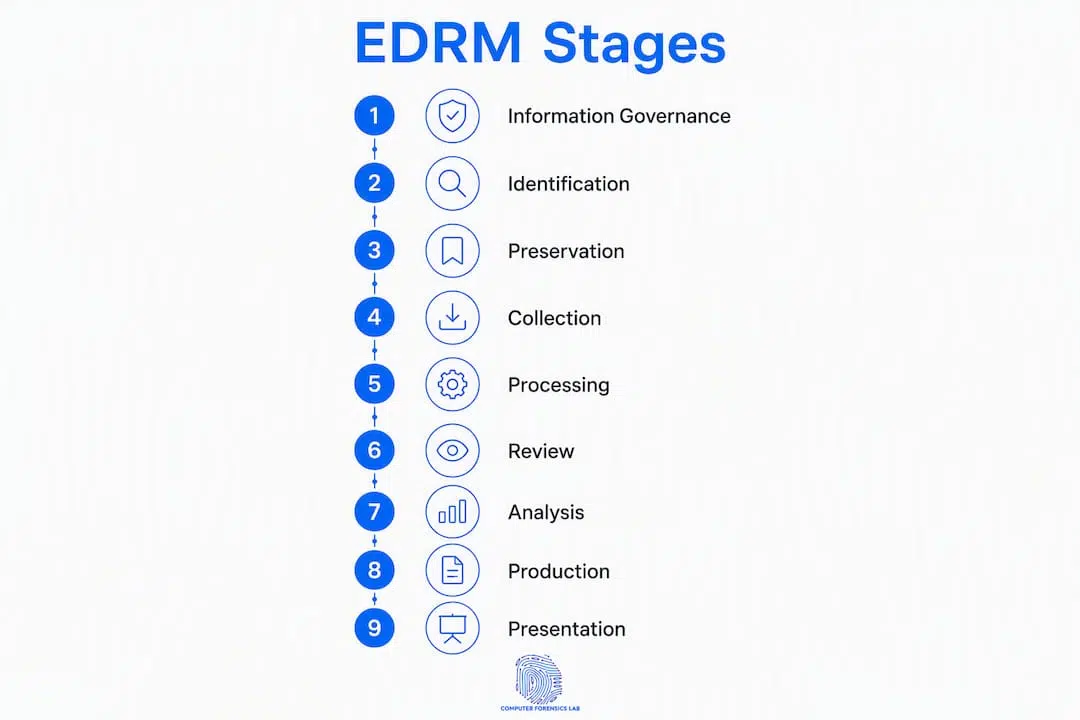
The EDRM organises electronic discovery into nine iterative stages. Critically, the model is non-linear: as a legal team’s understanding of the data improves, earlier stages may need to be revisited. A collection exercise may reveal previously unknown custodians, requiring a return to the identification stage. Processing results may prompt a revised search strategy. This iterative quality is what distinguishes well-managed eDiscovery from a one-pass document dump.

| Stage | Purpose | Typical owner |
|---|---|---|
| Information governance | Establish data maps and retention policies before litigation arises | IT / records management |
| Identification | Locate potentially relevant ESI and custodians | Legal team / IT |
| Preservation | Freeze relevant data to prevent alteration or deletion | Legal team / IT |
| Collection | Acquire data in a forensically sound manner | Digital forensics specialist |
| Processing | Convert, de-duplicate, and index data for review | eDiscovery vendor / forensics lab |
| Review | Assess documents for relevance, privilege, and responsiveness | Legal team / review platform |
| Analysis | Apply analytics, clustering, and TAR to surface patterns | Legal team / vendor |
| Production | Deliver responsive documents to opposing parties in agreed format | Legal team / vendor |
| Presentation | Use evidence at hearings, depositions, or trial | Counsel |
Early scoping is the single most cost-effective intervention available to a litigation team. Agreeing custodian lists, date ranges, and search parameters before collection begins prevents the exponential cost growth that comes from processing data that was never going to be relevant. Documentation of every decision at each stage — what was searched, why, and what was excluded — creates the audit trail courts expect.
Pro Tip: Record every scoping decision in writing as it is made, not retrospectively. Courts and opponents will scrutinise the methodology; a contemporaneous decision log is far more credible than a reconstructed account.
What counts as ESI? Common types and where to find them
Practice Direction 31B defines “electronic document” broadly, explicitly including emails, text messages, voicemail, word-processed documents, databases, files on portable devices, backups, deleted files, and metadata. That breadth is deliberate: the definition is intended to capture any information stored in electronic form, regardless of whether it is currently accessible or has been marked for deletion.
Common ESI types legal teams encounter include:
- Emails and attachments — still the primary source of documentary evidence in most commercial disputes.
- Instant messaging and collaboration platforms — Teams, Slack, WhatsApp Business, and similar tools generate large volumes of potentially relevant communications.
- Cloud storage — OneDrive, Google Drive, SharePoint, and Dropbox repositories, which may span multiple jurisdictions.
- Mobile device data — SMS, call logs, app data, location data, and photographs from smartphones and tablets.
- Databases and structured data — financial records, CRM systems, ERP exports, and transactional logs.
- Audio and video files — recorded calls, CCTV footage, and video conference recordings.
- Backup tapes and archive systems — often overlooked but potentially containing the only surviving copy of deleted material.
- System and application logs — access logs, audit trails, and event records that establish who did what and when.
Two categories consistently surprise legal teams. First, deleted files: deletion from a user interface rarely means permanent erasure. Forensic tools can recover data from unallocated disk space, shadow copies, and recycle bins. Second, metadata: every electronic document carries embedded data recording creation date, author, modification history, and sometimes geolocation. Metadata is frequently decisive in timeline disputes and authorship questions, and it is within scope of disclosure under Practice Direction 31B.
For a practical overview of the types of electronic evidence that arise in UK matters, Computerforensicslab maintains a detailed resource covering device, cloud, and network sources.
What UK rules govern electronic disclosure?
The legal framework for electronic disclosure in England and Wales rests on CPR Part 31 and Practice Direction 31B, supplemented by Practice Direction 57AD (PD57AD) for the Business and Property Courts. Together, these instruments define the duty to preserve, the standard of reasonable search, and the overriding requirement of proportionality.
PD57AD and the Disclosure Review Document (DRD) are now central to disclosure management in the Business and Property Courts. The DRD requires parties to set out, in advance, the issues for disclosure, the sources to be searched, the technology to be used, and the methodology for any TAR or AI-assisted workflow. Courts treat the DRD as an operational commitment, not a formality.
On the question of technology, courts are increasingly receptive to modern eDiscovery techniques where manual review would be impractical, provided the proposing party can demonstrate proportionality and defensibility. Accepting a TAR methodology is not automatic: the party deploying it must be able to explain the approach, the validation steps taken, and the human oversight applied.
Legal risks of non-compliance with disclosure duties include:
- Adverse costs orders, potentially on an indemnity basis.
- Unless orders requiring disclosure within a fixed period, with strike-out as the sanction for non-compliance.
- Adverse inference directions, where the court draws negative conclusions from missing evidence.
- Credibility damage before the tribunal, which can affect the weight given to other evidence.
- Professional conduct consequences for solicitors who fail to advise clients about preservation obligations.
For a detailed account of electronic disclosure obligations in UK litigation, including DRD preparation, Computerforensicslab’s guidance covers the procedural steps from first instruction through to production.
Preservation obligations, litigation holds, and spoliation risk
The duty to preserve arises the moment litigation is reasonably contemplated — not when proceedings are issued; for guidance on effective preservation steps, see What Evidence Should I Preserve After a Car Accident – Personal Injury Lawyers of Tampa. Solicitors are expected to advise clients about preservation at the earliest opportunity, and failure to do so carries real consequences: courts have imposed adverse costs orders and evidential sanctions where parties allowed relevant documents to be deleted, overwritten, or lost after the duty arose.
A practical preservation checklist for the start of a matter:
- Identify custodians — determine which employees, contractors, or third parties are likely to hold relevant data.
- Issue a litigation hold notice — written notification to all custodians suspending normal deletion and retention policies for relevant material.
- Suspend automated deletion — disable scheduled purges, email auto-delete rules, and backup overwrite cycles for the relevant period.
- Map data sources — document where relevant ESI resides: mail servers, shared drives, mobile devices, cloud accounts, and backup systems.
- Collect evidence of steps taken — retain copies of the hold notice, distribution records, and any IT configuration changes made to implement the hold.
- Hash collected data — generate cryptographic hash values (MD5 or SHA-256) at the point of collection to establish integrity and support chain-of-custody records.
Chain of custody is not a procedural nicety. A document whose provenance cannot be established — where it was found, who handled it, and whether it has been altered — may be challenged on admissibility grounds or given reduced weight. Contemporaneous records, including hash verification logs and evidence of who accessed what and when, are the foundation of a defensible collection.
For step-by-step guidance on preserving digital evidence in a litigation context, including litigation hold templates and chain-of-custody protocols, Computerforensicslab’s preservation resources cover the full process.
How do technology and AI-assisted review work in eDiscovery?
Technology plays a role at every stage of the eDiscovery process, from forensic collection through to production. The tooling landscape broadly divides into four functional categories:
- Collection and forensic acquisition tools — software and hardware used to create forensically sound images of devices and cloud accounts without altering the source data.
- Processing and de-duplication platforms — convert raw collected data into reviewable formats, remove exact and near-duplicate documents, and extract metadata.
- Analytics and clustering engines — group documents by conceptual similarity, identify key custodians and communication threads, and surface anomalies.
- Review workstations and production modules — provide the interface for legal review, privilege logging, redaction, and export in court-specified formats.
Technology-assisted review (TAR), also called predictive coding, uses machine learning to rank documents by likely relevance based on a seed set of human-reviewed examples. In high-volume matters, courts have accepted TAR workflows where manual review would be disproportionately expensive, provided the methodology is validated and disclosed. Generative AI tools are moving from niche experimentation into mainstream disclosure practice, though practitioners report that 2026 deployments will require stronger validation and transparency than earlier TAR iterations.
Defensibility is the non-negotiable requirement. When using AI-assisted review, parties must be prepared to document the specific model or tool used, the training or seed set, validation sampling results (recall and precision metrics), human review metrics, and a complete audit trail for every step. Stating that “AI found the documents” is not a methodology; it is an assertion that courts will not accept without evidence.

Pro Tip: Agree the TAR methodology with your opponent before deployment and record the agreement in the DRD. A jointly agreed protocol dramatically reduces the risk of a later challenge to the review process and gives the court confidence that the approach was transparent from the outset.
Limitations of AI-assisted review that teams must account for:
- Model errors, particularly where the seed set is too small or unrepresentative of the full dataset.
- Data bias, where the training documents reflect the reviewer’s assumptions rather than the actual relevance population.
- Confidentiality risks with cloud-based generative AI tools, where client data may be processed on third-party infrastructure without adequate data processing agreements.
- Language and format limitations, where non-English documents, audio files, or proprietary database formats fall outside the model’s effective scope.
Burges Salmon’s disclosure briefings confirm that courts and leading practitioners expect validation, audit trails, and transparency wherever GenAI is used in review workflows, and that these expectations are tightening rather than relaxing.
A practical start-of-matter checklist for legal teams
The decisions made in the first days of a matter determine whether eDiscovery remains proportionate or becomes a runaway cost. The following checklist covers the steps that should be completed before the first case management conference.
- Conduct an early case assessment — review the pleadings and identify the key factual issues to determine what categories of ESI are likely to be relevant.
- Identify and interview custodians — speak to the individuals most likely to hold relevant data; document their device usage, account access, and data storage habits.
- Map all data sources — produce a written inventory of servers, cloud accounts, mobile devices, backup systems, and any third-party repositories.
- Issue litigation hold notices — distribute written preservation instructions to all custodians and relevant IT personnel; retain proof of delivery.
- Suspend automated deletion — confirm with IT that scheduled purges and backup overwrite cycles have been paused for the relevant period and custodians.
- Agree scope with the opponent — use the meet-and-confer process (or its UK equivalent, the pre-CMC discussion) to agree custodian lists, date ranges, search terms, and technology.
- Consider sampling and analytics — before committing to full collection and review, use targeted sampling to test the likely yield of proposed search parameters.
- Prepare the Disclosure Review Document — complete the DRD with the agreed sources, methodology, technology, and any TAR protocol; treat it as a live document updated as the matter develops.
- Assess security and confidentiality — confirm that any vendor or cloud platform used for review holds appropriate certifications (ISO 27001 is the baseline) and that data processing agreements are in place.
- Budget and stage the process — agree a phased approach with the client: identification and preservation first, then collection and processing, then review and production; revisit the budget at each gate.
Questions to ask your IT team or vendor before collection begins: What backup retention schedules are in place? Which cloud accounts are covered by corporate data governance policies? Can mobile device data be extracted without wiping the device? What search tools are available, and have they been validated for the data types in scope?
What drives eDiscovery costs and how long does it take?
Cost in eDiscovery is primarily a function of data volume and review complexity. The relationship is not linear: doubling the data volume more than doubles the cost, because processing, de-duplication, and review time all scale with the size and diversity of the dataset.
| Factor | Impact on cost and time | Mitigation |
|---|---|---|
| Data volume | High: more data means more processing, storage, and review time | Early scoping, targeted collection, sampling |
| Number of custodians | Moderate to high: each additional custodian adds collection, processing, and review load | Agree a proportionate custodian list with the opponent early |
| Source complexity | High: cloud, mobile, and backup sources require specialist tools and more processing time | Identify complex sources at the mapping stage and budget accordingly |
| Review method | Very high: manual review is the largest single cost driver | Use TAR where proportionate and validated |
| Format diversity | Moderate: non-standard formats (audio, video, databases) require specialist processing | Identify format types during early case assessment |
Typical timelines vary considerably by matter size. A small commercial dispute with a defined custodian set and a few gigabytes of email data can move from preservation to production in four to eight weeks. A mid-size matter with multiple custodians, cloud sources, and a TAR workflow typically takes three to six months. Large-scale litigation involving terabytes of data, international custodians, and complex privilege review can run for a year or more, with rolling productions throughout.
Cost-control levers available at every stage include proportional sampling to test search yield before full collection, early analytics to identify the most relevant document clusters, TAR where the volume justifies the setup cost, staged productions to allow the opponent to review and raise issues before the next tranche, and clear DRD scoping to prevent scope creep.
When should you instruct a digital forensics lab or expert?
Not every eDiscovery matter requires a specialist forensics laboratory. Standard disclosure in a commercial dispute, where the data is accessible, the custodians are cooperative, and the formats are conventional, can often be managed by a competent eDiscovery vendor with appropriate legal oversight. The calculus changes when any of the following triggers are present.
Concrete triggers for instructing a forensics specialist:
- Suspected deletion or tampering — where there is reason to believe relevant data has been deliberately destroyed, overwritten, or concealed.
- Complex device collections — encrypted devices, damaged hardware, or devices running non-standard operating systems that require specialist acquisition tools.
- Contested metadata or chain-of-custody questions — where the authenticity or provenance of a document is in dispute and expert analysis is needed to resolve it.
- Data recovery requirements — where relevant ESI has been deleted, corrupted, or stored on damaged media and recovery is needed before review can begin.
- Malware or intrusion analysis — where the case involves a data breach, ransomware attack, or alleged unauthorised access, and the forensic artefacts need to be preserved and analysed.
- Expert witness reports — where the court requires independent expert evidence on a technical question, such as the authenticity of a document, the source of a data leak, or the integrity of a collection process.
Computerforensicslab’s forensic investigation services cover forensic imaging, data recovery from damaged or encrypted devices, secure analysis environments, malware analysis, and the preparation of expert witness reports that meet the requirements of CPR Part 35. Early instruction — before collection begins — is almost always preferable to remedial work after a collection has been compromised.
Expert witnesses in digital forensics carry duties to the court, not to the instructing party. A well-prepared expert report documents the methodology used, the tools applied, the data examined, and the limitations of the analysis. Contemporaneous notes taken during the examination are essential: reconstructed accounts prepared after the fact carry significantly less evidential weight.
For matters involving recovering deleted data or establishing the integrity of a collection, early engagement with a forensics specialist preserves options that may be lost if the device is handled incorrectly in the interim.
Key takeaways
E-discovery in law is the structured, legally governed process for handling electronically stored information in litigation, and in England and Wales it requires compliance with CPR Practice Direction 31B, early preservation, proportionate scoping, and defensible use of technology.
| Point | Details |
|---|---|
| Core definition | eDiscovery is the process of identifying, preserving, collecting, reviewing, and producing ESI for use in litigation. |
| EDRM stages | Nine iterative stages from information governance to presentation; non-linear and revisable as data understanding develops. |
| UK legal duties | CPR Practice Direction 31B and PD57AD require early preservation, proportionate search, and transparent methodology in the DRD. |
| TAR and AI | Technology-assisted review is court-accepted where validated; parties must document methodology, human oversight, and audit trails. |
| Computerforensicslab | Provides forensic collection, data recovery, chain-of-custody records, and CPR Part 35-compliant expert witness reports for UK litigation matters. |
A forensics practitioner’s perspective on where eDiscovery goes wrong
The most consistent failure pattern in eDiscovery is not technical. It is timing. Legal teams that treat preservation as something to address after the first case management conference have already lost ground: data has been overwritten, backup cycles have run, and the litigation hold notice arrives weeks after the duty to preserve arose. Courts notice this, and opponents exploit it.
A second persistent problem is the gap between what technology promises and what it actually delivers without proper configuration. TAR tools are powerful, but a model trained on a poorly selected seed set will systematically miss document categories that the seed set did not represent. The validation step — checking recall and precision against a statistically meaningful sample — is not optional. It is the mechanism by which the legal team can honestly represent to the court that the review was thorough.
Confidentiality deserves more attention than it typically receives during vendor-led review. Client data processed through a cloud-based review platform is subject to the platform’s data processing terms, the jurisdiction of the servers involved, and the security controls the vendor has in place. Instructing a vendor without confirming ISO 27001 certification and reviewing the data processing agreement is a risk that solicitors should not accept on a client’s behalf.
The final point concerns expert witness reports. A report that describes what was found without explaining how it was found, what tools were used, and what the limitations of the analysis are will be challenged. The methodology section is not a formality; it is the foundation on which the expert’s conclusions rest.
How Computerforensicslab supports eDiscovery matters
Computerforensicslab provides specialist digital forensics services to law firms, in-house legal teams, and corporate clients across the United Kingdom who need technically rigorous support for electronic disclosure and litigation.
The core services relevant to eDiscovery matters include forensically sound device imaging, data recovery from damaged or encrypted media, secure processing and analysis environments, chain-of-custody documentation, and the preparation of expert witness reports compliant with CPR Part 35. Where a matter involves suspected deletion, device tampering, or contested metadata, early instruction allows the laboratory to preserve forensic artefacts that would otherwise be lost.
A first engagement typically covers the scope of the matter, the devices and data sources involved, the preservation steps already taken, and the timescales for collection and reporting. For urgent preservation requirements, same-day instruction is available.
To discuss a current matter or request an evidence preservation consultation, contact Computerforensicslab through the digital forensics services page or review the step-by-step evidence collection guide for an overview of the collection process before your first call.
Useful sources and further reading
The following primary sources and practitioner resources are recommended for legal professionals who need to verify obligations, cite authority in court papers, or follow developments in UK disclosure practice.
- Practice Direction 31B — Disclosure of electronic documents — the primary UK procedural instrument governing electronic disclosure; consult this for the definition of electronic documents, preservation duties, and proportionality requirements.
- EDRM model — the Electronic Discovery Reference Model; the standard conceptual framework for eDiscovery stages used by practitioners and courts internationally.
- Generative AI in UK disclosure — JDSupra — practitioner analysis of how PD57AD and the DRD frame the use of AI and TAR in current disclosure practice; useful for understanding what courts expect when technology is deployed.
- AI and disclosure: Too much information — Law Gazette — analysis of how courts are balancing proportionality and defensibility as AI tools become mainstream in disclosure workflows.
- Three million PDFs: AI-assisted discovery and UK legal review — Lextrapolate — detailed account of the validation and audit-trail requirements courts apply to AI-assisted review; essential reading before deploying TAR in a contested matter.
- Practice Direction 31B — preservation and cooperation — Lexology — practitioner commentary on preservation obligations, client advice duties, and the consequences of spoliation under UK rules.
- Burges Salmon disclosure briefings — practice notes on GenAI in disclosure, validation requirements, and the direction of travel for 2026 and beyond.
This article provides general information about eDiscovery and electronic disclosure in England and Wales. It is not legal advice. Parties with specific disclosure obligations should confirm current procedural requirements with their solicitors or consult the primary sources listed above.