
TL;DR:
- Automated penetration testing tools offer continuous vulnerability validation and scalable coverage for organizations. They excel at proof-by-exploitation, reducing false positives, and integrating into CI/CD pipelines, but cannot replace manual testing for complex business logic flaws. Selecting the right tool depends on your asset types, compliance needs, and risk tolerance, especially regarding data residency and remediation workflows.
The shortlist for most UK security teams in 2026 breaks down cleanly by primary use case. For automated web application and API testing, PortSwigger Burp Suite Professional remains the practitioner standard. For continuous pipeline gating with proof-by-exploitation, Aikido Security and Pentera lead on automation depth. For network and infrastructure scanning at scale, Tenable Nessus is the default enterprise choice. For open-source coverage benchmarked against OWASP standards, OWASP ZAP remains the reference implementation. For proof-by-exploitation in red-team workflows, Rapid7 Metasploit has no direct peer. For enterprise-grade autonomous testing across internal and external assets, Invicti/Acunetix and Pentera both warrant evaluation.
- PortSwigger Burp Suite Pro — best for web/API security testing; unmatched manual-assist and automated scan combination.
- Tenable Nessus — best for broad network and infrastructure vulnerability scanning; high asset coverage, mature compliance reporting.
- Rapid7 Metasploit — best for proof-by-exploitation; the de facto framework for verifying whether a vulnerability is genuinely exploitable.
- OWASP ZAP — best free option for automated web application penetration testing; strong CI/CD integration via Docker and API.
- Invicti/Acunetix — best for enterprise web and API portfolio scanning; low false-positive rate through proof-based scanning.
- Pentera — best for autonomous internal network testing with full attack-chain coverage from recon to lateral movement.
- Aikido Security — best for DevSecOps teams wanting SaaS-delivered, CI/CD-native security testing with minimal operator overhead.
Automation provides continuous, repeatable exploit validation. It does not replace the creative judgement required for business-logic flaws or complex chained attacks. For UK organisations subject to GDPR, any automated testing programme also requires documented authorisation and careful data-residency controls. Computerforensicslab provides managed penetration testing and evidence-grade reporting for organisations that need a specialist to run or oversee that process.
Pro Tip: Before evaluating any tool, define whether you need vulnerability discovery (scanner), exploitability confirmation (automated pentest platform), or adversarial simulation (red team). These are distinct requirements and most tools optimise for only one.
Table of Contents
- What do “automated penetration testing tools” actually mean?
- How does automated penetration testing actually work?
- What are the real benefits and limits of automated pentesting?
- Which automated penetration testing tools lead in 2026?
- How do you choose the right automated pentesting tool?
- How should you deploy automated tools in a DevSecOps pipeline?
- When should you combine automation with manual testing?
- What does automated penetration testing cost?
- What are the UK regulatory and compliance considerations?
- What security and privacy risks do automated tools introduce?
- How do tool support and community activity signal longevity?
- Key takeaways
- A practitioner’s view on deploying automated pentesting at scale
- Computerforensicslab’s managed penetration testing for UK organisations
- Authoritative sources and further reading
What do “automated penetration testing tools” actually mean?
The term covers three distinct categories that practitioners frequently conflate, and the distinction matters for procurement, scoping, and compliance documentation.
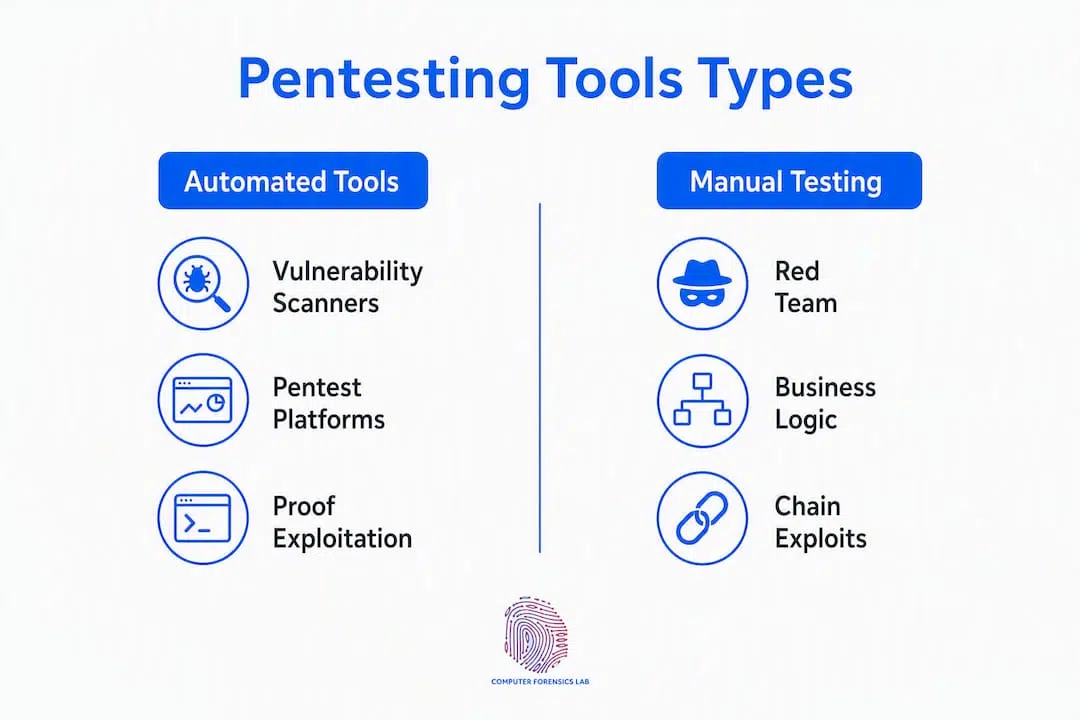
A vulnerability scanner (Nessus, OpenVAS) performs signature-based checks against known CVEs and misconfigurations. It identifies potential weaknesses but does not attempt exploitation. Output is a list of findings ranked by CVSS score, many of which may be false positives or unexploitable in context.
An automated penetration testing platform goes further: it maps the attack surface, forms hypotheses about exploitable paths, attempts targeted exploitation, and reports only confirmed findings with reproducible proof-of-concept evidence. Hypothesis-driven frameworks report only exploitable findings and capture the full evidence chain, which materially reduces false positives and triage burden. Pentera’s multi-agent architecture, for example, pursues objectives from reconnaissance through to lateral movement and privilege escalation.

A manual red team brings human creativity, contextual understanding of business logic, and the ability to chain low-severity findings into high-impact attack paths that no automated system currently replicates reliably. Automation complements but does not replace manual testing: automation provides continuous, repeatable validation while human experts remain necessary for complex scenarios.
| Dimension | Vulnerability scanner | Automated pentest platform | Manual red team |
|---|---|---|---|
| Coverage | Broad, signature-based | Targeted, hypothesis-driven | Bespoke, creative |
| Cadence | Continuous or scheduled | Continuous or triggered | Periodic (quarterly/annual) |
| Exploitation | None | Confirmed PoC | Full chain |
| False-positive rate | High (legacy) | Low (proof-gated) | Very low |
| Operator expertise | Low | Medium | High |
| Cost per test | Low | Medium | High |
Key terminology used throughout this article:
- Recon — passive and active discovery of assets, services, and exposed interfaces.
- Proof-by-exploitation — the tool executes a real exploit and captures evidence before reporting the finding.
- Runtime instrumentation — sensors embedded in the running application that observe actual data flows, used by tools like Contrast Security to confirm whether a vulnerability is reachable.
- False-positive rate — the proportion of reported findings that are not genuinely exploitable in the tested environment.
- Hypothesis-driven agent — an automated component that forms a testable attack hypothesis and pursues it rather than running broad signature sweeps.
How does automated penetration testing actually work?
Modern platforms follow a structured workflow, though the degree of autonomy at each stage varies considerably between tools.
- Reconnaissance — The platform discovers assets through DNS enumeration, port scanning (often using Nmap under the hood), service fingerprinting, and credential exposure checks. External and internal surfaces are mapped separately.
- Attack surface mapping — Discovered services, endpoints, and technologies are catalogued. Web applications are crawled; APIs are enumerated from OpenAPI specifications or traffic observation.
- Hypothesis generation — The platform identifies candidate attack paths based on the observed surface. Advanced tools use orchestrator agents that assign sub-tasks to specialised modules or LLM-assisted reasoning components.
- Targeted exploitation — Exploits are attempted against confirmed hypotheses. Proof-by-exploitation platforms execute real payloads and capture session tokens, command output, or data exfiltration evidence before logging the finding.
- Post-exploitation — Where authorised, the platform attempts lateral movement, privilege escalation, and credential harvesting to demonstrate the realistic impact of a confirmed entry point. Pentera’s multi-agent architecture maps internal and external attack surfaces and pursues objectives through to post-exploitation, including lateral movement.
- Reporting and remediation verification — Findings are presented with full evidence chains: request/response pairs, screenshots, exploit replay scripts, and CVSS scores. Remediation verification re-runs the specific exploit after a fix is applied.
Advanced autonomous agents separate orchestration logic from large language models and use specialised machine oracles to verify exploitability, reducing the risk of non-reproducible or hallucinated findings. This architectural separation is what distinguishes a genuine automated pentest platform from a scanner with an AI label attached.
Pro Tip: Require that any automated tool you evaluate can export findings in SARIF format. SARIF is the standard for integrating security findings into GitHub Advanced Security, Azure DevOps, and most modern CI systems, and it makes pipeline gating straightforward to configure.
What are the real benefits and limits of automated pentesting?
Where automation genuinely adds value
Speed and repeatability are the clearest gains. An automated platform can re-test an entire web application after every deployment, something no manual team can match economically. CI/CD gating — blocking a release when a verified exploit is found — is only practical with automation. At scale, the cost per test drops significantly compared with commissioning periodic manual assessments.
Runtime validation approaches can reduce false-positive rates from the typical legacy scanners down to very low percentages in some configurations, which directly reduces the engineering time spent triaging noise. Proof-by-exploitation also produces the reproducible evidence chains that compliance auditors and legal teams require.
- Continuous coverage between manual assessments.
- Regression detection: catches re-introduced vulnerabilities after code changes.
- Consistent methodology: the same tests run the same way every time.
- Lower cost per finding at scale compared with manual-only programmes.
- Audit-ready evidence: reproducible PoCs with timestamps and request/response logs.
Where automation falls short
Business-logic flaws are the clearest gap. An automated tool cannot understand that a multi-step checkout flow should prevent a user from applying a discount code twice, or that a document-sharing feature should not allow cross-tenant access under a specific sequence of API calls. These require a human tester who understands the application’s intended behaviour.

Certain chained exploits also remain difficult to automate reliably. A finding that requires combining a low-severity IDOR with a misconfigured S3 bucket and a timing attack on a session token is within reach of a skilled red teamer but beyond most current platforms. Environment-specific checks — legacy protocols, bespoke authentication schemes, air-gapped systems — similarly resist generic automation.
Misconfigured active testing is a genuine operational risk. A tool set to aggressive exploitation mode against a production database can cause data corruption or service disruption. This is not a theoretical concern.
| Dimension | Automated platform | Manual red team |
|---|---|---|
| Speed | High | Low |
| Business-logic coverage | Poor | High |
| Repeatability | Excellent | Variable |
| Chained novel exploits | Limited | Strong |
| Cost at scale | Low | High |
| Evidence quality | Structured, reproducible | Variable, analyst-dependent |
Pro Tip: Tune your automated platform to run in “safe” or “passive” exploitation mode on production targets and reserve active exploitation for staging environments. Most enterprise platforms expose this as a scan policy setting — verify it before your first run.
Which automated penetration testing tools lead in 2026?
Short profiles
PortSwigger Burp Suite Professional is the practitioner standard for web application and API security testing. Its automated scanner identifies injection flaws, authentication weaknesses, and business-logic indicators, while its manual-assist tooling (Repeater, Intruder, Collaborator) lets testers pursue findings that automation surfaces. Available as a desktop application and via the Burp Suite Enterprise Edition for CI/CD integration. Pricing is publicly listed; Enterprise Edition is licensed per concurrent scan.
Tenable Nessus covers the broadest asset type range of any tool in this list: network devices, cloud instances, containers, web applications, and OT/SCADA systems. Its compliance reporting templates map directly to CIS Benchmarks, ISO 27001, and Cyber Essentials, making it a natural fit for UK organisations with formal audit requirements. Nessus Professional is available as a perpetual licence with annual maintenance; Tenable.io is the SaaS variant.
Rapid7 Metasploit is the reference framework for proof-by-exploitation. Its module library covers thousands of known CVEs, and its integration with Rapid7 InsightVM allows teams to move from vulnerability identification to confirmed exploitation in a single workflow. Metasploit Framework is open source; Metasploit Pro adds automation, reporting, and phishing simulation. Available on-premises and via cloud-hosted instances.
OWASP ZAP (Zed Attack Proxy) is the leading open-source option for automated web application penetration testing. Its daemon mode and Docker image make it straightforward to embed in CI pipelines; its active scan rules cover the OWASP Top 10 comprehensively. ZAP is free, community-maintained, and has no data-residency concerns by default since it runs locally.
Invicti/Acunetix targets enterprise web and API portfolios. Its proof-based scanning technology confirms exploitability before reporting, which keeps noise low. Acunetix is the on-premises and SME-oriented product; Invicti is the enterprise SaaS platform with multi-user workflow, ticketing integrations (Jira, ServiceNow), and SDLC connectors. Both are available to UK customers with data-residency options.
Pentera is an autonomous platform for internal and external network testing. Its multi-agent architecture maps attack surfaces and pursues full attack chains from initial access through lateral movement and privilege escalation, producing evidence-grade reports with reproducible PoCs. Pentera Core is deployed on-premises as a virtual appliance; no cloud telemetry is required for core functionality, which is relevant for sensitive UK environments.
Aikido Security is a SaaS-delivered platform built for DevSecOps teams. It combines SAST, SCA, container scanning, and DAST in a single interface with direct integrations to GitHub, GitLab, and Bitbucket. Its focus is on reducing time-to-fix within development workflows rather than adversarial simulation. Pricing is tiered by repository count and is publicly listed.
Comparison matrix
| Tool | Best for | Automation depth | CI/CD integration | Deployment | Asset types | False-positive handling | Operator expertise | Pricing model | UK/GDPR compliance support |
|---|---|---|---|---|---|---|---|---|---|
| Burp Suite Pro/Enterprise | Web/API manual-assist + automated scan | Medium (scan + manual) | Enterprise Edition; SARIF export | Desktop / SaaS (Enterprise) | Web, API | Medium; manual triage common | Medium–High | Per seat / per concurrent scan | No mandatory cloud telemetry (desktop) |
| Tenable Nessus / Tenable.io | Network, cloud, container, OT scanning | Medium (signature + config) | Plugin API; Tenable.io webhooks | On-prem / SaaS | Network, cloud, containers, OT | Medium; CVSS-ranked | Low–Medium | Annual licence / SaaS subscription | CIS, ISO 27001, Cyber Essentials templates |
| Rapid7 Metasploit Pro | Proof-by-exploitation, red team | High (exploit execution) | InsightVM integration; API | On-prem / cloud | Network, web, services | Low (exploit-confirmed) | High | Open source (Framework) / commercial (Pro) | Audit logging; chain-of-custody export |
| OWASP ZAP | Web app CI/CD gating, open source | Medium (active scan) | Docker; API; GitHub Actions | On-prem / container | Web, API | Medium; rule-tunable | Low–Medium | Free / open source | Local execution; no telemetry |
| Invicti / Acunetix | Enterprise web/API portfolio | High (proof-based scan) | Jira, ServiceNow, SDLC connectors | SaaS (Invicti) / on-prem (Acunetix) | Web, API | Low (proof-based) | Medium | Subscription / perpetual licence | Data-residency options available |
| Pentera | Autonomous internal/external network | Very high (full attack chain) | API; ticketing integrations | On-prem virtual appliance | Network, AD, cloud | Low (PoC-confirmed) | Medium | Enterprise subscription | On-prem; no mandatory cloud telemetry |
| Aikido Security | DevSecOps, SaaS-native CI/CD | Medium (DAST + SAST + SCA) | GitHub, GitLab, Bitbucket native | SaaS | Code, containers, web | Low (deduplicated) | Low | Per-repository SaaS tiers | GDPR-compliant SaaS; EU data centres |
Important: run all active exploitation tools only against assets for which you hold documented written authorisation. In the UK, unauthorised access to computer systems is a criminal offence under the Computer Misuse Act 1990.
How do you choose the right automated pentesting tool?
Selection checklist
Before shortlisting vendors, confirm the following for your environment:
- Scope and asset types — web applications, APIs, internal network, cloud workloads, containers, OT/SCADA, or a combination.
- Proof-by-exploitation requirement — will your security programme accept scanner-grade findings, or do you require confirmed PoC evidence for every reported vulnerability?
- False-positive tolerance — high-noise tools create triage backlogs; quantify the engineering hours available for triage before accepting a tool with a high false-positive rate.
- CI/CD integration depth — does the tool support SARIF output, native pipeline plugins, and fail-on-verified-only policies, or does it require manual export steps?
- Data residency and telemetry — does the tool send scan data, credentials, or telemetry to vendor cloud infrastructure? For UK public sector and legal environments, this requires explicit review.
- Deployment model — on-premises, SaaS, or agent-based; confirm compatibility with your network architecture and any air-gap requirements.
- Reporting format — does output map to the compliance frameworks your auditors require (Cyber Essentials, ISO 27001, PCI DSS)?
Vendor questions for demos and PoCs
- How does the tool confirm exploitability before reporting a finding, and can it export the replay script?
- What is the update cadence for exploit modules and vulnerability signatures, and how are zero-days handled?
- What safety mechanisms prevent the tool from causing data corruption or service disruption during active exploitation?
- Can the tool run in a fully air-gapped or on-premises mode with no outbound telemetry?
- What SLAs apply to signature updates following a major CVE disclosure?
- How does the tool handle rate limiting and session management to avoid triggering WAF blocks or account lockouts?
- What does the evidence export look like, and is it admissible in a UK legal or regulatory context?
Red flags
- Findings reported without reproducible proof-of-concept evidence.
- No ability to tune scan aggressiveness or exclude sensitive endpoints.
- Mandatory cloud-only telemetry with no on-premises option.
- Vendor cannot demonstrate a false-positive rate with reference customer data.
- No SARIF or structured output format for CI/CD integration.
Pro Tip: Run a time-boxed PoC against a representative staging environment rather than a synthetic lab. Real application behaviour — session handling, rate limiting, authentication flows — surfaces integration problems that lab tests miss.
How should you deploy automated tools in a DevSecOps pipeline?
Effective deployment requires matching the tool’s scan profile to the pipeline stage. Running a full active exploitation scan on every pull request is both slow and dangerous; running only passive checks before production release misses the point of automation.
Recommended deployment patterns
- Pre-merge (fast smoke scan) — passive recon and SAST-grade checks only; target completion under five minutes. OWASP ZAP in baseline mode or Aikido’s SAST integration fits here. Block merge only on critical confirmed findings.
- Post-merge (deeper active scan) — active DAST scan against a deployed staging environment; allow 15–30 minutes. Apply SARIF gates: fail the pipeline on any finding with a confirmed PoC at high or critical severity.
- Nightly or weekly portfolio scan — full active scan across all registered assets; Nessus or Invicti scheduled scans are appropriate here. Results feed into the vulnerability management backlog rather than blocking deployments.
- Triggered deep-dive — on-demand full attack-chain run (Pentera or Metasploit Pro) following a significant architecture change, new external exposure, or prior to a compliance audit.
CI/CD safety checklist
- Use dedicated test accounts with no access to production data.
- Set explicit rate limits in the scan policy to avoid triggering WAF or DDoS protection.
- Target staging or ephemeral environments; never point active exploitation at production without explicit authorisation and a rollback plan.
- Run scanners inside ephemeral Docker containers to isolate session state and avoid impacting host systems.
- Log all scan activity with timestamps for audit trail purposes.
- Define a “fail-on-verified-only” policy so unconfirmed findings do not block releases unnecessarily.
Pro Tip: Use canary re-test runs: after a fix is deployed, re-run the specific exploit module that confirmed the original finding. If it fails to exploit, the fix is verified. This is faster and more reliable than re-running the full scan.
When should you combine automation with manual testing?
Automation and manual testing are not competing approaches; they address different parts of the attack surface. The practical question is where to draw the handoff line.
A well-structured hybrid programme runs automated tools continuously as a baseline, uses confirmed exploit chains to prioritise manual review, and schedules periodic manual deep-dives for business-logic coverage and compliance validation. The penetration testing process at Computerforensicslab follows this layered model, with automated findings triaged before human analysts pursue complex attack paths.
Practitioner rules for the handoff
- Automated tools should confirm exploitability before any finding is escalated to a human tester. Passing unconfirmed scanner output to a red team wastes specialist time.
- Confirmed exploit chains from automated runs should be prioritised in the manual test scope. A verified SQL injection in an authentication endpoint warrants immediate manual follow-up; a low-severity information-disclosure finding in a static asset does not.
- Reproducible evidence from automated runs must be preserved in a forensically sound format for audit and legal purposes. Request/response logs, timestamps, and exploit replay scripts should be retained with chain-of-custody documentation.
- Manual testers should focus on business-logic flaws, multi-step attack chains, and social engineering vectors that automated tools cannot reach.
The most common mistake in hybrid programmes is treating the automated tool’s output as the final word. Automation tells you what is provably broken. It does not tell you what a motivated attacker would do next with that access, or whether the business impact is material. That judgement requires a human.
Pro Tip: Before commissioning a manual red team engagement, share the automated tool’s confirmed findings with the testers. This lets them start from a verified foothold rather than spending the first day on reconnaissance the tool has already completed.
For UK organisations, the authorisation documentation for any penetration test — automated or manual — should be in place before testing begins. This includes written scope agreement, named contacts, and confirmation that GDPR-relevant data will not be processed by the testing tool without a lawful basis. Computerforensicslab’s UK legal team guidance covers the authorisation requirements in detail.
What does automated penetration testing cost?
Pricing models vary significantly, and comparing vendors on headline price alone is misleading when they use different licensing metrics.
Pricing buckets
- Open source / free — OWASP ZAP, Metasploit Framework, OpenVAS, Nmap. No licence cost, but engineer time for configuration, maintenance, and integration is substantial.
- Per-seat or per-runner — Burp Suite Professional is priced per user; Burp Suite Enterprise is priced per concurrent scan. Predictable for small teams; expensive at scale.
- SaaS subscription tiered by assets — Aikido Security, Invicti, Tenable.io. Monthly or annual fees scale with repository count, asset count, or scan targets. Watch for overage charges when asset counts grow.
- Enterprise on-premises flat licence — Pentera, Nessus Professional (perpetual). Higher upfront cost; lower marginal cost per scan. Preferred for organisations with data-residency constraints.
- Managed service — vendor or specialist-delivered testing with reporting included. Computerforensicslab offers managed penetration testing engagements with evidence-grade reporting; pricing is scoped per engagement.
PoC budgeting tips
- Time-box PoCs to two to four weeks with a defined scope. Open-ended trials accumulate hidden costs in engineer time.
- Budget for test-environment infrastructure separately: a staging environment that mirrors production is a prerequisite for meaningful results.
- Account for integration engineering time. Connecting a tool to your CI/CD pipeline, ticketing system, and reporting workflow typically takes two to five days of engineer effort, regardless of vendor claims.
- When comparing vendors using different metrics (asset count vs concurrent scans vs API calls), normalise to cost-per-verified-finding over a representative test period.
Red flag: recurring costs that scale with the number of findings rather than the number of assets create a perverse incentive for vendors to report more, not fewer, findings.
What are the UK regulatory and compliance considerations?
UK organisations conducting automated penetration testing operate under several overlapping legal and regulatory frameworks. The Computer Misuse Act 1990 makes unauthorised access to computer systems a criminal offence, which means written authorisation from the asset owner is a legal prerequisite, not a best practice. This applies equally to automated tools and manual testers.
Under UK GDPR (retained post-Brexit as the UK GDPR), automated testing tools that process personal data during a scan — for example, by crawling authenticated application pages that display user records — are processing personal data and require a lawful basis. Data minimisation principles apply: tools should be configured to avoid capturing personal data where possible, and any captured data should be deleted promptly after the test. Organisations subject to ICO oversight should document this in their data protection impact assessment (DPIA) for the testing programme.
For organisations pursuing Cyber Essentials or Cyber Essentials Plus certification, automated vulnerability scanning is a component of the technical verification process. Nessus and Invicti both provide Cyber Essentials-aligned reporting templates. ISO 27001-certified organisations should ensure their penetration testing programme is documented in their Statement of Applicability and that findings feed into the corrective action process. The cybersecurity guidance for legal professionals published by Computerforensicslab covers data protection obligations in detail for regulated sectors.
Financial services firms regulated by the FCA should also be aware of the CBEST and TIBER-UK frameworks, which set standards for threat-intelligence-led penetration testing. Automated tools typically form the continuous baseline layer in CBEST-aligned programmes, with manual red-team exercises conducted periodically against the threat intelligence picture.
This article provides general information about UK regulatory frameworks. Confirm current requirements with a qualified legal or compliance professional for your specific situation.
What security and privacy risks do automated tools introduce?
Automated tools are not passive observers. An active exploitation scan carries genuine operational risk, and several categories of harm are worth planning for explicitly.
Inadvertent data exposure is the most common risk. A tool that successfully exploits a SQL injection vulnerability and exfiltrates sample data to confirm the finding has now processed that data outside the normal application boundary. If the data includes personal information, this may constitute a personal data breach under UK GDPR, requiring ICO notification within 72 hours if the breach is likely to result in a risk to individuals.
Service disruption can occur when active exploitation modules send malformed payloads at high volume. Rate-limiting and connection-flooding modules can trigger denial-of-service conditions on under-resourced services. Always validate scan aggressiveness settings before running against any production-adjacent environment.
Credential exposure is a risk specific to tools that test authentication endpoints. Some tools store captured credentials in local logs or, in SaaS deployments, in vendor-managed cloud storage. Confirm where captured credentials are stored and how they are purged after a scan.
Supply chain risk applies to open-source tools and community-maintained plugins. A malicious or compromised plugin in OWASP ZAP’s marketplace or a Metasploit module from an untrusted source could exfiltrate scan data or introduce a backdoor into the testing environment. Maintain a vetted, version-pinned set of plugins and review updates before applying them.
Local, privacy-first tools that keep keys and telemetry on-premises avoid the SaaS callback risk entirely, which is a meaningful advantage for legal, public sector, and financial services environments in the UK.
How do tool support and community activity signal longevity?
A tool’s community health is a proxy for its long-term viability. A scanner with an active GitHub repository, frequent releases, and a responsive maintainer team will keep pace with new CVEs and attack techniques; one that has not shipped a meaningful update in twelve months will accumulate blind spots.
OWASP ZAP has one of the most active open-source security communities, with regular release cycles and a large contributor base. Its OWASP backing provides institutional continuity that purely commercial open-source projects lack.
Metasploit Framework is maintained by Rapid7 with daily module additions from both the commercial team and the community. Its GitHub repository is among the most active in the security tooling space, and the Metasploit Pro commercial layer ensures sustained investment.
Tenable Nessus benefits from Tenable’s commercial research team, which publishes plugins for new CVEs typically within hours of public disclosure. Its plugin library is the largest of any scanner in this list.
Burp Suite receives regular updates from PortSwigger’s research team, whose published work on web security techniques (HTTP request smuggling, prototype pollution, SSRF) directly feeds into the scanner’s detection capabilities.
Aikido Security is a newer entrant with a SaaS delivery model; its update cadence is controlled by the vendor and is not publicly visible in the same way as open-source projects. Evaluate vendor transparency about their detection coverage and update frequency during the PoC.
Pentera publishes a community forum and regular threat research, but as a closed commercial platform its internal update cadence is not publicly auditable. Request a documented SLA for signature and module updates during procurement.
For any tool, check the following before committing to a licence:
- Date of the most recent release or plugin update.
- Number of open critical issues on the public issue tracker (where applicable).
- Vendor response time to CVE disclosures in the past twelve months.
- Availability of a public roadmap or changelog.
Key takeaways
Automated penetration testing tools deliver the most value when proof-by-exploitation is required, false-positive rates are actively managed, and findings feed directly into CI/CD gating and a scheduled manual testing programme.
| Point | Details |
|---|---|
| Proof-by-exploitation is the baseline requirement | Require confirmed PoC evidence for every reported finding; legacy scanners with high false-positive rates waste triage capacity. |
| Match the tool to the asset type | Web/API testing, network scanning, and autonomous attack-chain simulation are distinct capabilities; no single tool covers all three equally well. |
| CI/CD gating needs SARIF and fail-on-verified-only | Block releases only on confirmed exploitable findings to avoid alert fatigue and developer friction. |
| UK GDPR and the Computer Misuse Act apply | Written authorisation and a DPIA are legal prerequisites for any automated testing programme processing personal data. |
| Computerforensicslab for managed assessments | For evidence-grade reporting, expert witness support, or manual follow-up on complex findings, Computerforensicslab provides specialist managed penetration testing in the UK. |
A practitioner’s view on deploying automated pentesting at scale
The most persistent mistake in UK security programmes is treating the purchase of an automated platform as the end of the procurement process rather than the beginning of an operational one. Teams acquire a licence, point the tool at their estate, and then spend the first three months drowning in unconfirmed findings because nobody configured a proof-by-exploitation policy or defined what “critical” means in their environment.
The practical starting point is always narrower than vendors suggest. Begin with read-only, hypothesis-driven scans against a single application or network segment. Require the tool to produce a confirmed PoC before any finding reaches a developer’s backlog. Only after that baseline is stable should you expand scope, increase scan aggressiveness, or introduce CI/CD gating. This sequencing prevents the alert-fatigue spiral that kills automated security programmes within six months of launch.
For UK teams specifically, the data-residency question deserves more attention than it typically receives. Several SaaS platforms route scan telemetry through US-based infrastructure by default. For organisations handling legally privileged material, health data, or financial records, that routing requires explicit review and, in some cases, a data processing agreement that the vendor may not offer as standard. On-premises tools like Pentera Core and local deployments of OWASP ZAP sidestep this entirely.
Computerforensicslab has supported UK organisations in designing hybrid programmes where automated tools handle continuous baseline validation and specialist analysts conduct periodic manual assessments for business-logic coverage and compliance evidence. The combination consistently produces better audit outcomes than either approach alone.
Computerforensicslab’s managed penetration testing for UK organisations
For security teams that need evidence-grade findings rather than scanner output, Computerforensicslab offers managed penetration testing engagements that combine automated tooling with specialist manual analysis. The service is designed for organisations where findings must withstand legal or regulatory scrutiny: chain-of-custody documentation, reproducible PoC evidence, and expert witness reporting are standard outputs, not optional add-ons.
The engagement process follows a structured path: discovery call to define scope and authorisation, a scoped PoC to validate tool selection and environment compatibility, active testing with continuous reporting, and a formal handover including remediation guidance and retest scheduling. On-premises assessments are available for air-gapped or data-sensitive environments. CI/CD integration support is included for organisations embedding findings into their development pipeline.
For organisations that have completed an automated scan and need specialist follow-up on complex or chained findings, Computerforensicslab’s digital forensics services provide the manual depth that automation cannot reach. Contact the team to discuss scope and engagement terms.
Authoritative sources and further reading
- OWASP ZAP documentation — primary reference for ZAP’s capabilities, CI/CD integration patterns, and OWASP Top 10 coverage. UK-relevant as the OWASP standard is widely referenced in UK security frameworks.
- OpenVAS / Greenbone — open-source vulnerability scanner; useful as a free alternative to Nessus for network scanning. General technical reference.
- Nmap — the reference tool for network discovery and port scanning; used as a recon component by most automated platforms. General technical reference.
- SQLMap — open-source SQL injection detection and exploitation tool; useful for understanding how automated SQL injection testing works under the hood. General technical reference.
- Kali Linux — the standard penetration testing distribution; includes Metasploit, ZAP, Nmap, SQLMap, and most tools referenced in this article. Practical PoC resource.
- Pentera Core product page — vendor documentation for Pentera’s multi-agent architecture and attack-chain coverage. Vendor reference.
- Fennec (GitHub) — open-source hypothesis-driven automated pentest framework; useful for understanding proof-by-exploitation architectures. General technical reference.
- Computerforensicslab penetration testing service — UK-based managed penetration testing with evidence-grade reporting. UK-specific resource.
- Automated penetration testing formalisation research (ScienceDirect) — peer-reviewed academic paper on automated penetration testing architectures; useful for grounding capability claims in published research.
- Website security checklist (MonsterWP) — practical hardening checklist for web assets; useful for remediation steps following automated scan findings.