
TL;DR:
- A structured investigation workflow guides evidence collection, analysis, and presentation to ensure legal admissibility. Automation and AI speed up digital investigations by reducing manual effort but require stringent governance to maintain evidence integrity. Following strict procedural best practices is essential to produce reliable, defendable results in legal and digital forensic cases.
An investigation workflow is the structured sequence of steps an investigator follows to collect, analyse, and present evidence in a legally defensible manner. Without this structure, even well-resourced investigations produce results that fail at tribunal or collapse under court scrutiny. For legal professionals and digital forensic investigators, understanding the investigation workflow explained here is the difference between evidence that holds and evidence that does not. Modern workflows now span traditional workplace enquiries, security incident response, and complex digital forensic cases involving devices, cloud data, and off-channel communications.
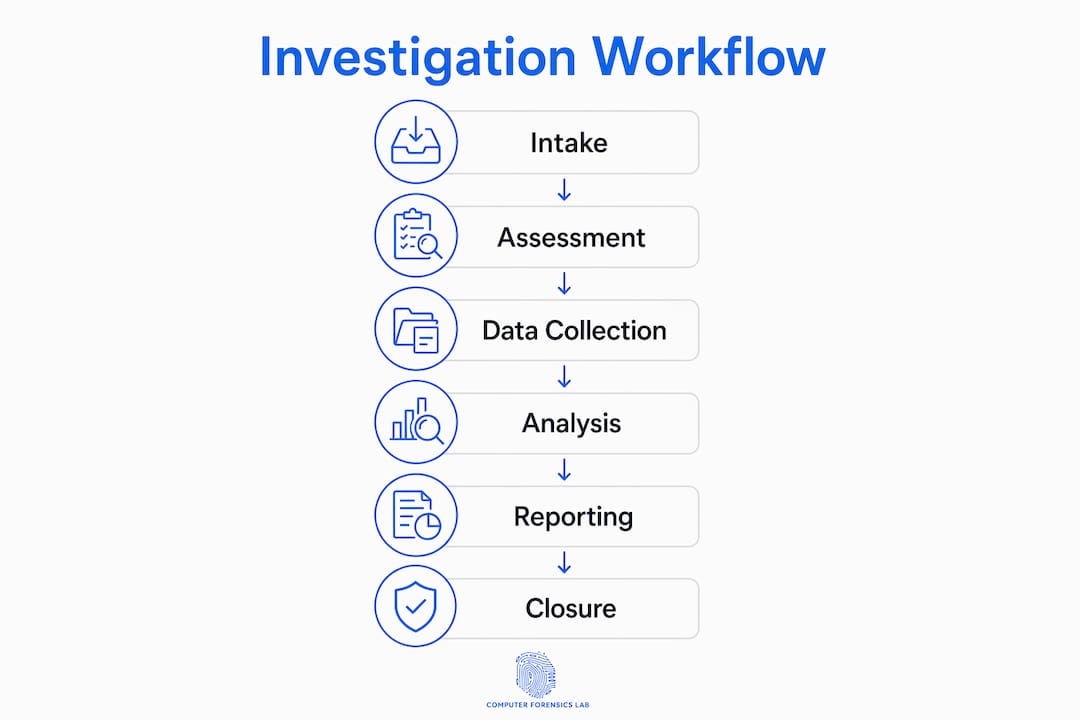
What are the standard steps in an investigation workflow?
A modern investigation workflow follows a clear sequential structure. Workplace and corporate investigations typically run through six defined stages: intake and assessment, planning, evidence collection, witness interviews, analysis, and resolution. Security incident investigations follow a closely related seven-step process: validate the alert, scope the incident, collect and preserve evidence, reconstruct the timeline, map behaviours, document findings, and report.
Each stage has a distinct purpose and a defined output. Skipping or compressing any stage creates gaps that opposing counsel will find.
- Intake and assessment. The investigator receives the referral and determines whether an investigation is warranted. This stage sets the scope and identifies potential conflicts of interest.
- Planning. The investigator defines the investigative question, identifies evidence sources, and assigns responsibilities. A clear, falsifiable question at this stage prevents mission creep later.
- Evidence collection. Physical devices, digital records, emails, chat logs, and cloud data are acquired. Step-by-step evidence collection must follow chain-of-custody protocols from the first moment of acquisition.
- Witness interviews. Interviews are conducted in a structured sequence, typically starting with peripheral witnesses before the subject. Effective investigative interview techniques reduce the risk of contaminating testimony.
- Analysis and reconstruction. The investigator correlates evidence, builds a timeline, and tests the initial hypothesis. In digital cases, this stage includes device examination, metadata review, and log correlation.
- Reporting and case closure. Findings are documented in a format suitable for the intended audience, whether that is HR, a board, or a court. Manager review and approval before closure is the most effective quality control at this stage.
Pro Tip: In security incident cases, the first 15 minutes set the quality of the entire investigation. Treat the initial scoping decision as a formal step, not an informal chat.
The six-step and seven-step models are not competing frameworks. They describe the same underlying logic applied to different contexts. Legal professionals benefit from understanding both, because digital forensic evidence frequently appears in both workplace and criminal proceedings.

How does automation and AI change the investigation process?
Modern investigation workflows are shifting from manual, search-driven methods to automated, reconstruction-driven processes. The practical effect is a reduction in investigation time from weeks to minutes for data-heavy cases. Automated tools process evidence across email, chat, voice, mobile, and off-channel sources to create a unified timeline in near real-time.
The distinction between search-driven and reconstruction-driven workflows matters enormously in practice:
- Search-driven workflows require investigators to formulate queries, review results, and manually correlate findings across disconnected platforms. Each tool produces its own output, and the investigator assembles the picture by hand.
- Reconstruction-driven workflows use orchestration platforms to ingest data from multiple sources simultaneously, identify participants, map communications, and produce an evidence-linked narrative automatically.
- Manual data correlation is the primary bottleneck in traditional investigations. Disconnected platforms cause delays and introduce inconsistencies that only become visible at the legal scrutiny stage.
- Tool-hopping, moving between separate applications for each evidence type, remains a major inefficiency. Integrated orchestration platforms reduce this and improve consistency across the case.
AI accelerates data review significantly, but it introduces its own risks. AI-powered investigations require strict governance and reliability checks to maintain evidence admissibility in high-stakes matters. The most effective investigative teams apply AI for speed and reserve human judgement for interpretation, context, and legal assessment.
Pro Tip: AI tools reshape how legal technology is applied in courtroom settings. Understand the governance requirements before deploying any automated tool in a matter that may reach litigation.
The goal of automation is not to replace investigative judgement. It is to remove the mechanical burden of data correlation so investigators can focus on the analysis that actually requires expertise.
What best practices ensure thoroughness and legal compliance?
The quality of an investigation is determined by its discipline, not its resources. Investigations that lack procedural rigour produce findings that are difficult to defend, regardless of how much time was spent on them.
“The goal of an investigation is to clearly demonstrate what happened, supported by fully auditable evidence that withstands scrutiny. Modern workflows deliver a complete evidence-linked narrative rather than isolated search results.”
The following practices define the difference between an investigation that holds and one that does not:
- Start with a falsifiable question. Investigations without a clear question drift and lose effectiveness. Define what you are trying to prove or disprove before collecting a single document.
- Maintain append-only collection logs. Every query, every artefact collected, and every negative result must be recorded with a timestamp. Collection logs should be append-only to prevent retrospective amendment.
- Follow the Acas Code of Practice. Workplace investigations must follow fair procedures to avoid legal risks and tribunal challenges. Fairness requires gathering evidence from all sides and documenting transparently.
- Apply manager review before closure. Manager review and approval prior to case closure is the most effective control for assuring evidence quality and consistency. Without it, errors made by less experienced investigators remain undetected until legal scrutiny.
- Preserve chain of custody from first contact. Every piece of evidence must have a documented record of who handled it, when, and why. A break in chain of custody can render otherwise strong evidence inadmissible.
- Document contemporaneously. Notes written after the fact carry less weight than records made at the time. Courts and tribunals assess the credibility of documentation partly by its timing.
Poor workflow adherence does not just weaken a case. It creates liability. An employer who fails to follow a fair investigation procedure faces tribunal risk even when the underlying facts support their position.
How do investigation workflows apply in digital forensic cases?
Digital forensic cases apply the same workflow logic but add a layer of technical complexity at every stage. The digital investigation workflow in UK legal settings requires investigators to align forensic data collection with procedural requirements from the outset.
The practical application of workflow principles in digital forensic matters looks like this:
| Workflow stage | Digital forensic application |
|---|---|
| Intake and assessment | Identify device types, data locations, and legal authority for access |
| Evidence collection | Forensic imaging of devices, cloud acquisition, and mobile extraction |
| Witness interviews | Coordinate interview timing to prevent evidence destruction or collusion |
| Analysis and reconstruction | Build attack timelines, recover deleted data, and correlate metadata |
| Reporting | Produce court-ready expert witness reports with full evidential chain |
Admissibility depends on how evidence was collected, not just what it shows. Gathering forensic evidence correctly from the start is the single most important factor in whether digital findings survive challenge. A forensic image taken without write-blocking, or cloud data acquired without proper legal authority, may be excluded entirely.
Timeline reconstruction is particularly powerful in digital cases. Correlating file access times, login records, email metadata, and device location data produces a factual narrative that is far harder to dispute than witness testimony alone. Computerforensicslab applies this approach across cybercrime, data breach, and employee misconduct investigations, producing evidence packages that meet the standards required for UK court proceedings.
The corporate litigation context for digital evidence is expanding. Legal professionals who understand workflow principles can instruct forensic experts more effectively and anticipate the questions that will arise at disclosure.
Key takeaways
A structured investigation workflow is the foundation of every defensible finding, whether the matter involves a workplace grievance, a data breach, or criminal proceedings.
| Point | Details |
|---|---|
| Define the question first | A clear, falsifiable investigative question prevents scope drift and keeps resources focused. |
| Follow a sequential workflow | The six-step or seven-step model applies across workplace, security, and digital forensic cases. |
| Automate data correlation | Reconstruction-driven tools reduce investigation time and improve consistency across evidence sources. |
| Document every step | Append-only, timestamped collection logs are the foundation of a legally defensible case. |
| Apply human oversight to AI | AI accelerates review but requires governance checks to maintain evidence admissibility. |
What I have learned about investigation workflows in practice
The most common failure I see is not a lack of skill. It is a lack of structure applied early enough. Investigators who skip the planning stage, or who begin collecting evidence before defining their question, spend weeks producing material that does not answer the right question. The evidence may be technically sound, but it does not serve the case.
Automation has genuinely changed what is possible. Processing thousands of messages across multiple platforms to produce a unified timeline used to take a team of analysts several weeks. The same task now takes hours with the right orchestration tools. That shift is real and significant. What has not changed is the need for an experienced investigator to interpret the output, identify what is missing, and make judgements that no algorithm can make.
The platforms investigators work with are also changing faster than most workflows account for. Encrypted messaging applications, ephemeral content, and off-channel communications create evidence gaps that a standard email-focused workflow will miss entirely. Investigators who treat their workflow as a fixed template, rather than a structured framework they adapt to each case, will increasingly find themselves working with incomplete pictures.
My view is that workflow discipline is not a bureaucratic requirement. It is the mechanism by which good investigative thinking becomes defensible legal output. The investigators who produce the most reliable results are not necessarily the most technically gifted. They are the ones who follow the process with the most rigour.
— Computer
How Computerforensicslab supports your investigation workflow
Computerforensicslab provides professional digital forensics services to legal professionals, law enforcement, and businesses across the UK. The team handles every stage of the investigation workflow, from forensic device imaging and cloud data acquisition through to expert witness reporting and court-ready evidence packages. Cases handled include cybercrime, data breaches, employee misconduct, and intellectual property theft. Every engagement follows strict chain-of-custody protocols and produces findings that meet UK court admissibility standards. For legal professionals who need a forensic partner that understands both the technical and procedural requirements of a sound investigation, Computerforensicslab is the right starting point.
FAQ
What is an investigation workflow?
An investigation workflow is the structured sequence of stages, from intake through to reporting, that guides an investigator in collecting, analysing, and presenting evidence in a legally defensible manner.
How many steps are in a standard investigation workflow?
Workplace investigations typically follow a six-step cycle, while security incident investigations follow a seven-step process. Both models share the same core logic of scoping, collecting, analysing, and reporting.
Why does workflow structure matter for legal cases?
Poor workflow adherence creates procedural gaps that opposing counsel can exploit. Tribunals and courts assess not just what evidence was found, but how it was collected and documented.
How does AI affect the investigation process?
AI-powered tools reduce data review time significantly by processing evidence across multiple sources simultaneously. They require strict governance controls to ensure the output remains admissible in high-stakes legal matters.
What is chain of custody and why does it matter?
Chain of custody is the documented record of every person who handled a piece of evidence, when they handled it, and why. A break in this record can render otherwise strong digital evidence inadmissible in court.