
TL;DR:
- UK courts require social media evidence to be relevant, authentic, and properly collected.
- Deletion of social media content during proceedings can lead to court orders to recover or prevent further removal.
- Collecting social media data must comply with UK GDPR, ensuring lawful, fair, and proportionate processing.
A single social media post can tip the balance of a UK legal case. That much is settled. What surprises many practitioners is just how strict, nuanced, and demanding the rules around handling that post actually are. Social media evidence is not simply “fair game” because something appears online. UK courts, the Crown Prosecution Service, and the Information Commissioner’s Office each impose obligations that go well beyond pressing a screenshot button. This guide walks you through the legal framework, collection best practices, deletion risks, data protection obligations, and the strategic thinking that separates credible evidence from challenged material.
Table of Contents
- The legal status of social media evidence in the UK
- Collecting and preserving social media material: Best practices
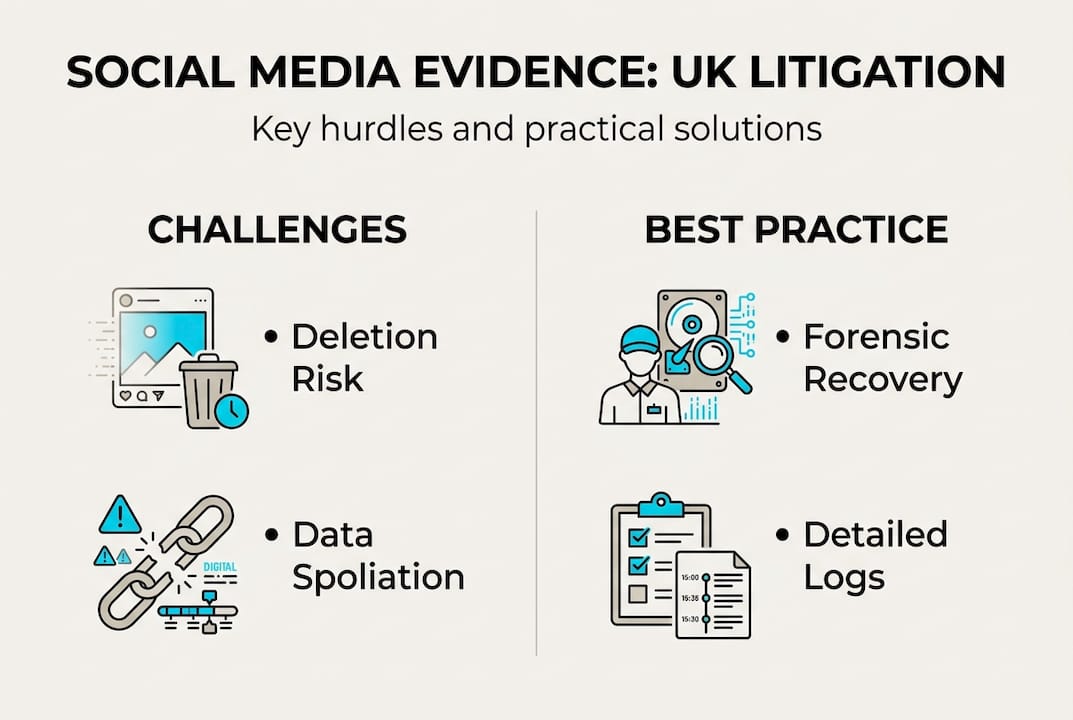
- Challenges: Deletion, spoliation, and court expectations
- Privacy, data protection, and the UK GDPR
- The critical edge: What most legal teams miss in social media evidence
- Expert support for every stage of social media evidence
- Frequently asked questions
Key Takeaways
| Point | Details |
|---|---|
| Admissibility demands rigour | UK courts require social media evidence to be relevant, authentic, and securely handled to count in legal cases. |
| Privacy laws apply | Even public social media data is subject to UK GDPR and ICO guidance before you can use it in litigation. |
| Collection must be robust | Screenshots are risky alone—use verified methods, document provenance, and maintain chain of custody for best results. |
| Deletion carries consequences | UK courts can order recovery or sanction parties who improperly delete or hide social media evidence. |
| Strategic planning pays off | Best outcomes come from early, integrated evidence and privacy planning, not rushed last-minute fixes. |
The legal status of social media evidence in the UK
Social media evidence covers a broad range of digital material: public and private posts, direct messages, images, videos, account metadata, geolocation tags, and profile information. Its prominence in UK litigation has grown sharply. Employment tribunals, family courts, criminal proceedings, and civil disputes now regularly feature content drawn from platforms such as Facebook, Instagram, X (formerly Twitter), WhatsApp, and TikTok.
The CPS official guidance sets a clear standard for prosecutors handling digital material. It requires investigators to pursue “reasonable lines of enquiry”, which explicitly includes social media accounts relevant to an allegation. Failure to follow reasonable lines of enquiry can result in disclosure failures and, in serious cases, collapse of proceedings.
For UK courts, three criteria consistently determine whether social media evidence carries weight:
- Relevance: Does the material go to a fact in issue?
- Authenticity: Can the party producing it demonstrate the material is what it purports to be?
- Chain of custody: Has the evidence been handled in a way that prevents tampering or contamination?
High Court judges have become increasingly assertive about the standard expected. Evidence that arrives without documented provenance or with obvious gaps in handling will face robust challenge, and rightly so.
| Type of social media evidence | Common use in UK proceedings |
|---|---|
| Public posts and comments | Establishing conduct, credibility, timelines |
| Private messages (DMs) | Proving agreement, intent, or harassment |
| Images and videos | Corroborating or refuting factual claims |
| Account metadata and timestamps | Verifying authorship and timing |
| Geolocation data | Placing a person at a location |
| Profile and connection data | Mapping relationships between parties |
A common misconception is that anything visible online is automatically admissible. It is not. The steps for social media forensics matter enormously to admissibility and evidential weight. Courts can, and do, exclude material that has been poorly handled, improperly obtained, or inadequately authenticated, regardless of how damaging it might appear.
Collecting and preserving social media material: Best practices
Knowing the legal standard is not enough. You also need a disciplined, repeatable process for gathering and safeguarding social media evidence in ways that withstand scrutiny.
Begin with a clear pre-collection scope. Identify which accounts, platforms, timeframes, and content types are relevant before collecting anything. Undirected or speculative collection creates both legal and regulatory risk. The evidence collection process should be planned, proportionate, and documented.
When it comes to actual collection, the method matters. Documented provenance, chain of custody, non-editing, and fair handling are foundational requirements for social media content to function as reliable evidence. Review the methods and challenges involved in different extraction approaches before committing to a single strategy.

| Collection method | Strengths | Risks |
|---|---|---|
| Basic screenshot | Quick and simple | No metadata, easily altered, weak authenticity |
| Forensic download tool | Captures metadata, timestamps, full thread | Requires specialist knowledge |
| Platform API extraction | Structured, comprehensive data | Access limitations, requires authorisation |
| Third-party archival service | Court-accepted format, timestamped | Cost, potential access delays |
How to document provenance correctly:
- Record the date, time, and operator details at the point of collection.
- Note the URL, platform, and account identifier for each piece of content.
- Capture a full-page view including visible timestamps and account names.
- Hash the collected file immediately (MD5 or SHA-256) to prove integrity.
- Store all material on write-protected media and log every subsequent access.
- Produce a contemporaneous continuity certificate signed by the collecting officer.
Preservation pitfalls are common and costly. Editing screenshots for clarity, saving images in compressed formats, or failing to record metadata all weaken admissibility. A chain break at any point invites challenge.
Pro Tip: For any evidence that carries significant weight in your case, do not rely solely on screenshots. A forensic extraction that captures native metadata and a full activity log is far more defensible under cross-examination.
Challenges: Deletion, spoliation, and court expectations
Once social media evidence is secured, further hurdles emerge when crucial content goes missing or parties face allegations of non-disclosure.
Deletion is a real and recurring problem. Parties who suspect litigation sometimes remove posts, deactivate accounts, or alter profile data in the belief that digital content vanishes permanently. It rarely does. UK courts can order recovery of deleted social media content and have issued disclosure-related injunctions tied directly to deletion conduct.
The practical consequences of spoliation (deliberate or reckless destruction of evidence) are severe:
- Courts can draw adverse inferences from unexplained deletion.
- Judges may issue recovery orders compelling platforms or device holders to restore deleted material.
- Injunctions can be granted to prevent further deletion during proceedings.
- Serious cases may warrant contempt of court proceedings.
“A party who destroys or conceals social media evidence relevant to proceedings risks not only losing evidential ground but facing court-level sanctions that can undermine their entire case position.”
The balancing act between privacy and disclosure is a live tension in UK courts. Judges weigh the evidential value of intrusive social media material against the individual’s reasonable expectation of privacy, particularly where private messages or sensitive content is involved. Courts generally require that any intrusion be proportionate to what the evidence actually proves.
To assist with recovering deleted social media material, specialist forensic analysis is often needed. Understanding the full range of evidence types and risks before proceedings begin gives you a significant advantage.
Pro Tip: Document your own evidence handling meticulously from the outset. If challenged, you need to demonstrate not just what you found, but precisely how, when, and by whom it was collected and stored.
Privacy, data protection, and the UK GDPR
Beyond admissibility, social media evidence raises complex issues at the intersection of justice, privacy, and regulatory compliance.
ICO and UK GDPR rules apply whenever personal data is collected from social media, even where that data appears publicly available. Lawfulness, transparency, and fair processing are mandatory. The fact that a post is visible to anyone does not make its collection for legal proceedings automatically lawful under UK GDPR.
Before collecting personal data from social media as evidence, legal teams should confirm:
- A lawful basis for processing exists (most commonly legitimate interests or legal obligation).
- The collection is proportionate and limited to what is genuinely necessary.
- A record of the decision rationale is kept for accountability purposes.
- Individuals are informed of data use where legally required and practically feasible.
- Any third-party data captured incidentally is handled with equivalent care.
| Scenario | Lawful collection | Risk of breach |
|---|---|---|
| Collecting a public post directly relevant to a court claim | Yes, if proportionate and documented | Low if scoped correctly |
| Mass downloading of an account’s full history “just in case” | Unlikely without strong justification | High: over-collection, proportionality failure |
| Accessing a private account without authorisation | No | Very high: likely unlawful access |
| Using platform API with subject’s consent | Yes | Low |
A crucial distinction that practitioners sometimes miss: admissibility and lawfulness of processing are separate questions. A court may accept evidence that was gathered in breach of UK GDPR. However, that breach still exposes the collecting party to regulatory action, and in some circumstances judges will consider how evidence was obtained when assessing its weight or excluding it entirely.
For detailed social media investigation tips and a practical social media checklist covering all seven key steps, careful pre-planning is the difference between clean compliance and costly exposure.
The critical edge: What most legal teams miss in social media evidence
There is a mindset problem in how many legal teams approach social media evidence. They treat it as an afterthought. Someone identifies a useful post during case preparation, a trainee takes a screenshot, and it lands in the bundle with minimal thought about provenance, chain of custody, or data protection. That approach was marginal practice five years ago. In 2026, it is a liability.
The strongest litigators we work with at Computer Forensics Lab integrate evidence strategy and privacy planning from the moment a matter opens. They scope the relevant digital landscape early, instruct specialist collection before platforms can be tampered with, and document every step for potential court scrutiny. This is not over-caution. It is the minimum standard modern UK judicial expectations demand.
Common last-minute failures include over-collection (pulling everything and sorting later, creating GDPR exposure), poorly documented screenshots that crumble under authentication challenge, and privacy review done as a box-tick rather than a genuine proportionality assessment. Each of these can unravel otherwise strong cases.
Understanding comprehensive social media forensics as a strategic discipline, rather than a technical task bolted on at the end, is what separates credible evidence from challenged material.
Expert support for every stage of social media evidence
If you want to avoid costly missteps and meet every evidential obligation, expert advice is your next logical step. At Computer Forensics Lab, we support legal professionals across the full evidence lifecycle: from pre-collection scoping and forensic extraction, through chain of custody documentation and expert witness reporting. Our work in digital forensics for social media is built around court-ready standards and UK regulatory compliance. Explore our full range of digital forensics services, or review our step-by-step evidence collection framework to understand how we can strengthen your next case from the ground up.
Frequently asked questions
Is all social media evidence automatically admissible in UK courts?
No. Social media evidence must be relevant, authentic, and properly handled to be admissible and carry evidential weight in UK legal proceedings.
What should I do if a party deletes important social media content during proceedings?
You may seek a court order for restoration or an injunction to prevent further deletions. UK courts can order recovery of deleted social media content, as established in recent High Court decisions.
How do privacy and the UK GDPR affect collecting social media evidence?
Any collection of personal data from social media must comply with UK GDPR and ICO guidance to ensure processing is lawful, fair, and proportionate to the evidential purpose.
Are screenshots enough for proving social media evidence?
Screenshots alone may not ensure integrity or admissibility. Documented collection methods and a clear chain of custody are crucial to withstanding authentication challenges in court.