
Corporate misconduct rarely follows a straightforward path, especially when digital transactions and cybercrime complicate the evidence trail. For legal professionals in London, understanding the distinct role of forensic audits is vital when financial misconduct crosses into online fraud. Unlike traditional audits, forensic audits focus on generating court-admissible evidence and tracing funds with investigative precision. This specialised approach transforms complex, digital financial cases into clear, actionable legal arguments, ensuring your evidence satisfies both regulatory and judicial requirements.
Table of Contents
- Defining Forensic Audits And Core Concepts
- Distinguishing Forensic Audits From Standard Audits
- Key Techniques And Digital Evidence Gathering
- Legal Frameworks And Compliance In The UK
- Risks, Costs, And Mistakes In Forensic Auditing
Key Takeaways
| Point | Details |
|---|---|
| Distinction of Forensic Audits | Forensic audits focus on uncovering wrongdoing and generating court-admissible evidence, unlike standard audits that verify compliance and accuracy. |
| Importance for Legal Professionals | Engaging forensic auditors early can prevent evidentiary gaps and strengthen legal arguments related to financial misconduct. |
| Technological Integration | The use of advanced technology like AI and data analytics in forensic audits significantly enhances the detection of fraud patterns. |
| Compliance with UK Legal Frameworks | Understanding and adhering to legal standards for evidence collection is crucial for ensuring the admissibility of findings in court. |
Defining forensic audits and core concepts
A forensic audit is far more than a standard financial review. It combines accounting expertise with investigative techniques to uncover financial misconduct, fraud, and embezzlement. Unlike routine audits that simply verify accuracy, forensic audits focus on finding evidence that holds up in court.
Think of it this way: a standard auditor checks whether figures add up correctly. A forensic auditor asks why those figures exist, where the money actually went, and whether someone deliberately concealed something.
The core distinction lies in evidence admissibility. Forensic auditors document their findings to meet court standards. They trace fund movements, quantify losses, and create records that withstand legal scrutiny. This investigative approach makes all the difference when your case reaches the courtroom.
Key characteristics of forensic audits include:
- Investigative focus rather than compliance verification
- Financial evidence prepared specifically for legal proceedings
- Detailed documentation of findings and methodologies
- Tracing of funds to identify misconduct patterns
- Quantification of financial damages with supporting evidence
- Chain of custody procedures for all documentation
For legal professionals working on cybercrime-related cases, understanding financial misconduct investigation techniques becomes critical when digital evidence intersects with financial crimes. Cases often involve embezzlement through digital channels, fraudulent wire transfers, or cryptocurrency movements that require both forensic accounting and digital forensics expertise.
The growing sophistication of financial crimes has elevated forensic auditing’s role significantly. Technology integration—including artificial intelligence and data analytics—now enables auditors to detect fraud patterns that manual reviews would miss entirely. In London’s competitive legal market, demonstrating this technical competency strengthens your case considerably.
Forensic audits differ fundamentally from standard audits because they pursue investigative objectives and generate court-admissible evidence rather than providing compliance verification.
Why this matters for your practice: When handling corporate misconduct cases involving employees or external fraud, a forensic audit creates the financial foundation your legal arguments require. It answers the “how much” and “where did it go” questions that judges and juries need answered.
The evidence gathered becomes your building blocks for liability claims, damages calculations, and regulatory reporting. Without proper forensic audit methodology, your financial evidence may be challenged or excluded entirely during litigation.
Pro tip: Early engagement with forensic auditors helps you understand the financial landscape before filing claims, preventing costly evidentiary gaps that opposing counsel will exploit.
Distinguishing forensic audits from standard audits
Standard audits and forensic audits operate under completely different objectives, even though both examine financial records. Standard audits verify that financial statements are accurate, complete, and comply with accounting standards—their purpose is assurance for investors and stakeholders. Forensic audits hunt for evidence of wrongdoing.

The distinction matters enormously in litigation. A standard auditor asks: “Are these numbers correct?” A forensic auditor asks: “What crimes or misconduct occurred here?”
Standard audits focus on compliance and accuracy. They follow established frameworks like International Financial Reporting Standards (IFRS) or Generally Accepted Accounting Principles (GAAP). Auditors sample transactions, verify controls, and confirm balances with external parties. The scope is broad but not investigative.
Forensic audits concentrate on investigation and evidence gathering. They examine suspected fraud or misconduct with legal admissibility as the primary goal. Every finding must withstand court scrutiny and opposing counsel’s challenges.
Core differences include:
- Objective: Standard audits provide assurance; forensic audits uncover wrongdoing
- Scope: Standard audits review broad financial statements; forensic audits target specific suspected activities
- Evidence standards: Standard audits document compliance; forensic audits prepare court-admissible evidence
- Expertise required: Standard audits need accounting knowledge; forensic audits demand legal and investigative expertise
- Documentation approach: Standard audits follow audit standards; forensic audits follow legal evidence protocols
For corporate misconduct cases, this distinction becomes critical. You cannot use a standard audit’s findings directly in court without forensic audit methodology. The audit trail, documentation procedures, and investigative depth differ fundamentally.
Consider a suspected employee embezzlement case. A standard audit might identify unusual transactions and flag them in the financial statements. A forensic audit traces every pound that employee accessed, documents intentional concealment methods, quantifies total loss, and creates evidence that proves intent and culpability.
Standard audits verify “what happened” with financial statements. Forensic audits prove “who did it, how much, and why” for legal proceedings.
In practice, you need forensic audit evidence to support damages claims, regulatory investigations, and criminal prosecution. Standard audit findings alone won’t satisfy court requirements for financial evidence in misconduct cases.
To better understand how forensic audits diverge from standard audits, consider this side-by-side comparison of their practical applications:
| Aspect | Standard Audit | Forensic Audit |
|---|---|---|
| Purpose | Stakeholder assurance | Investigation of misconduct |
| Methodology | Transaction sampling | Evidence tracing and analysis |
| Legal Impact | Not court-focused | Admissible in litigation |
| Expertise | Accounting proficiency | Legal and investigative background |
| Documentation | Compliance-based records | Detailed, court-ready evidence |
Pro tip: Request forensic audit engagement early when you suspect misconduct, rather than relying on standard audit findings—forensic auditors can preserve evidence properly and ensure chain of custody from the start, preventing legal challenges to your financial evidence later.
Key techniques and digital evidence gathering
Modern forensic audits rely on sophisticated techniques to uncover financial misconduct buried in digital systems. Traditional manual review simply cannot process the volume of transactions in today’s corporate environments. Auditors now use advanced technology to detect patterns that indicate fraud.
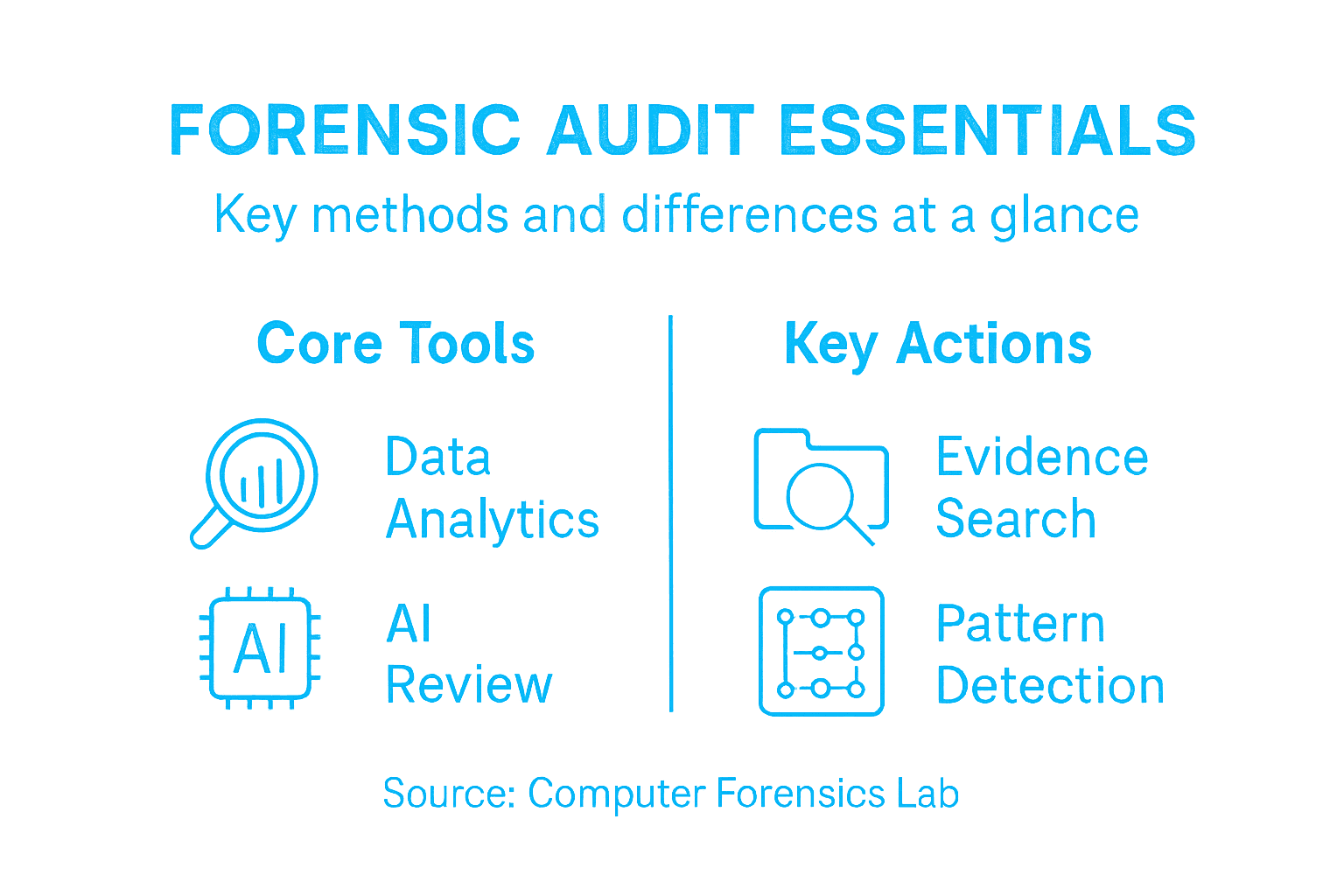
Data analytics and artificial intelligence form the backbone of modern forensic auditing. These tools analyse massive datasets quickly, flagging anomalies that suggest intentional misconduct. AI can identify unusual transaction sequences, duplicate payments, or suspicious timing patterns across thousands of records in minutes.
Forensic auditors gather evidence from multiple digital sources. They collect bank statements, transaction records, emails, system logs, and user activity reports. Each piece of evidence must be properly documented and preserved to remain admissible in court.
Electronic evidence gathering typically includes:
- Bank and payment system records with transaction metadata
- Email communications and message histories
- System access logs showing who accessed what and when
- Database records and backup files
- Cloud storage and backup system data
- Mobile device records and messaging applications
Data mining and forensic accounting software coupled with statistical analysis reveal patterns invisible to manual review. Auditors use these tools to trace fund movements, identify conflicts of interest, and document concealment attempts that prove intent.
The combination of technology and expertise matters significantly. Software detects anomalies, but auditors interpret what those anomalies mean legally and financially. A repeated small payment to the same vendor might be routine—or it might be a money laundering scheme.
Chain of custody procedures protect evidence integrity. Every file accessed, every analysis performed, and every finding documented must follow legal standards. Without proper procedures, opposing counsel will challenge your evidence’s reliability and admissibility.
Forensic auditors combine AI-driven detection with expert human analysis to transform raw financial data into court-admissible evidence of misconduct.
For cybercrime-related cases in London, understanding how digital financial evidence connects to computer forensics becomes essential. Fraudsters often use digital systems to conceal their activities—encrypted communications, deleted files, or falsified transaction timestamps. Your forensic audit must integrate findings with broader digital forensics investigation.
Pro tip: Engage digital forensics specialists alongside forensic auditors early in misconduct investigations; coordinating their expertise ensures financial evidence aligns with digital evidence from computers and devices, creating a comprehensive, legally defensible case.
Legal frameworks and compliance in the UK
Forensic audits in the United Kingdom operate within strict legal boundaries that govern evidence collection, documentation, and admissibility. These frameworks exist to protect the integrity of legal proceedings whilst ensuring that financial investigations meet court standards. Understanding them is non-negotiable for your litigation strategy.
The UK legal system requires forensic auditors to follow specific rules of evidence. Any findings must be collected, documented, and presented in ways that withstand judicial scrutiny. Auditors cannot simply hand over their working papers and analysis—they must demonstrate proper methodology throughout.
Key compliance areas for forensic audits include:
- Understanding national regulations governing fraud investigation procedures
- Adhering to data protection requirements when handling sensitive financial information
- Maintaining audit trails showing exactly what was examined and how
- Following anti-fraud legislation including the Proceeds of Crime Act 2002
- Ensuring court admissibility through proper documentation standards
- Complying with professional auditing standards that differ from regular audit engagements
Forensic auditors must understand how bribery, corruption, and fraud legislation applies to their investigations. The Bribery Act 2010 and Fraud Act 2006 establish specific offences that auditors must identify and document. Missing these distinctions weakens your legal position considerably.
Data protection presents another critical compliance requirement. When forensic auditors examine employee records, communications, and financial transactions, they must comply with GDPR and UK Data Protection Act 2018 requirements. Improper data handling can exclude evidence or expose your organisation to regulatory penalties.
Chain of custody documentation proves absolutely critical. Every file accessed, every analysis performed, and every finding recorded must be documented systematically. This audit trail demonstrates to the court that evidence remained uncontaminated and reliable throughout investigation.
UK legal frameworks require forensic auditors to balance thorough investigation with strict procedural compliance—shortcuts compromise both admissibility and regulatory standing.
Regulatory compliance extends beyond litigation needs. The Financial Conduct Authority and Prudential Regulation Authority expect firms to conduct thorough misconduct investigations. Forensic audits fulfil these regulatory obligations whilst generating evidence for potential legal action.
Pro tip: Confirm your forensic auditor understands UK-specific legal frameworks and evidentiary standards before engagement; auditors trained in international standards may miss critical United Kingdom requirements that prosecutors and judges expect, potentially rendering your evidence inadmissible.
Risks, costs, and mistakes in forensic auditing
Forensic audits demand significant investment. The intensive investigation, specialised expertise, and advanced technology required mean costs can escalate quickly. A complex case involving multiple data sources, encrypted communications, or international transactions may cost substantially more than initial estimates.
Cost drivers in forensic auditing are substantial. You’re paying for expert auditors with legal knowledge, advanced software licences, extended investigation timelines, and potential expert witness testimony. Budget surprises happen when initial scoping reveals more complexity than expected.
Beyond finances, forensic audits carry operational risks. Mistakes in evidence handling can render findings inadmissible in court, undermining your entire investigation. Incomplete data analysis leaves gaps opposing counsel will exploit ruthlessly during cross-examination.
Common mistakes that jeopardise cases include:
- Improper chain of custody documentation or handling of evidence
- Failing to follow legal procedures required for admissibility
- Insufficient auditor training in digital forensics or legal frameworks
- Bias influencing interpretation of ambiguous transactions
- Incomplete analysis missing critical data sources
- Inadequate customisation of audit techniques to case specifics
- Using outdated methodologies unsuitable for modern digital systems
Errors in digital evidence interpretation create particularly damaging problems. Auditors must understand not just accounting principles but also how digital systems operate, how data becomes corrupted or deleted, and how timestamps can be manipulated. Misinterpreting technical evidence weakens financial findings significantly.
Auditor skill gaps represent a critical risk. Forensic auditing requires continuous training as technology evolves and criminal methods become sophisticated. An auditor trained five years ago may lack expertise in cryptocurrency transactions, cloud forensics, or artificial intelligence-driven fraud schemes.
Bias presents another subtle but serious risk. Auditors must approach investigations objectively, following evidence rather than confirming preconceived conclusions. Confirmation bias—focusing only on evidence supporting misconduct whilst ignoring contradictory data—undermines case credibility entirely.
Forensic audit failures typically result from cost-cutting, inadequate planning, or choosing auditors without sufficient specialised expertise rather than from legitimate investigation challenges.
In London’s competitive legal market, cutting corners on forensic audits damages your reputation with judges and regulators. Courts recognise sloppy evidence gathering immediately. Building a defensible case requires proper investment in experienced, properly trained forensic auditors.
Here is a summary of the main risks and cost factors when commissioning forensic audits:
| Risk/Cost Factor | Impact on Investigation | Mitigation Strategy |
|---|---|---|
| Auditor skill gap | Weak evidentiary value | Continuous training |
| Inadequate chain of custody | Evidence can be excluded | Systematic documentation |
| Technology limitations | Missed fraud patterns | Use modern software |
| Underestimated complexity | Budget overruns | Early, thorough scoping |
Pro tip: Budget 15-20% more than initial cost estimates for forensic audits and select auditors with specific experience in your industry sector; penny-pinching creates evidentiary gaps that destroy case outcomes and cost exponentially more through failed litigation.
Strengthen Your Case with Expert Forensic Auditing and Digital Forensics
Navigating the complex challenges of forensic audits demands more than accounting skills alone. When your investigation requires court-admissible evidence, clear chain of custody, and expert analysis of sophisticated financial and digital data, partnering with trusted specialists is essential. Whether addressing employee misconduct, financial fraud, or cyber-enabled corporate crimes, the risks of inadequate evidence handling can jeopardise your entire litigation effort.
At Computer Forensics Lab, we combine advanced digital forensic techniques with rigorous investigative audit standards to support your legal strategy. Our expertise includes data recovery, malware analysis, and cloud data examination, ensuring thorough evidence collection compliant with UK legal frameworks. Protect your firm with a detailed forensic audit that integrates seamlessly with your case, helping you anticipate challenges like evidence exclusion or chain of custody breaches.
Discover how our specialised services can complement your forensic audit and maximise evidentiary strength by visiting Computer Forensics Lab. Act now to build a robust, defensible case supported by comprehensive digital and financial forensic insights.
Frequently Asked Questions
What is a forensic audit?
A forensic audit is an investigative analysis that combines accounting expertise with legal standards to uncover financial misconduct, fraud, or embezzlement. Unlike standard audits, forensic audits focus on producing evidence that can be presented in court.
How do forensic audits differ from standard audits?
Forensic audits are designed to uncover wrongdoing and generate admissible evidence for legal proceedings, while standard audits focus on verifying the accuracy of financial statements and compliance with relevant accounting standards.
What techniques are used in forensic audits to gather digital evidence?
Modern forensic audits often rely on data analytics and artificial intelligence to process large datasets and identify anomalies in financial transactions. Evidence can be gathered from various digital sources, including bank records, emails, and system logs.
What are the main risks and cost factors associated with forensic audits?
Forensic audits can be costly due to the need for specialised expertise and advanced technology. Common risks include inadequate chain of custody documentation, auditor skill gaps, and bias in interpreting evidence, which can compromise the integrity of the investigation.