

Over 85% of malicious traffic now travels through encrypted channels, rendering traditional log-based evidence collection dangerously incomplete. For legal professionals and corporate security teams in England, this creates a pressing problem: how do you build an admissible, defensible case when the most critical evidence is invisible to conventional tools? Network forensics answers that question directly. This guide explains what network forensics is, how the process works within English legal frameworks, what challenges practitioners face, and how organisations can apply it effectively to cybercrime investigations and data breach litigation.
Table of Contents
- What is network forensics?
- The network forensics process: from collection to courtroom
- Key UK legal and compliance requirements
- Challenges and advanced techniques: encryption, volatility, and machine learning
- Applying network forensics: case insights and best practices
- Why network forensics must go beyond compliance: a practitioner’s viewpoint
- Leverage network forensics with expert support
- Frequently asked questions
Key Takeaways
| Point | Details |
|---|---|
| Targeted traffic capture | Network forensics isolates and recovers digital evidence by analysing network traffic, not just device data. |
| Legal compliance matters | Following ACPO, PACE, and regulator codes is essential for evidence to be accepted in English courts. |
| Handle encrypted and volatile data | Advanced techniques are crucial for extracting evidence from encrypted or short-lived network streams. |
| Best practice ensures success | Documenting process and using robust tools underpins case success and upholds chain of custody. |
What is network forensics?
Network forensics is not simply monitoring your firewall or reviewing server logs. It is a structured discipline focused on the targeted recovery and analysis of network traffic as digital evidence. As defined in professional guidance, network forensics involves the collection, preservation, analysis, and court presentation of network evidence. That last element, court presentation, is what separates it from routine IT security work.
Standard network monitoring is designed to keep systems running. Network forensics is designed to prove what happened, when it happened, and who was responsible. The distinction matters enormously when you are preparing evidence for litigation or a regulatory investigation.
For legal and security teams, network forensics is indispensable because it captures evidence that exists nowhere else. Malware command-and-control communications, data exfiltration pathways, and lateral movement across a corporate network leave traces in traffic that no endpoint tool will record. Understanding the legal considerations for digital forensics in the UK context is essential before any collection begins.
Key capabilities that define network forensics include:
- Full packet capture: Recording every byte of traffic across a network segment for later reconstruction
- Flow analysis: Examining metadata about connections without necessarily storing full payloads
- Protocol analysis: Decoding application-layer communications to identify malicious behaviour
- Timeline reconstruction: Sequencing events across multiple network nodes to establish causation
- Intrusion detection correlation: Linking alerts to raw traffic for evidential confirmation
“Network forensics bridges the gap between a security incident and a legally defensible account of events. Without it, you have suspicion. With it, you have evidence.”
The NCSC guidance on digital forensics reinforces that protective monitoring and forensic readiness must be planned together, not treated as separate concerns. For any organisation facing potential litigation, that integration is not optional. Consulting a digital evidence handling guide before an incident occurs is far preferable to scrambling after one.
The network forensics process: from collection to courtroom
Understanding the structured process behind network forensics helps legal professionals assess the reliability of evidence presented to them and helps corporate teams implement defensible practices from the outset.
The forensic process steps follow a clear sequence:
- Identification: Determine which network segments, devices, and time windows are relevant to the incident under investigation
- Preservation: Immediately secure volatile data, including RAM captures and live traffic, before it is lost or overwritten
- Collection: Capture full packet data or flow records using forensically sound tools, maintaining write-protection where applicable
- Examination: Filter and reconstruct relevant sessions, extracting artefacts such as transferred files, credentials, or command sequences
- Analysis: Correlate findings across sources to build a coherent account of the incident and attribute actions to specific actors or systems
- Reporting: Produce a structured, court-ready report that documents methodology, findings, and the digital chain of custody principles throughout
As established in professional forensic guidance, the process involves identification, preservation, collection, examination, analysis, and reporting, with evidence prepared for court at every stage.

| Aspect | Network forensics | Traditional static forensics |
|---|---|---|
| Evidence source | Live and captured network traffic | Stored data on devices or media |
| Volatility | High: data can disappear in seconds | Low: data persists on storage |
| Scope | Organisation-wide or internet-facing | Device or storage-specific |
| Legal complexity | Requires real-time authorisation planning | Typically post-seizure analysis |
| Reconstruction capability | Full session and timeline rebuild | File and artefact recovery |
Pro Tip: Always document your collection methodology before you begin, not after. Courts and opposing counsel will scrutinise the process as closely as the findings themselves.
Key UK legal and compliance requirements
Network forensics evidence is only as strong as the legal framework surrounding its collection. In England, several interlocking obligations govern what practitioners must do to ensure admissibility.
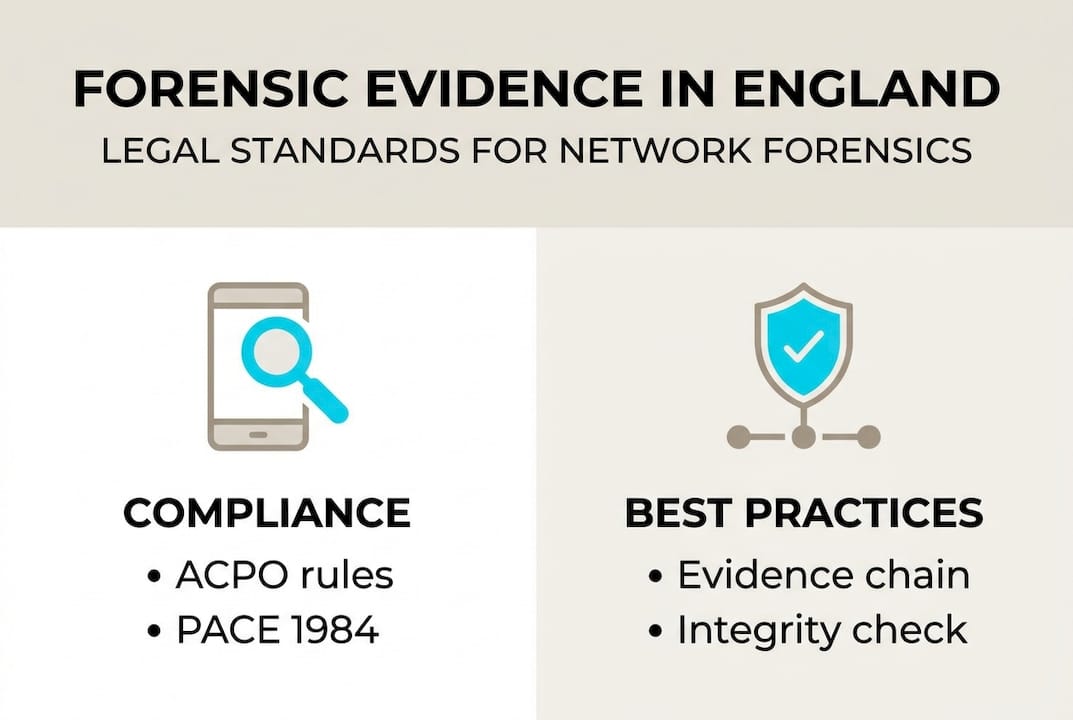
The compliance requirements for digital forensics in the UK are clear: practitioners must comply with ACPO principles, PACE 1984, the Investigatory Powers Act 2016, and the Forensic Science Regulator codes.
The four ACPO principles remain the bedrock of evidential integrity:
- Principle 1: No action should change data that may be relied upon in court
- Principle 2: Persons accessing original data must be competent and able to explain their actions
- Principle 3: An audit trail must be created and preserved
- Principle 4: The investigating officer is responsible for ensuring these principles are followed
For digital forensics in UK courts, the Police and Criminal Evidence Act 1984 governs how evidence is obtained, stored, and disclosed. The Investigatory Powers Act 2016 adds a further layer, particularly where interception of communications is involved, requiring appropriate authorisation before collection begins.

| Obligation | Governing framework | Key requirement |
|---|---|---|
| Evidence integrity | ACPO principles | No alteration of original data |
| Lawful interception | Investigatory Powers Act 2016 | Prior authorisation required |
| Admissibility | PACE 1984 | Proper handling and disclosure |
| Practitioner competence | Forensic Science Regulator | Demonstrated expertise and audit trail |
| Data protection | UK GDPR / DPA 2018 | Proportionate and lawful processing |
Disclosure obligations under the Criminal Procedure and Investigations Act 1996 also apply in criminal matters, meaning investigators must retain and disclose all relevant material, including material that may assist the defence. Failing to account for this during network forensic collection can undermine an entire prosecution.
Challenges and advanced techniques: encryption, volatility, and machine learning
Modern network forensics operates in an environment that would have been unrecognisable a decade ago. The challenges are real, but so are the tools available to address them.
The encryption problem is acute. Research confirms that encrypted traffic accounts for more than 85% of malicious flows, yet advanced modelling can identify users even in encrypted streams with a 93.3% true positive identification rate. This means that encryption does not render network forensics impossible. It changes the methodology.
Rather than inspecting packet payloads directly, analysts working within the UK legal digital forensics context increasingly rely on:
- Traffic flow metadata: Connection timing, volume, frequency, and destination patterns reveal behaviour even without payload access
- TLS fingerprinting: Techniques such as JA3 fingerprinting identify the client software initiating encrypted sessions
- Behavioural analytics: Establishing baselines and detecting deviations that indicate compromise or exfiltration
- Machine learning classification: Training models on known malicious traffic patterns to flag anomalies in encrypted flows
- DNS analysis: Monitoring domain resolution patterns to identify command-and-control infrastructure
Volatility is the other major challenge. Network evidence is inherently ephemeral. Router buffers overwrite continuously. Session data disappears when connections close. Firewall logs rotate on short cycles. The window for capturing decisive evidence can be measured in minutes.
Pro Tip: Deploy continuous packet capture on critical network segments before an incident occurs. Retrospective forensics is only possible if you have already been recording. Waiting until after an attack to consider capture capability is too late.
Machine learning is not a future aspiration in this field. It is already operational in leading forensic platforms, enabling analysts to process volumes of traffic that no human team could review manually, while surfacing the specific sessions that matter for legal proceedings.
Applying network forensics: case insights and best practices
Theory becomes meaningful when you see how network forensics performs under real investigative conditions. The lessons from actual cases are instructive for both legal practitioners and corporate security teams.
In documented investigations, tools like Wireshark and NetworkMiner were decisive in identifying malware command-and-control communications, tracing lateral movement, and attributing exfiltration to specific internal hosts. Without network-level evidence, those cases would have relied entirely on endpoint artefacts, which attackers routinely clear.
For network evidence in UK courts to withstand challenge, practitioners follow these steps:
- Establish forensic readiness before incidents occur: Deploy capture infrastructure, define retention policies, and document the chain of custody process in advance
- Capture at the earliest opportunity: Prioritise volatile data, including live traffic and session tables, before any remediation activity begins
- Segregate forensic copies from operational systems: Never analyse original evidence directly; work from verified copies with hash validation
- Document every action contemporaneously: Courts expect a timestamped record of who did what, when, and why
- Engage qualified expert witnesses early: Forensic reports prepared by competent, accredited practitioners carry significantly more weight
“The cases that collapse in court are rarely those with insufficient evidence. They are the ones where the evidence was mishandled, undocumented, or collected without proper authorisation.”
Failed forensic investigations share common patterns: sensors misconfigured to drop packets under load, retention periods too short to capture the relevant timeframe, and collection that began after remediation had already altered the environment. Organisational readiness, not just technical capability, determines whether network forensics delivers results.
Why network forensics must go beyond compliance: a practitioner’s viewpoint
Compliance checklists are a starting point, not a destination. We see organisations invest in the minimum required to satisfy regulators, then discover during an actual investigation that their evidence is incomplete, inadmissible, or simply absent. Ticking boxes does not build cases.
The most effective approach marries real-time network security monitoring with retrospective forensic capability. These are not competing priorities. A well-designed network security monitoring programme generates the data that forensic analysts need when an incident escalates to litigation. Treating them as separate budgets and separate teams is a structural mistake.
Full packet capture on critical segments, behavioural analytics tuned to your specific environment, and regular exercises that test your forensic readiness under realistic conditions: these are what separate organisations that can prove what happened from those that can only speculate. Ongoing professional education and engagement with current UK guidance are equally non-negotiable. The threat landscape evolves faster than most compliance frameworks. Practitioners who rely on expert network forensics support and stay current with primary sources are the ones whose evidence holds up.
Leverage network forensics with expert support
Building defensible network forensic evidence requires more than good intentions. It demands specialist knowledge, the right technical infrastructure, and a rigorous approach to legal admissibility from the first moment of collection. Our digital forensics services are designed specifically for legal professionals and corporate security teams who need evidence that will withstand scrutiny in English courts and regulatory proceedings. Whether you are responding to a live incident, preparing for litigation, or strengthening your forensic readiness, we provide the expertise and methodology to support you. Explore how our approach to forensic data expertise can make the difference between a case that holds and one that does not. Contact us to discuss your specific requirements.
Frequently asked questions
How does network forensics differ from traditional digital forensics?
Network forensics focuses on capturing and analysing network traffic in real-time or post-incident, while traditional digital forensics analyses data at rest on devices or storage media. The key distinction lies in volatility: network evidence can vanish within seconds if not captured promptly.
What are the main legal requirements for network forensics in England?
English law mandates compliance with ACPO principles, PACE 1984, and the Forensic Science Regulator code for digital evidence to be admissible. The Investigatory Powers Act 2016 also governs any interception of communications during collection.
Can network forensics analyse encrypted traffic?
Yes. Analysts use metadata, flow patterns, TLS fingerprinting, and machine learning to attribute and profile encrypted communications. Advanced modelling techniques can achieve identification rates exceeding 93% even without access to payload content.
What tools are used in network forensics investigations?
Common tools include Wireshark, NetworkMiner, and SIEM solutions for packet capture and flow analysis. Wireshark and NetworkMiner have been decisive in real case outcomes, particularly for identifying malware communications and tracing exfiltration paths.
Why is immediate capture important in network forensics?
Volatile or ephemeral data, including live session tables and router buffers, can be lost within minutes. Immediate collection ensures that the most time-sensitive evidence is preserved before overwriting or remediation activity destroys it permanently.
Recommended
- Master the Network Forensics Workflow for Effective Investigations
- Essential Cybercrime Investigation Steps for Legal Cases
- Essential Cybercrime Investigation Steps for Legal Cases
- How To Tackle Cybercrime With A Helping Hand From Digital Forensics
- How to protect business phone numbers from fraud: UK guide|BM