

Digital evidence looks deceptively simple. Files exist, you retrieve them, you hand them over. In practice, electronic disclosure is one of the most technically and legally demanding aspects of modern litigation, and digital disclosure is becoming increasingly complex under both civil and criminal proceedings. The volume of data involved, the legal protocols that govern its handling, and the consequences of getting it wrong make this a discipline that demands rigorous expertise. This guide walks through what electronic disclosure actually involves, how it differs across legal contexts, and what best practice looks like in 2026.
Table of Contents
- What is electronic disclosure?
- Comparing electronic disclosure in civil and criminal cases
- The electronic disclosure process: stages and strategies
- Key challenges and expert solutions in electronic disclosure
- A new era: rethinking electronic disclosure best practices
- Expert support for electronic disclosure success
- Frequently asked questions
Key Takeaways
| Point | Details |
|---|---|
| Electronic disclosure defined | It is the formal legal process of handling digital evidence, distinct from general IT asset management. |
| Civil vs criminal requirements | Civil and criminal cases have fundamentally different rules and challenges for disclosing electronic evidence. |
| Proportionality is vital | Balancing scope, cost, and complexity is central to electronic disclosure under civil rules. |
| Forensic expertise matters | Early engagement of forensic specialists greatly reduces risk and improves outcomes in disclosure. |
| Technology and judgement | Strategic use of technology aids efficiency, but must be guided by expert legal oversight. |
What is electronic disclosure?
Electronic disclosure is the formal legal process of identifying, preserving, collecting, reviewing, and producing digital evidence in response to court obligations or regulatory requirements. It covers everything from emails and spreadsheets to deleted files, chat logs, cloud storage, and metadata. The scope is far broader than most clients initially expect.
Unlike paper-based disclosure, electronic evidence presents unique challenges. A single custodian’s work laptop can contain hundreds of thousands of documents. Add mobile devices, shared drives, and cloud platforms, and the data volumes become genuinely difficult to manage without structured processes.
The key stages of electronic disclosure are:
- Identification: Locating all potentially relevant data sources across the organisation
- Preservation: Ensuring data is not altered, deleted, or overwritten while proceedings are active
- Collection: Gathering data using forensically sound methods that maintain integrity
- Processing: Filtering, deduplicating, and indexing data to make review manageable
- Review: Assessing documents for relevance, privilege, and confidentiality
- Production: Delivering the final set of disclosable documents to the opposing party or court
Engaging a forensic computer expert from the outset significantly reduces the risk of procedural errors at any of these stages.
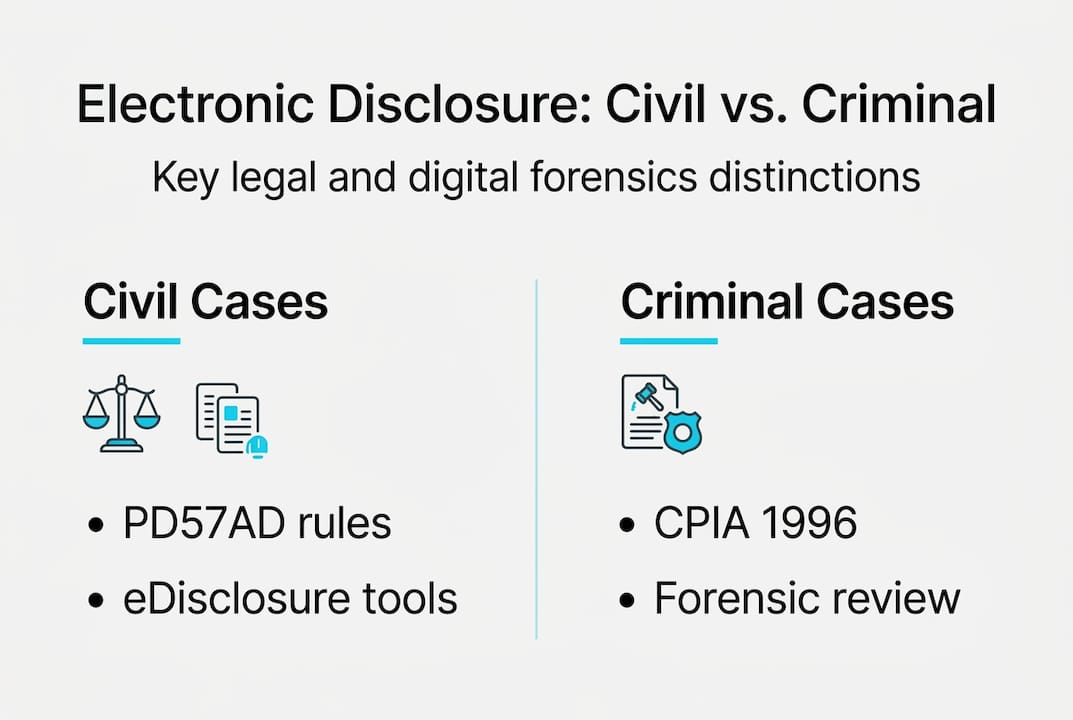
It is also worth understanding that civil and criminal proceedings approach electronic disclosure differently. Civil litigation in England and Wales is governed primarily by Practice Direction 57AD (PD57AD), which applies to the Business and Property Courts and introduces proportionality principles and structured disclosure models. Criminal proceedings are governed by the Criminal Procedure and Investigations Act 1996 (CPIA), which was designed before smartphones and cloud storage existed.
“Electronic evidence is not simply a digital version of a paper document. It carries metadata, version histories, and contextual information that can be as significant as the content itself.”
| Data type | Common sources | Disclosure complexity |
|---|---|---|
| Emails | Exchange, Gmail, Outlook | High: volume and threading |
| Documents | SharePoint, OneDrive, local drives | Medium: version control issues |
| Chat messages | Teams, WhatsApp, Slack | High: informal language, encryption |
| Metadata | All file types | Medium: often overlooked |
| Deleted files | Hard drives, cloud recycle bins | High: requires forensic recovery |
Comparing electronic disclosure in civil and criminal cases
The divergence between civil and criminal electronic disclosure is not a minor procedural detail. It shapes the entire approach your legal team must take.
In civil proceedings, PD57AD requires parties to complete an Extended Disclosure application using one of five models (Models A through E), ranging from no disclosure beyond known documents to wide search-based disclosure. Crucially, proportionality is built into the framework. Parties must justify the cost and complexity of any disclosure exercise relative to the value and issues in dispute. Technology Assisted Review (TAR), which uses machine learning to prioritise relevant documents, is explicitly accepted under PD57AD and can dramatically reduce review costs.
Criminal proceedings present a starkly different picture. The CPIA struggles with digital data volumes, and calls for reform have grown louder following the independent review of disclosure in the digital age. Investigators and prosecutors are often required to manually review enormous datasets without the benefit of TAR or structured search models, leading to backlogs, missed evidence, and wrongful outcomes.
| Feature | Civil (PD57AD) | Criminal (CPIA 1996) |
|---|---|---|
| Governing framework | Practice Direction 57AD | Criminal Procedure and Investigations Act 1996 |
| Proportionality principle | Yes, explicitly required | No formal equivalent |
| Technology Assisted Review | Accepted and encouraged | Rarely used; no formal framework |
| Disclosure models | Models A to E | No equivalent structured models |
| Primary burden | Both parties | Prosecution-led |
The disclosure in the digital age review published in 2025 highlighted systemic failures in criminal disclosure, particularly in fraud and complex cases where digital evidence is central. These failures have real consequences: collapsed trials, appeals, and reputational damage for all parties involved.
For legal professionals advising corporate clients on computer forensics in litigation, understanding which framework applies to your matter is the first practical decision you need to make. It determines your timeline, your technology choices, and your obligations.

The electronic disclosure process: stages and strategies
Knowing the stages of electronic disclosure is one thing. Executing them in a way that is defensible, proportionate, and cost-effective is another matter entirely.
- Data mapping: Before anything else, identify where your client’s data lives. This means cataloguing devices, cloud accounts, third-party platforms, and any legacy systems. A poor data map leads to incomplete disclosure and potential sanctions.
- Legal hold: Issue a formal preservation notice to all relevant custodians immediately. Any destruction of data after proceedings are reasonably anticipated constitutes spoliation, which courts treat seriously.
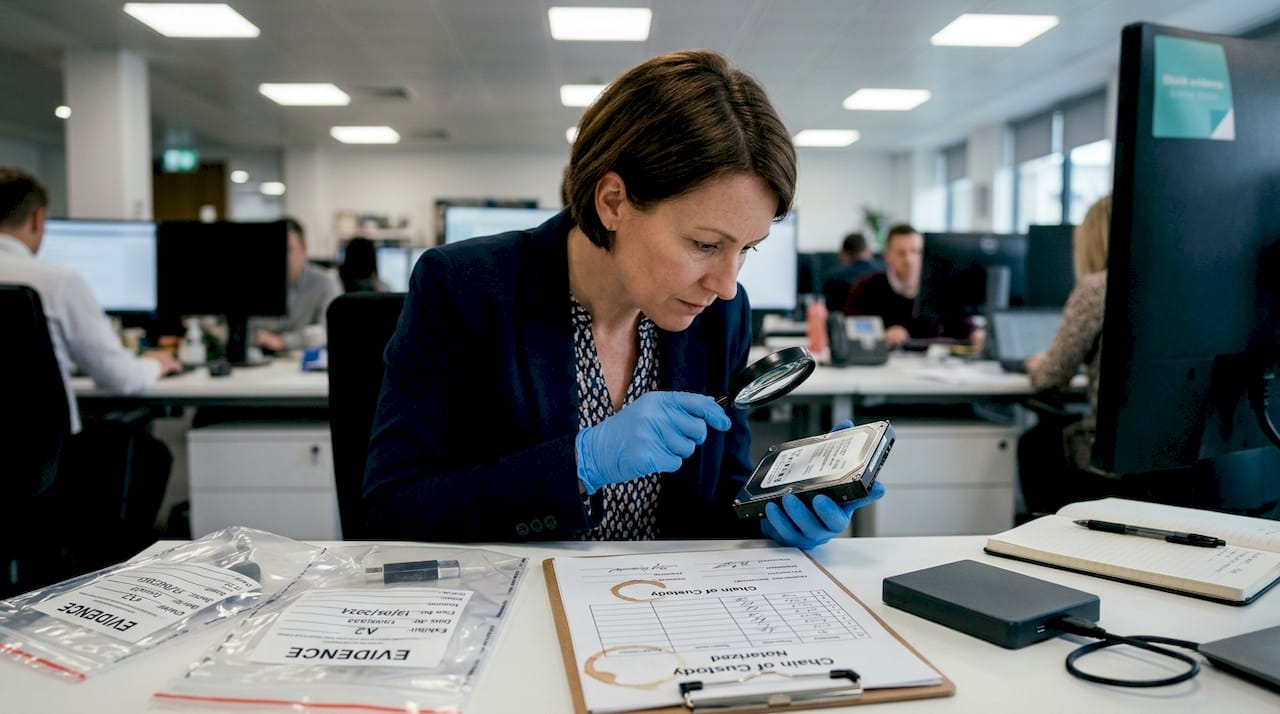
- Forensic collection: Use write-blocked collection tools and document the chain of custody at every step. This is where computer forensics experts in legal proceedings add irreplaceable value.
- Processing and culling: Deduplicate, apply date filters, and use keyword searches or TAR to reduce the review population. Under PD57AD, you must be able to justify your search parameters.
- Privilege review: Identify and redact legally privileged material before production. Inadvertent disclosure of privileged documents can have serious consequences.
- Production: Deliver documents in the agreed format, with appropriate metadata preserved and a clear production log.
Proportionality is the governing principle under PD57AD. The cost and effort of disclosure must be balanced against value and complexity, and courts expect parties to make sensible, documented decisions about scope.
“A defensible workflow is not about perfection. It is about being able to demonstrate, at every stage, that reasonable and proportionate decisions were made.”
For complex matters, involving an expert witness in disclosure early allows the legal team to structure the process correctly from day one, rather than correcting errors under time pressure. A well-structured defensible e-discovery workflow is not a luxury; it is a professional obligation.
Pro Tip: Document every decision made during the disclosure process, including decisions not to collect from certain sources. Courts do not just scrutinise what you produced; they scrutinise how you decided what to produce.
Key challenges and expert solutions in electronic disclosure
The practical difficulties of electronic disclosure are growing faster than most legal teams can adapt. Understanding the specific barriers helps you address them before they become problems.
The most significant challenges currently facing legal and corporate clients include:
- Data volume: The average employee generates gigabytes of potentially relevant data annually across email, messaging apps, and cloud platforms
- BYOD (Bring Your Own Device) policies: Personal devices used for work create complex collection and privacy issues
- Cloud and cross-border data: Data stored across multiple jurisdictions introduces legal complications around access and transfer
- Social media and ephemeral messaging: Platforms like WhatsApp and Signal present collection challenges, especially where auto-delete features are active
- Incomplete retrieval: Keyword searches alone miss contextually relevant documents; manual processes in criminal cases struggle with digital volumes, which drives calls for technology reforms
- Spoliation risk: Routine IT processes such as backup cycles and auto-deletion can destroy evidence if legal holds are not issued promptly
Technology Assisted Review addresses the volume problem directly. TAR systems train on a small set of documents reviewed by a senior lawyer, then predict relevance across the entire dataset. In large matters, this can reduce review time by 60 to 80 per cent without sacrificing accuracy.
However, technology is only part of the answer. Understanding the role of forensics in legal cases makes clear that forensic consultants bring something TAR cannot: legal judgment about what the evidence means, how it was created, and whether it has been tampered with.
Pro Tip: If your matter involves mobile devices, act quickly. Many messaging applications overwrite data within days. Forensic preservation of mobile evidence is time-critical in a way that email preservation often is not.
For matters involving suspected data manipulation or deletion, an expert witness in digital forensics can provide court-ready analysis that goes far beyond what a standard review platform can offer. Engaging that expertise early, rather than reactively, is consistently the more cost-effective approach. The PD57AD framework provides a useful reference for understanding what proportionate, defensible disclosure looks like in practice.
A new era: rethinking electronic disclosure best practices
There is a persistent assumption in legal practice that electronic disclosure is an administrative function, something to be managed by IT or junior staff once the legal strategy is set. That assumption is wrong, and it is expensive.
In our experience, the cases that go wrong do not fail because of bad legal arguments. They fail because evidence was not preserved in time, because a search strategy missed a critical data source, or because a production error triggered a sanctions application. These are operational failures with legal consequences.
The uncomfortable truth is that electronic disclosure is now a core competency for any legal team handling complex litigation. Treating it as a back-office function creates real exposure. The most effective approach we see involves early engagement of a computer forensics expert witness, clear data mapping before any collection begins, and a documented decision trail that can withstand judicial scrutiny.
Automation helps enormously with volume. But legal judgment, forensic rigour, and strategic thinking are what make the difference between disclosure that supports your case and disclosure that undermines it.
Expert support for electronic disclosure success
If your matter involves significant digital evidence, the question is not whether to involve forensic expertise, it is when. Computer Forensics Lab works directly with solicitors, barristers, and corporate legal teams across the UK to provide digital forensics services that are court-ready, proportionate, and defensible. Whether you need support with data preservation, collection, TAR implementation, or expert witness reporting, our team brings the technical and legal understanding your case requires. Our forensic consultants in litigation have experience across civil, criminal, and regulatory matters. Explore how forensic consultancy in litigation can reduce your risk and strengthen your position.
Frequently asked questions
What is electronic disclosure in UK litigation?
Electronic disclosure is the formal process of identifying, reviewing, and producing digital evidence in legal cases, following court-mandated protocols such as PD57AD in civil matters. It covers all forms of digital data, including emails, documents, messages, and metadata.
What are the main differences between civil and criminal electronic disclosure?
Civil disclosure follows PD57AD and allows proportional, tech-driven methods including TAR, while criminal cases are governed by the CPIA and often rely on manual, less efficient processes that are increasingly inadequate for modern data volumes.
Why should forensic experts be involved in disclosure?
Engaging forensic experts ensures proper identification, defensible collection, and risk reduction, especially in complex or high-volume cases. Forensic expertise is highly recommended for any matter where data integrity or completeness is likely to be contested.
Is Technology Assisted Review (TAR) accepted in UK courts?
Yes, TAR is accepted in civil proceedings under PD57AD and can significantly increase efficiency. Its use remains limited in criminal cases, where no equivalent formal framework currently exists.