

Securing a cybercrime case in a London courtroom often hinges on the clarity and credibility of your documentation. Forensic investigators and legal professionals know that even minor gaps in reporting can create openings for serious legal challenges. This guide delivers clear steps for preparing standardised documentation templates and robust chain of custody practices, supporting your work from evidence collection through to court presentation while meeting the strict standards required for admissibility.
Table of Contents
- Step 1: Prepare Documentation Templates And Tools
- Step 2: Record Evidence Collection And Chain Of Custody
- Step 3: Detail Forensic Analysis Methods And Results
- Step 4: Verify Documentation For Accuracy And Completeness
- Step 5: Present Findings In A Court-Ready Format
Quick Summary
| Key Point | Explanation |
|---|---|
| 1. Create Standardised Templates | Develop templates specific to your investigation type to ensure essential information is captured consistently. |
| 2. Maintain Chain of Custody | Document every step of evidence handling to transform raw findings into legally admissible evidence in court. |
| 3. Detail Analytical Methods | Clearly document all analysis techniques and tools used, providing transparency and scientific rigor in your findings. |
| 4. Verify Documentation Thoroughly | Conduct a comprehensive review of all documents to catch errors and ensure completeness before final submission. |
| 5. Present Findings Clearly | Structure your report for clarity and accessibility, avoiding jargon to ensure judges and juries understand the evidence. |
Step 1: Prepare documentation templates and tools
You’re about to create the backbone of your entire forensic investigation record. Getting this right from the start saves countless hours later and prevents critical evidence from falling apart under cross-examination. This step involves selecting or developing standardised templates and assembling the technical tools you’ll need to document your findings systematically.
Start by establishing a core set of templates that capture the essential information for every investigation you handle. These templates should reflect your specific investigative focus, whether that’s malware analysis, data recovery, or social media evidence gathering. Your templates need consistent fields for case identifiers, examiner details, timestamps, and findings descriptions. The standard operating procedures from forensic guidance emphasise this consistency across investigations, which becomes invaluable when you’re working across multiple cases or collaborating with other investigators.
Next, think about the technical tools you’ll embed into your workflow. Photography and image analysis software form the foundation here. You’ll want tools that allow you to annotate findings clearly, preserve original evidence integrity, and create audit trails showing exactly what you’ve examined and how. Many cybercrime specialists rely on image editing software to highlight alterations, document metadata, and create visual comparisons that judges and juries can actually understand in court.
Don’t overlook the documentation platform itself. Whether you choose digital forms, spreadsheets, or specialised forensic software, your system must allow you to record observations in real-time without compromising evidence. Your tools should automatically timestamp entries and prevent retroactive modifications. This creates the chain of custody documentation that separates admissible evidence from inadmissible findings.
The following table compares documentation platforms commonly used in forensic investigations:
| Platform Type | Strengths | Limitations |
|---|---|---|
| Digital Forms | Real-time entry, automatic timestamps | System compatibility, training required |
| Spreadsheets | Customisable fields, easy exporting | Error risk, lacks audit trails |
| Specialised Forensic Software | Secure, tamper-evident, audit trails | Higher cost, specialist knowledge |
Test your templates with a practice case before deploying them across your active investigations. This reveals gaps in your fields, identifies tools that don’t integrate smoothly, and shows you where examiners need clarification. A template that works theoretically might create confusion under actual investigation pressure.
Professional advice Create template versions specifically for different cybercrime scenarios, such as separate documentation protocols for email forensics versus mobile device analysis, so your investigators always capture the right details without unnecessary fields cluttering their workflow.
Step 2: Record evidence collection and chain of custody
This step is where your investigation becomes legally bulletproof. Every item you collect, every person who touches that evidence, and every movement it makes must be documented with precision. Creating a comprehensive chain of custody record is what transforms raw findings into admissible court evidence.
Begin recording immediately when you first encounter digital evidence. Document the exact date, time, and location of collection, along with the specific device or data source involved. Capture details about the condition of the evidence before you touch it, the hardware or software you use during acquisition, and your own name and credentials as the examiner. These initial observations become the foundation of your entire chain of custody, so take time to be thorough and specific here.
Next, establish a system for tracking every single person who handles your evidence going forward. The documented journey of evidence includes recording names, job titles, dates, times, and the specific purpose for each transfer or examination. This might include other examiners reviewing your work, legal teams preparing for trial, or court officials storing evidence. Each interaction must be logged with the same precision you used during initial collection.
Create a master evidence log that follows your evidence from acquisition through to court presentation. This log should contain identifying information about the evidence, the complete chronology of who accessed it and when, storage conditions, any analyses performed, and the current location. Courts scrutinise this record intensely, so accuracy and completeness matter enormously. Even small gaps or inconsistencies can undermine the admissibility of your findings.
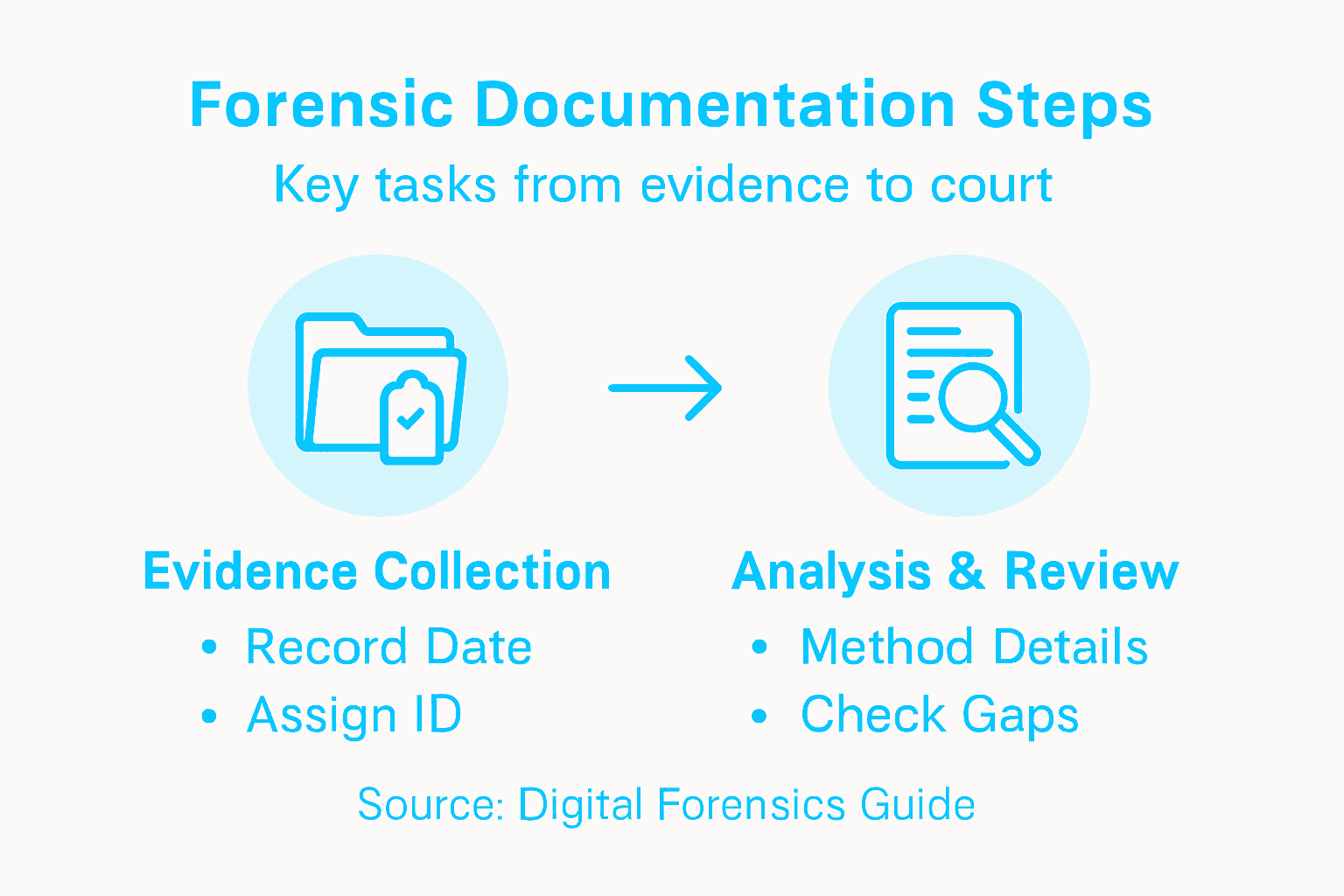

Store your chain of custody documentation separately from the evidence itself, though keep them linked by consistent identification numbers. Your records should use tamper-evident methods, whether that means sealed envelopes with initialled seals or digital systems with audit trails. Consider how you’ll preserve chain of custody for digital evidence specifically, as digital evidence requires special attention to hashing, imaging, and version control alongside traditional documentation practices.
Here is a summary of steps to maintain an unbroken chain of custody for digital evidence:
| Step | Critical Action | Legal Rationale |
|---|---|---|
| Initial Collection | Document collector, device, timestamp | Establishes evidence origin |
| Transfers/Accesses | Record all handlers and purposes | Supports traceability and accountability |
| Storage and Preservation | Secure storage with integrity measures | Prevents tampering or loss |
| Presentation in Court | Link logs to exhibits with identifiers | Admissibility depends on audit trail |
Professional advice Use sequential numbering or barcoding systems for all evidence items, with matching references in your chain of custody logs, so that you can instantly verify at trial that every piece of documentation corresponds to the correct evidence without confusion or delay.
Step 3: Detail forensic analysis methods and results
Your analysis is only as credible as the documentation you create around it. This step transforms your investigative work into a transparent, scientifically grounded record that judges and defence counsel can scrutinise thoroughly. You need to explain not just what you found, but precisely how you found it and why your methods are reliable.
Document every analytical technique you employ before you begin using it. Whether you’re conducting malware analysis, examining email headers, recovering deleted files, or analysing mobile device data, record the specific tools, software versions, and procedures involved. Include the rationale for choosing each method and any limitations it might have. This approach reflects scientifically validated methods that demonstrate objectivity and professional rigour to the court.

As you work through your analysis, create contemporaneous notes describing your observations in real-time. Don’t wait until the end to write up your findings. Your contemporaneous notes become powerful evidence of your methodology because they show the investigative process unfolding naturally rather than being constructed retroactively. Record what you expected to find, what you actually discovered, and any unexpected results or anomalies that emerged.
Structure your findings documentation around clear cause and effect relationships. For cybercrime investigations, this means explaining how data corruption occurred, why timestamps changed, or how malicious code functioned. Be precise about what your evidence shows and equally precise about what it does not show. Avoid speculation or interpretations that extend beyond your technical findings.
Include visual documentation wherever possible. Screenshots, hash comparisons, metadata displays, and annotated images make your analysis accessible to non-technical court users. Your forensic analysis process should incorporate quality images that illustrate your key findings without compromising evidence integrity.
Review your complete analysis documentation before finalising it. Check for gaps in logic, unsupported conclusions, or technical errors that could be challenged in court. Your documentation should stand alone, allowing another qualified examiner to understand and potentially replicate your work.
Professional advice Create a detailed methodology section at the start of your findings that lists every tool used, its version number, and the specific settings applied, allowing defence counsel to evaluate your technical decisions and understand exactly how you reached your conclusions.
Step 4: Verify documentation for accuracy and completeness
Before your documentation leaves your hands, you need to conduct a thorough verification process. This is your final opportunity to catch errors, fill gaps, or clarify ambiguous statements that could undermine your case in court. A single overlooked inconsistency or missing detail can give defence counsel ammunition to challenge your entire investigation.
Start by reading through every page of your documentation as if you were opposing counsel preparing to cross-examine you. Look for statements that lack supporting evidence, conclusions that extend beyond your findings, or technical claims you cannot defend with certainty. Check that every reference to evidence has a corresponding chain of custody entry and that all dates, times, and device identifiers match across your report consistently.
Verify that your documentation accurately reflects your findings without distortion or selective presentation. Confirm that you have included both findings that support your conclusions and those that might complicate them. Omitting inconvenient results will be discovered during disclosure to the defence and severely damages your credibility. Objectivity matters more than reaching a particular outcome.
Check for completeness by working through a verification checklist. Does your report include your full qualifications and experience? Have you explained all analytical methods with sufficient detail for another examiner to understand your approach? Are all exhibits referenced in your text actually attached? Have you documented every significant step of your investigation, including dead ends and alternative hypotheses you tested? Missing sections create questions about what you might be hiding.
Have a colleague conduct an independent review of your documentation if possible. Someone with forensic expertise but unfamiliar with your specific case can spot unclear language, logical gaps, and technical errors more effectively than you can after intensive work. This peer review process reflects professional standards for maintaining accurate and complete records that withstand scrutiny.
Professional advice Create a final documentation checklist covering evidence identification, methodology, findings presentation, and chain of custody integrity, then work through it methodically before releasing your report, treating each item as a critical control point that cannot be skipped.
Step 5: Present findings in a court-ready format
Your forensic investigation is only as effective as your ability to communicate it to judges and juries who lack technical expertise. This step transforms your technical findings into a compelling, understandable narrative that withstands legal scrutiny. A court-ready format balances rigorous methodology with accessibility, ensuring every stakeholder grasps your evidence and its significance.
Structure your report with a clear executive summary at the outset. Begin with a concise statement of what you examined, what you found, and how those findings answer the legal questions posed to you. Non-technical readers need this summary to orient themselves before navigating technical details. Follow with your methodology section, then detailed findings, and conclude with your professional opinions supported by evidence. This conventional structure guides readers through your logic systematically.
Write in plain English throughout, avoiding unnecessary jargon or technical abbreviations. Where specialist terminology is unavoidable, define it immediately and use consistent language throughout. Your report should remain clear and concise in addressing legal questions, anticipating what the court actually needs to know rather than overwhelming readers with every technical detail. Think of your audience sitting in a courtroom, unfamiliar with cybercrime investigation, trying to understand your evidence.
Incorporate visual elements strategically. Annotated screenshots, timeline diagrams, and side-by-side comparisons transform complex findings into something judges can visualise. Every visual should have a caption explaining its relevance and labelled elements highlighting key details. However, never allow visuals to replace written explanation. They support your narrative but do not substitute for it.
Acknowledge limitations explicitly in your report. State what your analysis can and cannot definitively prove. Courts respect honesty about methodological constraints more than overconfident claims that cannot be defended. Transparency about sound methodology and ethical standards strengthens rather than weakens your credibility because it demonstrates professional integrity.
Format your final report professionally. Use consistent fonts, margins, page numbering, and heading styles throughout. Include a table of contents if your report exceeds ten pages. Attach all exhibits referenced in the text. Ensure your report could be printed and handed to a judge without further adjustment.
Professional advice Number every paragraph in your findings section sequentially, then reference those numbers in footnotes rather than repeating findings text multiple times, creating a cross-referenced document that allows lawyers to locate specific points instantly during examination or cross-examination.
Strengthen Your Forensic Documentation with Expert Digital Forensics Support
Documenting forensic findings for legal proceedings requires meticulous attention to detail, unbroken chain of custody, and clear presentation of complex analysis. If you face the challenge of ensuring your digital evidence withstands rigorous legal scrutiny, Computer Forensics Lab offers trusted expertise to support your investigation from data collection through to court-ready reporting. Our strong focus on maintaining comprehensive documentation and transparent methodologies addresses critical pain points such as evidence integrity, accurate analysis records, and professional presentation.
Gain peace of mind by partnering with specialists experienced in Digital Forensics, including device examination, malware analysis, and expert witness report preparation. Our services ensure your evidence is carefully handled and documented according to best practices, easing your burden while bolstering case credibility. Take the next step to secure your investigation’s success today by contacting Computer Forensics Lab and explore how our Computer Forensics solutions can help you confidently document and present your findings with the professionalism demanded by legal proceedings.
Frequently Asked Questions
How do I prepare documentation templates for forensic findings?
To prepare documentation templates, establish a core set that captures essential information for each investigation, such as case identifiers and examiner details. Create these templates specifically for different forensic scenarios, ensuring they are tailored to your investigative focus, like malware analysis or data recovery.
What steps should I take to maintain a chain of custody for digital evidence?
To maintain a chain of custody, document the initial collection details, track every person who handles the evidence, and record every movement meticulously. Create a master evidence log that includes all interactions and store documentation separately from the evidence while keeping them linked by identification numbers.
How do I document my forensic analysis methods effectively?
Document your forensic analysis methods by detailing every technique used, including the tools, software versions, and procedures. Create contemporaneous notes during your analysis to showcase your methodology and findings, allowing another examiner to understand and potentially replicate your work later.
What should I verify in my documentation before submission?
Before submission, ensure your documentation is free from errors, complete, and accurately reflects your findings. Conduct a thorough review using a checklist that includes verifying references to evidence, supporting conclusions, and including all significant steps to avoid leaving gaps or inconsistencies.
How can I present my forensic findings in a court-ready format?
To present forensic findings in a court-ready format, structure your report with a clear executive summary followed by detailed methodologies and findings. Write in plain English, use visual aids strategically, and maintain professional formatting to enhance clarity and understanding for non-technical audiences.