

Facing a cybercrime trial in London, barristers know the shift from physical evidence to complex digital artefacts can upend even the strongest defence. In these high-stakes cases, every email, deleted message, or recovered file must meet strict requirements for authenticity, integrity, and reliability in court. Understanding the unique demands of digital evidence admissibility helps you challenge prosecution findings, secure thorough expert testimony, and protect your client against technical ambiguities that could tip the verdict.
Table of Contents
- Defining Digital Evidence in Legal Contexts
- Categories and Sources of Digital Evidence
- Admissibility and Chain of Custody in UK Courts
- Legal Frameworks Governing Digital Evidence
- Risks, Pitfalls, and Defence Challenges
- Expert Witnesses and Role of Forensic Analysis
Key Takeaways
| Point | Details |
|---|---|
| Digital Evidence Requirements | Digital evidence must meet legal standards of relevance, authenticity, integrity, and reliability to be admissible in court. |
| Chain of Custody Importance | An unbroken chain of custody is essential, documenting every step the evidence takes from collection to courtroom to ensure its integrity. |
| Engaging Forensic Experts Early | Early consultation with forensic experts can identify vulnerabilities in the prosecution’s evidence, guiding the defence strategy before trial. |
| Understanding Digital Evidence Sources | Knowledge of different sources of digital evidence is crucial for proper collection, as each source has unique preservation requirements. |
Defining Digital Evidence in Legal Contexts
Digital evidence is fundamentally different from the physical evidence you might examine at a traditional crime scene. Rather than a bloodstain or a document, you’re dealing with information stored or transmitted through digital means that can be used in court proceedings. This might include emails, text messages, deleted files recovered from a hard drive, metadata from photographs, financial transaction records, or data extracted from mobile devices. The critical distinction is that digital evidence admissibility requires meeting specific legal and technical standards that differ markedly from traditional evidence rules.
What makes defining digital evidence legally complex is that courts must assess it across multiple dimensions simultaneously. Your evidence must satisfy relevance, authenticity, integrity, and reliability requirements before admission. Authenticity means proving the data hasn’t been altered or fabricated. Integrity refers to maintaining an unbroken chain of custody from collection through court presentation. Reliability concerns whether the technical methods used to extract and analyse the evidence were sound. In practice, this means you need more than just the data itself—you need a complete technical narrative explaining how it was obtained, preserved, and analysed.
The challenge deepens because digital evidence exists in what technicians call a “digital landscape” where evidence manifests as computer interactions rather than physical objects. A deleted message isn’t gone; it leaves traces. A device’s activity log creates a timeline. A person’s browsing history tells a story. Yet for barristers without technical backgrounds, interpreting these digital fingerprints requires translating technical concepts into legal language. Courts increasingly expect practitioners to understand fundamentals about how devices store data, how timestamps work, how encryption functions, and why certain recovery methods matter. The gap between technical reality and legal understanding often determines whether your digital evidence succeeds or fails in court.
Practical consideration: When receiving digital evidence from your forensic experts, always request not just the findings but the detailed methodology. How was the device accessed? What tools were used? How were deleted files recovered? What safeguards prevented contamination? These procedural details form the backbone of authenticity arguments that prosecutors will challenge ruthlessly.
To clarify key legal requirements for admitting digital evidence, consider the following summary:
| Requirement | Legal Meaning | Impact on Evidence |
|---|---|---|
| Relevance | Directly relates to the case | Evidence must help prove or disprove facts |
| Authenticity | Proven to be genuine and unchanged | Prevents submission of fabricated data |
| Integrity | Maintained through documented chain of custody | Ensures evidence hasn’t been contaminated |
| Reliability | Methods used are technically sound | Results can be trusted in court |
Pro tip: Always request a detailed chain of custody document and technical methodology report alongside digital evidence findings—these documents are essential for defending admissibility when opposing counsel cross-examines your forensic expert in court.
Categories and Sources of Digital Evidence
Digital evidence doesn’t come from a single source. Understanding where it originates helps you build stronger cases and know what to request from forensic teams. The sources break down into several key categories. Physical storage media includes hard drives, solid state drives, USB flash drives, memory cards, and external storage devices. These contain vast amounts of data that may be relevant to your case. Digital objects represent information created and stored online: emails, social media posts, instant messages, cloud storage files, and web browsing activity. Mobile device data encompasses everything extracted from smartphones and tablets, including call logs, location services, app activity, and messaging history. Network-based evidence involves server logs, internet service provider records, firewall logs, and router data that track communication patterns and user activities across networks.
The complexity arises because preserving digital evidence integrity requires careful handling from the moment of collection. A deleted email doesn’t disappear permanently; forensic experts recover it from unallocated disk space. A device’s timestamp metadata reveals when actions occurred. A person’s location history paints a timeline of movements. Each category of evidence presents distinct preservation challenges. Hard drives require imaging before examination to prevent overwriting data. Mobile devices need isolated environments to prevent automatic updates that destroy evidence. Cloud-stored data requires proper legal authority and cooperation from service providers who control the servers.
Criminal cases often involve evidence spanning multiple categories simultaneously. A fraud investigation might include bank statements from cloud storage, email communications spanning years, and phone records showing coordination between conspirators. A sexual assault case could involve deleted messages recovered from devices, CCTV footage with timestamps, and metadata from digital photographs. The prosecution’s strength frequently depends on collecting and properly documenting all relevant sources rather than focusing narrowly on one category.
What often catches practitioners unprepared is that different sources require different collection methodologies and chains of custody procedures. An external hard drive needs forensic imaging; an email account requires a preservation notice; a social media account requires proper authentication and account holder cooperation or legal process. Failing to collect evidence appropriately from its source undermines admissibility later, regardless of what the data actually shows.
Here’s a comparison of major digital evidence sources and unique preservation challenges:
| Evidence Source | Typical Content | Preservation Challenge |
|---|---|---|
| Hard drives & storage media | Files, deleted data, logs | Avoid overwriting during imaging |
| Mobile devices | Calls, messages, location data | Prevent auto-updates and remote access |
| Cloud services | Backups, emails, documents | Require legal authority to access servers |
| Networks & logs | User activity, connections | Maintain log integrity during extraction |
Pro tip: During your initial case assessment, create a detailed evidence source map identifying all potential digital evidence locations—devices, accounts, services, networks—and document what legal authority you need to access each one before starting collection.
Admissibility and Chain of Custody in UK Courts
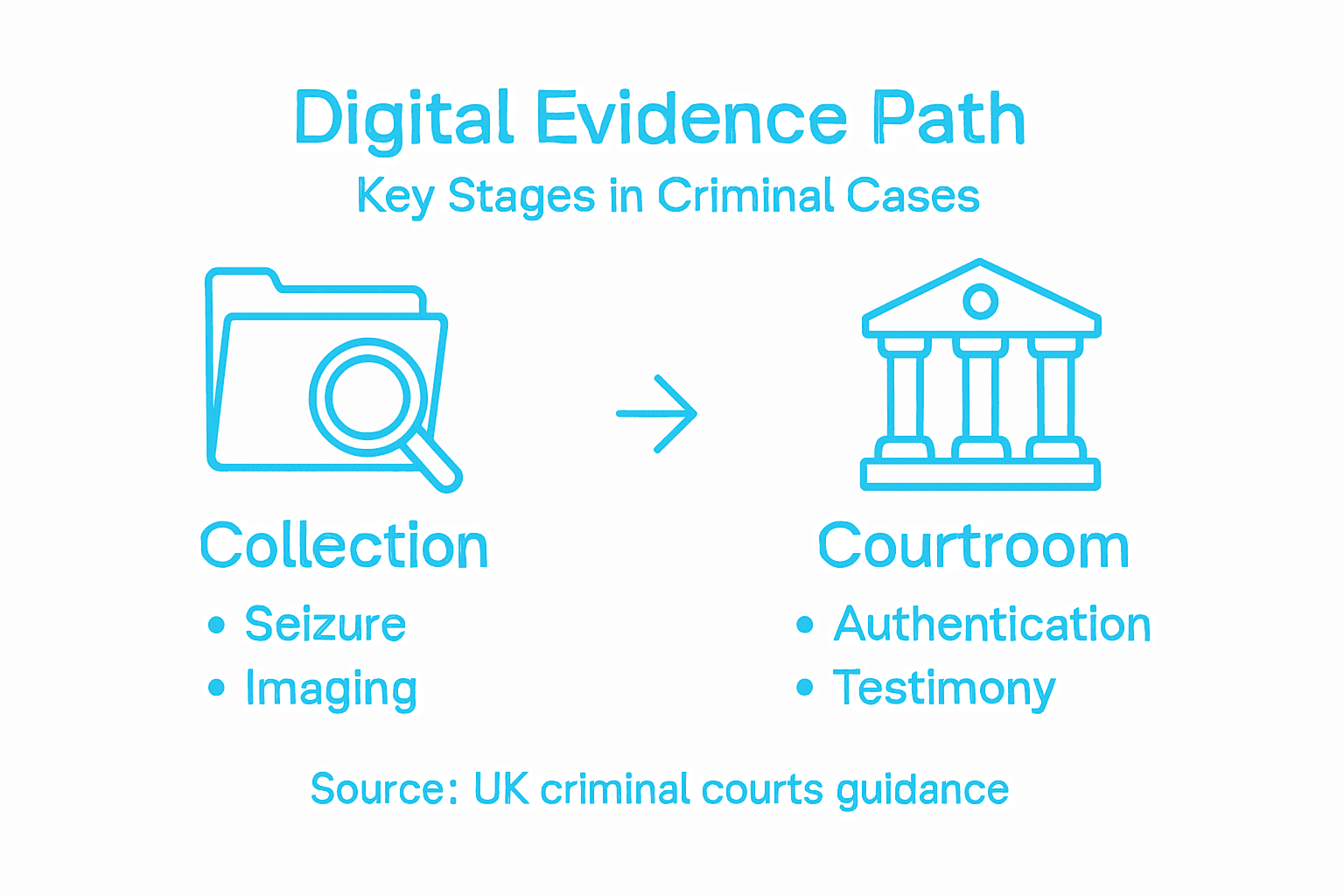
Admissibility of digital evidence in UK courts hinges on two inseparable elements: proving the evidence is what it claims to be, and demonstrating an unbroken chain of custody from collection to courtroom. The courts apply strict standards. Your digital evidence must be relevant, authentic, and reliable. Authenticity requires proving the evidence hasn’t been tampered with or altered. Reliability demands that the methods used to obtain and analyse it were scientifically sound. A flawless forensic analysis becomes worthless if you cannot account for the evidence at every step. An opposing counsel will tear apart your case if there are gaps in documentation, unexplained access to devices, or uncertainty about who handled evidence and when.

The chain of custody is where most cases stumble. This unbroken record documents who collected the evidence, when they collected it, what condition it was in, who subsequently accessed it, and what they did with it. Every transfer requires documentation. Every examination requires a record. The chain of custody procedures in UK criminal investigations establish rigorous standards, yet practical challenges persist. Human error creeps in. Documentation lapses occur. A forensic examiner forgets to note the time they began analysing a hard drive. A device sits on a desk without a signed access log. Defence barristers exploit these gaps ruthlessly. They argue that without a perfect chain, the evidence’s integrity is compromised. Courts must be satisfied beyond reasonable doubt that no opportunity existed for the evidence to be contaminated, altered, or misidentified.
Your expert witnesses carry substantial responsibility here. Expert evidence admissibility requires providing scientific information beyond common knowledge, and experts must demonstrate objectivity and impartiality whilst fulfilling duties to the court above any party’s interests. When your forensic expert testifies about how evidence was collected, preserved, and analysed, they’re essentially vouching for the entire chain. If they cannot articulate precisely how safeguards prevented contamination, or if they rely on memory rather than contemporaneous documentation, prosecutors will undermine their credibility. The expert’s report must be meticulous. Every procedure documented. Every tool validated. Every access logged.
Practical reality: failures in chain of custody documentation often come down to inadequate logging at the forensic examination stage. A technician examines a device for twelve hours but records only the start and end times. Evidence sits in a secure facility overnight without signed handover documentation. A device is removed from an evidence bag without photographic evidence of the seal’s integrity. These seemingly minor administrative gaps become fatal when cross-examined in court.
Pro tip: Insist on contemporaneous, detailed documentation at every evidence transfer point, and require your forensic provider to photograph the evidence condition before and after examination—this visual record proves integrity far more powerfully than written statements alone.
Legal Frameworks Governing Digital Evidence
Digital evidence in UK criminal courts operates within multiple overlapping legal frameworks, and understanding which rules apply to your case is essential. The primary framework is the Criminal Procedure Rules, which govern how evidence must be collected, preserved, and presented. These rules explicitly address digital evidence, requiring disclosure of all material that might reasonably be considered capable of undermining the prosecution’s case or assisting the defence. The rules demand proper authentication and chain of custody documentation. Beyond domestic law, cross-border digital evidence collection involves European frameworks that add complexity. The Budapest Convention and European e-evidence package govern service providers’ roles in electronic evidence collection during criminal proceedings, meaning that evidence obtained from servers outside the UK may require compliance with international protocols.

The common law principle of admissibility remains central. Digital evidence must be relevant, and its probative value must not be substantially outweighed by the danger of unfair prejudice. The Civil Evidence Act 1995 and the hearsay rules apply to digital communications, meaning that emails or messages are hearsay unless they fall within recognised exceptions. A defendant’s assertion in a text message is hearsay; a system’s automated log entry recording a transaction is not. This distinction matters enormously. In practice, you need to understand which hearsay exception your evidence falls within before trial. Computer-generated evidence is often admitted under the common law exception for machine records, provided the machine was functioning properly and producing reliable output. However, this requires proof through technical evidence, not assumption.
Data protection frameworks layer additional complexity. The General Data Protection Regulation and UK Data Protection Act 2018 apply even in criminal investigations. Obtaining evidence from data controllers requires justifiable legal process. A WhatsApp backup recovered from cloud storage may contain personal data of third parties, triggering compliance obligations. Social media evidence obtained without proper legal authority can face challenges for privacy violations. Furthermore, the Regulation of Investigatory Powers Act 2000 governs interception evidence, and improperly obtained intercepted communications cannot be admitted, regardless of their probative value.
Your digital evidence strategy must account for these layered frameworks simultaneously. A single piece of evidence might need to satisfy Criminal Procedure Rules, common law admissibility standards, hearsay exceptions, and data protection compliance all at once. Most practitioners find the intersection point by working backwards from trial, determining what admissibility challenges opposing counsel will raise and ensuring documentation addresses each requirement.
Pro tip: Before collecting any digital evidence, consult the specific legal framework applicable to your evidence source—data protection obligations differ for cloud storage, interception differs from consent-based access, and each source has distinct admissibility requirements best addressed at collection rather than trial.
Risks, Pitfalls, and Defence Challenges
Digital evidence introduces vulnerabilities that traditional physical evidence does not. The fundamental risk lies in the evidence’s intangible nature. A bloodstain remains a bloodstain. A digital file can be replicated, modified, or fabricated without leaving obvious traces. Legal and practical challenges in digital evidence collection include risks of tampering and privacy violations that traditional evidentiary rules never contemplated. Your defence team must understand these specific vulnerabilities because prosecutors will not volunteer them. You need to identify weaknesses in the prosecution’s digital evidence chain before trial. Was the forensic examination conducted on the original device or a forensic image? If an image, how was its integrity verified? Could the examination tools themselves introduce artifacts that look like user activity? These technical questions become legal questions when admissibility is challenged.
Authentication presents the most common pitfall. Prosecutors must prove that the digital evidence is what they claim it is. An email printout might be authentic, but that same email recovered from a server backup requires proof that the recovery process preserved the original content. A mobile device screenshot purporting to show a message requires proof that the device’s clock was accurate and the message wasn’t fabricated. Metadata can lie. A file’s creation date reflects when the file was copied, not when it was originally created. A photograph’s embedded timestamp depends on whether the device’s clock was set correctly. Defence barristers exploit these ambiguities ruthlessly. They argue that without definitive proof of authenticity, the evidence’s probative value collapses.
Resource imbalance creates a systemic challenge. Prosecution teams typically have access to forensic experts, digital analysts, and sophisticated examination tools. Defence teams often struggle to afford equivalent expertise. This imbalance means your client may face highly technical evidence that you cannot adequately challenge because you lack the resources to hire a competing expert. The gap widens when examining encrypted data, cloud evidence, or device-specific forensic techniques. A prosecution expert testifies that deleted messages were recovered using validated forensic software. Your defence expert might conclude the same evidence could have been fabricated using readily available tools. The jury sees contradictory expert testimony and often defaults to trusting the prosecution’s expert, particularly when that expert appears more confident or experienced.
Misinterpretation risks are substantial. Digital forensic reports contain technical terminology that barristers and judges often struggle to understand. A “unallocated cluster” sounds suspicious even though it simply means deleted file fragments. An “artefact” in forensic analysis is a technical byproduct, not evidence of user activity. Yet these terms, misunderstood in court, can prejudice a jury against your client. Similarly, correlation is frequently presented as causation. A defendant’s IP address was associated with an illegal download. This proves the defendant downloaded it, right? No, not necessarily. The network could have been compromised. Someone else could have used the defendant’s connection. The IP geolocation could be inaccurate. But once the jury hears “defendant’s IP address,” they often stop asking critical questions.
Pro tip: Before trial, request the prosecution’s complete forensic methodology, including the specific tools used, their validation protocols, and any limitations or known issues—then engage a defence digital forensics expert to identify weaknesses in both the methodology and the conclusions before opening statements.
Expert Witnesses and Role of Forensic Analysis
Your case’s strength often depends entirely on your expert witness. Digital forensic evidence is inherently technical, and juries cannot evaluate it without qualified expert testimony. The expert’s credibility, clarity, and ability to withstand cross-examination determine whether complex technical evidence strengthens or weakens your position. A knowledgeable expert translates forensic findings into language that barristers and judges can understand. A weak expert undermines even solid technical work. Expert witnesses owe primary duty to the court and must provide objective, unbiased opinions within their expertise rather than advocating for the party who engaged them. This impartiality requirement is non-negotiable. Courts scrutinise expert witnesses for signs of bias. If the expert appears motivated by the fee or the desired outcome rather than scientific truth, the judge will question their reliability and juries will discount their testimony.
Forensic analysis encompasses far more than simply running software tools on a device. The forensic expert’s multifaceted responsibilities include accurately collecting, analysing, and presenting scientific evidence whilst preventing contamination, with methodology directly impacting case outcomes. A competent digital forensic expert documents their examination process meticulously. They explain which tools they used and why. They acknowledge the tools’ limitations. They describe what they did to prevent cross-contamination of evidence. They explain how they verified their findings. They disclose any inconclusive results. They avoid overreaching conclusions. A mediocre expert, by contrast, generates findings without explaining methodology. They make definitive statements about facts that remain ambiguous. They dismiss alternative explanations without genuine consideration. They become defensive when challenged. These red flags alert opposing counsel that the expert is vulnerable to cross-examination.
Your defence team benefits enormously from engaging a forensic expert early, not at trial preparation. Early engagement allows the expert to identify weaknesses in the prosecution’s evidence collection. Were devices properly isolated before examination? Was the forensic image properly verified? Were the examination tools validated? Could artefacts introduced by the tools be mistaken for user activity? An early expert assessment guides your trial strategy. You understand precisely where the prosecution’s digital evidence is vulnerable before you walk into court. You can cross-examine the prosecution’s expert knowledgeably. You can explain technical concepts to the jury clearly. You can challenge conclusions that overreach the evidence.
The expert witness selection process matters enormously. A forensic analyst working for a police agency brings institutional knowledge but potential bias. A private sector expert offers independence but may lack criminal investigation experience. An academic expert understands methodology but may lack practical courtroom experience. Your choice depends on your case specifics. A complex mobile device analysis might require someone specialising in that specific device manufacturer. An encryption case requires expertise in cryptographic methodologies. A cloud evidence case requires someone familiar with specific service providers’ data structures. Selecting the right expert with the right specialist knowledge makes the difference between effective testimony and testimony that fails under scrutiny.
Pro tip: Request your expert’s curriculum vitae, prior court testimony, and any cases where their findings were challenged or contradicted before engaging them—then discuss your case strategy with them before trial to ensure they understand which forensic findings matter most to your defence.
Strengthen Your Case with Expert Digital Forensics Support
Navigating the complexities of digital evidence admissibility, chain of custody, and forensic analysis can be daunting. The risks of improper data handling and technical misunderstandings often jeopardise the integrity of crucial evidence in criminal cases. If you are facing challenges related to preserving, authenticating, or analysing digital evidence, it is vital to partner with a specialist who fully understands both the legal and technical demands.
At Computer Forensics Lab, we provide comprehensive Digital Forensic Investigation services designed to maintain evidence integrity from collection to court. Our expertise in Electronic Evidence and Digital Evidence Preservation ensures that your digital evidence withstands intense scrutiny. Don’t risk gaps in your chain of custody or technical vulnerabilities undermining your case. Contact us today at computerforensicslab.co.uk to secure trusted, clear, and court-ready digital forensic support.
Frequently Asked Questions
What is digital evidence?
Digital evidence refers to information stored or transmitted through digital means that can be used in court proceedings. It includes emails, text messages, deleted files, metadata, financial records, and data from mobile devices.
What factors determine the admissibility of digital evidence in court?
The admissibility of digital evidence hinges on its relevance, authenticity, integrity, and reliability. Evidence must relate directly to the case, be proven genuine and unaltered, maintained in a documented chain of custody, and obtained through sound technical methods.
How is the chain of custody important for digital evidence?
The chain of custody is crucial as it provides an unbroken record of who collected and handled the evidence, ensuring it hasn’t been tampered with. Any gaps in this documentation can lead to challenges in admissibility during court proceedings.
Why is expert testimony essential in cases involving digital evidence?
Expert testimony is vital because digital evidence is inherently technical. Experts translate complex forensic findings into understandable terms, ensuring the jury comprehends the evidence’s significance and reliability.