

Many legal professionals believe that once a file is deleted, it vanishes forever. In reality, forensic experts routinely recover supposedly erased data from computers, mobiles, and cloud storage, uncovering critical evidence that shapes UK legal outcomes. This guide explains how computer forensics works, the strict legal standards governing digital evidence in the UK, and practical workflows that ensure your investigations meet court requirements. You will learn essential techniques for preserving evidence integrity, avoiding common mistakes, and selecting the right forensic tools for your cases.
Table of Contents
- Introduction To Computer Forensics
- Legal Framework And Evidentiary Requirements In The Uk
- Detailed Forensic Process Workflows
- Chain Of Custody And Documentation Standards
- Common Errors And Mitigation Strategies
- Comparison Of Digital Forensic Tools And Their Legal Suitability
- Roles Of Expert Witnesses In Digital Forensics
- Cybersecurity Overlap With Digital Forensics In Corporate Contexts
- Explore Professional Computer Forensics Services
- Frequently Asked Questions
Key takeaways
| Point | Details |
|---|---|
| Legal compliance | UK laws like PACE 1984 set strict admissibility rules for digital evidence in court proceedings. |
| Forensic workflows | Proper identification, imaging, and documentation protect evidence integrity and satisfy judicial scrutiny. |
| Chain of custody | Timestamped logs and controlled handling prevent evidence challenges and ensure legal validity. |
| Accredited tools | UKAS and ISO/IEC 17025 accredited forensic software meets UK evidentiary standards reliably. |
| Expert witnesses | Qualified digital forensic specialists clarify technical findings and strengthen case outcomes in court. |
Introduction to computer forensics
Computer forensics is the scientific examination of digital devices to uncover evidence that supports legal and corporate investigations. This discipline involves recovering, preserving, and analysing data from computers, smartphones, tablets, and cloud platforms to establish facts in criminal cases, civil disputes, and internal corporate inquiries. Digital evidence includes emails, browsing histories, deleted files, social media activity, and metadata that can reveal timelines, intent, and connections between parties.
Maintaining data integrity throughout the investigation is paramount. Any alteration to original evidence, even unintentional, can render it inadmissible in UK courts. Forensic specialists use write blockers and forensic imaging tools to create exact copies of devices without modifying source data. These copies become the working files for analysis, ensuring the original remains untouched and legally defensible.
Common digital evidence sources include desktop computers, laptops, external hard drives, USB devices, mobile phones, SIM cards, memory cards, email servers, and cloud storage accounts. Each source requires specific handling procedures to preserve evidence and meet legal standards. Understanding the computer forensics workflow guide helps investigators plan methodical approaches that withstand judicial scrutiny.
Pro tip: Engage forensic specialists at the earliest stage of an investigation. Delayed involvement risks evidence loss through overwriting, corruption, or unintentional destruction. Early consultation ensures proper preservation protocols from the outset, maximising the likelihood of recovering crucial evidence.
Legal professionals must recognise that digital forensics extends beyond technical skills. It requires strict adherence to legal considerations digital forensics UK frameworks that govern evidence collection and presentation. Failure to follow these protocols can result in evidence exclusion, undermining entire cases. The digital forensics defence lawyers guide offers further insights into how forensic evidence supports litigation strategies.
Legal framework and evidentiary requirements in the UK
The UK legal framework regarding digital evidence is primarily governed by the Police and Criminal Evidence Act 1984 and the Criminal Procedure Rules. PACE 1984 establishes standards for collecting, handling, and presenting evidence in criminal proceedings, whilst the Criminal Procedure Rules outline procedural requirements for admissibility. Digital evidence must meet authenticity, reliability, and continuity standards to be accepted in court.
Authenticity requires proof that digital evidence has not been altered since collection. Courts demand detailed documentation showing how data was acquired, stored, and analysed. Chain of custody records must account for every person who handled the evidence, when they accessed it, and what actions they performed. Any gap in documentation invites defence challenges that can exclude evidence or diminish its credibility.
Reliability depends on using scientifically validated methods and accredited tools. Forensic examiners must demonstrate that their techniques produce consistent, reproducible results. UK courts favour evidence obtained through UKAS or ISO/IEC 17025 accredited laboratories, which undergo rigorous quality assessments. These accreditations signal adherence to international forensic standards, strengthening evidence credibility.

Compliance with data protection laws, particularly GDPR and the Data Protection Act 2018, is essential during investigations. Forensic examiners must balance investigative needs with individuals’ privacy rights. Unauthorised access to personal data can result in legal penalties and evidence exclusion. Understanding data protection & GDPR UK requirements helps investigators navigate this complex landscape lawfully.
Key legal must dos for forensic evidence handling:
- Document every step of evidence collection, preservation, and analysis with timestamps and personnel records
- Use write blockers and forensic imaging to prevent data modification during acquisition
- Store evidence in secure, controlled environments with access logs
- Employ accredited forensic tools that meet UK evidentiary standards
- Maintain continuous chain of custody from seizure through court presentation
- Ensure compliance with GDPR and data protection regulations throughout the investigation
The legal considerations digital forensics UK resource provides comprehensive guidance on navigating these requirements. Additionally, how to preserve chain of custody digital evidence offers practical protocols that satisfy judicial expectations.
Detailed forensic process workflows
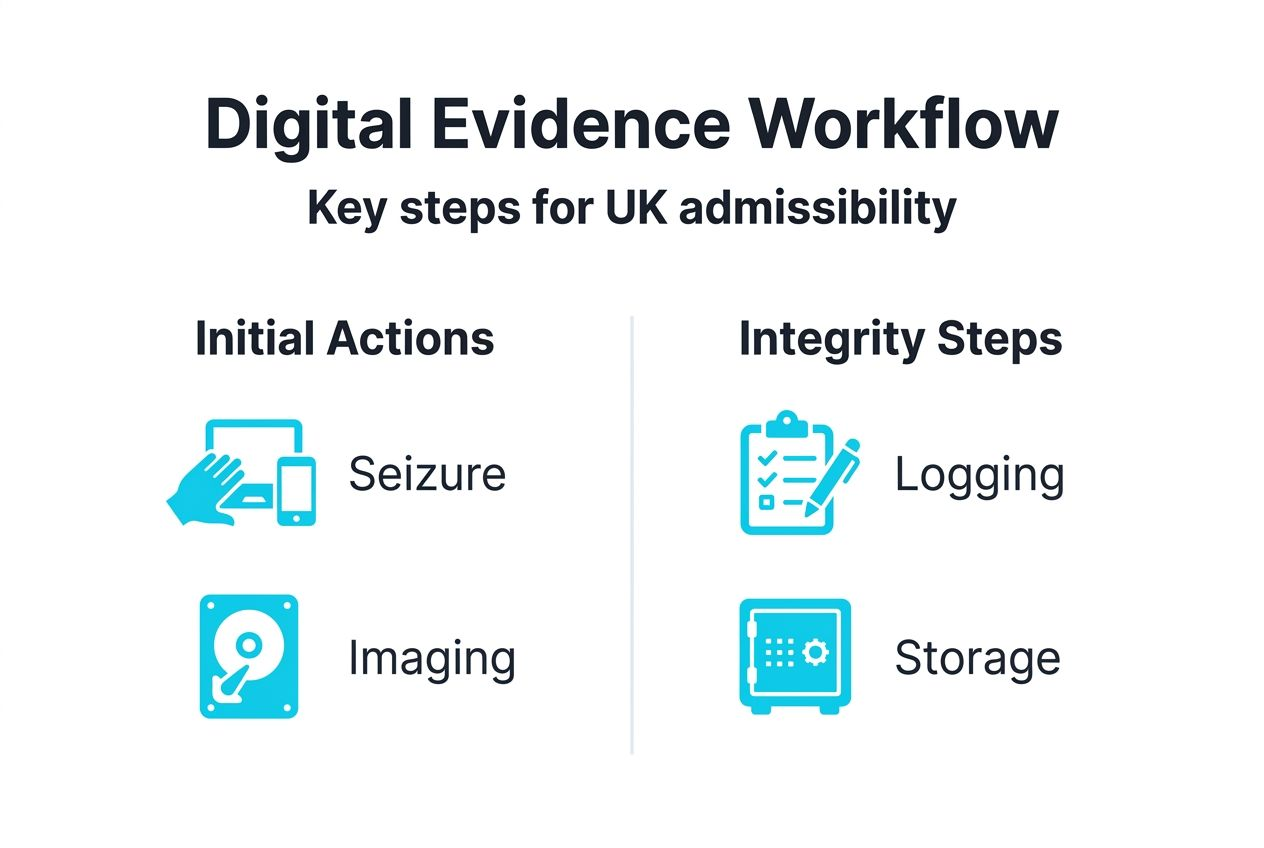
Conducting digital forensic investigations requires systematic workflows that preserve evidence integrity whilst meeting legal standards. The following sequential steps form the foundation of professional forensic practice:
-
Identification: Determine which devices and data sources contain relevant evidence. This includes computers, mobiles, cloud accounts, and network logs. Document the location, condition, and ownership of each device before proceeding.
-
Preservation: Secure devices to prevent data modification or destruction. Power down computers properly to preserve volatile memory if necessary. Use anti static bags for storage and maintain environmental controls to prevent physical damage.
-
Collection (imaging): Create forensic images using write blockers that prevent any write commands to the original device. Verify image integrity through cryptographic hashing (MD5 or SHA-256) to prove the copy matches the original exactly. This process ensures the original evidence remains pristine for potential re examination.
-
Analysis: Examine the forensic image using accredited software to uncover relevant data. This includes recovering deleted files, analysing metadata, reviewing browser histories, examining application data, and reconstructing timelines. Document all findings with screenshots and detailed notes.
-
Reporting: Prepare comprehensive reports that explain technical findings in clear language suitable for legal audiences. Include methodologies, tools used, evidence discovered, and expert opinions. Reports must withstand cross examination and support case strategies.
Write blockers are hardware or software tools that permit read only access to storage devices. They prevent accidental writes that could alter timestamps, file structures, or metadata. Using write blockers is non negotiable in professional forensic practice, as any modification can compromise evidence admissibility.
Pro tip: Perform forensic imaging immediately upon device seizure. Delays increase the risk of data overwriting, especially on devices with active background processes or remote wipe capabilities. Prompt imaging captures the most complete evidence snapshot possible.
Detailed chain of custody documentation must accompany every workflow stage. Record who performed each action, when it occurred, what tools were used, and what results were obtained. This documentation proves evidence integrity and defeats challenges based on alleged tampering or mishandling.
The step by step digital evidence collection guide provides granular instructions for each workflow phase. For broader context, review the complete computer forensics workflow resource, which covers planning, execution, and quality assurance throughout investigations.
Chain of custody and documentation standards
Chain of custody refers to the chronological documentation of evidence handling from collection through court presentation. It proves that evidence has been continuously controlled, accounted for, and protected from alteration or contamination. UK courts scrutinise chain of custody rigorously, as any weakness can result in evidence exclusion or reduced weight.
Essential chain of custody components include:
- Detailed descriptions of evidence items (device type, serial numbers, physical condition)
- Dates and times of collection, transfers, storage, and analysis
- Names and signatures of every person who handled or accessed the evidence
- Locations where evidence was stored at each stage
- Purpose of each evidence access (imaging, analysis, court presentation)
- Security measures employed (locked storage, access logs, environmental controls)
Accurate, timestamped logs are mandatory. Even brief gaps in documentation invite defence arguments that evidence may have been tampered with during unaccounted periods. Courts expect continuous accountability, meaning every moment of evidence existence must be documented and explained.

Chain of custody errors can devastate cases. Defence lawyers routinely challenge digital evidence by highlighting documentation gaps, unexplained transfers, or periods when evidence was unsecured. Successfully proving a broken chain of custody can result in evidence suppression, leaving prosecutors or plaintiffs without critical proof.
Best documentation practices:
- Use standardised evidence forms that capture all required chain of custody information
- Implement digital logging systems that automatically timestamp and record evidence access
- Photograph evidence at collection and after each significant handling event
- Store evidence in tamper evident packaging with unique identifiers
- Maintain redundant backup documentation in case primary records are lost or damaged
- Train all personnel on proper evidence handling and documentation protocols
The impact on admissibility is straightforward: impeccable chain of custody documentation strengthens evidence credibility, whilst gaps weaken it. Judges assess whether evidence reliability has been compromised by handling deficiencies. Even technically sound forensic findings can be excluded if chain of custody fails to meet judicial standards.
For practical guidance, consult preserving chain of custody digital evidence, which details protocols that satisfy UK court requirements and protect evidence integrity throughout investigations.
Common errors and mitigation strategies
Even experienced investigators make mistakes that jeopardise digital evidence. Recognising these pitfalls and implementing preventive measures is essential for maintaining evidentiary integrity and court acceptance.
Common errors include:
- Contamination: Accessing devices without write blockers modifies timestamps and file structures, rendering evidence unreliable.
- Mishandling devices: Improper shutdown procedures, exposure to magnetic fields, or physical damage can corrupt or destroy data.
- Delayed imaging: Postponing forensic imaging allows ongoing device activity to overwrite recoverable evidence.
- Inadequate documentation: Missing chain of custody records, vague descriptions, or undocumented procedures invite defence challenges.
- Improper storage: Unsecured evidence environments risk tampering, theft, or environmental damage.
Each error poses serious risks. Contamination creates doubt about evidence authenticity, giving defence lawyers grounds to argue data was altered after collection. Mishandling can result in permanent data loss, eliminating crucial evidence entirely. Delayed imaging reduces the volume and quality of recoverable data, as operating systems continuously overwrite deleted files. Inadequate documentation breaks chain of custody, potentially excluding evidence regardless of its substantive value.
Mitigation strategies:
- Use write blockers: Always employ hardware or software write blockers during evidence acquisition to prevent any modifications.
- Document meticulously: Record every action, no matter how minor, with timestamps, personnel names, and detailed descriptions.
- Prioritise timely imaging: Image devices immediately upon seizure, before any further activity occurs.
- Train personnel continuously: Ensure all legal and corporate staff involved in evidence handling understand forensic protocols and legal requirements.
- Employ proper storage: Use locked, climate controlled facilities with access logs and tamper evident packaging.
- Understand forensic limits: Recognise that data recovery has constraints. Overwritten data may be unrecoverable, encrypted data requires decryption keys, and physical damage can prevent access.
Pro tip: Continuous training for all personnel involved in digital investigations is critical. Forensic techniques, legal standards, and technology evolve rapidly. Regular training ensures teams remain current with best practices, reducing the likelihood of errors that compromise evidence.
Understanding forensic limits helps set realistic expectations. Not all data is recoverable, and attempting to exceed technical capabilities can waste resources or damage evidence. Honest assessments of what forensic analysis can and cannot achieve preserve credibility and guide strategic decision making.
Comparison of digital forensic tools and their legal suitability
Selecting appropriate forensic tools is crucial for UK investigations. Tools must meet accreditation standards, handle diverse data types, and produce court admissible results. UKAS and ISO/IEC 17025 accreditation indicate that tools have been independently validated for accuracy, reliability, and scientific rigour.
Three major forensic platforms dominate UK practice: Forensic Toolkit (FTK), EnCase, and X-Ways Forensics. Each offers distinct capabilities, making tool selection dependent on investigation requirements, budgets, and technical expertise.
| Tool | UKAS/ISO Accreditation | Local Data Handling | Cloud Data Handling | Usability | Cost |
|---|---|---|---|---|---|
| FTK | Yes | Excellent | Good | Moderate | High |
| EnCase | Yes | Excellent | Excellent | Moderate | High |
| X-Ways Forensics | Yes | Excellent | Moderate | Advanced | Low |
FTK (Forensic Toolkit): Widely used in law enforcement and corporate investigations. FTK excels at processing large data volumes quickly and offers robust email analysis, registry examination, and file carving. Its visualisation features help investigators understand complex data relationships. FTK’s accreditation and established case law history make it highly suitable for UK courts.
EnCase: The gold standard for comprehensive forensic investigations. EnCase handles both local and cloud based data exceptionally well, supporting investigations involving cloud storage services, webmail, and SaaS applications. Its scripting capabilities enable custom workflows for unique investigation needs. EnCase’s strong cloud data handling makes it ideal for cases involving modern digital environments.
X-Ways Forensics: A cost effective option favoured by smaller firms and corporate clients. Despite its lower price, X-Ways maintains UKAS accreditation and delivers powerful analysis capabilities. It requires more technical expertise than FTK or EnCase but offers excellent value for organisations with skilled forensic staff. X-Ways is particularly suitable for corporate investigations where budget constraints exist.
Tool selection should align with investigation needs. Cases involving extensive cloud data benefit from EnCase’s capabilities. Budget conscious corporate clients may prefer X-Ways. Law enforcement agencies often standardise on FTK for its proven track record and comprehensive feature set.
All three tools produce court admissible evidence when used properly. The key is ensuring operators are trained, methodologies are documented, and results are reproducible. Courts care more about proper application of accredited tools than which specific platform was used.
For corporate contexts, understanding corporate forensics investigations UK requirements helps match tools to organisational needs and ensures compliance with internal policies and external regulations.
Roles of expert witnesses in digital forensics
Expert witnesses bridge the gap between complex technical evidence and legal decision makers. Their testimony clarifies digital forensic findings, explains methodologies, and helps judges and juries understand evidence significance. In UK courts, expert witnesses must meet strict qualification and professional standards to testify.
Qualification requirements include relevant academic credentials, professional certifications (such as IACIS, EnCE, or GIAC), and substantial practical experience conducting digital forensic investigations. Courts assess whether experts possess specialised knowledge beyond layperson understanding and whether their testimony will assist in resolving factual disputes.
Professional standards demand objectivity and impartiality. Expert witnesses serve the court, not the party retaining them. They must present balanced opinions based on evidence, acknowledge limitations of their findings, and withstand rigorous cross examination. Biased or advocacy driven testimony damages credibility and can result in expert disqualification.
Expert testimony supports evidence admissibility by explaining how digital evidence was collected, preserved, and analysed. Experts demonstrate that proper forensic protocols were followed, that tools used are scientifically validated, and that findings are reliable. This testimony satisfies judicial requirements for authenticity and reliability.
Contributions in investigations and trials include:
- Advising legal teams on digital evidence potential and limitations during case planning
- Conducting forensic examinations and producing detailed technical reports
- Translating complex technical concepts into clear, accessible language for court audiences
- Responding to cross examination questions about methodologies, tools, and conclusions
- Rebutting opposing expert opinions when technical disagreements arise
Key qualities of effective digital forensic experts:
- Deep technical knowledge across multiple forensic disciplines and technologies
- Excellent communication skills to explain findings clearly without jargon
- Unimpeachable integrity and commitment to objective, evidence based analysis
- Practical courtroom experience and composure under cross examination pressure
- Current awareness of evolving forensic techniques, tools, and legal standards
Experts clarify complex technical findings by using analogies, visual aids, and step by step explanations. For instance, explaining data recovery might involve comparing deleted files to recycled paper that remains recoverable until new content overwrites it. These simplified explanations help non technical audiences grasp evidence significance without requiring deep technical expertise.
The expert witness digital forensics role resource provides comprehensive insights into how forensic specialists support litigation and strengthen case outcomes through credible, authoritative testimony.
Cybersecurity overlap with digital forensics in corporate contexts
Forensic methods play a vital role in corporate cybersecurity by detecting insider threats, investigating data breaches, and protecting intellectual property. Whilst cybersecurity focuses on prevention, digital forensics provides the investigative capacity to understand security incidents after they occur and support legal or disciplinary actions.
Forensic investigations uncover insider threats by analysing employee activity logs, email communications, file access patterns, and data transfers. These examinations reveal unauthorised access, data exfiltration, policy violations, or malicious activities that security monitoring alone may miss. Forensic evidence can support employment tribunals, criminal prosecutions, or civil litigation related to insider misconduct.
Data breach investigations require coordination between IT security teams and forensic specialists. Security teams identify and contain breaches, whilst forensic examiners determine breach scope, identify perpetrators, recover compromised data, and establish timelines. This collaboration ensures comprehensive incident response that satisfies regulatory reporting requirements and supports potential legal actions.
Forensic techniques relevant to corporate investigations:
- Log analysis to reconstruct user activities and identify anomalous behaviours
- Email forensics to uncover communications related to misconduct or data theft
- Network forensics to trace unauthorised access and data exfiltration paths
- Malware analysis to understand attack vectors and attacker capabilities
- Mobile device forensics to examine employee devices involved in policy violations
Intellectual property protection benefits significantly from forensic capabilities. When trade secrets are stolen or confidential information is leaked, forensic investigations identify the source, trace data movements, and provide evidence for legal remedies. This protection is crucial for maintaining competitive advantages and enforcing non disclosure agreements.
Forensic support for compliance and incident response includes documenting security incidents for regulatory authorities, supporting internal investigations, and providing evidence for audits. Many UK regulations require organisations to investigate and report data breaches promptly. Forensic specialists ensure these investigations meet legal standards and produce defensible documentation.
Corporate clients should integrate forensic readiness into cybersecurity strategies. This includes maintaining logs suitable for forensic analysis, establishing incident response protocols that preserve evidence, and retaining forensic specialists who can respond rapidly to security incidents.
For detailed guidance, review corporate forensics investigations UK, which explains how forensic services support corporate security, compliance, and risk management. Additionally, understanding the corporate cybersecurity connection helps organisations build comprehensive security and forensic programmes.
Explore professional computer forensics services
Applying the principles outlined in this guide requires expertise, accredited tools, and meticulous attention to legal requirements. Computer Forensics Lab provides comprehensive digital forensics services tailored for UK legal professionals and corporate clients. Our specialists handle evidence collection, forensic analysis, and expert witness testimony, ensuring your investigations meet the highest standards of integrity and admissibility.
Whether you need support with criminal defence, civil litigation, employment disputes, or corporate security incidents, our team delivers reliable, court ready results. We follow rigorous step by step digital evidence collection protocols that preserve evidence and satisfy judicial scrutiny. Our accredited tools and experienced examiners provide the technical depth and legal credibility your cases demand.
Expert witnesses from Computer Forensics Lab bring extensive courtroom experience and technical authority. Learn more about the expert witness digital forensics role and how our specialists support litigation success through clear, credible testimony that withstands cross examination and strengthens case outcomes.
Frequently asked questions
What is computer forensics and why is it important?
Computer forensics is the science of collecting and analysing digital evidence to support legal and corporate investigations whilst ensuring its integrity and admissibility. It is important because digital evidence can resolve cases and support legal decisions when handled properly.
How does the legal framework in the UK affect digital forensic investigations?
UK laws like PACE 1984 set strict rules on evidence admissibility and handling. Compliance with these laws ensures digital evidence is legally valid in court.
What are common mistakes during computer forensic investigations?
Common mistakes include poor chain of custody, delayed imaging, and contamination. These mistakes risk evidence exclusion or reduction in credibility in UK courts.
How can legal professionals ensure evidence integrity throughout an investigation?
Maintain detailed, timestamped records of evidence transfers and handling. Use digital and physical safeguards like write blockers and controlled storage environments.
Why is the choice of forensic tools critical in UK investigations?
Only UKAS and ISO/IEC 17025 accredited tools meet strict evidentiary standards. Selecting proper tools ensures data integrity and legal acceptance of evidence.
Recommended
- Step by Step Digital Evidence Collection Guide
- Complete Guide to Computer Forensics Workflow
- Digital vs Physical Evidence UK 2026: 30% Mishandling Risk
- How to Conduct Digital Forensics: Step-by-Step Guide
- Perché Prevenire Gli Incidenti Informatici: Guida Completa – Security Hub