

Working with digital evidence in a British courtroom demands more than technical skill; it requires a precise grasp of legal compliance and evidence integrity at every stage. Failing to uphold these standards can mean evidence is excluded entirely, regardless of its technical validity. For digital forensics analysts and criminal lawyers in London, understanding how collection, review, disclosure, and presentation fit within the UK legal framework is crucial for securing admissible outcomes.
Table of Contents
- Defining Legal Aspects Of Digital Forensics
- Key UK Laws And Regulatory Frameworks
- Types Of Digital Evidence And Admissibility
- Chain Of Custody And Validation Procedures
- Privacy, Data Protection And Human Rights
- Investigator Responsibilities And Common Pitfalls
Key Takeaways
| Point | Details |
|---|---|
| Legal Framework Importance | Understanding the legal aspects of digital forensics is essential to ensure evidence is collected, handled, and presented correctly in court proceedings. |
| Evidence Admissibility Standards | Digital evidence must meet strict criteria of relevance, authenticity, and lawful acquisition to be considered admissible in court. |
| Chain of Custody Documentation | Maintaining an accurate chain of custody is critical to protect against claims of evidence tampering or mishandling. |
| Privacy Compliance | Investigators must navigate privacy regulations and data protection laws meticulously to avoid violations during digital evidence examination. |
Defining Legal Aspects of Digital Forensics
When you’re working with digital evidence in a UK courtroom, understanding what constitutes the “legal aspects” of digital forensics is non-negotiable. These aspects extend far beyond simply extracting data from a device. The legal framework encompasses collection, review, disclosure, and presentation of digital evidence within court proceedings. Each stage carries distinct legal obligations, and missing a single requirement can compromise your entire case.
The scope of legal considerations in digital forensics covers several critical dimensions. First, there’s the matter of evidence integrity, which demands that you maintain an unbroken chain of custody from the moment you seize a device through to its presentation in court. Second, you must navigate privacy regulations—a pervasive concern that threads through collection, examination, and disclosure stages. Third comes legislative compliance, particularly with statutes like the Regulation of Investigatory Powers Act 2000 and the Data Retention and Investigatory Powers Act 2014, which establish the parameters for lawfully obtaining and using digital evidence. The range of devices involved in investigations—from smartphones and laptops to cloud storage systems—means you’re dealing with multiple legal regimes simultaneously. What applies to accessing a mobile phone’s encrypted contents differs substantially from accessing cloud data or extracting metadata from email servers.
Beyond these foundational elements, digital forensics in a legal context requires you to interpret both generic laws and specific statutes as they apply to digital evidence. Criminal law, data protection legislation, and procedural rules all intersect. When evidence is obtained, analysed, and eventually used in criminal proceedings, every decision you make must withstand judicial scrutiny. This includes understanding what makes evidence admissible, how to document your methodology so it can be challenged and defended, and recognising when technological barriers—like encryption—create legal questions that transcend simple technical solutions. For criminal lawyers in London particularly, this means building relationships with forensic practitioners who grasp not just the technical mechanics of devices but the legal architecture that governs how their findings can be used.
Pro tip: Document every step of your forensic examination with explicit reference to the legal authority justifying that step—whether it’s a warrant, statutory power, or consent. This transforms your technical report into a legally defensible document that stands up to cross examination.
Key UK Laws and Regulatory Frameworks
The legal scaffold supporting digital forensics in the UK rests on several pillars, and understanding which laws apply to your investigation is critical. The Police, Crime, Sentencing and Courts Act 2022 stands as one of the primary pieces of legislation governing how digital evidence must be handled. Alongside this, the Regulation of Investigatory Powers Act 2000 and the Data Retention and Investigatory Powers Act 2014 create boundaries around what investigators can access and how. These statutes regulate the identification, seizure, extraction, analysis, and presentation of evidence, whilst simultaneously protecting privacy rights and ensuring human rights compliance. For criminal lawyers and forensic practitioners in London, knowing which statute applies to your specific investigation can mean the difference between admissible evidence and inadmissible material thrown out by the court.
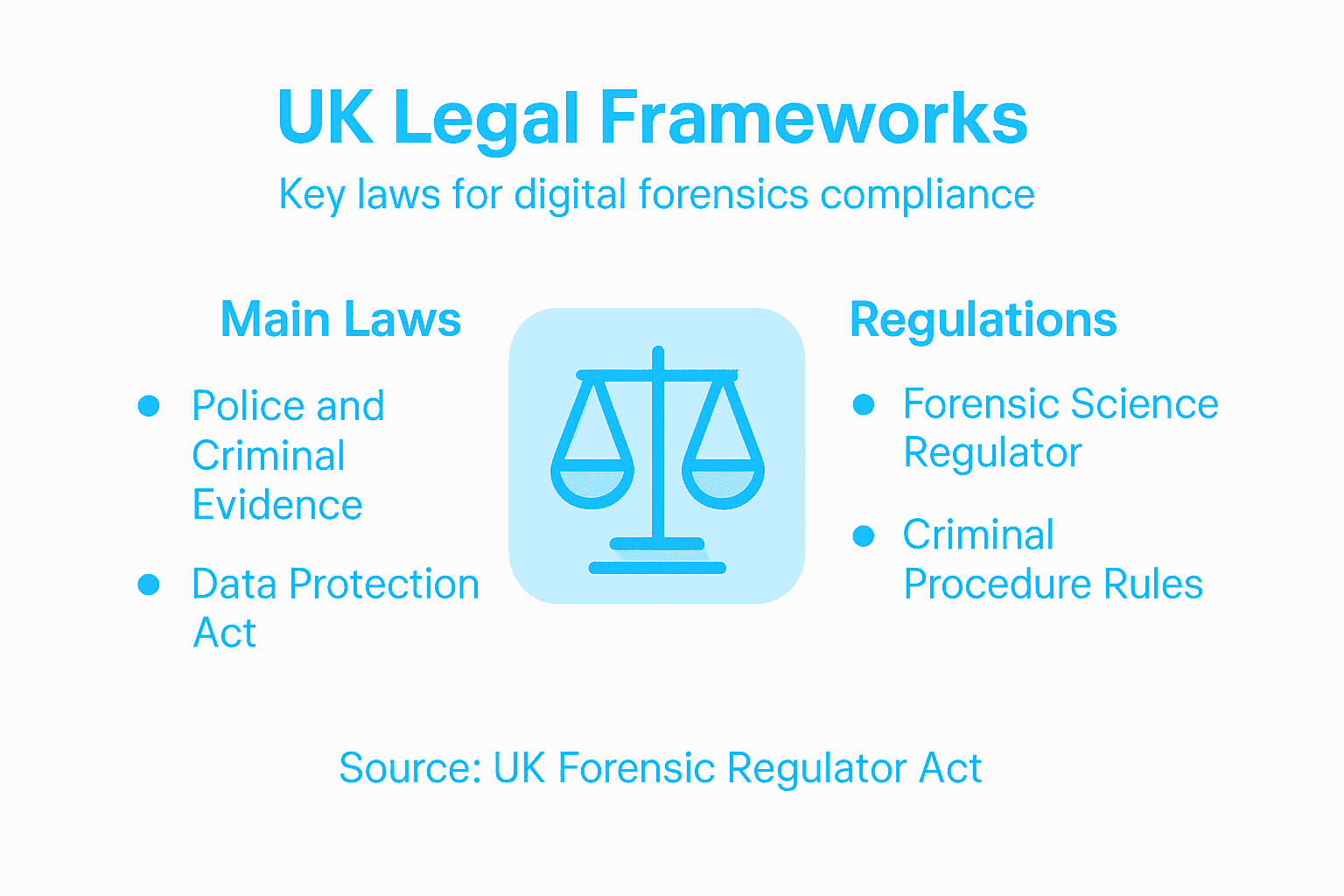

Beyond statutory law, quality standards themselves carry legal weight. The Forensic Science Regulator Act 2021 mandates compliance with a statutory code of practice for forensic science activities in England and Wales. This code sets specific quality requirements that your digital forensic work must meet. It is not optional guidance. The code addresses accuracy, reliability, and compliance with criminal justice laws, and it applies directly to how you conduct examinations, document your methods, and present your findings. If your forensic processes fall outside these standards, courts can exclude your evidence entirely, regardless of how technically accurate your conclusions might be.
When working with digital evidence specifically, you must also consider data protection legislation, particularly the UK General Data Protection Regulation and the Data Protection Act 2018. These laws create tension with investigative powers because they establish individual rights over personal data even whilst law enforcement operates within statutory authority to access that data. Courts expect you to have navigated this tension thoughtfully. Your seizure of a mobile phone might be lawful under RIPA 2000, but the extraction and analysis of that phone’s contents must also respect data protection principles. This means understanding what data falls within scope, ensuring proportionality in your examination, and documenting your reasoning. The intersection of investigatory powers with privacy laws is where many digital forensic cases stumble.
The procedural requirements are equally important. The Criminal Procedure Rules and associated guidance demand that digital evidence be disclosed properly, handled transparently, and made available for challenge. This is not merely about technical competence. You must maintain an auditable trail showing exactly what was examined, when it was examined, who examined it, and what was found. Courts now expect practitioners to have understood digital forensic investigations thoroughly before they step into the witness box. Your compliance with legal frameworks is not something you can retrofit after analysis completes. It must be embedded in your methodology from the first moment you power on a device.
Here is a summary of key UK statutes and their relevance to digital forensics:
| Legislation | Main Purpose | Key Impact on Forensics |
|---|---|---|
| Police, Crime, Sentencing and Courts Act 2022 | Governs evidence handling | Sets procedures for lawful seizure |
| Regulation of Investigatory Powers Act 2000 | Authorises intercepting communications | Defines lawful scope for digital data search |
| Data Protection Act 2018 & UK GDPR | Protects personal data rights | Controls use and disclosure of digital evidence |
| Forensic Science Regulator Act 2021 | Mandates forensic quality practices | Requires compliance with forensic standards |
Pro tip: Before you begin any forensic examination, create a written record identifying which specific legal authority justifies each stage of your investigation (warrant, statutory power, consent), then reference this document throughout your examination notes to demonstrate continuous legal compliance.
Types of Digital Evidence and Admissibility
Digital evidence comes in many forms, and not all of it carries equal weight in court. You might recover emails, photographs, metadata, chat messages, banking records, location data, or deleted files from a hard drive. Each type presents different challenges for admissibility. An email appears straightforward until opposing counsel questions whether you can prove who actually sent it or that it hasn’t been altered. A photograph from a mobile phone seems like straightforward proof until someone challenges the device’s timestamp settings. Metadata can reveal when a document was created or modified, but only if you can demonstrate the reliability of the systems that generated it. The type of evidence matters because courts apply different scrutiny depending on what you’re presenting. A confession in a text message, for instance, carries different evidentiary weight than a deleted file you’ve recovered from unallocated disk space.
For digital evidence to be admissible, it must meet strict legal standards. First comes relevance, which means the evidence must directly relate to the facts in dispute. Second is authenticity, which requires you to prove the evidence is genuinely what you claim it is and hasn’t been tampered with or corrupted. Third is lawful acquisition, meaning you obtained it through proper legal authority without breaching privacy rights or investigatory powers. Meeting these standards requires validated forensic tools and scientific methods documented through clear protocols. You cannot rely on experimental tools or untested methodologies. Courts in London and across England have become increasingly sophisticated about challenging the validity of forensic techniques. If you’re using a tool that lacks peer review or industry acceptance, expect the defence to challenge it vigorously. Your chain of custody documentation becomes critical here. It demonstrates that the evidence remained under your control from seizure through analysis and presentation, protecting it against allegations of tampering or contamination.
Another layer affecting admissibility involves the nature of the data itself. Recovered data from deleted files or damaged devices raises questions about integrity because you’re working with fragments or reconstructed information. Metadata can be manipulated on some systems, so you must be prepared to explain why you trust it. Encrypted data presents particular challenges because you may be unable to decrypt it lawfully, which then affects what conclusions you can reasonably draw. Cloud data introduces additional complexity because it often resides outside the UK, raising jurisdictional and privacy issues. When presenting evidence, you need to address not just what you found but why that evidence is reliable. Courts want to understand your methodology, your tools, your training, and your ability to defend your findings under cross-examination. This is where thorough documentation throughout your examination becomes non-negotiable. The burden falls on you to establish that your digital evidence is trustworthy.
The table below compares common types of digital evidence encountered and particular admissibility challenges:
| Evidence Type | Unique Challenge | Court Scrutiny Focus |
|---|---|---|
| Emails | Proving sender identity | Authenticity and source reliability |
| Photographs | Validating timestamp accuracy | Device settings and alteration risk |
| Metadata | Potential for manipulation | System reliability and verification |
| Cloud-stored files | Jurisdictional issues | Privacy and international access laws |
| Deleted data | Integrity of reconstruction | Chain of custody for recovered data |
Pro tip: Create a detailed “evidence admissibility checklist” before you begin examination, addressing relevance, authenticity, lawful acquisition, and chain of custody for each data type you anticipate recovering; use this checklist to guide your documentation and ensure no admissibility gaps emerge later.
Chain of Custody and Validation Procedures
Chain of custody is not paperwork. It is your legal defence against anyone suggesting that evidence has been tampered with, contaminated, or mishandled. From the moment you seize a device, every person who touches it, every location it occupies, and every examination performed on it must be meticulously documented. This documentation serves a single purpose: to prove to a court that the evidence you present is identical to the evidence you recovered. In digital forensics, where invisible alterations are theoretically possible, chain of custody documentation becomes your most powerful tool. When defence counsel cross-examines you about whether the evidence might have been modified, you need records showing exactly who had access, when they had access, and what they did. Without this, even technically flawless forensic work can be excluded from court.

Practical chain of custody procedures require you to record specific details at each handover point. The person handing over evidence must document their name, role, date, time, and reason for transfer. The recipient must sign and acknowledge receipt, including the condition of the evidence and any seals or integrity checks used. For digital devices, this means photographing the device before examination, noting its condition, serial numbers, and any visible damage. Create a sealed forensic image before analysis begins, and document the hash values of that image. If you use write-blockers or forensic tools, record their version numbers and validation status. Any interruption in this chain requires explanation. If a device sits in an evidence locker for three months between seizure and examination, document that storage period. If multiple analysts examine the same evidence, each must have their own entry in the chain. The objective is to create a continuous record that leaves no gaps for reasonable doubt.
Validation procedures work alongside chain of custody to establish the reliability of your methods. Forensic methods must be robustly validated and verified to ensure reproducibility and support court confidence in evidence. This means before you use any forensic tool on casework, you need documented evidence that the tool works reliably. Have you tested it on known data? Can you reproduce results consistently? Has the tool been peer-reviewed or independently verified? The UK Forensic Science Regulator requires risk assessments and validation stages before deployment. You cannot simply assume a commercial tool works correctly. Courts expect you to have validated your methodology. This includes understanding the tool’s limitations, knowing when it might produce false positives or false negatives, and being able to articulate why you trust the results. Documentation of validation is not optional. It is a legal requirement under the statutory code of practice.
When presenting digital evidence in court, every step from collection to presentation must demonstrate that evidence remains untampered. Your examination notes should read like a narrative that anyone could follow. What device did you examine? What was its condition? What tools did you use? What settings did you apply? What did you find? What did you not find? Courts want to understand your methodology so thoroughly that they can assess whether your conclusions are justified. If you made any assumptions, state them explicitly. If you encountered technical obstacles, explain how you addressed them. The goal is to remove any ambiguity about what you did and why you did it.
Pro tip: Implement a standardised chain of custody template for every case, including sections for device condition photography, hash value verification, tool validation confirmation, and signed handover at each stage; this consistency demonstrates professional practice and strengthens admissibility.
Privacy, Data Protection and Human Rights
Privacy is not a side issue in digital forensics. It is woven through every stage of your investigation, from the moment you decide to examine a device through to presenting evidence in court. When you seize a smartphone, you are potentially accessing intimate communications, financial information, location history, and medical data. The General Data Protection Regulation (GDPR) and the Data Protection Act 2018 protect this information, even when law enforcement has legitimate investigative reasons to access it. This creates a genuine tension. You have statutory authority under the Regulation of Investigatory Powers Act 2000 to access certain data, yet data protection law simultaneously imposes obligations on how you handle, store, and use that data. Courts expect you to have navigated this tension thoughtfully, not simply seized everything and sorted it out later.
When examining digital evidence, you must apply the principle of proportionality. This means your examination scope should match the seriousness of the investigation and the specific legal authority you hold. If you have a warrant to examine a device in relation to fraud allegations, you cannot justify examining every photograph, message, and browsing history simply because the data exists. You must focus on evidence reasonably related to the suspected offence. Compliance with GDPR and incorporation of human rights considerations requires this restraint. This is not just legally necessary; it is good practice. When you limit your examination to what is proportionate, you reduce the risk of disclosing irrelevant personal information that could prejudice the suspect or violate third parties’ privacy rights. A defendant’s private medical data or intimate communications unrelated to the investigation should not become court evidence simply because it was on their phone. Your methodology must demonstrate that you have considered privacy implications and acted accordingly.
Another practical challenge involves third-party data. Mobile phones and computers often contain information belonging to people other than the suspect. Messages from friends, family photographs shared with partners, contact lists, financial records of people who use the same device. You cannot simply disclose all this data to the prosecution without considering the privacy rights of those third parties. Courts have excluded digital evidence when investigators failed to redact irrelevant personal information or when examination methodologies were insufficiently targeted. This is where privacy-enhancing technologies and careful examination planning become operationally significant. Before you begin examination, consider what data types you genuinely need to access. Can you search for specific keywords instead of reviewing all messages? Can you use filtering to exclude personal communications unrelated to the investigation? Can you examine data in a manner that protects third-party privacy?
Human rights considerations add another layer. The right to private and family life, guaranteed under Article 8 of the European Convention on Human Rights and incorporated into UK law, means any interference with privacy must be lawful, necessary, and proportionate. Courts will scrutinise whether your investigative methods struck the right balance. If you recovered data through means that were technically lawful but grossly disproportionate to the offence being investigated, a court might exclude the evidence despite its relevance. This is particularly significant in cases involving minor offences, where extensive digital examination might be judged as excessive. Your documentation throughout the investigation should reflect that you considered privacy and human rights implications, not simply that you had the legal authority to act.
Pro tip: Before beginning any digital forensic examination, document your examination plan specifying which data types you will access, why they are necessary, how you will limit the scope, and how you will protect third-party privacy; present this plan to the prosecution early so proportionality concerns can be addressed proactively rather than raised later in court.
Investigator Responsibilities and Common Pitfalls
Your responsibility as a digital forensic investigator extends beyond technical competence. You are the guardian of evidence integrity, the custodian of legal compliance, and ultimately the person whose work will be scrutinised in court. This means your obligations begin long before you open a forensic toolkit and continue well after analysis completes. You must understand not just how to extract data, but why the law permits or restricts that extraction. You must document not just what you found, but why you searched in that manner. You must recognise when you lack expertise to examine certain evidence types and be honest about those limitations rather than proceeding regardless. The stakes are extraordinarily high. A mishandled examination can result in guilty verdicts being overturned, investigations collapsing, and innocent people experiencing years of legal proceedings that should never have progressed.
Common pitfalls cluster around several predictable areas. First comes inadequate examination planning. Investigators sometimes begin examining devices without clearly defining what they are searching for, leading to unfocused, expansive examinations that breach privacy principles and create disclosure nightmares. You seize a phone and examine everything, rather than targeting specific data types relevant to the investigation. Second is poor documentation. Notes that are vague, incomplete, or created after the fact rather than contemporaneously are extremely vulnerable to challenge. A defence solicitor will scrutinise your examination records relentlessly, looking for gaps, inconsistencies, or signs that you deviated from proper procedure. Third involves tool misuse or misunderstanding. Using forensic software without understanding its limitations, assumptions, or known issues can produce misleading results. A tool might report a particular file as deleted when it is actually archived, or might misinterpret timestamps due to device settings. Common pitfalls such as backlogs, evidentiary mistakes, and lack of digital forensic literacy risk miscarriages of justice. These are not theoretical concerns. They are documented failures from real investigations that have undermined prosecutions and harmed the credibility of digital forensic evidence generally.
A fourth pitfall involves scope creep and disproportionality. You begin examining a phone for fraud evidence and discover material relating to an unrelated offence. The temptation to expand your examination to capture all potentially relevant evidence is understandable but legally dangerous. Your authority to examine the device is limited to the scope of the warrant or statutory power you hold. Expanding beyond that scope breaches privacy principles and can render evidence inadmissible. Similarly, you might examine a device proportionately for serious offences but then realise the scope was excessive for what the investigation ultimately concerns. Fifth comes failure to seek specialist advice. Digital forensics encompasses vastly different device types, operating systems, cloud services, and encryption methods. No single investigator can be expert in everything. If you encounter encrypted messaging applications, specialised financial software, or unfamiliar device types, recognise those limitations and consult specialists rather than attempting examination beyond your competence.
Finally, many investigators underestimate the importance of proactive communication with legal teams. Before beginning examination, brief the prosecution on your examination plan, the legal bases for your actions, and any proportionality concerns. Flag issues early rather than discovering problems when disclosure happens or when the defence challenges your evidence at trial. If you encounter third-party data, redacted material, or encrypted content you cannot access, document these limitations clearly and communicate them openly. This transparency builds credibility and prevents ambushes in court.
Pro tip: Create a pre-examination checklist covering legal authority confirmation, examination scope definition, proportionality assessment, third-party data considerations, tool validation verification, and disclosure planning; complete this checklist before powering on any device to prevent the pitfalls that derail cases.
Ensure Legal Compliance with Expert Digital Forensics Support
Navigating the complex legal landscape of UK digital forensics demands precision in maintaining evidence integrity, privacy protection, and statutory compliance. If you face challenges like establishing admissibility, managing the chain of custody, or respecting data protection laws, understanding these crucial legal considerations is only the first step. Whether it is dealing with encrypted evidence or sensitive personal data, mistakes can risk your entire case.
Partner with experienced professionals from Digital Forensic Investigation at Computer Forensics Lab based in London. We specialise in comprehensive digital evidence collection and analysis fully aligned with UK compliance requirements. Our team ensures accurate documentation, validated forensic methodologies, and respect for privacy and legal scope to protect your investigation from costly pitfalls. Discover how we can help you build confident cases today at Computer Forensics Lab. For insights into forensic procedures and scrutiny, explore our Infographics to visualize the meticulous processes involved.
Take the next step now to safeguard your case by consulting with digital forensic experts who understand the law as well as the technology.
Frequently Asked Questions
What are the key legal standards for digital evidence to be admissible in court?
For digital evidence to be admissible, it must meet three primary legal standards: relevance (the evidence must relate directly to the facts in dispute), authenticity (the evidence must be proven to be what it claims to be), and lawful acquisition (the evidence must be obtained through proper legal authority, respecting privacy rights).
How can I ensure the integrity of digital evidence during an investigation?
To ensure the integrity of digital evidence, maintain an unbroken chain of custody throughout the entire process, document every handover of evidence, and create a sealed forensic image before analysis. Proper documentation includes recording who handled the evidence, when they did so, and any relevant conditions or seals applied.
What are the implications of GDPR and data protection laws in digital forensics?
GDPR and data protection laws impose obligations regarding how personal data is handled, even during criminal investigations. Investigators must ensure proportionality in their search and examination processes, limit the scope of their inquiries to what is necessary, and take care to protect the privacy rights of third parties whose data may be present in the digital evidence.
What common pitfalls should investigators avoid when handling digital evidence?
Investigators should avoid pitfalls such as inadequate examination planning, poor documentation practices, misuse of forensic tools, scope creep beyond the original mandate, and failing to seek specialist advice when necessary. It is crucial to communicate proactively with legal teams to identify potential issues early in the process.