
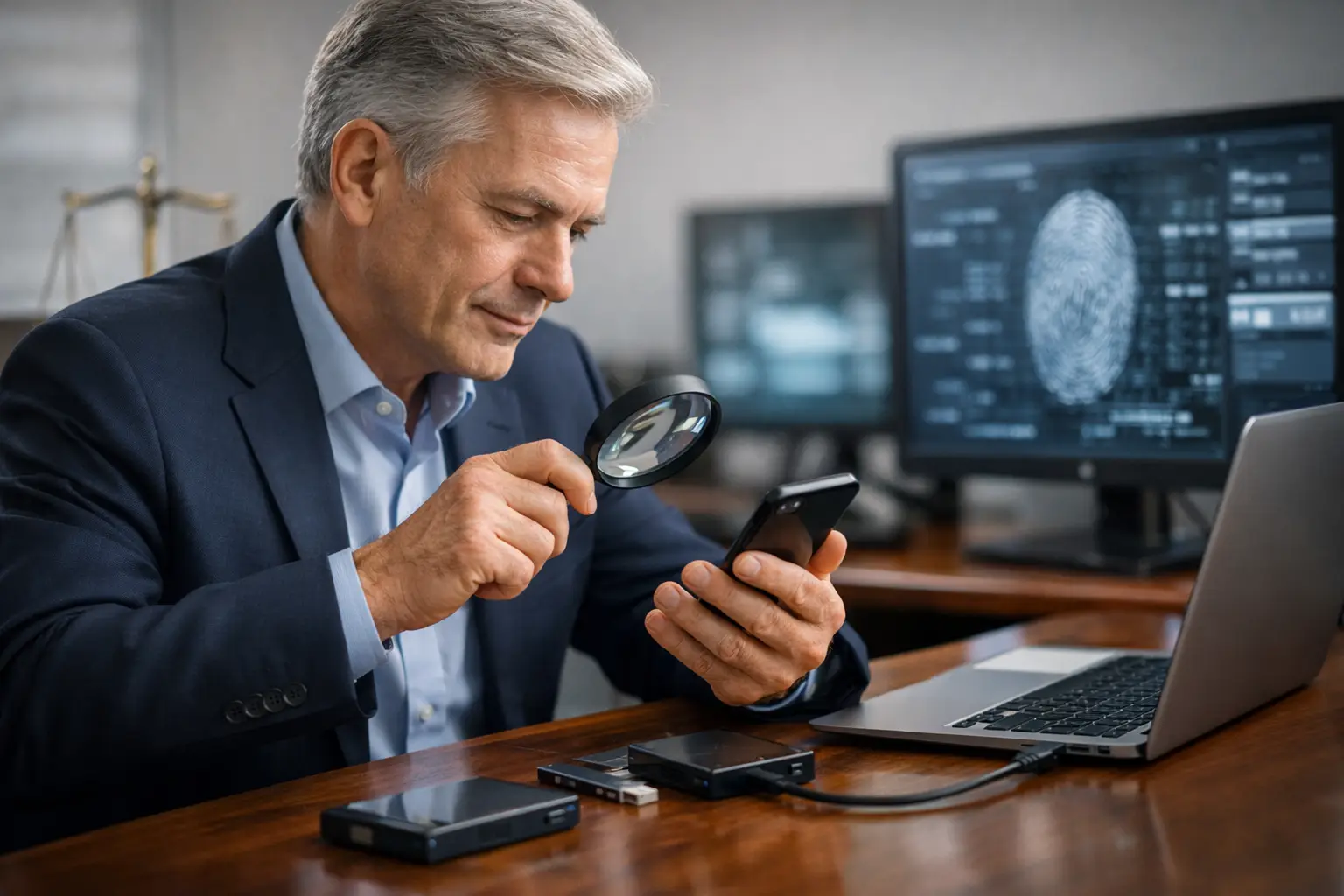
A disputed WhatsApp message, a deleted file, an alleged login, or a mobile phone said to contain decisive material can alter the direction of a case. Yet digital material only assists the court when its source, handling, interpretation and limitations can be clearly demonstrated. Expert witness services turn complex electronic data into independent, court-ready evidence that can be tested fairly by all parties.
For solicitors, businesses and private clients, the issue is rarely whether a device contains information. The issue is whether that information has been preserved lawfully, examined using defensible methods, and explained without speculation. A forensic expert’s role is to assist the court, not to advance a client’s preferred narrative.
What expert witness services involve
In digital forensics, expert witness services combine forensic examination, written reporting and, where required, oral evidence. The work may concern mobile phones, computers, tablets, removable media, cloud-linked accounts, CCTV systems, vehicle data or business platforms. The scope depends on the pleaded issues and the questions that genuinely require specialist opinion.
An expert may be instructed to recover deleted communications, establish when files were created or accessed, assess evidence of malware or unauthorised access, identify data exfiltration, or evaluate whether activity can reliably be attributed to a particular user. In family, civil and criminal matters, the expert may also need to distinguish between what the data proves, what it suggests, and what it cannot establish.
That distinction matters. A browser history entry may indicate that a webpage was accessed, but not necessarily that its contents were read. A device may contain a message, but that alone may not prove who sent it. A properly qualified expert makes such limitations explicit rather than allowing technical findings to be overstated.
Independence is not optional
A digital forensic expert owes an overriding duty to the court. That duty takes priority over the interests of the party paying for the instruction. Independence is therefore not a presentation style or a line added to a report. It must be evident in the method, language, records and conclusions.
This is particularly relevant where one party has already commissioned an internal IT review, collected screenshots, or drawn conclusions from incomplete device access. Those materials may be useful leads, but they are not automatically forensic evidence. Screenshots can omit surrounding context. Metadata can change when a file is copied. A device examined after informal handling may have lost data or acquired new activity.
An independent expert should identify these risks early. If the available evidence is insufficient to answer a question reliably, that should be stated. If an alternative explanation remains plausible, it should be considered. Such candour may narrow a party’s case in the short term, but it protects the credibility of the evidence when it comes under scrutiny.
The instruction should be precise
The best expert evidence begins with a focused instruction. Broad requests to “look for anything relevant” can increase cost, delay disclosure and create unnecessary disputes about proportionality. A clearer approach identifies the devices or accounts, relevant date range, issues in dispute and the specific questions the expert is asked to address.
For example, an employment dispute may require analysis of whether confidential documents were copied to personal storage before an employee’s departure. A criminal matter may concern the provenance and timing of messages recovered from a handset. A cyber incident may require an assessment of whether logs show external intrusion, misuse of credentials, or ordinary system behaviour.
The questions must still leave room for objective findings. An expert should not be asked to assume guilt, ownership, intent or authorship where the digital evidence cannot support that conclusion.
Preserving digital evidence before examination
Digital evidence is unusually vulnerable. A phone can receive new messages, a laptop can synchronise with cloud storage, and a compromised system can continue to overwrite logs. Even a well-meaning attempt to inspect a device can alter the material that later becomes important.
Preservation should therefore begin with controlled handling. The device’s condition should be recorded, access restricted, and a clear chain of custody maintained from collection through to examination. Where appropriate, forensic acquisition methods are used to create a verifiable copy while protecting the original evidence.
Chain of custody is more than an administrative formality. It records who had possession of an item, when it changed hands, what was done to it and why. If that record is incomplete, the other side may challenge whether the evidence has been altered, contaminated or confused with another source.
The correct approach will depend on the facts. A live server involved in a cyber incident may need urgent preservation of volatile data before it is powered down. A mobile phone may require steps to prevent remote alteration. Cloud-based evidence may demand rapid legal and technical action because retention periods can be limited. There is no single procedure that suits every matter, but delay generally reduces the available options.
From technical findings to a court-ready report
A forensic report must do more than list artefacts extracted from a device. It should allow a solicitor, barrister, judge or jury to understand what was examined, how the work was carried out, what was found and how firmly each conclusion can be drawn.
A defensible report normally explains the materials received, acquisition and examination methodology, relevant software or tools, validation steps, findings, interpretation and limitations. It should separate fact from opinion. It should also use plain language where possible, without sacrificing technical accuracy.
Peer review is valuable in significant or contentious matters. A second qualified examiner can test whether the method was appropriate, whether important alternative explanations have been considered and whether the report accurately reflects the underlying data. This is especially useful where the evidence is central to liability, liberty, reputation or a substantial financial claim.
Reports must also be prepared with disclosure in mind. The expert’s notes, working records and underlying material may become relevant to the proceedings. A disciplined forensic process ensures that conclusions remain traceable to the evidence rather than resting on unsupported assertion.
When oral expert evidence may be needed
Many disputes resolve before trial, and a clear report can help parties assess the strength of their positions. However, oral evidence may be necessary where technical findings are challenged, experts disagree, or the court requires clarification.
Giving evidence effectively is not about making technology sound more complicated than it is. It is about answering the question asked, explaining the evidential basis for an opinion and acknowledging the boundaries of expertise. Cross-examination commonly tests chain of custody, tool reliability, interpretation of artefacts, the possibility of third-party access and whether conclusions go further than the data permits.
Preparation should focus on the evidence and the report, not on rehearsing an outcome. An expert who can explain both favourable and unfavourable findings is more credible than one who appears to advocate for the instructing party.
Choosing a digital forensic expert
Credentials and specialist experience matter, but they are only part of the assessment. The right expert should have relevant experience of the device type, data source and legal context. A specialist in mobile phone extraction may not be the appropriate person to analyse enterprise network logs, just as a cyber incident responder may not be the best fit for a complex family-law messaging dispute.
Before instruction, consider whether the expert can preserve evidence promptly, work within the court timetable, provide transparent scope and costs, maintain an auditable chain of custody, and produce reports suitable for litigation. Ask how limitations, unavailable data and conflicting interpretations will be handled. These questions reveal whether the work is being approached as forensic evidence or merely as technical support.
Computer Forensics Lab provides independent digital forensic examinations, expert reporting and litigation support where electronic evidence must withstand challenge. Early instruction can be critical where devices, logs or cloud data remain at risk.
When digital evidence may influence the outcome of a dispute, the safest first step is often to preserve it before anyone tries to investigate it themselves. A properly scoped forensic review can then establish what the evidence can reliably say, and what it cannot.