Pentesting automation uses orchestrated tools and agentic pipelines to run reconnaissance, exploitation and validation with minimal human input, producing reproducible proof-of-concept evidence at a speed manual testing cannot match. It delivers frequent, scalable validation of known attack paths across large estates. It does not replace human-led testing for novel, business-logic driven attacks that require judgement rather than pattern matching.
TL;DR:
- Automated pentesting runs full attack cycles with verification, producing reproducible proof-of-concept evidence, unlike vulnerability scanners that only identify potential issues.
- Deployment options include local, cloud, or hybrid architectures, with local setups preferred for handling sensitive data due to strict control over evidence and credentials.
- Validation chains involve multiple testing stages and strict gating to ensure findings are confirmed and reproducible before reporting, reducing false positives.
- Automation excels in continuous validation of frequently changing assets but struggles with business-logic flaws, novel attacks, and certain proof-of-exploit steps.
- Trustworthiness depends on a rigorous verification process, including replayable artifacts and adherence to forensic evidence standards, not just scan speed or tool count.
Table of Contents
- What is automated pentesting and how does it differ from scanning?
- How does an agentic pentesting pipeline actually work?
- What are the benefits and limitations of pentesting automation?
- Local-first, hosted or hybrid: which operational model fits?
- How do you verify that automated findings are trustworthy?
- When should you automate a pentest, and when do you need a human?
- How do you run a 90-day pentesting automation pilot?
- Why does forensic methodology matter for automated pentest evidence?
- The overrated promise and the underrated safeguard
- Get standards-based automated testing with forensic-grade evidence
- Sources
What is automated pentesting and how does it differ from scanning?
Automated pentesting covers the full offensive cycle, not just discovery. A properly built pipeline handles reconnaissance (asset and service enumeration), exploitation (payload delivery against confirmed vulnerabilities), validation (proving exploitability rather than inferring it), and reporting (structured, evidence-backed findings ready for a human reviewer). That last step is what separates genuine automated pentesting from a vulnerability scanner: a scanner flags a version string that matches a CVE database entry, but an automated pentest agent actually attempts the exploit and records what happened when it did.
Several adjacent categories get conflated with pentesting automation, and the distinctions matter when you’re evaluating a tool or setting a testing cadence.
- Vulnerability scanning matches signatures against known CVEs and misconfigurations without attempting exploitation, so it produces high volumes of unverified candidates.
- Breach and Attack Simulation (BAS) replays known attacker techniques against your existing controls to test detection and response, rather than searching for new exploitable paths.
- PTaaS (Penetration Testing as a Service) blends human testers with a platform for scheduling, scoping and reporting, keeping a person in the exploitation loop.
- Manual engagements rely entirely on tester expertise for novel attack chains, business-logic abuse and social engineering that no automated system currently handles reliably.
- Agentic autonomous pentesting sits closest to true automation: role-specialised software agents plan, execute and verify attacks with limited human checkpoints.
Deployment tends to follow one of three rhythms: scheduled runs (weekly or monthly sweeps against a defined scope), continuous exposure validation (near-real-time testing triggered by infrastructure changes), or fully agentic autonomous runs that operate against a live target with defined guardrails. Each mode assumes the target is in scope and that testing is formally authorised. Running exploit code against systems without written permission is illegal in most jurisdictions regardless of the tooling used, and that authorisation requirement doesn’t change just because a machine is pulling the trigger instead of a person. Computerforensicslab’s primer on automated pen testing tools covers how these modes map onto typical toolchains.
How does an agentic pentesting pipeline actually work?
Most credible automated pentesting platforms share a common architecture: a controller or orchestrator sits at the centre, coordinating role-specialised subagents and writing everything to a persistent evidence store. Open-source projects such as pentestgpt demonstrate this pattern clearly, with multi-stage pipelines, persistent task trees and integration across dozens of existing pentest tools rather than one monolithic script trying to do everything.
The orchestrator is often built on a Model Context Protocol (MCP) server, which standardises how the controller talks to tools, models and the evidence store. This matters more than it sounds: it means the same pipeline can run against a local, offline language model or a cloud API without rewriting the tool integrations, which is exactly the flexibility a firm handling sensitive client data needs.
Subagents typically split into four roles:
- Scout — performs reconnaissance: subdomain enumeration, port scanning, technology fingerprinting and endpoint discovery.
- Analyzer — takes scout output and hypothesises which findings are genuinely exploitable, filtering noise before anything touches a live exploit.
- Exploiter — executes the attack against a confirmed hypothesis, using deterministic tooling (fuzzers, injection frameworks, SSRF probes) rather than free-form generation.
- Reporter — packages verified findings with reproducible artefacts and maps them to a testing standard.
A phase gate sits between each role. Nothing moves from analyzer to exploiter without meeting a defined confidence threshold, and nothing moves from exploiter to reporter without a machine-decidable verification step. That gating is what stops an autonomous system from confidently reporting a false positive as fact.
Underneath the role split, most implementations follow a seven-phase workflow that maps cleanly onto how a human tester would approach the same engagement:
- Discovery — asset and scope confirmation.
- Reconnaissance — service, technology and endpoint enumeration.
- Configuration testing — TLS settings, exposed admin panels, default credentials, misconfigured storage.
- Authentication and session testing — token handling, session fixation, privilege boundaries.
- Input validation and exploitation — the core attack phase, covering injection, cross-site scripting (XSS) and server-side request forgery (SSRF) chains.
- Coverage verification — checking which parts of the defined scope were actually exercised, flagging gaps rather than silently skipping them.
- Final QA and reporting — a last-pass review before findings reach a human, often performed by a distinct “judge” agent rather than the same agent that found the issue.
Academic work backs the feasibility of this structure at an architectural level. A 2025 paper on the ADAPT architecture formalised a self-organising pentesting system and demonstrated it running automated tests successfully against common lab targets including Metasploitable environments, which is a useful reference point when a client asks whether “agentic pentesting” is marketing language or a real engineering discipline.
Exploitation channels themselves are usually pipelined rather than run as one giant sweep. An SSRF probe, an injection fuzzer and an XSS payload generator each run as a distinct sub-pipeline with its own success criteria, feeding results back to the analyzer for cross-referencing. This is also where products like Burp AT sit: it wraps agentic automation around Burp Suite’s deterministic tooling, so the exploitation step stays consistent and repeatable run to run, with fine-grained autonomy controls and audit logs available to the operator.
Pro Tip: If your organisation handles regulated or litigation-sensitive data, keep the exploit-execution runner isolated from the analysis layer on a dedicated jump box with short-lived credentials and full logging. It limits blast radius if an exploiter agent misfires, and it gives you a clean audit trail if a finding ever needs to stand up in a legal proceeding.
Local versus cloud execution is a genuine architectural decision, not a minor preference. A local-first, MCP-based orchestrator keeps target data, credentials and exploit artefacts inside your own infrastructure, which matters enormously when the target environment holds client records, privileged legal material or personal data subject to breach notification law. Cloud-hosted platforms can be faster to scale and require no local compute, but they mean sending scan telemetry and evidence off-premises, which should trigger a proper data protection review before you sign anything.
What are the benefits and limitations of pentesting automation?
Automation earns its place primarily on speed and repetition. A pipeline can re-test an entire external attack surface every week rather than once a year, catching a misconfiguration the day it appears rather than eleven months later. Because the same exploit logic runs identically each time, findings are reproducible: a developer can rerun the exact PoC and see the same result, which cuts the back-and-forth that plagues manual reports built on tester notes.
Where automation genuinely pays off:
- Continuous validation across large or fast-changing attack surfaces (cloud accounts, CI-deployed services, API fleets).
- Reproducible PoC artefacts that developers can replay without needing the original tester.
- Direct CI/CD integration, so a new deployment can be gated on a clean automated scan before it ships.
- Broader raw coverage of known attack classes than a time-boxed manual engagement can achieve.
- Continuous re-validation of previously fixed issues, catching regressions automatically.
Autonomous platforms increasingly lean on this last point: chaining verified attack steps to prioritise remediation by actual exploitability and blast radius, rather than a static CVSS score, and then re-testing the fix automatically once it ships.
Where automation still falls short:
- Business-logic flaws — a discount code that shouldn’t stack with another, a workflow that lets a user skip a required approval step — rarely fit a machine-decidable test.
- Genuinely novel attack techniques that haven’t been encoded into any tool’s playbook yet.
- Safe-exploitation constraints: some proof steps that would definitively confirm exploitability (e.g. destructive database writes) are deliberately not run in production, leaving a verification gap.
- Unvalidated output risk: any pipeline without a strict verification chain will surface false positives at a rate that erodes trust in the whole system.
Rules of Engagement (RoE) and detection concerns are operational limitations as much as technical ones. An automated pipeline running exploit attempts against production infrastructure can trip alerting thresholds, generate support tickets, or in rare cases cause service degradation if a payload interacts badly with a fragile legacy component. This is precisely why the validation chain covered in the next section exists: most of the false-positive and safe-exploitation problems above get solved not by making the exploiter smarter, but by refusing to report anything the pipeline can’t prove.
Local-first, hosted or hybrid: which operational model fits?
The deployment decision comes down to where you want data and control to sit. Three patterns dominate current practice, and they’re not mutually exclusive within a single security programme.
Local-first (MCP-based) architectures run the orchestrator, tool integrations and evidence store entirely on infrastructure you control, often with a bring-your-own language model or an offline model rather than a third-party API call. Practitioner reporting consistently points to this as the preferred pattern where data sensitivity is high, because target credentials, exploit output and PoC artefacts never leave your network boundary. For firms doing forensic or legally sensitive work, that data residency guarantee is often the deciding factor over raw feature count.
Hosted SaaS platforms trade some of that control for operational simplicity. You get elastic scale, no infrastructure to maintain, and faster time-to-first-scan, but scan telemetry, target metadata and sometimes exploit artefacts pass through a vendor’s cloud. That’s a reasonable trade for a low-sensitivity marketing site; it’s a harder sell for anything touching client legal files or health records without a serious look at the vendor’s own privacy safeguards.
Hybrid models split the control plane from the runner plane: scheduling, orchestration logic and the evidence store stay on-premises or in a private tenant, while lightweight scan runners deploy into cloud regions closer to the target infrastructure. This gets you geographic reach without shipping sensitive artefacts to a third party’s central store.
Whichever model you choose, the value compounds when it plugs into workflows you already run:
- Attack Surface Management (ASM) feeds automated pentesting a live, current inventory of what’s actually exposed, rather than a scope list from three months ago.
- Vulnerability management (VM) platforms consume verified findings to prioritise patch cycles by proven exploitability, not just severity score.
- SIEM/EDR integration lets a security operations team correlate an automated exploit attempt with the alert it should have triggered, closing the loop on detection tuning.
- CI/CD pipelines gate deployments on scan results, blocking a release if a newly introduced flaw gets confirmed before merge.
- Ticketing systems turn a verified finding directly into an assigned, tracked remediation task instead of a PDF nobody reads.
How do you verify that automated findings are trustworthy?
Trust in automated pentesting comes down to one question: did anything actually confirm this finding, or is it a model’s best guess? The answer lives in the validation chain that sits between a candidate finding and a report line item.
A defensible pipeline routes every candidate through several distinct checks before it’s allowed to reach a human reader. The pattern that’s emerged across current agentic pentesting projects looks like this: candidate finding → analyzer review → exploiter confirmation → reporter packaging → a final judge agent, distinct from the one that found it, signing off before release. Some platforms enforce this at the database level rather than trusting a language model’s own claim of success, which meaningfully reduces the chance that a plausible-sounding assertion gets logged as a verified fact.
The mechanics underneath that chain rely on machine-decidable oracles: a test that produces a definite yes/no answer rather than a probability. An approach modelled on hypothesise, test against an oracle, then refine if inconclusive gives you reproducible proof rather than a confidence score. In practice this means setting an exhaustion gate per vulnerability class before anything counts as verified.
- SQL injection: require several distinct payload classes to succeed, plus at least one out-of-band confirmation, before marking it verified.
- Cross-site scripting: require a replayable DOM proof of concept alongside reproduction through a captured HTTP request.
- Server-side request forgery: require a confirmed outbound callback, not just a plausible-looking response difference.
Pro Tip: Insist that every verified finding ships with a replayable artefact, not just a written description. A curl command, a short Python script, an exported Burp XML request, and a plain-text README explaining the reproduction steps together let a developer, an auditor or an expert witness confirm the finding independently, months later, without access to the original pipeline run.
That evidence trail is also what makes automated findings usable outside the security team. Mapping findings against the OWASP Web Security Testing Guide or PTES gives auditors a recognised reference point, and tracking a verified ratio (verified findings as a share of total candidates), time-to-verify, and reproducibility rate over time tells you whether the pipeline itself is improving or drifting.
When should you automate a pentest, and when do you need a human?
Automation earns its place fastest on internet-facing assets that change often and carry moderate business risk: public APIs, web applications behind continuous deployment, and cloud infrastructure that gets reconfigured weekly. These are exactly the targets where manual testing’s annual cadence leaves the widest window of exposure.
Human-led testing still wins decisively in a few specific situations, and pretending otherwise wastes budget on the wrong side of the problem.
- Business-logic complexity — workflows with multiple interacting rules (pricing, entitlements, approval chains) need a tester who understands the business, not just the code.
- Crown-jewel assets — systems where a successful breach is catastrophic justify a dedicated red team exercise that emulates a specific, motivated adversary rather than a generic playbook.
- Compliance requirements demanding attestation — some regulatory frameworks explicitly require a named, qualified human tester’s signature on the report, which no automated pipeline can substitute.
- Genuinely novel attack surface — a bespoke protocol or unusual architecture that no existing tool or agent playbook has encountered yet.
The pragmatic mix most mature programmes land on is continuous automated validation running against the full internet-facing estate, paired with scheduled manual or red-team engagements aimed squarely at the assets that would hurt most if breached. Measure success with a blend of coverage (percentage of scope actually exercised each cycle), mean time-to-verify, and reduction in repeat findings across cycles, and budget time for your team to build the fuzzing, scripting and exploit-development skills that let them supervise and extend automated pipelines rather than just reading their output.
How do you run a 90-day pentesting automation pilot?
A pilot succeeds or fails on scoping discipline long before any tool gets switched on. Rushing straight to tool selection without settled authorisation is the single most common reason pilots stall.
- Weeks 1 to 2: policy and authorisation. Get written sign-off from asset owners and legal or compliance stakeholders defining exact scope, permitted techniques, and Rules of Engagement. Reference Computerforensicslab’s guide for UK legal teams if the target environment touches client or case data.
- Weeks 3 to 4: sandbox and baseline. Run the pipeline against a staging or sandbox replica first, not production, and record a baseline coverage and verified-finding rate.
- Weeks 5 to 8: scoped production run. Select a limited, low-risk slice of the real environment, choose your operational model (local MCP orchestrator versus hosted SaaS) based on data sensitivity, and integrate the evidence store with your ticketing system.
- Weeks 9 to 12: verification tuning and rollout runbook. Tighten exhaustion gates based on false-positive patterns you observed, document a CI gating rule on verified counts, and write the operational runbook that hands the pipeline to the team running it day to day.
Pro Tip: Treat week 4’s baseline run as a control, not a throwaway test. Rerunning the identical scope after tuning your verification gates gives you a clean before-and-after figure to justify the programme’s budget at the 90-day review.
Why does forensic methodology matter for automated pentest evidence?
Computerforensicslab approaches automated pentesting findings the way it approaches any digital evidence: chain of custody first, reproducibility second, admissibility always in view. A verified PoC that can’t be independently replayed months later is of limited use to an expert witness report or a court proceeding, which is why evidence-backed artefacts, not confidence scores, sit at the centre of a defensible testing programme.
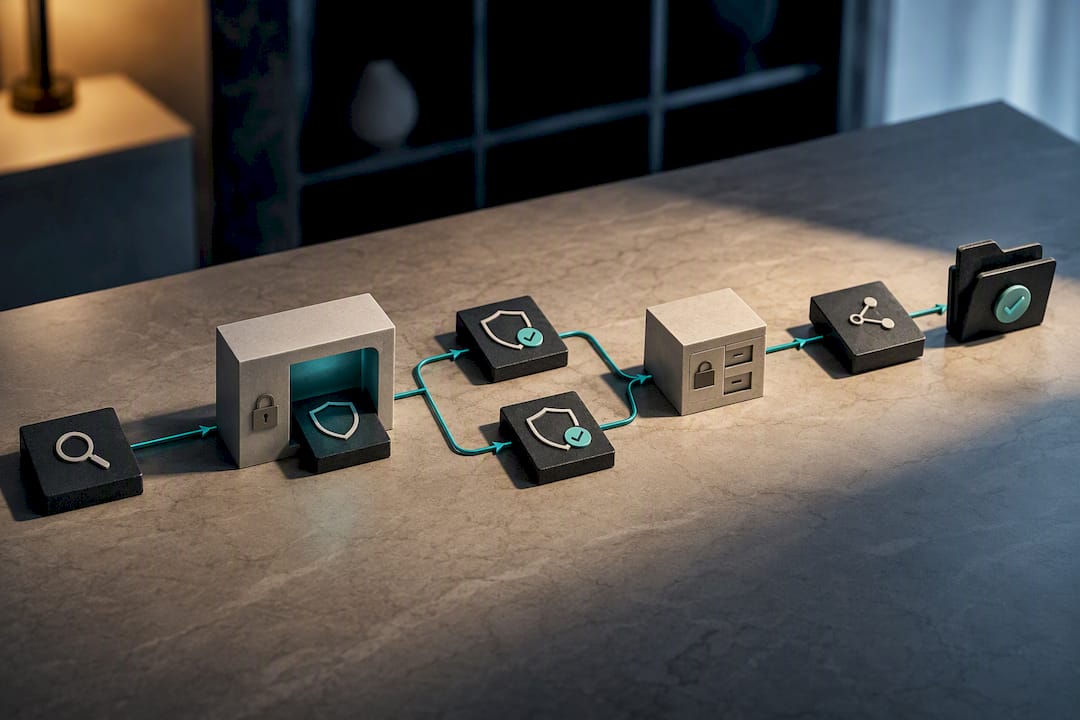

That standards-based discipline, mapping findings against recognised frameworks and preserving artefacts to forensic norms, is what lets automated results feed directly into a legal workflow rather than sitting isolated in a security dashboard. For organisations operating in legally sensitive environments, that continuity between technical testing and evidentiary standard is not optional.
The overrated promise and the underrated safeguard
The most overrated claim in this space is full autonomy. Vendors talk about “agentic pentesting” as though the human disappears from the loop entirely; the architectures that actually hold up in practice, from Burp AT’s audit-logged autonomy controls to database-enforced verification chains, all keep a human checkpoint somewhere in the pipeline. That’s not a limitation to apologise for. It’s the design feature that makes the output trustworthy.
The underrated safeguard is the exhaustion gate: the quiet rule that decides how many independent proofs a finding needs before it’s allowed to call itself “verified”. Most conversations about automation focus on speed and coverage numbers. Few focus on what standard of proof a platform actually enforces before a finding reaches a report, and that standard is the difference between a pipeline your security team trusts and one it learns to ignore.
If you’re evaluating pentesting automation for the first time, prioritise the verification chain over the feature list. Ask what evidence a “verified” finding actually carries, whether that evidence is replayable independently, and whether the architecture keeps sensitive data under your control. Everything else, scan speed, dashboard polish, tool count, matters far less than whether you can trust and defend what the pipeline tells you.
— Computer
Get standards-based automated testing with forensic-grade evidence
Automated pipelines can scale validation, but the evidence they produce is only as useful as the methodology behind it. Computerforensicslab runs penetration testing to the same chain-of-custody and reproducibility standards it applies to digital forensic casework, so findings that come out of an automated pipeline arrive documented well enough to support internal remediation, board reporting, or, where needed, an expert witness statement. That combination, automation’s speed paired with forensic rigour, is the practical advantage over a pipeline that produces fast results nobody can fully stand behind later.
If your organisation is weighing an automated testing programme against a manual engagement, or needs both working together, get in touch through Computerforensicslab’s digital forensics services page to scope a testing and evidence-handling plan suited to your environment.
Sources
For technical grounding beyond this article, the OWASP Web Security Testing Guide sets the reference framework most verification chains map against, the ADAPT architecture paper demonstrates automation feasibility formally, and the pentestgpt repository shows a working agentic pipeline design in practice.
- Burp AT documentation — PortSwigger
- Automated penetration testing: Formalization and realization — ScienceDirect
- pentestgpt — GitHub
- PentestPilot — Autonomous penetration testing