Chain of custody is the chronological, documented record that tracks every person who handled a piece of evidence, from the moment it was collected to the moment it appears in court. Its primary purpose is to prove that the evidence presented is authentic and unaltered. When that record has gaps, judges can exclude the evidence entirely or allow a jury to give it far less weight, which can decide the outcome of a criminal trial or a civil dispute.
TL;DR:
- Missing signatures, unsealed containers, excessive transfers, or lack of digital hash records frequently undermine the admissibility of evidence in court.
- For physical evidence, every transfer, storage condition, and handling action must be documented with signed records and tamper-evident seals to ensure authenticity.
- Digital evidence requires cryptographic hashes, write-protected imaging, and detailed access logs; any alteration or metadata changes can break the chain of custody.
- Proper early handling, such as photographing evidence on-site and minimum handling, drastically reduces the risk of record gaps or contamination.
- For high-stakes cases, involving a digital forensics lab ensures technical safeguards and thorough documentation that withstand legal scrutiny.
Table of Contents
- What is chain of custody in legal and forensic terms?
- Why chain of custody matters for admissibility and evidentiary weight
- How chain of custody works from scene to courtroom
- Digital evidence needs its own technical controls
- What breaks the chain of custody
- A practical checklist for preserving chain of custody
- How a professional digital forensics lab maintains the chain
- What years of casework teach you about chain of custody
- Where Computer Forensics Lab fits when the stakes are high
- Sources
What is chain of custody in legal and forensic terms?
Chain of custody is often described as a paper trail: a sequential, documented account of who collected an item, who has held it since, where it has been stored, and what has happened to it at every stage. That definition applies equally to a bloodstained garment, a hard drive, or a mobile phone seized during an investigation. The record exists to answer one question convincingly: is this the same item, in the same condition, that was originally collected?
That documentary trail is distinct from the physical act of handling evidence carefully. A technician can package, store, and transport an item flawlessly and still leave the case vulnerable if the paperwork behind it is incomplete. Courts do not take good handling on trust; they expect a written or digital record that stands up to scrutiny.
The components legal teams and forensic practitioners expect to see include:
- A unique identification number or barcode assigned at the point of collection
- Tamper-evident labels and seals showing whether a container has been opened
- Signatures and printed names of every person who took custody
- Dates and times for every collection, transfer, and storage event
- Notes on storage conditions, including temperature and access restrictions where relevant
- Signed transfer records documenting the reason for each handover
Miss any one of those elements and the item’s authenticity becomes arguable, regardless of how competently it was actually examined.
Why chain of custody matters for admissibility and evidentiary weight
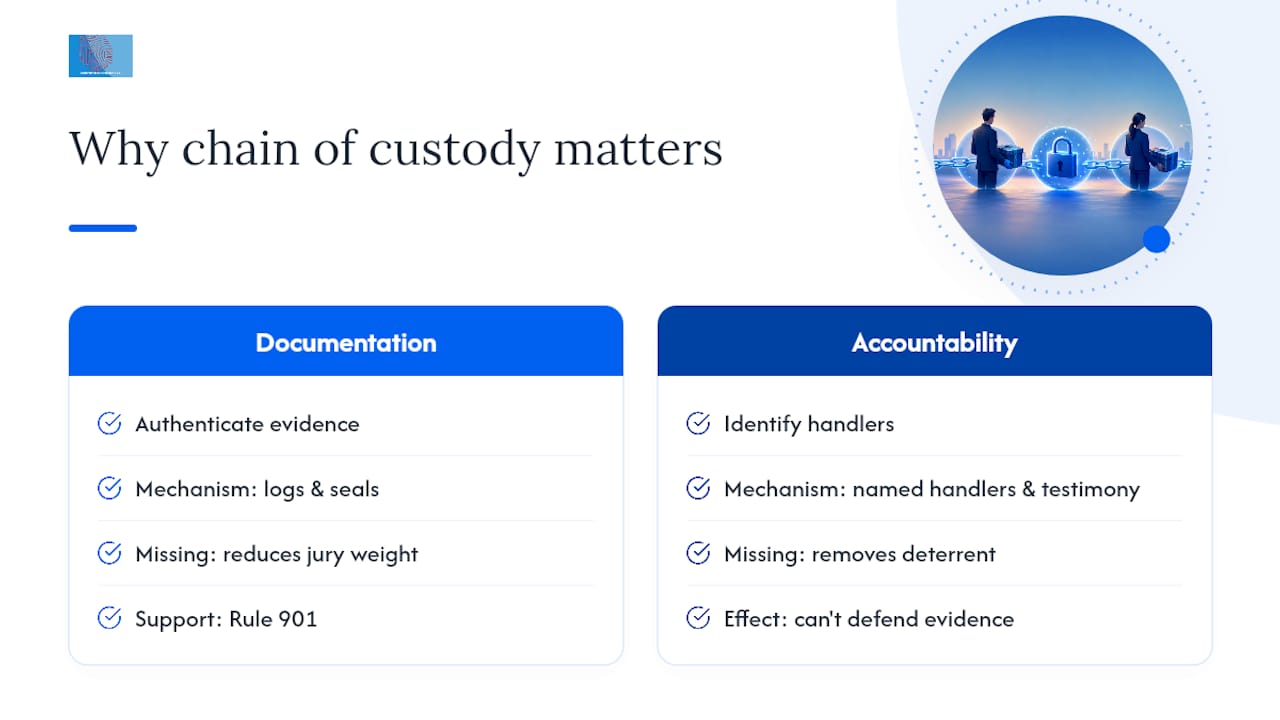
Chain of custody exists to satisfy authentication rules, and Rule 901 of the Federal Rules of Evidence sets out the underlying principle clearly: whoever presents an item must show it is what they claim it to be. Documentation is the mechanism that supports that claim. Without it, a defence lawyer has an obvious opening: argue that the item in the courtroom might not be the item collected at the scene.
Statistic callout: Courts distinguish between minor and critical gaps in the record. Minor inconsistencies, such as a slightly delayed log entry, typically affect how much weight a jury gives the evidence rather than whether it is admitted at all. A critical, unexplained gap, such as several days unaccounted for between seizure and laboratory receipt, can be enough to exclude the evidence outright.
Accountability is the other half of the equation. A properly maintained record identifies exactly who handled an item at each stage, which means those individuals can be called to testify about what they did and observed. That traceability also deters tampering, because every handler knows their name is attached to the item’s condition at the moment they held it. Remove that traceability and you remove both the deterrent and the ability to defend the evidence when it is challenged.

How chain of custody works from scene to courtroom
Evidence moves through a fairly consistent sequence of custody events, and each one generates its own documentation. Understanding the sequence helps you recognise, at a glance, whether a record looks complete or has an obvious hole in it.
- Collection and labelling at the scene. The collector records the date, time, exact location, a description of the item, and assigns a unique identifier before anything is moved.
- Sealing in tamper-evident packaging. The container is sealed in a way that shows visibly if it has been opened, and the seal number is logged against the item.
- Transfer to the laboratory. Every handover requires a signature from the person releasing custody and the person accepting it, along with the date, time, and stated purpose of the transfer.
- Storage under restricted access. Evidence is held in a controlled facility where only authorised personnel can retrieve it, and every entry into that facility is logged.
- Laboratory handling and analysis. Analysts record what tests were performed, when, by whom, and what condition the item was in on receipt and on return to storage.
- Preparation for court. Exhibits are formally logged out, described, and accompanied by the full custody record so the item can be authenticated in front of a judge.
At every single handoff, practitioners must be able to answer four questions: who had the item, when they had it, what they did to it, and its condition on transfer. Miss the answer to any one of those and you have created a weak point.
Pro Tip: Fewer handlers means fewer opportunities for error. Official guidance consistently recommends limiting the number of custodians an item passes through, because every additional transfer is another signature, another date, and another chance for the record to break down.
Digital evidence needs its own technical controls
Physical evidence shows tampering visually, a broken seal, a torn bag. Digital evidence often does not, which is why the chain of custody for a laptop, phone, or cloud account depends on technical proof rather than visible signs alone.
- Cryptographic hashes generate a unique digital fingerprint of a file or drive at the point of acquisition, so any later alteration, however small, produces a different hash value and exposes the change.
- Read-only forensic imaging creates a bit-for-bit copy of the original device using write-blocking hardware, ensuring the source data is never modified during examination.
- Metadata capture and audit logs record who accessed an image, when, and what actions they took, forming a digital equivalent of the signed transfer sheet used for physical evidence.
- Cloud and ephemeral data present a particular challenge because content can change or disappear before it is preserved, which makes timestamped capture and clear documentation of the collection method essential.
Because digital items can be altered without leaving obvious marks, hash records and access logs effectively become the chain of custody for that category of evidence. This is also the point at which many businesses and legal teams reach their limit. Anyone unsure how to acquire an image forensically, or how to document a cloud extraction defensibly, should read up on preserving chain of custody for digital evidence before attempting it, or bring in a specialist from the outset.
What breaks the chain of custody
Most challenges to evidence target a small, predictable set of weaknesses. Recognising them helps you understand exactly what opposing counsel will look for.
- Missing or forged signatures, and time gaps in the log that nobody can explain.
- Unsealed containers, damaged packaging, or storage conditions that were never recorded.
- An excessive number of transfers, each additional handler adding another point of potential failure.
- Digital-specific issues, including no hash value recorded at acquisition, metadata that has been altered, or system logs that have been overwritten.
Even a single unexplained gap can be enough grounds for a spoliation argument in civil litigation, where a party claims evidence was lost, destroyed, or handled so poorly that it can no longer be trusted.
A practical checklist for preserving chain of custody
If you are the first person to encounter evidence, physical or digital, the actions you take in the first few minutes matter more than almost anything that follows.
- Identify the item without touching it more than necessary, and note its exact location.
- Photograph it in place before moving or repackaging anything.
- Label it immediately with a unique identifier, your name, and the date and time.
- Seal it in tamper-evident packaging appropriate to the item type.
- Record every transfer with a signature, date, time, and stated reason.
For digital devices, the steps differ slightly but the principle is identical:
- Do not change the power state of a device unless you have been specifically instructed to, since switching it on or off can alter or destroy data.
- Photograph the device and its screen exactly as found.
- Capture a forensic image rather than working from the original where possible.
- Record hash values for every image taken, along with associated account or login details.
Pro Tip: If you are uncertain whether an action you are about to take could alter the evidence, stop. Contact a digital forensics service or legal counsel before proceeding. A pause costs you nothing; a mistake at this stage can be irreversible.
Reviewing a short set of chain of custody tips before you are in this situation, rather than during it, tends to make the difference between a clean record and a contested one.
How a professional digital forensics lab maintains the chain
Laboratories that handle digital evidence day to day build their entire workflow around minimising custodians and maximising documentation. Every handoff, from initial receipt to final reporting, is logged against a named individual, and access to storage is restricted and audited rather than left to informal trust.
The core technical protections are consistent across serious casework: write-blocked imaging to guarantee the original is never modified, hash logs generated at acquisition and checked again before analysis and reporting, and secure, access-controlled storage for every image and original device.
Cloud data extractions, complex mobile phone recoveries, and cases requiring expert witness testimony are precisely where lab involvement stops being optional. A detailed technical explanation of these safeguards shows how much documentation sits behind a single line in a court report.
What years of casework teach you about chain of custody
Chain of custody looks like paperwork until the moment a case turns on it, and then it looks like the only thing that matters. Computer Forensics Lab has seen strong technical findings undermined by a single unexplained gap in a log, and seen weaker findings hold up because the documentation behind them was flawless. The lesson is consistent: the record is the evidence, as far as a court is concerned, not just a description of it.
The most common misjudgement is treating digital evidence as self-evidently reliable because it is technical. It is not. A device without a hash value recorded at acquisition is no more defensible than a bag without a seal. If there is any doubt about how to preserve an item correctly, particularly a phone, laptop, or cloud account, that is the moment to call a specialist rather than after the fact.
— Computer
Where Computer Forensics Lab fits when the stakes are high
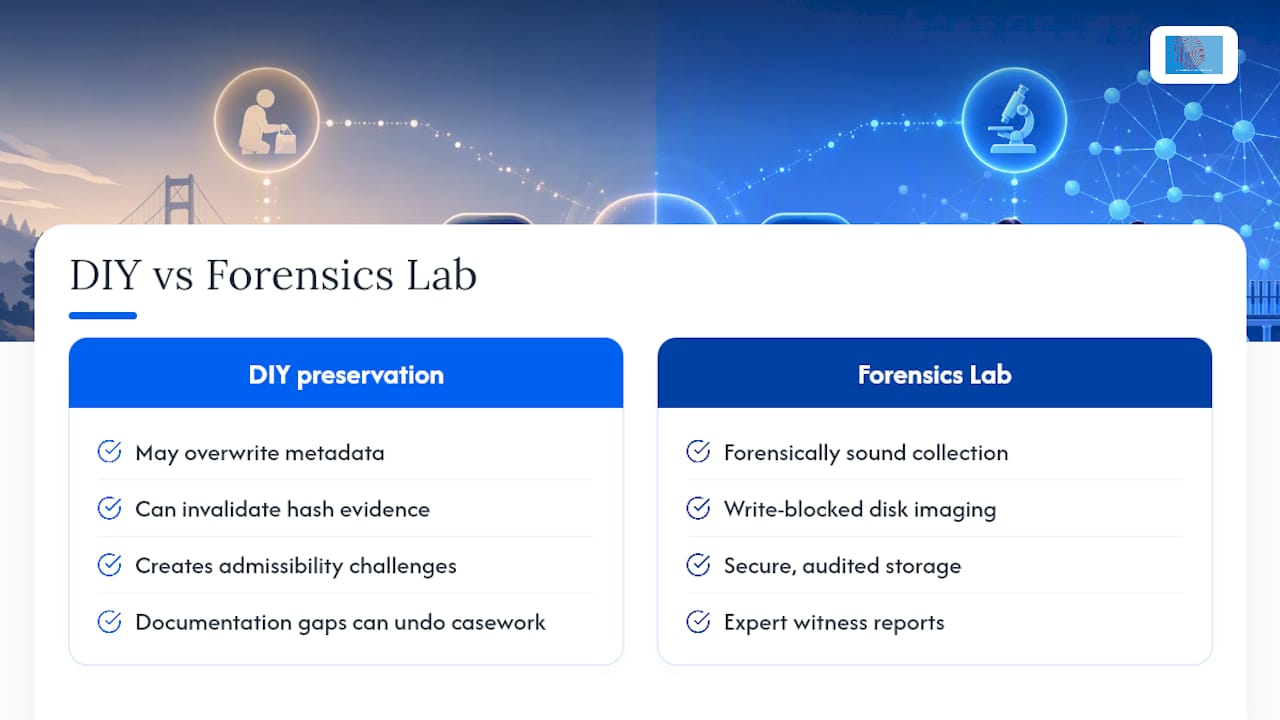
Attempting to preserve digital evidence without the right tools rarely ends well: one wrong click can overwrite metadata, invalidate a hash, or hand the opposing side an easy admissibility challenge. Computer Forensics Lab exists for exactly the moment DIY preservation reaches its limit, offering forensically sound evidence collection, write-blocked imaging, secure audited storage, and expert witness reports that stand up under cross-examination. Instructing a lab rather than improvising matters most with cloud accounts, encrypted devices, or any case likely to reach a courtroom, where a single documentation gap can undo months of casework.
If you are dealing with a device, account, or dataset that needs to survive legal scrutiny, visit the digital forensics services page to see how an engagement works, or get in touch directly to discuss your case before you touch the evidence yourself.
Sources
- Chain of Custody – StatPearls – NCBI Bookshelf – NIH
- Federal Rules of Evidence Rule 901 (authentication requirement)
- Chain of custody in forensic science (CASRAI guidance)