
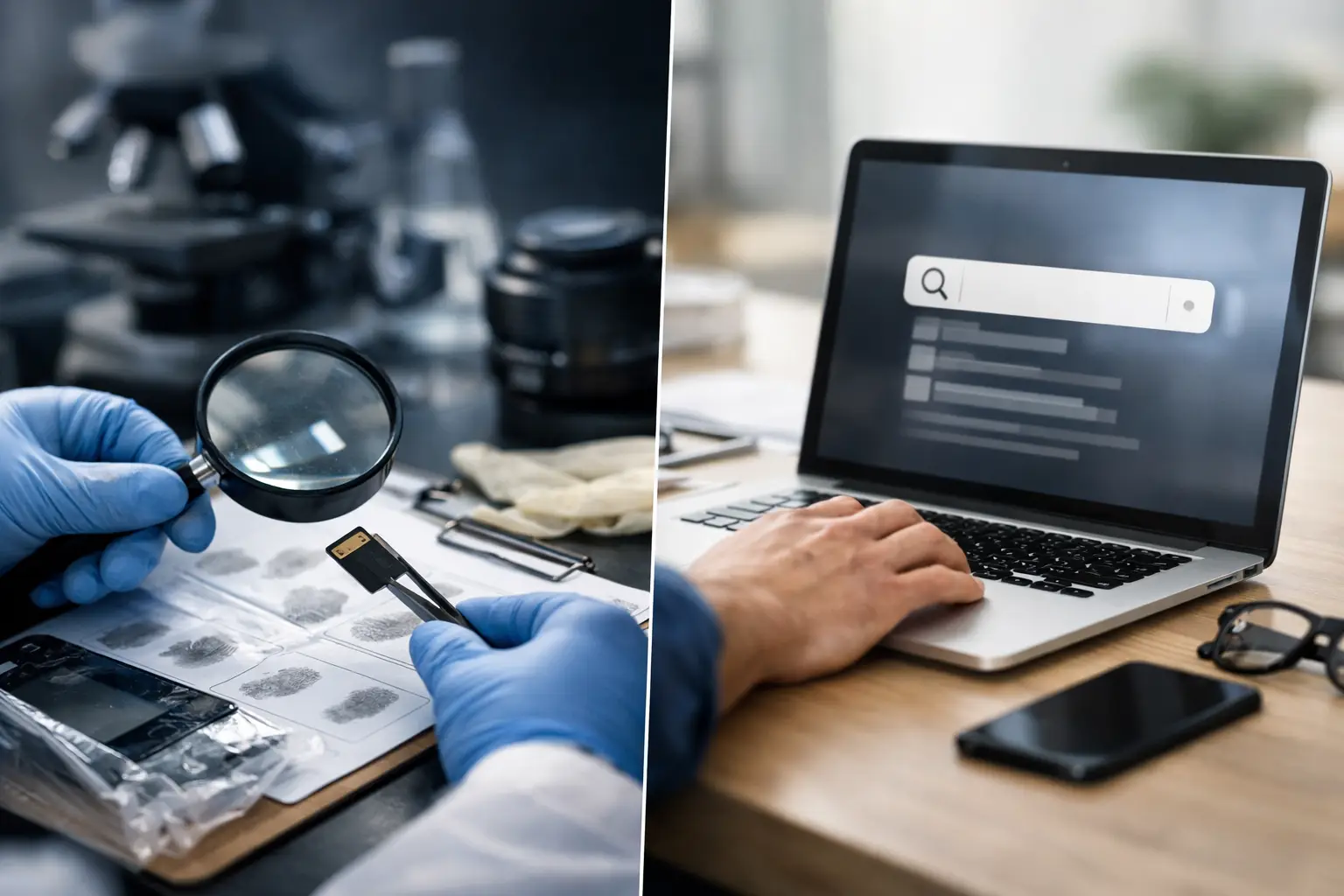
A search for one word can locate a useful message in seconds. It can also miss the deleted attachment, the altered timestamp, the conversation thread that changes its meaning, or evidence that the device user did not send it. That is the central distinction in forensic review versus keyword search: one is a defensible examination of digital evidence; the other is a filtering method that may assist an investigation but cannot, by itself, establish the full evidential picture.
For solicitors, investigators and businesses responding to a dispute, this distinction matters early. Decisions about preservation, disclosure, interviews and case strategy are often made from what appears to be a straightforward search result. If the material is later challenged, the question will not simply be whether a word was found. It may be whether the evidence was collected lawfully, preserved without alteration, reviewed in context and presented in a form the court can test.
What a keyword search actually does
A keyword search looks for specified words, phrases, names or number strings within an available collection of data. Depending on the platform and settings, it may search document text, emails, messages, file names or indexed content. It is fast, proportionate and often highly useful for narrowing a large data set.
In e-disclosure, for example, carefully designed search terms may identify potentially relevant documents for legal review. In an internal investigation, searches for a project name, competitor, customer or codeword can help establish where to look next. A client may also conduct a basic search on a handset or laptop to identify material requiring urgent preservation.
However, a keyword search returns only what its design permits it to return. It depends on the chosen terms, spelling variations, language, optical character recognition quality, the data sources included and whether the content remains searchable. It is not a finding of fact. It does not prove authorship, intent, timing, completeness or authenticity.
A search for “invoice” may miss an image containing an invoice, a spreadsheet identified by an account number, a deleted email, a conversation using shorthand, or a document saved under an unrelated title. Equally, a search hit may be irrelevant because the word appears in a quoted message, a forwarded chain or a file created automatically by software.
Forensic review versus keyword search in legal matters
A forensic review begins with the evidence itself, not merely the words that can be retrieved from it. The examiner works from an appropriately acquired forensic image or extraction, records the source and handling of the data, and uses validated methods to recover and analyse relevant artefacts. The work should be repeatable, transparent and capable of explanation to the court.
The scope varies by case. A mobile phone examination may consider messages, call records, media, application data, location artefacts, deleted material and device activity. A computer examination may assess user accounts, external media use, browser activity, cloud synchronisation, file system metadata, deleted files and indications of data transfer. In a cyber incident, the review may extend to event logs, persistence mechanisms, unauthorised access indicators and evidence of exfiltration.
Keywords can form part of that process. They are often valuable investigative prompts. The difference is that a forensic examiner can test the result against its surrounding context and underlying artefacts. If a message refers to a document, the examiner may establish whether that document existed on the device, when it was created or modified, whether it was transmitted, and whether other records support or contradict the apparent narrative.
That distinction becomes critical where a party alleges fabrication, deletion, unauthorised access, harassment, employee misconduct, concealment of assets or theft of confidential information. A screenshot and a keyword result may raise a serious issue. They rarely resolve it.
Context is where the evidential value sits
Digital evidence is frequently fragmented. A single item can look persuasive until its metadata, neighbouring records or technical source are examined. A message timestamp might reflect when a message was displayed, copied, exported or synchronised rather than when it was originally sent. A file date may be changed during transfer. A browser record may show that a page was accessed, but not necessarily who read it or what action they took next.
Forensic review seeks to distinguish observation from inference. It records what the artefact shows, the method used to obtain it and the limits of what can safely be concluded. This is particularly important in expert reporting, where overstatement can damage a case as much as an overlooked item of evidence.
Consider a workplace allegation that an employee copied confidential files before leaving. A keyword search might locate the company name in emails or a folder labelled with a client project. A forensic examination can go further by considering file access records, removable media history, cloud storage activity, archive creation, USB device connections and traces of attempted deletion. Even then, the proper conclusion may be limited: the evidence may support that files were accessed or copied to a device, but not establish the employee’s motive without further evidence.
Preservation and chain of custody cannot be added later
A common problem arises when a relevant device has already been searched, used, reset or passed between several people before a specialist is instructed. This does not automatically make the evidence unusable, but it can affect what can be recovered and how confidently it can be relied upon.
A forensic process protects evidential integrity from the outset. The device or media is identified, its condition documented, and its movement recorded. Acquisition is carried out using appropriate tools and methods designed to avoid unnecessary alteration. Original material is preserved while examination takes place on verified forensic copies where appropriate.
This chain of custody is not administrative decoration. It allows the parties and the court to understand where the evidence came from, who handled it and whether there is a reasonable basis to trust that it has not been changed. Where material has been gathered informally, an examiner may still be able to assess it, but the report must make clear any limitations.
Keyword searches carried out directly on a live device can also alter the very data later relied upon. Opening an application may update access times, trigger synchronisation or overwrite volatile information. That risk is particularly acute after suspected hacking, insider misuse or deletion. The urgent priority is usually preservation, not casual exploration.
When keyword search is the right tool
Keyword search should not be dismissed. It is often the sensible first-stage tool where the issue is defined, the document population is known and the aim is to identify potentially relevant material efficiently. In disclosure exercises, a negotiated search methodology can help manage volume and cost. In a business investigation, a targeted search may establish whether there is a credible basis for a wider enquiry.
It is most reliable when the search population is complete, the terms are designed with knowledge of the facts, and results are reviewed by a person able to assess relevance and privilege. Search terms should account for aliases, abbreviations, common misspellings, date ranges and likely coded language. Sampling and iterative refinement can expose gaps in an initial approach.
But the question should always be: what decision will this result support? If the answer is a procedural triage decision, keyword searching may be sufficient. If the answer concerns disputed conduct, authenticity, deletion, device use or evidence intended for court, specialist forensic review is usually required.
Choosing a proportionate investigative approach
The correct approach depends on the allegations, the available devices, the urgency and the intended use of the findings. A proportionate instruction is not necessarily the narrowest or cheapest one. It is the one that addresses the issue without creating an avoidable evidential gap.
Before commissioning work, establish whether the original device or account data is available, whether there is a risk of continued alteration or remote wiping, and whether privacy, employment or disclosure obligations apply. Define the relevant time period and the factual questions to be tested. A clear instruction helps the examiner distinguish necessary analysis from broad, unfocused searching.
Computer Forensics Lab can advise on preservation, acquisition and an examination scope suited to civil disputes, criminal matters and internal investigations. The objective is not to produce the greatest volume of data. It is to recover and assess the material capable of answering the questions that matter, with findings that can withstand scrutiny.
When digital material may influence a settlement, disciplinary decision, charging decision or trial, treat the first search result as the start of the enquiry, not its end. Preserve the source, identify the limits of what is known, and obtain independent forensic analysis before a potentially incomplete record becomes the foundation of the case.