

TL;DR:
- Forensic imaging creates exact, comprehensive copies including deleted and hidden data, ensuring legal admissibility.
- Proper forensic procedures maintain evidence integrity through hash verification, chain of custody, and standard-compliant practices.
- In complex environments like cloud or SSDs, early volatile memory capture and thorough documentation are crucial for reliable evidence.
When a case turns on digital evidence, the difference between a standard file copy and a forensic image can determine whether that evidence is accepted or thrown out of court entirely. Legal teams and corporate investigators in the UK frequently underestimate this distinction, assuming that any copy of digital data will suffice when scrutiny arrives. Forensic imaging is not simply a more thorough form of copying. It is a rigorous, standards-based process designed from the outset to survive challenge, preserve integrity, and demonstrate an unbroken chain of custody from the moment of collection to the courtroom.
Table of Contents
- How forensic imaging supports digital evidence integrity
- Key advantages of forensic imaging for legal investigations
- Managing challenging environments: cloud and volatile data
- Forensic imaging and evidential confidence in UK courts
- What most professionals miss about forensic imaging’s value
- How to access proven forensic imaging support
- Frequently asked questions
Key Takeaways
| Point | Details |
|---|---|
| Evidence integrity | Forensic imaging thoroughly safeguards digital evidence against tampering for reliable legal use. |
| Courtroom confidence | Adherence to international standards strengthens the admissibility and credibility of digital evidence. |
| Handling complexity | Proven adaptations allow forensic imaging even in challenging environments such as cloud and live systems. |
| Common pitfalls | Documentation and proper technique are often underestimated but critical for success in high-stakes cases. |
How forensic imaging supports digital evidence integrity
Having introduced why a normal file copy will not suffice, we now examine how forensic imaging fulfils strict legal criteria and international standards.
Forensic imaging creates a bit-for-bit duplicate of an entire storage device, capturing every sector including deleted files, hidden partitions, unallocated space, and file system metadata that standard copying completely ignores. A conventional file copy simply replicates visible, accessible data. Forensic imaging captures the whole picture, and that distinction matters enormously in litigation. Understanding why forensic imaging matters for legal cases is the foundation upon which solid digital investigations are built.
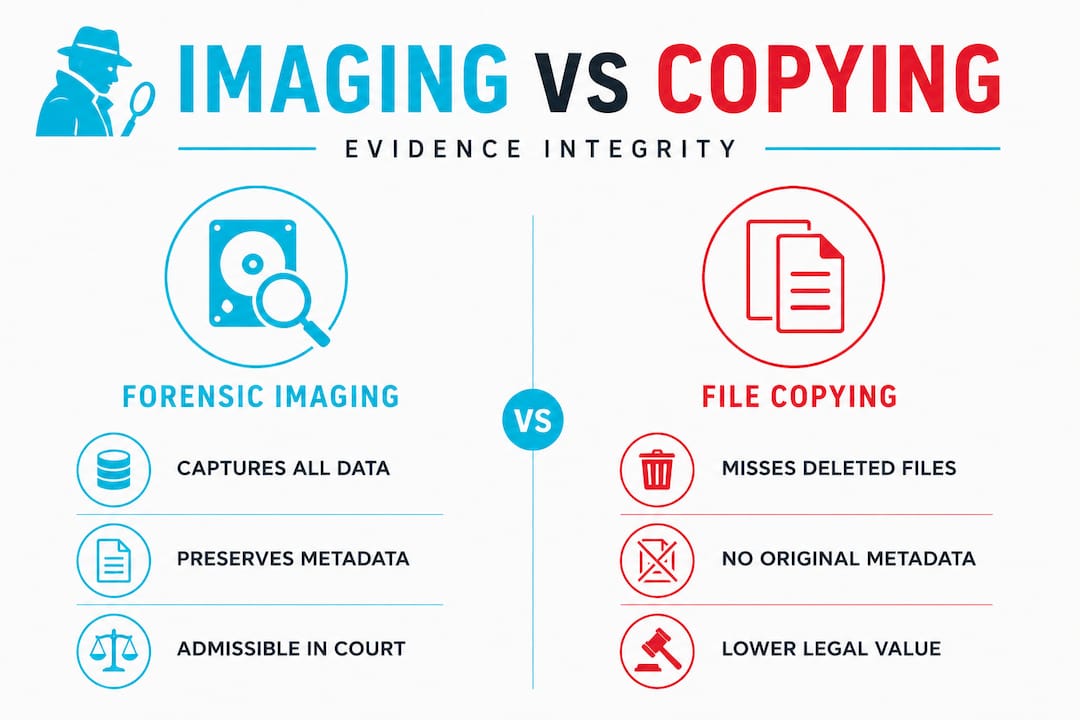

The process aligns with international standards like ISO/IEC 27037 and SWGDE/NIST best practices, which govern identification, collection, acquisition, and preservation of digital evidence. These frameworks are not advisory suggestions. They are the benchmarks against which opposing counsel and expert witnesses will measure the reliability of your evidence.
Key technical safeguards built into proper forensic imaging include:
- Bit-for-bit sector copying that captures all data, not merely what the operating system presents as accessible
- Write blockers that prevent any data being written back to the original device during acquisition, preserving its pristine state
- Cryptographic hash values (typically MD5 or SHA-256) generated both before and after imaging to mathematically verify that the copy is identical to the original
- Documented chain of custody recording every person who handled the evidence, when they handled it, and what actions were taken
- Verification logs that can be independently reviewed by any qualified expert
“Proper forensic acquisition requires that the integrity of digital evidence be maintained and verified throughout the process, with full documentation of all actions taken.” SWGDE Best Practices for Digital Evidence Collection
Pro Tip: In our experience, thorough documentation is what separates admissible forensic evidence from evidence that opposing counsel successfully challenges. Every step of securing digital evidence must be recorded contemporaneously, not reconstructed later from memory. Courts are far more receptive to evidence supported by contemporaneous logs than to verbal explanations after the fact.
Key advantages of forensic imaging for legal investigations
With these standards in mind, the tangible benefits forensic imaging brings to legal and investigatory work become clear.
For legal professionals and corporate clients, forensic imaging delivers advantages that directly influence case outcomes. Here are the principal benefits in order of their courtroom significance:
- Admissibility: Evidence collected through forensic imaging, with full hash verification and documented chain of custody, satisfies the criteria for admissibility under UK courts’ expectations for digital evidence. Evidence collected carelessly may not.
- Reproducibility: Because the forensic image is an exact duplicate, any qualified examiner can independently verify findings. This reproducibility underpins expert testimony and withstands cross-examination.
- Non-alteration: Write blockers and hash verification ensure the original device remains unchanged and the image is a true copy. Hash verification and write-blocking are non-negotiable for mathematical proof of non-alteration, directly addressing common defence challenges in UK courts.
- Investigative efficiency: Working from an image rather than the original device protects the source evidence while allowing analysts to work freely, run multiple examination passes, and restore to a clean state if needed.
- Regulatory compliance: Many sectors, from financial services to healthcare, face data governance obligations. Forensic imaging supports audit trails and demonstrates procedural rigour when regulators investigate.
| Feature | Forensic imaging | Standard file copying |
|---|---|---|
| Captures deleted data | Yes | No |
| Preserves metadata | Yes | Partial |
| Write protection | Yes | No |
| Hash verification | Yes | No |
| Chain of custody documentation | Yes | No |
| Admissible in UK courts | Yes (when standards followed) | Rarely |
| Captures unallocated space | Yes | No |
| Reproducible by third party | Yes | No |
Studies in digital forensic practice consistently show that improperly preserved digital evidence is one of the most frequently exploited vulnerabilities by defence teams. When evidence has not been collected following a recognised forensic methodology, challenges to its integrity are a straightforward legal strategy. The forensic imaging process closes that vulnerability by making the proof of integrity mathematical rather than testimonial.
For corporate investigations, the advantages extend beyond the courtroom. Internal investigations into employee misconduct, intellectual property theft, or data breaches require the same rigour if findings are to support disciplinary action or civil litigation. Verifying digital evidence at the point of collection prevents costly disputes about whether data was altered or cherry-picked during the investigation itself.
Managing challenging environments: cloud and volatile data
Now that the core advantages are established, let’s address the reality of imaging in complex, modern data environments.
The clarity of forensic imaging principles meets genuine complexity when applied to modern infrastructure. Static hard drives in desktop computers are the straightforward case. The majority of corporate investigations now involve solid-state drives (SSDs), cloud-hosted data, virtual machines, and systems that cannot simply be powered down without destroying critical evidence.
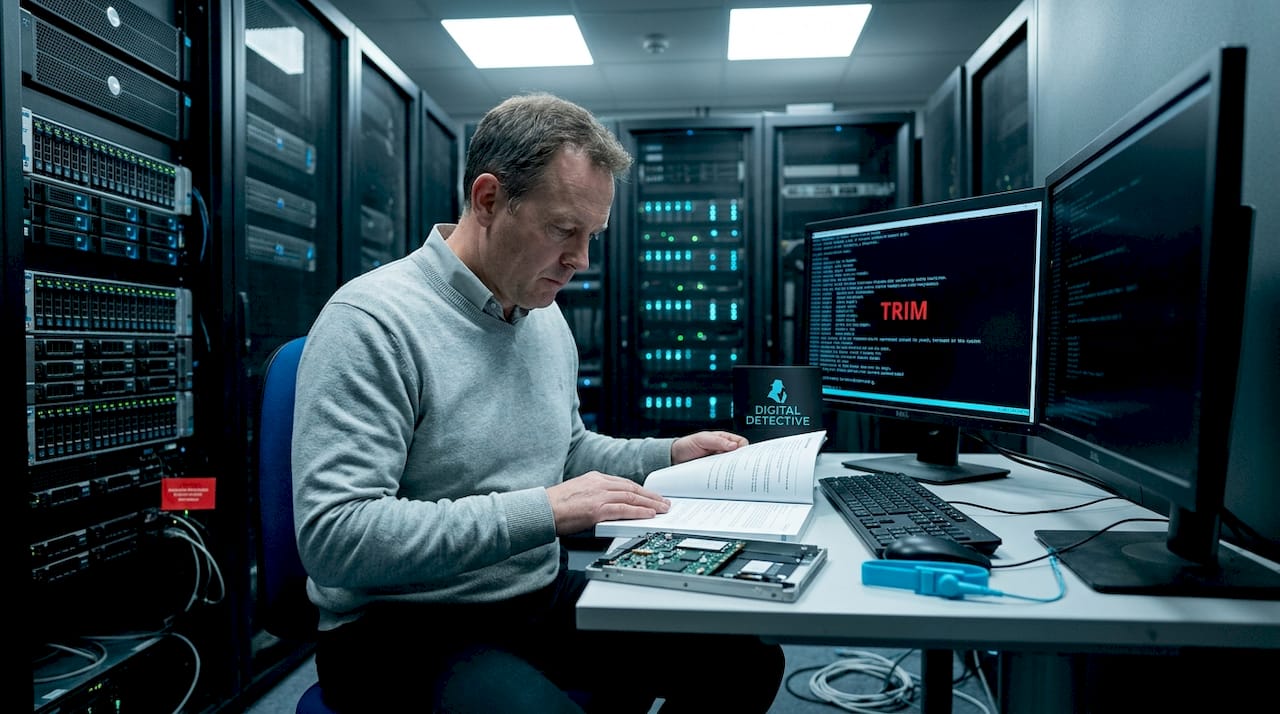
SSDs present a particular challenge because of a background process called TRIM, which actively overwrites deleted data to maintain performance. Unlike traditional magnetic hard drives, an SSD may begin altering data the moment the device is powered on, even before any examiner has touched it. This is not negligence; it is the nature of the technology. Documenting this reality is essential.
Cloud environments add another layer of difficulty. Data stored in cloud services may span multiple jurisdictions, may be subject to rapid deletion policies, and cannot be imaged in the traditional sense. ISO 27037 adaptations for cloud and volatile evidence require alternative approaches, including capturing volatile memory first, using provider-specific preservation requests, and maintaining detailed logs of what was accessible and when.
| Data source | Primary challenge | Best-practice approach |
|---|---|---|
| Traditional HDD | Physical damage, fragmentation | Standard bit-for-bit imaging with write blocker |
| SSD | TRIM, data alteration on power-up | Immediate imaging, document TRIM behaviour |
| Live/running system | Volatile memory loss on shutdown | RAM capture first, then disk imaging |
| Cloud storage | Jurisdictional complexity, deletion policies | Legal preservation requests, API logging |
| Virtual machines | Snapshots, distributed storage | Snapshot acquisition, hypervisor-level imaging |
| Mobile devices | Encryption, remote wipe risk | Immediate isolation from networks, specialist tools |
Practical workarounds for challenging environments include:
- Capture volatile memory first on any live system before considering disk acquisition. RAM contains running processes, active network connections, and encryption keys that vanish on shutdown
- Issue legal preservation notices to cloud providers at the earliest possible stage to prevent automated deletion
- Use Faraday isolation for mobile devices immediately upon seizure to prevent remote wipe commands reaching the handset
- Document unavoidable changes in full, explaining the technical necessity in plain language that a judge or jury can understand
- Deploy specialist tools such as FTK Imager, EnCase, or Cellebrite for device-specific acquisition challenges, and record which tool version was used
Pro Tip: When facing situations where a textbook forensic image is impossible, detailed real-time documentation of every decision and its justification becomes your substitute for technical perfection. Courts understand that perfect conditions rarely exist. What they require is evidence that the examiner acted professionally and transparently within those constraints. Refer to practical imaging steps and cloud evidence workflows to ensure these deviations are handled with the appropriate procedural rigour. Following volatile data collection guidelines can also assist when operating across different jurisdictions.
Forensic imaging and evidential confidence in UK courts
After considering the complexities of digital environments, let us focus on the advantage forensic imaging offers for courtroom validation and confidence.
UK courts expect digital evidence to meet a standard of reliability that goes beyond simply producing a printout of alleged data. Judges, opposing counsel, and expert witnesses are increasingly sophisticated about digital forensics, and the bar for evidential confidence continues to rise. Forensic imaging, when conducted properly, provides the foundation that allows legal teams to present digital evidence without apology or qualification.
Building trust in digital evidence through proper imaging methodology allows your expert witnesses to speak with certainty rather than hedging their testimony. An expert who can point to verified hash values, contemporaneous logs, and an unbroken chain of custody is a far more convincing witness than one who must acknowledge that proper procedures were not followed.
Cases that have faced evidential difficulties due to poor digital collection practices illustrate the consequences clearly:
- Employment tribunals where disciplinary dismissals were overturned because the employer’s IT team copied files without forensic rigour, making it impossible to prove when files were created or accessed
- Intellectual property disputes where forensic examination was undermined because the original device had been accessed multiple times after the alleged theft, contaminating the evidence trail
- Fraud investigations where deleted financial records that would have been recoverable through forensic imaging were lost because a standard backup was taken instead
- Contract disputes where metadata proving document creation dates was stripped during a standard copy, removing crucial evidence of backdating
“Standards universally recognise that imaging with full verification remains the most reliable approach to digital evidence acquisition, with live acquisitions acknowledged as necessary compromises that require thorough documentation to preserve evidential value.” SWGDE Best Practices for Digital Evidence Collection
The practical takeaway for UK legal practitioners is straightforward. Instruct forensic specialists at the earliest opportunity, before any internal IT team member has accessed the relevant device. The cost of proper forensic imaging is negligible compared to the cost of losing a case on evidential grounds.
What most professionals miss about forensic imaging’s value
There is an uncomfortable truth that most guidance on digital forensics fails to address directly. Legal teams and corporate clients frequently engage forensic specialists too late, often after an internal investigation has already compromised the evidence. The assumption is that forensic imaging is a technical formality that can be added at any point in the process. It cannot.
The practical risk of bypassing proper imaging at the outset extends well beyond the immediate case. Consider an internal investigation into suspected data theft. If the company’s IT department runs a standard backup first, they have potentially altered timestamps, failed to capture deleted files, and demonstrated to any opposing expert exactly where the evidential gaps are. The damage is not always repairable.
There is also the myth of the “good enough” image. Some practitioners believe that as long as a copy of relevant files exists, the detail of how it was collected is a technicality that courts will overlook. This is not the experience of those who have sat through expert witness cross-examination. A well-prepared opposing expert can systematically dismantle evidence that was not collected to standard, raising sufficient doubt to neutralise its value entirely.
What experience genuinely teaches is that the quality of forensic imaging is a multiplier on every other aspect of your case. Strong witness testimony backed by forensically sound digital evidence is compelling. That same testimony backed by evidence that has been challenged on procedural grounds becomes a liability. Reviewing a deeper look at imaging’s vital role in investigations often changes how legal teams prioritise their early-stage decisions.
A cross-team evidence review involving both legal counsel and a forensic specialist at the start of any investigation, not at the disclosure stage, routinely uncovers risks that would otherwise surface only under pressure. This early collaboration is perhaps the single most underused advantage available to legal teams dealing with digital evidence.
How to access proven forensic imaging support
Computer Forensics Lab provides professional forensic imaging and digital forensics services across the full spectrum of legal and corporate investigation needs. From straightforward hard drive acquisitions to complex cloud and mobile device examinations, our team works to the standards that UK courts and regulators require. Whether you are building a case for litigation, responding to a regulatory inquiry, or investigating internal misconduct, our forensic specialists bring both technical precision and courtroom-ready documentation to every engagement. Explore how digital footprints data shapes modern investigations, and review practical imaging guidance to understand how our process maps to your specific circumstances.
Frequently asked questions
What is the main difference between forensic imaging and normal data copying?
Forensic imaging captures an exact, bit-for-bit copy of all data including hidden and deleted content, while normal copying only saves files that are currently accessible to the operating system.
Are forensic images admissible in UK courts?
Forensic images are admissible when collected under international standards such as ISO/IEC 27037 and SWGDE best practices, provided that full contemporaneous documentation is maintained throughout.
How does hash verification prove evidence integrity?
Hash verification generates a unique mathematical fingerprint of the data at the point of collection, allowing any examiner to confirm that the image has not been altered since acquisition, which is why write-blocking and hashing are considered non-negotiable in forensic practice.
What should be done when forensic imaging is not feasible on live or cloud systems?
Capture volatile memory first and document all actions comprehensively in line with ISO 27037 adaptations, including the technical reasons why standard imaging was not possible, to preserve evidential value and admissibility.