
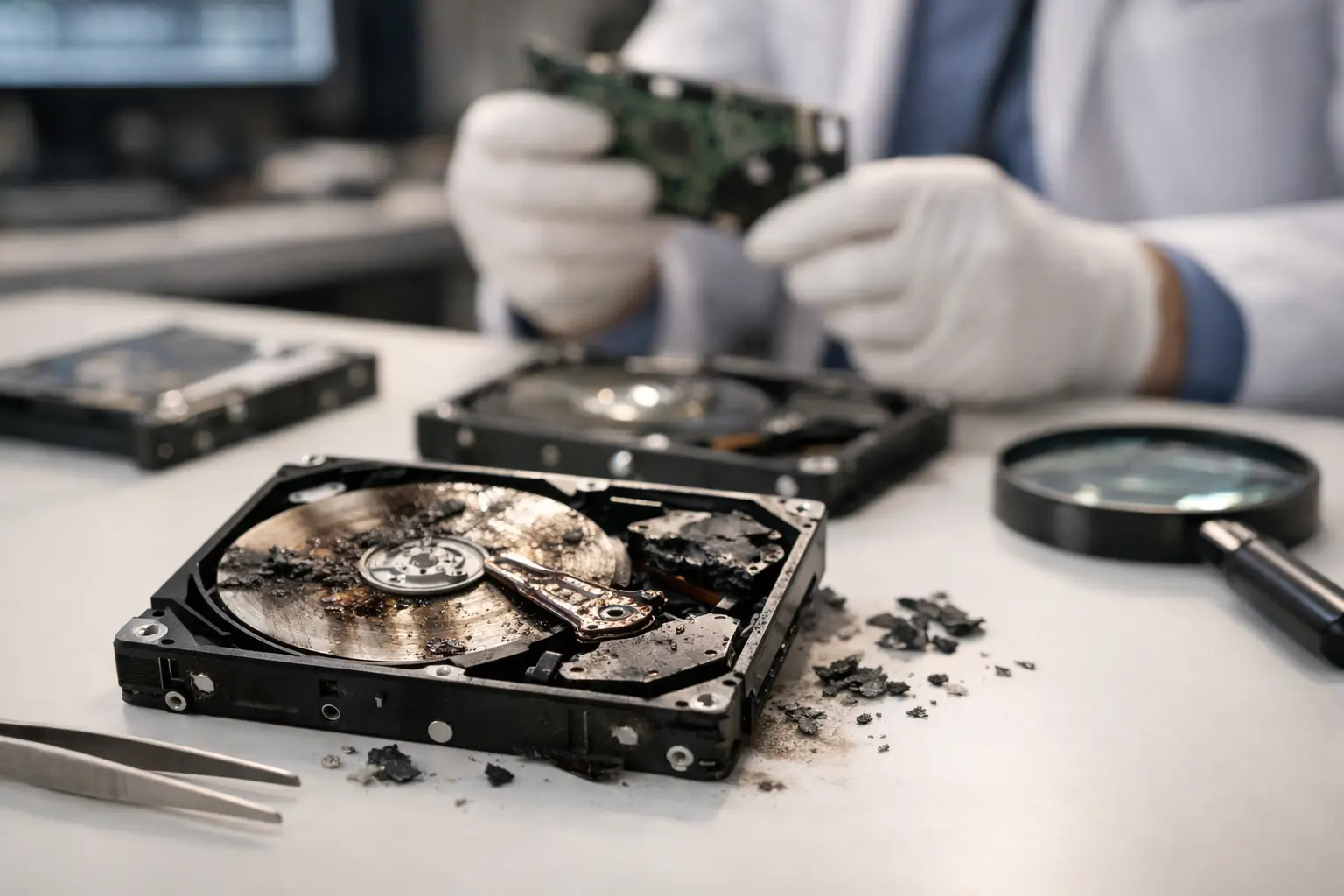
When a hard drive fails in the middle of a fraud inquiry, employee dispute or criminal defence matter, the question is rarely whether the data matters. The question is whether damaged hard drive evidence recovery can be carried out without compromising admissibility, chronology or confidence in the result. In legal and investigative work, that distinction is decisive.
A damaged drive is not simply an IT problem. It may contain emails, user documents, deleted material, internet history, application artefacts, file system metadata, encryption indicators and timestamps capable of supporting or undermining a case theory. If the device has been dropped, exposed to liquid, suffered electrical damage or developed internal mechanical faults, every action taken afterwards can affect what remains recoverable and how persuasive that recovery will be.
Why damaged hard drive evidence recovery must be forensic
In ordinary data recovery, the client usually wants their files back. In forensic work, the objective is different. The task is to preserve evidential integrity, document each stage of handling and recover data in a way that can be explained under scrutiny. That means the process must account not only for what is found, but how it was found, what condition the media was in, whether the recovery altered the source, and what limitations apply.
This matters because opposing parties, regulators and courts do not assess digital evidence on trust alone. They look at provenance, continuity and methodology. If a damaged hard drive has already been powered on repeatedly by office staff, opened by a general repair shop or connected through uncontrolled software tools, the evidential value may be weakened even where some data is still available.
The most common early mistake is treating a potentially evidential device as though it were routine business hardware. A well-meaning attempt to “see if it still works” can trigger further degradation, overwrite volatile areas, alter metadata or interfere with encryption states. In some cases, one additional power cycle is enough to reduce the prospect of a complete forensic image.
What damage means for evidence
Not all hard drive damage presents the same forensic problem. A logical issue, such as file system corruption or accidental deletion, is different from physical damage involving read/write heads, platters or controller components. There are also mixed scenarios, where the drive has physical instability and logical corruption at the same time.
From an evidential perspective, the type of damage affects both strategy and risk. A drive with bad sectors may still allow partial imaging, but that image may contain gaps that need to be disclosed and interpreted carefully. A drive with mechanical failure may require controlled specialist intervention before any imaging can begin. A drive affected by malware, sabotage or deliberate wiping may call for a different line of analysis altogether, because the issue is not merely failure but contested activity.
This is why legal teams and businesses should resist broad assumptions such as “the data is gone” or “everything can be recovered”. The honest answer is usually more precise. Some evidence may be recoverable, some may be fragmentary, and some may remain inaccessible because of the condition of the media, encryption, prior handling or the architecture of the storage itself.
The first response often determines the outcome
The period immediately after a drive is discovered to be damaged is often the most consequential. If the matter may lead to litigation, disciplinary action, insurance proceedings or criminal investigation, the device should be isolated, labelled and its handling recorded from the outset. Basic continuity can become unexpectedly important months later when a party asks who had access, what was done and when.
Powering the device off and seeking specialist advice is usually the safest course, but context matters. If the device is part of a live incident response, a business continuity event or a machine linked to broader compromise, decisions may need to balance preservation against operational needs. That balance should be made consciously and documented, not improvised by whoever happens to be nearest the machine.
Chain of custody is not an administrative extra. It is part of the evidence. If the provenance of the drive becomes unclear, even a technically successful recovery may carry less weight than the client expects.
Damaged hard drive evidence recovery in practice
A proper forensic process begins with examination of the media condition, interface, make, model and reported failure history. The practitioner needs to understand whether the priority is immediate stabilisation, non-invasive imaging, targeted recovery, or referral for controlled physical intervention. The order matters because each stage can affect the next.
Where imaging is possible, the aim is usually to capture the contents in a forensically sound manner while preserving the original media from unnecessary further stress. Hash verification, contemporaneous notes and full auditability are central. If sectors are unreadable, that fact is recorded. If multiple imaging passes are attempted to improve completeness, that too should be documented. The report should not present an incomplete image as if it were whole.
If physical repair or component-level intervention is required, the forensic implications become even more sensitive. Work may need to be carried out in controlled conditions, and the examiner must be clear about what was done to facilitate access. Courts do not expect magic, but they do expect transparency. Any departure from ideal non-invasive acquisition needs to be justified, proportionate and properly explained.
Once data has been acquired, recovery is only one part of the task. The material then requires forensic interpretation. Recovered files without context can mislead. Timestamps may reflect copying rather than creation. User attribution may be contested. Deleted fragments may show presence without proving access or intent. In legal settings, these distinctions matter far more than raw volume.
Common evidential pitfalls after recovery
A recovered document is not automatically reliable simply because it was found on the drive. Lawyers and investigators need to know whether it was active, deleted, partially overwritten, cached, transferred from another source or reconstructed from fragments. Each scenario carries different evidential weight.
Equally, absence of evidence is not always evidence of absence. If a damaged area of the disk corresponds to a relevant date range, the inability to recover material may reflect media loss rather than proof that nothing existed. A disciplined expert report should make those limitations plain rather than overstate certainty.
There is also the issue of contamination by prior handling. If a client, employee or third party has run consumer recovery software before forensic instruction, that action may alter artefacts and generate fresh metadata. The examiner then has to separate original user activity from post-incident interference. That can be done in some cases, but it adds complexity and may narrow the conclusions available.
When the legal question is bigger than the hardware
Often, the drive itself is only one source of evidence. A damaged hard drive may sit within a wider evidential picture that includes cloud accounts, email servers, mobile devices, USB history, network logs or account access records. Focusing too narrowly on the failed disk can miss the broader narrative.
For example, in an employee departure matter, the real issue may be whether confidential data was accessed, copied or removed before the laptop later became unreadable. In a criminal matter, the question may be whether user activity can be attributed to the suspect, another household member or a remote actor. In a matrimonial or civil dispute, the significance may lie in chronology – when a file was created, altered, moved or concealed.
That is where specialist forensic reporting becomes more valuable than standalone recovery. Decision-makers need findings that connect technical evidence to the issues in dispute, set out limitations fairly and remain defensible if challenged in conference, cross-examination or expert discussion.
Choosing the right specialist
Not every recovery provider is equipped for evidential work. A provider may be technically capable of extracting files yet unable to support chain of custody, statement evidence, expert reporting or court scrutiny. That gap becomes obvious late in the process, usually when the stakes are highest.
For legal professionals and organisations dealing with disputed digital material, the better question is not simply “can you recover the data?” but “can you recover it in a manner that preserves its evidential value?” That includes independence, documentation, defensible methodology and clear explanation of what the evidence does and does not show.
Computer Forensics Lab approaches these matters on that basis – recovery as part of a forensic process, not as a generic technical service. That distinction is often what determines whether recovered data becomes useful evidence or merely a bundle of files.
A damaged drive can still contain critical truth, even when the hardware appears beyond normal use. The priority is to act early, preserve properly and ensure the recovery path is led by forensic judgement rather than guesswork.