

TL;DR:
- Tested incident response plans save organizations an average of $2.66 million per breach.
- Early legal involvement and privilege protection are crucial for effective cyber incident management.
- Regular simulations and cross-functional coordination enhance organisational resilience and response effectiveness.
Organisations with tested incident response plans detect breaches 54 days faster and save an average of $2.66 million per incident. Yet many UK legal and corporate teams still treat incident response as a compliance formality rather than a genuine business asset. That misreading is costly. Effective incident response protects your organisation’s legal position, accelerates containment, shields evidence from disclosure, and keeps regulators satisfied. This article unpacks exactly how it delivers those advantages and why getting it right matters far more than simply having a plan on paper.
Table of Contents
- Why incident response matters for UK legal and corporate teams
- Top operational and financial benefits
- Legal privilege and regulatory protection in incident response
- Building resilience: Preparation, detection, and cross-functional coordination
- Common pitfalls and how advanced IR avoids them
- A fresh perspective: Why incident response works when it is more than a checklist
- How to strengthen your incident response with expert support
- Frequently asked questions
Key Takeaways
| Point | Details |
|---|---|
| Faster breach detection | Robust incident response plans can detect threats up to 98 days faster, limiting harm. |
| Significant cost reduction | Effective incident response saves organisations millions in direct and indirect breach costs. |
| Stronger legal protection | Early legal team involvement in incident response shields evidence and supports regulatory compliance. |
| Resilience through practice | Regular testing and simulation ensure teams respond confidently and improve after each incident. |
| Fewer common pitfalls | Addressing gaps and learning from incidents reduces the risk of costly errors. |
Why incident response matters for UK legal and corporate teams
Cyber breaches are happening faster and with greater legal consequence than at any point in the past decade. Ransomware actors, insider threats, and supply chain compromises are accelerating. Regulatory bodies are watching closely, and courts are increasingly scrutinising how organisations respond when data is compromised.
For UK legal and corporate teams, incident response is not simply an IT concern. It sits at the intersection of law, regulation, reputation, and operational continuity. Understanding incident response in legal context means recognising that the decisions made in the first hours of a breach can shape litigation outcomes months or even years later.
Modern frameworks reinforce this. NIST SP 800-61r3 integrates incident response into the Cybersecurity Framework 2.0, providing structured guidance across preparation, detection, response, and recovery. The UK’s National Cyber Security Centre (NCSC) and Cyber Assessment Framework (CAF) mirror that approach, embedding incident response as a foundational control rather than an afterthought.
Key obligations that make incident response a legal priority in the UK include:
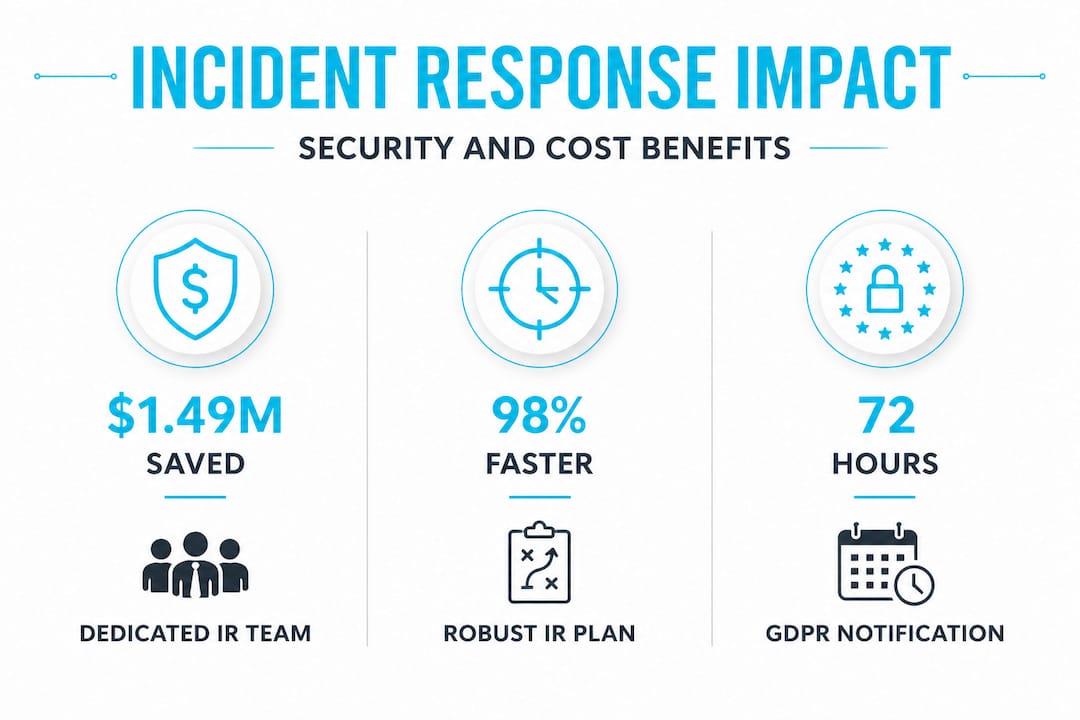
- GDPR 72-hour notification deadline: Organisations must notify the Information Commissioner’s Office within 72 hours of becoming aware of a personal data breach. Without a structured response process, that window closes before the scope is even understood.
- Legal privilege: Uncoordinated responses risk waiving privilege over communications and forensic findings, which can be used against you in litigation.
- Chain of custody: Evidence collected without proper forensic process may be inadmissible or challenged.
- Regulatory fines: The ICO can issue fines up to £17.5 million or 4% of global annual turnover under UK GDPR.
“Incident response is not a technical exercise. It is a legal, regulatory, and operational discipline that determines how well an organisation survives a crisis.”
For solicitors, in-house counsel, and corporate risk officers, those stakes make incident response a board-level conversation, not a helpdesk ticket.
Top operational and financial benefits
With the legal and organisational stakes established, it is worth examining what a well-executed incident response practice actually delivers in concrete operational and financial terms.
The data is striking. IBM reports that organisations with dedicated incident response teams save an average of $1.49 million per breach compared to those without. When artificial intelligence and automation are incorporated into the response process, the incident lifecycle shortens by 98 days, saving organisations nearly an additional $1 million per incident. These are not marginal improvements; they represent the difference between a manageable crisis and an existential one.

| Capability | Average saving or improvement |
|---|---|
| Dedicated IR team (vs no team) | $1.49M saved per breach |
| AI and automation in IR | 98-day shorter breach lifecycle |
| Tested IR plan (vs untested) | 54 days faster breach detection |
| Full IR plan with rehearsal | $2.66M average saving per incident |
For legal and corporate decision-makers, those figures translate directly into risk management. Consider how the incident response impact unfolds across the business: faster containment reduces the volume of data exfiltrated, which reduces both regulatory exposure and litigation risk. Quicker detection limits reputational damage because the organisation is seen to act decisively rather than discovering the breach weeks after the fact.
The operational benefits also include:
- Reduced downtime: Structured response processes restore services faster than ad hoc reactions.
- Clear communication channels: Pre-agreed escalation paths prevent confusion during high-pressure situations.
- Supplier and partner confidence: Demonstrating mature incident response capability reassures clients and third parties.
- Reduced insurance premiums: Some cyber liability insurers offer lower premiums to organisations with tested IR plans.
Pro Tip: Review your IR plan with both your IT and legal teams at least twice a year. Outdated contact lists and unclear escalation paths are among the most common causes of delayed response.
Containment speed is particularly important for legal and corporate clients because it directly limits the number of individuals whose data is affected. Fewer affected data subjects means fewer notification letters, reduced class action risk, and lower ICO scrutiny.

Legal privilege and regulatory protection in incident response
After exploring the financial case, it is worth examining the distinctly legal protections that structured incident response offers. This is where many organisations inadvertently harm their own position.
Legal privilege in incident response exists in two forms. Advice privilege protects confidential communications between a lawyer and client made for the purpose of legal advice. Litigation privilege applies when proceedings are reasonably anticipated and documents are created for the dominant purpose of those proceedings. Both can be preserved during a cyber incident, but only if the legal team is involved from the outset.
UK legal privilege in IR protects investigations, but early lawyer involvement is essential to shield forensic findings and evidence from later disclosure. Organisations that bring legal counsel in after the technical team has already prepared reports and shared findings risk losing that protection entirely.
Practical steps to preserve privilege during incident response:
- Instruct legal counsel immediately when an incident is confirmed or even suspected. The forensic investigation should ideally be commissioned through or in consultation with your lawyers.
- Label documents carefully: Communications and reports created during the investigation should be clearly marked as privileged and created for the purpose of legal advice or anticipated litigation.
- Limit distribution of forensic reports: Do not circulate draft findings beyond those who need them for legal advice purposes. Wide distribution weakens privilege claims.
- Brief the forensic team on privilege boundaries: Digital forensics specialists engaged through legal channels are better positioned to structure their findings to support privilege claims.
- Meet the GDPR 72-hour deadline: A structured IR plan with legal input ensures that the notification decision is made with proper legal advice and documented reasoning, which matters if the ICO later scrutinises your response.
| Regulatory obligation | Deadline | Consequence of failure |
|---|---|---|
| ICO breach notification (UK GDPR) | 72 hours from awareness | Fines up to £17.5M or 4% of turnover |
| NIS Regulations (critical infrastructure) | As soon as practicable | Fines up to £17M |
| PCI DSS breach notification | Immediately upon awareness | Card scheme fines and loss of processing rights |
The legal approach to data breaches must combine technical forensic rigour with procedural discipline. A forensically sound investigation that is legally unprotected can be weaponised against the organisation in subsequent proceedings.
Pro Tip: Never let technical staff send forensic findings directly to management or regulators without legal review. That single step is one of the most common causes of unintended privilege waiver.
Building resilience: Preparation, detection, and cross-functional coordination
With privilege and regulatory protection addressed, it is time to consider how incident response builds lasting organisational resilience. This goes well beyond having a plan in a drawer.
The NCSC emphasises preparing for severe threats through the CAF, which includes mapping critical systems and rehearsing isolation procedures. The message from the NCSC is directed at leaders, not just IT teams: senior executives must understand the organisation’s critical assets and be ready to make decisions under pressure.
Effective preparation involves:
- Asset mapping: Knowing which systems are critical and which data is most sensitive before an incident occurs.
- Pre-agreed playbooks: Documented response procedures for common incident types such as ransomware, data exfiltration, and insider threat.
- Defined roles and responsibilities: Every team member should know exactly what they are expected to do during an incident. Confusion wastes hours.
- Communication templates: Pre-drafted notifications for regulators, customers, and the media reduce errors during high-pressure moments.
- Vendor and partner contacts: Having pre-established relationships with forensic specialists, legal counsel, and PR advisers removes the scramble to identify suppliers mid-crisis.
Cross-functional coordination between IT, legal, and executive teams is essential. The research is clear: 80% of senior leaders report that incident simulations significantly improve team understanding of roles and responsibilities. That statistic should drive a change in how organisations approach preparation.
“Simulation exercises are not a box to tick. They expose the real gaps in your plan and build the muscle memory that makes your team effective when it genuinely matters.”
The incident response procedures that work in practice are those that have been tested, challenged, and refined through realistic exercises. Tabletop simulations, red team exercises, and live drills each reveal different categories of failure. Organisations that combine all three build genuinely robust resilience.
Post-incident reviews are equally important. Each incident, however small, provides intelligence that should feed back into the plan. Teams that treat every event as a learning opportunity consistently outperform those that treat incident response as a one-time project.
Pro Tip: Run at least one tabletop simulation per year that specifically includes your legal, communications, and executive teams. IT-only exercises miss the most consequential decision points.
Common pitfalls and how advanced IR avoids them
Even organisations with formal incident response plans frequently fall short when a real incident occurs. Understanding the most common failures helps legal and corporate teams ask better questions of their own advisers and service providers.
The most significant technical vulnerability remains unpatched systems. Vulnerability exploitation is the primary attack vector in 32 to 39% of breaches, with attackers moving from initial access to data exfiltration in as little as 72 minutes. An organisation whose incident response plan is excellent on paper but whose patch management is poor is still exposed to rapid, damaging attacks.
Common incident response pitfalls include:
- Untested plans: A plan that has never been exercised under realistic conditions will fail when pressure is highest. Teams will not know their roles, contact lists will be outdated, and decisions will be delayed.
- Poor communication protocols: Without pre-agreed escalation routes, critical information gets stuck in email chains or is communicated verbally without documentation, creating both operational delays and evidentiary problems.
- Absence of legal counsel in the first hours: As discussed, this is one of the costliest mistakes. Legal privilege cannot be retrofitted once reports have been distributed.
- No post-incident review: Post-incident reviews feed continuous improvement. Organisations that skip this step repeat the same mistakes in subsequent incidents.
- Isolated IT response: Treating the incident as purely technical prevents the broader organisational learning and legal coordination that determines long-term outcomes.
“Untested plans give organisations false confidence. The real test of an incident response programme is not whether it looks good in a policy document, but whether it functions under genuine crisis conditions.”
Advanced incident response avoids these pitfalls through regular simulation, continuous patch and vulnerability management, and deeply embedded cross-functional practice. The UK cybersecurity best practices that separate resilient organisations from vulnerable ones are almost always rooted in discipline and repetition rather than technology alone.
A fresh perspective: Why incident response works when it is more than a checklist
Most organisations approach incident response as a compliance requirement. They commission a plan, file it, and revisit it at the next audit cycle. That approach produces documents, not capability.
The genuine value of incident response only emerges when it is treated as a living process that the whole organisation practises, challenges, and improves. The legal privilege protections outlined earlier are not automatic; they require coordinated involvement of legal counsel from the very first moments of an incident. The financial savings depend on speed, and speed depends on rehearsal. The regulatory compliance benefits are only achievable if the 72-hour notification pathway has been mapped, assigned, and tested before the incident occurs.
What we observe repeatedly in our work is that organisations which lose privilege, miss notification deadlines, or suffer prolonged outages share a common characteristic: their incident response existed on paper but not in practice. The disconnect between policy and reality is where the real cost accumulates.
There is also a strategic dimension that many firms overlook. An organisation that responds to a breach with speed, legal discipline, and clear communication does not just limit its losses; it actively builds trust with clients, regulators, and the court. A demonstrably well-managed response can mitigate regulatory sanction, reduce litigation exposure, and preserve commercial relationships that might otherwise be irreparably damaged. Incident response, properly executed, is not just about surviving a crisis. It is about emerging from it in a stronger position than your competitors who were less prepared.
How to strengthen your incident response with expert support
Putting best-practice incident response into action requires more than good intentions. It demands forensic expertise, legal coordination, and proactive preparation that many organisations are not equipped to deliver internally.
Computer Forensics Lab works with legal teams, corporate clients, and law enforcement across the UK to provide the technical rigour and evidential discipline that effective incident response demands. Our digital forensics services are designed to support both reactive investigation and proactive readiness. From forensic digital footprint analysis to full-scale digital forensic investigations, we operate in a way that preserves legal privilege, maintains chain of custody, and meets the evidential standards required for litigation. If you want your incident response to deliver its full legal and commercial value, we are ready to help.
Frequently asked questions
How does incident response save money during a cyber breach?
Organisations with incident response teams save up to $1.49M per breach by shortening detection and containment time, reducing the overall volume of data compromised and limiting downstream legal and regulatory costs.
What are the main legal benefits of involving lawyers early in incident response?
Early legal involvement secures both advice and litigation privilege, meaning forensic findings and internal communications are protected from disclosure. It also ensures the GDPR 72-hour notification decision is made with proper legal guidance and documented reasoning.
How does regular testing and simulation improve incident response?
Simulation exercises reveal gaps in plans, clarify individual roles, and build the team coordination that translates directly into faster, more effective real-world responses. 80% of senior leaders report that simulations significantly improve their team’s understanding of responsibilities during a live incident.
Does incident response help with regulatory requirements like GDPR?
A structured incident response plan maps and assigns the notification pathway in advance, making it far more achievable to meet the GDPR’s 72-hour reporting requirement and document the decision-making process in a way that satisfies ICO scrutiny.