Every major breach of the last decade falls into one of four patterns: supply‑chain compromise, cloud identity abuse, mass record exposure, or ransomware against critical infrastructure. Yahoo, Equifax, Marriott, SolarWinds, the Storm‑2949 cloud intrusion and the Change Healthcare ransomware attack each illustrate one of these patterns clearly. These cases are examined below with forensic detail showing not just what happened, but how investigators pieced it together.
TL;DR:
- Most breaches rely on legitimate access and credential abuse, with password theft and cloud identity misuse being common methods.
- Supply-chain attacks like SolarWinds and ChainDrop demonstrate how trusted software and code-signing compromise can propagate malware widely.
- Cloud resource access abuse often mimics normal administrative activity, making anomaly-based detection and proper permission management critical.
- Rapid evidence preservation within the first 72 hours is vital, focusing on logs, secrets, and persistence markers before attacker cleanup begins.
- Regularly testing backup recovery procedures and enforcing multi-factor authentication can significantly reduce the impact and likelihood of successful breaches.
Table of Contents
- Notable cyber security breach examples and what they teach
- What attack vectors keep reappearing across these breaches?
- How much do breaches actually cost, in data, downtime and fines?
- What do forensic investigators look for first?
- What practical steps actually reduce breach risk?
- How our forensic team approaches breach evidence
- How Computer Forensics Lab can help after a breach
- Sources
Notable cyber security breach examples and what they teach
The incidents below span nearly a decade, but they share a common thread: attackers rarely need to break anything. They log in, wait, and use whatever legitimate access they can find. Each entry lists the attack vector, the scale of exposure, and the single most useful lesson it offers.
-
Yahoo (2013–2014, disclosed 2016). State‑sponsored actors compromised Yahoo’s user database using forged cookies and stolen cryptographic keys, exposing details from roughly three billion accounts across two separate intrusions. The breach stayed hidden for years because Yahoo’s logging did not flag the forged authentication tokens as anomalous. Lesson: authentication artefacts need active monitoring, not just retention.
-
Equifax (2017). An unpatched Apache Struts vulnerability in a consumer complaint web portal gave attackers a foothold that persisted undetected for 76 days, ultimately exposing Social Security numbers, birth dates and addresses for around 147 million people. The vulnerability had a patch available months before exploitation began. Lesson: patch management failures are rarely about awareness. They are about prioritisation and asset inventory gaps that let a known CVE sit unaddressed on a public‑facing system.
-
Marriott/Starwood (2014–2018, disclosed 2018). Attackers accessed Starwood’s guest reservation database years before Marriott completed its acquisition, and the compromise carried over into the merged systems, ultimately touching around 500 million guest records including passport numbers and payment card data for a smaller subset. The case shows how merger due diligence rarely extends deep enough into a target company’s existing forensic exposure. Lesson: acquiring a company means inheriting its unresolved intrusions, not just its assets.
-
SolarWinds (2020). Nation‑state actors inserted malicious code into the Orion network management platform’s build process, distributing a trojanised update to roughly 18,000 customers, including US federal agencies. This is the reference case for supply‑chain compromise: attackers did not breach each victim directly, they compromised one vendor’s build pipeline and let legitimate software updates carry the payload. Lesson: trust in vendor software has to be verified through code‑signing integrity and build‑environment monitoring, not assumed because the update came through official channels.
-
Storm‑2949 cloud breach. This campaign turned a single compromised identity into a sprawling cloud intrusion by abusing legitimate Azure administrative functions, including Key Vault access, RBAC role assignment and storage account key retrieval, to move laterally through Microsoft 365 and Azure resources. No malware was needed once the attacker held valid credentials. Lesson: cloud breaches increasingly look like normal administrative behaviour, which means detection has to focus on anomalous use of legitimate permissions rather than malware signatures.
-
ChainDrop npm supply‑chain worm. Attackers used stolen publishing tokens to inject malicious preinstall hooks into hundreds of npm packages, creating a self‑propagating worm that harvested developer credentials and republished infected releases automatically. Each infected package became a new distribution point without any further attacker action. Lesson: a single compromised CI/CD credential can cascade across an entire software ecosystem, which makes token isolation and package provenance checks essential, not optional.
-
Change Healthcare/McKesson (2024–2026). A ransomware attack against Change Healthcare disrupted pharmacy and claims processing across the US healthcare system for weeks, and related reporting on cloud‑based healthcare platforms describes social‑engineering attacks against Okta accounts used to reach connected Salesforce and Snowflake environments. Reporting indicates the Change Healthcare incident alone affected data belonging to 190 million Americans. Lesson: healthcare’s reliance on a small number of centralised claims processors means one compromised vendor can stall an entire national payment pipeline.
-
Ticketmaster/Live Nation (2024). Attackers accessed a third‑party cloud database provider used by Ticketmaster, exposing customer records including partial payment details for hundreds of millions of accounts. The breach reached public attention only after stolen data appeared for sale on a criminal forum. Lesson: outsourcing data storage to a cloud provider does not outsource the liability, and breach detection often depends on external threat intelligence rather than internal alerting.
-
National Public Data breach (2024). A background‑check data broker suffered exposure of Social Security numbers and personal records affecting a huge share of the US population, reportedly through a scraped or leaked database rather than a sophisticated intrusion. The company’s limited security investment for the sensitivity of data it held became the central criticism. Lesson: organisations holding aggregated sensitive data carry a security obligation disproportionate to their size or public profile.
-
Capital One (2019). A former cloud engineer exploited a misconfigured web application firewall to access over 100 million customer records stored in Amazon Web Services buckets. The misconfiguration allowed a server‑side request forgery attack to retrieve temporary security credentials. Lesson: cloud misconfiguration remains one of the most common and preventable causes of large exposures, and insider knowledge of infrastructure sharply increases the risk.
-
British Airways (2018). Attackers injected malicious JavaScript into the airline’s payment page through a compromised third‑party script, skimming card details from roughly 400,000 transactions in real time. The technique, known as a Magecart‑style attack, required no direct breach of BA’s core systems at all. Lesson: front‑end supply‑chain risk from third‑party scripts is as dangerous as backend vulnerabilities, and it is far less commonly monitored.
-
LastPass (2022). Attackers compromised a senior engineer’s home computer, using it to access cloud storage containing encrypted customer vault backups and source code. A second breach months later exploited credentials stolen in the first. Lesson: a single unremediated intrusion often becomes the launchpad for a follow‑on breach if scope containment is incomplete the first time round.
What attack vectors keep reappearing across these breaches?
Across all twelve cases, the technical method varies but the underlying pattern repeats: attackers find the path of least resistance, and it is rarely a zero‑day exploit.
- Phishing and credential theft. Storm‑2949 and the Change Healthcare related incidents both began with compromised identities rather than malware, giving attackers valid credentials that bypassed perimeter defences entirely.
- Supply‑chain compromise. SolarWinds and ChainDrop show two versions of the same idea: corrupt a trusted distribution channel once, and every downstream user inherits the compromise automatically.
- Cloud identity and management‑plane abuse. Storm‑2949’s use of Azure Key Vault access and RBAC role assignment demonstrates how administrative features designed for legitimate operations become attack tools once credentials are stolen.
- Unpatched vulnerabilities. Equifax’s Apache Struts flaw sat unpatched for months. Vulnerability data shows exploitation remains concentrated in a limited set of known CVEs rather than exotic new flaws.
- Insider misuse or negligence. Capital One’s breach depended on insider knowledge of AWS infrastructure; LastPass depended on a compromised personal device with corporate access.
- Ransomware against critical infrastructure. Change Healthcare’s disruption shows how ransomware against a single processing hub can cascade into a national operational crisis.
Standard perimeter defences often miss these vectors precisely because they exploit legitimate functionality. A firewall does not flag a valid RBAC role assignment as malicious, and an endpoint antivirus tool has nothing to detect when a CI/CD preinstall script runs with developer-level trust.
Pro Tip: If your organisation cannot answer “who has access to our cloud management plane, and would we notice if that access were misused?” within a few minutes, that gap is your most likely breach vector, not an exotic external threat.
How much do breaches actually cost, in data, downtime and fines?
Breach impact splits into four measurable categories, and the figures for each vary enormously between incidents. Records exposed is the headline figure everyone quotes, but it rarely captures the full cost.
Operational disruption often outlasts the headline. Change Healthcare’s ransomware incident stalled pharmacy claims processing for weeks across the US healthcare system, a scale of interruption that dwarfs the cost of the ransom itself. SolarWinds forced thousands of organisations into emergency incident response, auditing every system the compromised Orion update had touched, regardless of whether that specific customer was actually targeted for follow‑on exploitation.
The NCSC reports that the UK experiences multiple nationally significant cyber attacks every week, a frequency that makes breach preparedness a baseline operational requirement rather than a contingency plan for the unlucky.
Regulatory and legal consequences add a separate layer of cost, often arriving years after the technical incident closes. The FTC’s landmark privacy enforcement action set a benchmark for how regulators treat systemic data mishandling, and equivalent enforcement regimes exist across other jurisdictions. In the UK, reporting obligations and enforcement mechanisms sit within the framework the Data (Use and Access) Act 2025 is now implementing, which shapes how organisations must disclose and respond to incidents going forward.
Follow‑on harm is the category most often underestimated. Customers whose Social Security numbers were exposed in Equifax or National Public Data face years of elevated fraud risk, not a one‑off inconvenience. Ecosystem harm from SolarWinds and ChainDrop extended to organisations that never interacted with the original attacker directly, simply because they trusted a compromised software supplier.


What do forensic investigators look for first?
The first hours after a suspected breach determine whether an investigation can reconstruct what actually happened or ends up guessing from incomplete fragments. Cloud intrusions like Storm‑2949 leave a different evidence trail than on‑premises malware, and investigators need to know which artefacts to preserve before they are overwritten by retention policies or attacker cleanup.
Priority artefacts include:
- Cloud audit trails, such as Azure Activity Logs or equivalent platform logging, which often reveal lateral movement that endpoint logs never capture.
- Key Vault and secrets‑management access logs, showing exactly which credentials were retrieved and when.
- CI/CD job history and pipeline logs, essential in supply‑chain cases where a compromised preinstall script can propagate silently across builds.
- Preinstall and postinstall script contents, since supply‑chain worms frequently hide their payload inside routine package installation hooks.
- Persistence markers, including new service principals, scheduled tasks, or added RBAC role assignments that outlast the initial access point.
Chain of custody matters as much in a cloud breach as in a physical evidence seizure. If logs are exported, copied, or analysed without a documented, verifiable process, a court or regulator may later question whether the evidence was altered, which can undermine an otherwise sound investigation. Evidence preservation should be treated as the first action, not an afterthought that happens once the technical picture looks stable.
In the first 24 to 72 hours, investigators typically want answers to a short set of questions: which accounts showed anomalous authentication activity, which secrets or keys were accessed and by whom, whether any CI/CD tokens were used from an unfamiliar location, and whether attacker persistence has already been established beyond the initial point of entry. A structured investigation into a data breach follows this sequence deliberately, because skipping ahead to remediation before scope is understood often means missing a second foothold the attacker left behind.
Pro Tip: Revoke and rotate suspected compromised credentials immediately, but capture forensic images or exported logs first wherever feasible. Rotating a key before preserving its access history destroys the very evidence that would show how it was misused.
What practical steps actually reduce breach risk?
Every incident above maps to a specific, addressable gap. Turning those lessons into a working checklist means matching the mitigation to the vector that actually caused the damage, not applying generic security advice indiscriminately.
- Enforce phishing‑resistant multi‑factor authentication across all administrative and cloud management accounts, since credential compromise underpinned both Storm‑2949 and the healthcare‑sector cloud intrusions.
- Apply privileged access management with time‑limited elevation, so a compromised identity cannot retain standing access to Key Vault, RBAC assignment, or storage account keys indefinitely.
- Govern the software supply chain, including code‑signing verification and vendor build‑pipeline audits, directly addressing the SolarWinds and ChainDrop pattern.
- Lock down CI/CD secrets with short‑lived tokens and mandatory revocation on suspected compromise, since a single stolen publishing token propagated the npm worm automatically.
- Invest in anomaly‑based logging rather than signature‑based detection alone, because cloud breaches increasingly look like legitimate administrative activity.
- Test backup and recovery procedures regularly against a ransomware scenario, not just a hardware‑failure scenario, given how long Change Healthcare’s disruption lasted.
For individuals, the checklist is shorter: use a password manager with unique credentials per service, enable multi‑factor authentication wherever it is offered, and monitor credit files after any breach notification involving Social Security or national insurance numbers. Organisations that suspect an active compromise should prioritise containment and evidence preservation over public communication, since premature disclosure without a clear scope often creates more legal exposure than the delay itself. Incident response strategies built around this sequence tend to hold up far better under later scrutiny.
How our forensic team approaches breach evidence
Reconstructing a breach honestly means resisting the urge to explain it before the evidence supports the explanation. Every case above, from Equifax’s unpatched Struts flaw to Storm‑2949’s abuse of legitimate Azure permissions, looked different in the first hours than it did once investigators traced the full timeline. That gap between initial assumption and confirmed fact is where most investigations either succeed or quietly go wrong.
Computer Forensics Lab’s priority in any suspected breach is preservation before analysis: capturing volatile cloud logs, access records and system states before retention policies or attacker cleanup erase them. Scope containment comes next, because a breach that looks isolated to one account often reveals a second or third compromised credential once the log trail is followed properly. This discipline draws on the same forensic principles used in wider cybersecurity forensics work across legal and corporate investigations.
If your organisation suspects a breach, the value of an early, structured investigation is rarely appreciated until the alternative, a rushed internal review that misses the actual entry point, has already happened. Seek qualified forensic support before evidence degrades, not after.
— Computer
How Computer Forensics Lab can help after a breach
Every case examined above eventually needed the same thing: a forensic team that could establish exactly what happened, when, and through which vector, in a way that would stand up to scrutiny from regulators, courts or insurers. That is the gap filled for organisations and legal teams facing a suspected compromise, cloud identity abuse or ransomware event.
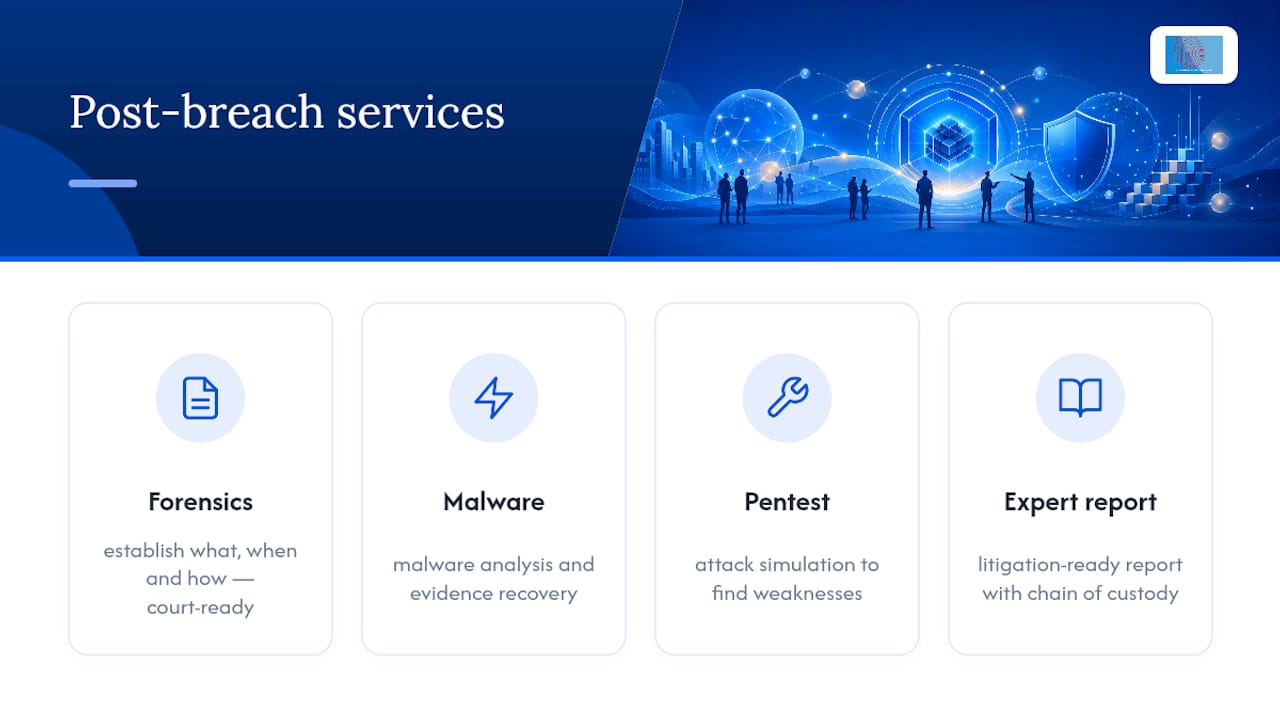
Services include digital forensic investigations, mobile and cloud data recovery, malware analysis, penetration testing and expert witness reporting with a documented chain of custody throughout. Cloud environments increasingly reflect the same administrative‑feature abuse seen in incidents like Storm‑2949, a pattern also explored in research on cloud data privacy and administrative controls, which makes early, specialist log analysis essential rather than optional.
If you suspect a breach, need to recover lost or deleted evidence, or require an expert report for litigation, get in touch through our digital forensics services page to discuss your case with our investigators.

Sources
The technical detail in this article draws on Microsoft’s published analyses of the Storm‑2949 cloud breach and the ChainDrop npm supply‑chain worm, alongside gov.uk guidance on the Data (Use and Access) Act 2025 and NCSC reporting on national attack frequency. Reuters and TechCrunch reporting on healthcare‑sector cloud compromises, and Statista’s aggregated vulnerability data, provided additional grounding for the impact and vector analysis throughout.
- How Storm-2949 turned a compromised identity into a cloud-wide breach | Microsoft Security Blog
- ChainDrop supply chain compromise: Anatomy of a self‑propagating worm | Microsoft Security Blog
- Gov
- UK experiencing four nationally significant cyber attacks weekly | NCSC