

Bold courtroom battles over cybercrime charges in London often hinge on the subtle power of electronic communication. For criminal defence lawyers, understanding how email evidence can shape legal outcomes is crucial. Emails carry both visible messages and hidden metadata, and careful forensic analysis can unravel timelines, reveal intent, and expose critical digital footprints. Grasping these methods helps legal professionals protect their clients and challenge digital accusations with confidence.
Table of Contents
- Defining Email Evidence And Forensic Analysis
- Types And Core Features Of Email Evidence
- How Forensic Analysis Uncovers Key Details
- Legal Standards For Admissibility And Reliability
- Risks Of Mishandling Digital Email Evidence
- Expert Roles And Best Practices For Defence
Key Takeaways
| Point | Details |
|---|---|
| Importance of Email Evidence | Email evidence is vital in legal investigations, requiring careful forensic analysis to ensure reliability. |
| Forensic Analysis Stages | The process includes identification, collection, preservation, analysis, and documentation of email communications. |
| Risks of Mishandling Evidence | Improper management can lead to data corruption and potential court rejection, highlighting the need for strict protocols. |
| Role of Forensic Experts | Digital forensic experts provide critical analysis, validate methodologies, and ensure fairness in legal proceedings. |
Defining email evidence and forensic analysis
Email evidence represents a critical category of digital information that plays a pivotal role in modern legal investigations. These electronic communications contain intricate details that can substantiate or challenge legal arguments in criminal defence scenarios.
Forensic analysis of email evidence involves a systematic, methodical approach to examining electronic communications. Forensic examination of digital evidence requires meticulous adherence to established principles that ensure the integrity and admissibility of digital records. The process encompasses several key stages:
- Identification of relevant digital communications
- Collection of electronic data without compromising its original state
- Preservation of email records to maintain forensic integrity
- Analysis of communication patterns, metadata, and content
- Documentation of all investigative processes and findings
The International Standards Organisation (ISO) provides crucial guidelines for digital evidence handling. Digital evidence standards emphasise the importance of maintaining the original data’s authenticity throughout the forensic investigation. This means forensic experts must work on precise copies of the original evidence, ensuring no inadvertent modifications occur during examination.
Criminal defence lawyers must understand that email forensics goes beyond simple data retrieval. It involves complex techniques to extract meaningful insights while preserving the legal standing of the evidence. Forensic experts use sophisticated tools and methodologies to:
- Recover deleted emails
- Analyse communication timelines
- Verify sender and recipient authenticity
- Extract hidden metadata
- Reconstruct communication sequences
Metadata serves as a crucial component in email forensic analysis. These hidden layers of information can reveal critical details such as transmission times, device origins, and potential alterations that might not be immediately visible in the email’s content.
Pro tip: Always consult a certified digital forensics expert when email evidence could be pivotal to your defence strategy, as professional analysis can uncover nuanced details that might significantly impact legal proceedings.
Types and core features of email evidence
Email evidence represents a complex digital artifact with multiple dimensions that criminal defence lawyers must thoroughly understand. Digital evidence characteristics demonstrate the intricate nature of electronic communications that can significantly impact legal proceedings.
Email evidence comprises two primary categories of information:
- Content Data: Actual text of messages, attachments, and communication substance
- Metadata: Hidden layers of information including:
- Transmission timestamps
- IP addresses
- Sender and recipient details
- Email routing information
- Device identification markers
These digital records are characterised by unique forensic properties that distinguish them from traditional evidence. They are inherently volatile, capable of crossing jurisdictional boundaries instantaneously, and can exist across multiple platforms including personal computers, mobile devices, and cloud storage services.
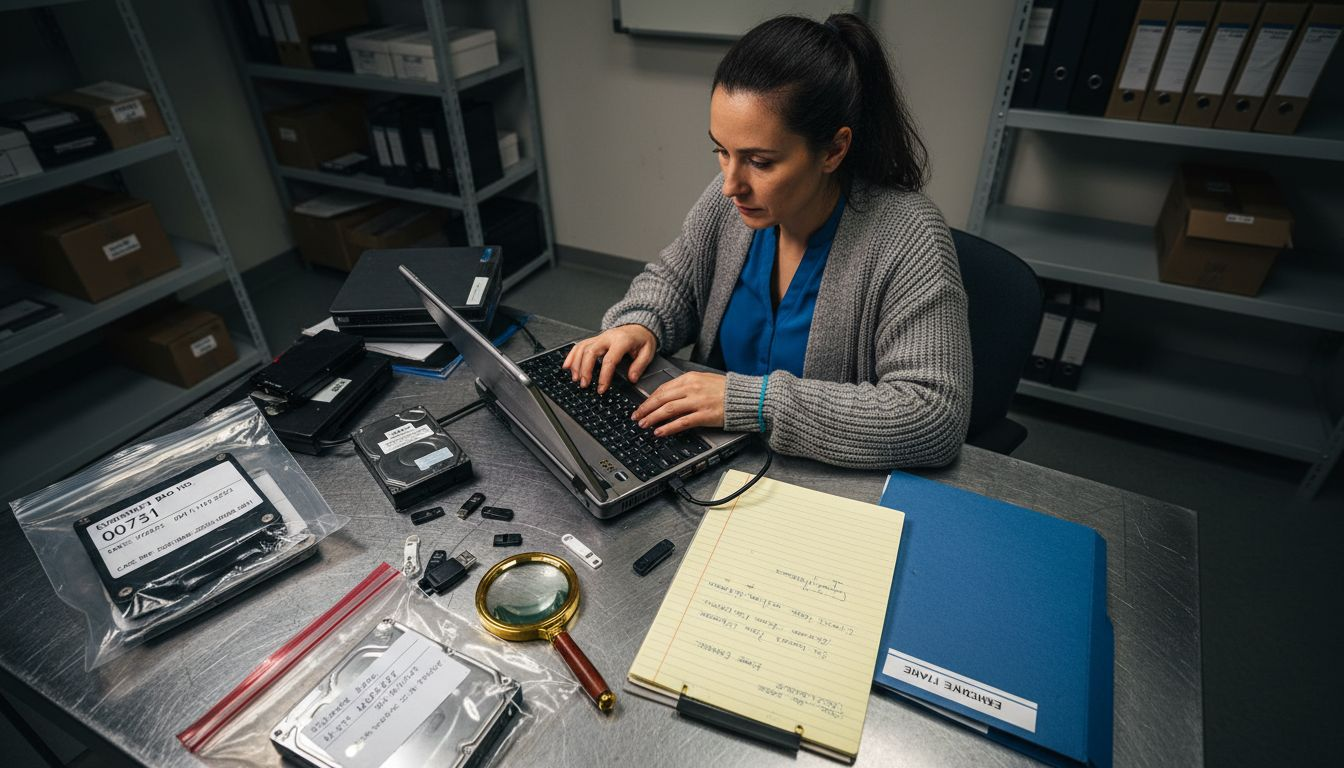
The following table contrasts content data and metadata in email evidence:
| Attribute | Content Data | Metadata |
|---|---|---|
| Visibility | Readable message text and attachments | Hidden from standard email view |
| Forensic Value | Reveals communication substance | Confirms authenticity and origins |
| Tamper Susceptibility | Easy to forge or edit | More difficult to alter without trace |
| Analysed Details | Message body, attachments | Timestamps, IP, device identifiers |
| Legal Role | Key to arguments or intent | Validates integrity and timeline |
Forensic experts recognise two primary types of digital footprints within email evidence:
- Active Data: Deliberately created information
- Passive Data: Unintentional technical traces
The fragile nature of digital evidence requires meticulous handling. Digital evidence forensic processes emphasise the importance of preservation, recognising that electronic records can be easily altered or inadvertently modified during investigation.
Contextual Analysis plays a crucial role in interpreting email evidence. Beyond simple message content, forensic experts examine communication patterns, frequency, tone, and contextual relationships that might reveal underlying motivations or establish critical timelines in legal cases.
Electronic communications are not just messages, but complex digital narratives waiting to be carefully decoded.
Pro tip: Engage a certified digital forensics expert early in your investigation to ensure proper evidence preservation and comprehensive analysis of email communications.
How forensic analysis uncovers key details
Forensic analysis provides criminal defence lawyers with a sophisticated toolkit for extracting critical insights from email communications. Digital evidence acquisition techniques enable investigators to uncover layers of information far beyond surface-level message content.
The forensic investigation process involves multiple sophisticated approaches to revealing hidden details:
- Timestamp Analysis: Reconstructing precise communication chronologies
- Sender Verification: Authenticating digital identity markers
- Routing Trace: Mapping communication pathways
- Attachment Examination: Revealing embedded file metadata
- Encryption Decryption: Penetrating protected communication layers
Forensic experts employ advanced computer science methodologies to systematically evaluate digital communications. They can recover seemingly deleted emails, identify subtle modifications, and trace intricate communication patterns that might otherwise remain invisible.
Key investigative techniques include:
- Cryptographic Authentication: Verifying message origins
- Metadata Extraction: Uncovering hidden communication contexts
- Pattern Recognition: Identifying behavioural communication signatures
- Temporal Sequencing: Establishing precise interaction timelines
- Digital Reconstruction: Reassembling fragmented communication evidence
Forensic analysis techniques go beyond simple data retrieval, transforming raw electronic information into comprehensible legal narratives. These methods ensure that digital evidence maintains its integrity and reliability throughout the investigative process.
Digital forensics transforms electronic whispers into articulate legal testimony.
Pro tip: Collaborate closely with digital forensics specialists who understand both technological complexities and legal evidence standards to maximise the investigative potential of email communications.
Legal standards for admissibility and reliability
Email evidence must meet stringent legal standards to be considered admissible in court. Forensic digital evidence guidelines establish critical protocols for ensuring the integrity and reliability of electronic communications during legal proceedings.
Key requirements for email evidence admissibility include:
- Chain of Custody: Documented tracking of evidence from collection to presentation
- Forensic Integrity: Preservation of original data without modification
- Expert Verification: Examination by qualified forensic professionals
- Technological Transparency: Clear documentation of analysis methods
- Source Authentication: Proving the legitimate origin of digital communications
Courts apply rigorous scrutiny to digital evidence, assessing multiple dimensions of reliability. International digital evidence standards highlight the complexity of establishing legal credibility across different jurisdictional frameworks.
The admissibility assessment typically involves evaluating:
- Lawful Acquisition: Demonstrating legal methods of evidence collection
- Technical Competence: Proving examiner expertise
- Reproducibility: Ability to replicate forensic analysis
- Data Preservation: Maintaining original evidence integrity
- Technological Neutrality: Using standardised forensic protocols
Digital evidence must speak the language of legal truth without technological bias.
Pro tip: Always engage forensic experts who can provide comprehensive, court-ready documentation that transparently explains their entire investigative methodology.
Risks of mishandling digital email evidence
Digital evidence requires meticulous handling to maintain its legal integrity. Digital evidence handling protocols highlight the critical importance of preventing data contamination or inadvertent modification during forensic investigations.
Potential risks of improper email evidence management include:
- Data Corruption: Permanent alteration of original electronic records
- Chain of Custody Breakdown: Loss of evidence tracking and authentication
- Metadata Destruction: Elimination of critical contextual information
- Evidential Invalidity: Potential court rejection of compromised digital materials
- Investigative Prejudice: Undermining legitimate legal proceedings
Forensic experts must navigate multiple complex challenges when processing digital communications. Forensic examination challenges demonstrate the intricate nature of preserving electronic evidence’s integrity.
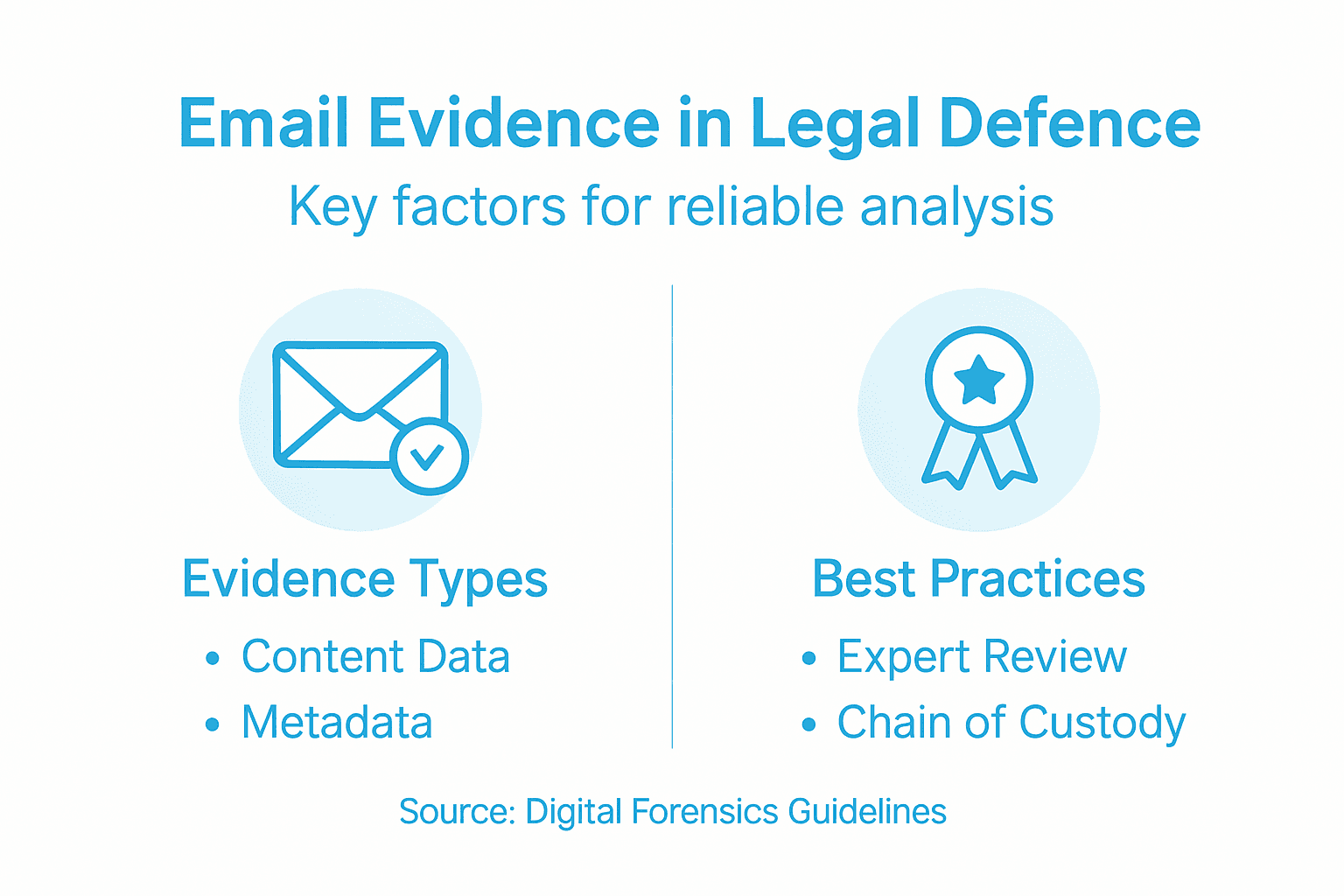

The most significant risks can be categorised into several critical domains:
Here is a summary of common risks when handling digital email evidence and their possible consequences:
| Risk Category | Example Issue | Potential Consequence |
|---|---|---|
| Technical | Unintentional data change | Loss of forensic authenticity |
| Procedural | Incomplete documentation | Evidence chain breaks in court |
| Legal | Lacking admissibility proof | Evidence rejected during trial |
| Analytical | Misinterpreted communication | Incorrect case conclusions |
| Preservation | Inadequate data backup | Permanent loss of crucial records |
-
Technical Risks
- Unintentional data modification
- Hardware or software-induced alterations
- Accidental file system changes
-
Procedural Risks
- Inadequate documentation
- Poor evidence handling protocols
- Insufficient expert qualifications
-
Legal Risks
- Evidence inadmissibility
- Potential case dismissal
- Compromised investigative credibility
Digital evidence is as fragile as glass and must be handled with equivalent precision.
Pro tip: Implement strict forensic protocols and maintain comprehensive documentation to mitigate risks of digital evidence contamination.
Expert roles and best practices for defence
Digital forensic experts play a pivotal role in defending clients against allegations involving electronic evidence. Forensic expert roles are fundamental to ensuring fair legal proceedings and maintaining rigorous standards of digital evidence examination.
Key responsibilities of forensic experts in criminal defence include:
- Independent Verification: Critically analysing prosecution’s digital evidence
- Methodology Validation: Assessing forensic collection and analysis techniques
- Technical Interpretation: Translating complex digital findings for legal teams
- Error Identification: Uncovering potential flaws in evidence processing
- Objective Reporting: Providing unbiased, scientifically grounded assessments
Forensic examination best practices emphasise the importance of maintaining professional objectivity and adhering to internationally recognised methodological standards. Defence experts must navigate complex technical terrain while preserving the core principles of legal fairness.
Critical best practices for defence forensic experts encompass:
-
Comprehensive Documentation
- Detailed procedure logs
- Transparent methodology records
- Comprehensive technical reports
-
Technical Competence
- Continuous professional development
- Mastery of latest forensic tools
- Understanding evolving technological landscapes
-
Ethical Considerations
- Maintaining professional neutrality
- Protecting client confidentiality
- Avoiding potential conflicts of interest
Forensic expertise is the bridge between technological complexity and legal comprehension.
Pro tip: Cultivate a multidisciplinary approach that combines technical expertise with clear, accessible communication to effectively support legal defence strategies.
Strengthen Your Legal Defence with Expert Email Forensics
The challenge of preserving and analysing email evidence demands precision and expert understanding of forensic integrity, metadata analysis, and legal admissibility. If you want to protect your client’s rights and ensure digital communications are handled with the highest standards, partnering with specialists who navigate these complexities is essential. Computer Forensics Lab offers trusted Email Forensic Investigation services designed to recover, verify, and authenticate electronic communications for robust defence strategies.
Avoid the risks of mishandled evidence and strengthen the credibility of your case with our skilled forensic experts. We maintain strict chain of custody and provide comprehensive reports that meet stringent court standards. Discover how our advanced techniques and meticulous approach to Email Forensics can transform complicated data into clear and persuasive legal narratives. Visit Computer Forensics Lab today and ensure your email evidence withstands the highest scrutiny.
Frequently Asked Questions
What is email evidence and why is it important in legal defence?
Email evidence consists of electronic communications that can support or refute legal arguments in criminal defence cases. Its importance lies in its ability to provide critical information that can influence the outcome of legal proceedings.
How does forensic analysis of email evidence work?
Forensic analysis involves systematically examining email communications through identification, collection, preservation, analysis, and documentation to maintain the integrity of the evidence and ensure its admissibility in court.
What are the key components of email evidence?
Email evidence comprises two main categories: content data, which includes message text and attachments, and metadata, which provides hidden details such as timestamps and sender information, essential for verifying authenticity and context.
What risks are associated with mishandling digital email evidence?
Improper handling of email evidence can lead to data corruption, breakdown of the chain of custody, loss of critical metadata, and potential rejection of evidence in court, ultimately undermining the legal defence process.