

Many legal professionals question whether social media content can serve as reliable evidence in court proceedings. This scepticism overlooks a critical reality: over 72% of UK legal professionals now consider social media evidence significant in civil and criminal cases. Social media forensics provides the systematic framework needed to collect, preserve, and present digital evidence from platforms like Facebook, Instagram, and WhatsApp in ways that meet stringent legal standards. This guide explores the forensic methodologies, technological capabilities, and legal frameworks that enable UK law enforcement and legal professionals to leverage social media evidence effectively whilst maintaining admissibility and compliance with data protection regulations.
Table of Contents
- Key takeaways
- Understanding social media forensics and its role in investigations
- Core methodologies and legal standards for UK social media forensic investigations
- Addressing challenges and leveraging technology in social media forensics
- Navigating UK legal frameworks and ensuring admissible social media evidence
- Enhance your investigations with expert digital forensics services
- Frequently asked questions
Key Takeaways
| Point | Details |
|---|---|
| Definition and purpose | Social media forensics defines a systematic approach to collecting preserving analysing and presenting digital evidence from platforms to support investigations and court proceedings. |
| Methodologies and standards | The process follows NIST phases and UK ACPO Good Practice principles to maintain chain of custody integrity competence validation and proportionality. |
| Operational challenges | Ephemeral content and varying retention policies alongside GDPR compliance pose practical and legal hurdles for evidence collection and admissibility. |
| Admissibility under UK law | Ensuring compliance with UK legal frameworks is essential for evidence to be admissible in civil and criminal proceedings. |
| AI capabilities | Advances in artificial intelligence enhance automated analysis of images, text and network data to speed up evidence processing while demanding robust validation to preserve admissibility. |
Understanding social media forensics and its role in investigations
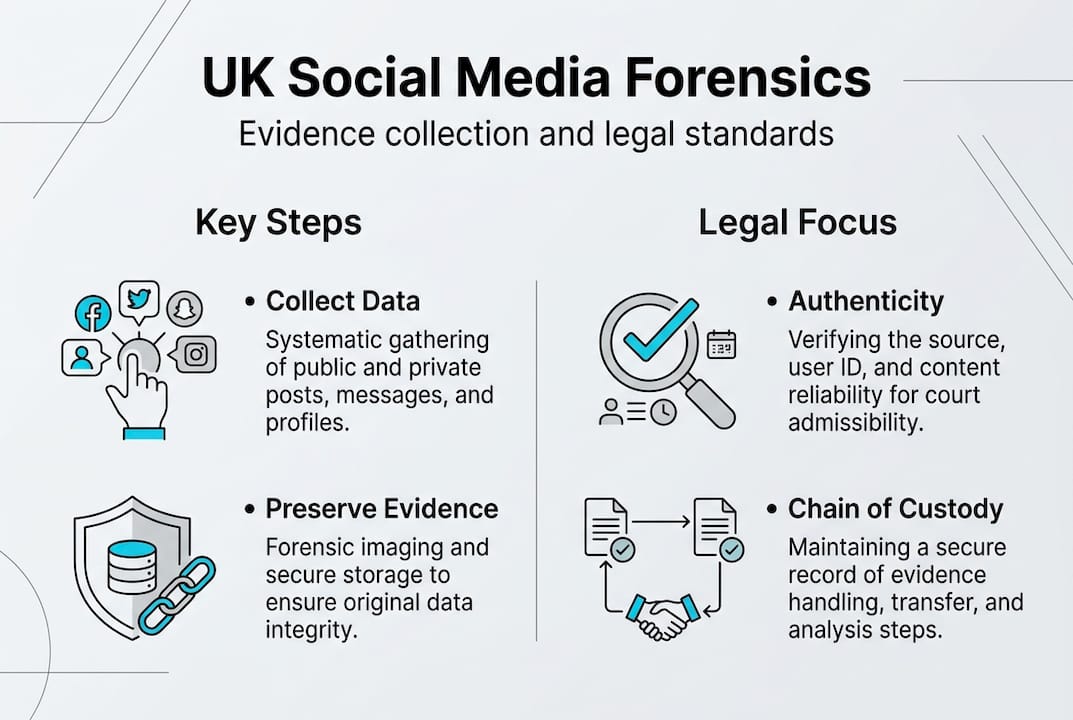
Social media forensics is systematic collection, preservation, analysis, and presentation of evidence from platforms to support legal investigations and proceedings. This discipline addresses the unique challenges posed by digital content that exists across distributed networks, often with limited lifespans and complex ownership structures. The goal extends beyond simple data capture to establishing evidential chains that withstand legal scrutiny.
Social media platforms present distinct evidence sources requiring tailored approaches. Facebook and Instagram preserve extensive metadata including geolocation stamps, device identifiers, and interaction histories. WhatsApp and Telegram introduce complications through encryption and ephemeral messaging features. LinkedIn offers professional networking data valuable in employment disputes and corporate investigations. Each platform maintains different retention policies and data access protocols that forensic practitioners must navigate.
Evidence types recovered through social media forensics legal investigations include:
- Metadata artefacts: Timestamps, IP addresses, device identifiers, geolocation coordinates, and application version information that establish context and authenticity
- Platform exports: Official data downloads containing message histories, friend lists, activity logs, and account settings preserved in structured formats
- Device extractions: Mobile phone images capturing cached content, deleted messages, application databases, and synchronisation records unavailable through platform interfaces
- Content analysis: Text mining, image recognition, network mapping, and behavioural pattern identification revealing relationships and intent
UK criminal cases increasingly rely on social media evidence for establishing timelines, demonstrating intent, and identifying suspects. Civil litigation utilises platform data in defamation claims, employment disputes, intellectual property theft, and family law proceedings. The breadth of applications demands forensic practitioners understand both technical acquisition methods and legal admissibility requirements specific to UK courts.

Core methodologies and legal standards for UK social media forensic investigations
Forensic examination of social media evidence follows structured phases ensuring methodological rigour and legal compliance. Core methodologies follow NIST phases and UK-specific ACPO Good Practice principles, emphasising chain of custody, integrity, competence, validation, and proportionality throughout the investigative process.
The four NIST forensic phases adapted for social media forensics steps legal investigations provide the operational framework:
-
Identification: Determine relevant platforms, accounts, timeframes, and content types based on case requirements. Document legal authority for access and establish preservation notices to prevent data deletion.
-
Acquisition: Capture evidence using forensically sound methods that maintain data integrity. Create bit-by-bit images of devices, request platform data exports through legal channels, and document all collection procedures with timestamps and hash values.
-
Analysis: Examine recovered data using validated tools and methodologies. Extract metadata, reconstruct timelines, identify deleted content, map social networks, and correlate findings across multiple evidence sources.
-
Reporting: Document findings in clear, defensible reports suitable for legal proceedings. Include methodology descriptions, tool validation records, chain of custody documentation, and expert opinions supported by evidence.
UK practitioners must adhere to ACPO Good Practice Guide for Digital Evidence and Forensic Science Regulator codes ensuring consistency and reliability. These standards mandate that no actions change data held on devices or media, individuals accessing original data must be competent, all processes must be auditable, and the person in charge bears overall responsibility for compliance.
Pro Tip: Combine device imaging with platform data exports for comprehensive evidence collection. Device extractions often reveal cached content, deleted messages, and application databases unavailable through official platform channels, whilst exports provide authenticated records with official timestamps and metadata.
Legal consultation remains essential throughout forensic processes. Social media forensics methods challenges require practitioners to balance investigative thoroughness with privacy protections, proportionality requirements, and jurisdictional limitations that affect evidence admissibility.
Addressing challenges and leveraging technology in social media forensics
Social media platforms present distinct obstacles that complicate evidence collection and analysis. Challenges include ephemeral content, end-to-end encryption, and GDPR compliance, requiring forensic practitioners to deploy specialised techniques and technologies that address these limitations whilst maintaining evidential integrity.

Ephemeral content on platforms like Snapchat, Instagram Stories, and WhatsApp Status disappears after predetermined periods, often before investigators can secure preservation orders. Device forensics may recover cached fragments, but completeness cannot be guaranteed. End-to-end encryption on messaging platforms prevents platform providers from accessing message content, forcing reliance on device-level extraction that requires physical access and bypass capabilities.
Technological solutions increasingly incorporate artificial intelligence and machine learning to enhance detection and analysis capabilities. AI/ML models achieve 93% accuracy in fake post detection, identifying manipulated content, bot accounts, and coordinated inauthentic behaviour that manual review might miss. Natural language processing enables semantic analysis of large message volumes, detecting patterns, sentiment shifts, and coded language relevant to investigations.
| Challenge type | Forensic approach | Technology solution | Limitation |
|---|---|---|---|
| Ephemeral content | Device caching analysis | Automated capture tools | Incomplete recovery |
| Encrypted messaging | Physical device extraction | Specialist bypass methods | Requires device access |
| Fake content detection | Metadata verification | AI authenticity scoring | Compression reduces accuracy |
| Large dataset analysis | Keyword filtering | Machine learning classification | False positive rates |
| Cross-platform correlation | Timeline reconstruction | Network mapping algorithms | Data format inconsistencies |
Deepfake technology introduces additional complications as manipulated video and audio content becomes increasingly sophisticated. Whilst detection algorithms exist, deepfake detectors lose accuracy after social media compression, with platform processing degrading the subtle artefacts that identify synthetic content. Forensic practitioners must combine multiple verification methods including metadata analysis, source device examination, and expert visual assessment.
GDPR compliance requires careful navigation when collecting social media evidence involving EU residents. Data minimisation principles demand that collection targets only relevant information proportionate to investigative needs. Subject access requests provide legitimate evidence gathering routes, but processing timeframes may delay urgent investigations. Cross-border data access agreements facilitate international cooperation whilst respecting jurisdictional privacy protections.
Pro Tip: Screenshots alone provide insufficient evidence for court proceedings. Always corroborate visual captures with metadata extraction, platform authentication records, and device-level verification to establish authenticity and defeat challenges regarding manipulation or fabrication.
Forensic practitioners must stay current with essential social media investigation tips as platforms evolve features, encryption methods, and data retention policies that affect evidence availability and collection methodologies.
Navigating UK legal frameworks and ensuring admissible social media evidence
UK courts impose strict requirements on digital evidence admissibility, demanding that social media forensics practitioners understand and comply with multiple overlapping legal frameworks. Evidence must meet UK legal frameworks including Police, Crime, Sentencing and Courts Act 2022, CPS guidance, UK GDPR to withstand defence challenges and judicial scrutiny.
Key legislation governing social media evidence collection and presentation includes:
- Police and Criminal Evidence Act 1984 (PACE): Establishes procedures for evidence collection, handling, and disclosure in criminal proceedings, with codes of practice governing digital evidence
- Criminal Procedure Rules: Mandates disclosure obligations, expert evidence requirements, and procedural compliance for prosecution and defence
- Civil Procedure Rules: Governs evidence disclosure in civil litigation, including electronic document production and expert witness protocols
- UK GDPR and Data Protection Act 2018: Regulates personal data processing with exemptions for law enforcement and legal proceedings under specific conditions
- Computer Misuse Act 1990: Criminalises unauthorised access to computer systems, affecting evidence collection methods and legal authority requirements
- Regulation of Investigatory Powers Act 2000: Controls surveillance and interception activities, establishing lawful grounds for communications data access
Admissibility criteria require evidence to satisfy relevance, authenticity, and lawful collection standards. Relevance demands direct connection to material facts in dispute. Authenticity requires proof that evidence genuinely originates from claimed sources and remains unaltered. Lawful collection mandates compliance with statutory authority, proportionality principles, and privacy protections.
Chain of custody documentation provides the evidential foundation for authenticity claims. Every evidence transfer, examination, and storage event must be recorded with timestamps, responsible parties, and integrity verification through cryptographic hashing. Breaks in custody chains invite defence challenges regarding tampering or contamination that can result in evidence exclusion.
| Legal requirement | Forensic practice | Verification method |
|---|---|---|
| Unbroken chain of custody | Document every evidence transfer | Timestamped custody logs with signatures |
| Data integrity preservation | Use write blockers and forensic imaging | Cryptographic hash verification |
| Competent practitioner | Maintain professional certifications | Training records and peer review |
| Validated methodology | Follow recognised forensic standards | Tool validation and quality assurance |
| Proportionate collection | Limit scope to case requirements | Data minimisation documentation |
Expert witness requirements demand that forensic practitioners demonstrate relevant qualifications, experience, and adherence to professional standards. Courts assess expert credibility based on methodology transparency, peer recognition, and absence of conflicts of interest. Written reports must explain technical processes in accessible language whilst maintaining scientific rigour.
Cross-jurisdictional complications arise when evidence involves platforms or users located outside UK borders. Mutual legal assistance treaties facilitate formal evidence requests between countries, but processing times often span months. US CLOUD Act provisions enable faster access to data held by US service providers under certain conditions, though privacy advocates challenge these mechanisms.
Forensic practitioners must consult social media forensics overview resources and maintain current knowledge of evolving legal interpretations, appellate decisions, and regulatory guidance affecting evidence admissibility and collection procedures.
Enhance your investigations with expert digital forensics services
Navigating the technical complexities and legal requirements of social media forensics demands specialised expertise and validated methodologies. Computer Forensics Lab provides comprehensive digital forensics services tailored for UK legal professionals and law enforcement agencies requiring court-admissible evidence from social media platforms. Our digital forensic investigations follow ACPO Good Practice principles and Forensic Science Regulator codes, ensuring unbroken chain of custody, validated tool usage, and methodological transparency. We deliver detailed forensic reports documenting evidence collection, analysis findings, and expert opinions suitable for disclosure and cross-examination. Our expert witness services provide testimony explaining technical evidence to courts, supporting legal teams with credible, defensible expertise throughout litigation and criminal proceedings.
Frequently asked questions
What is the primary purpose of social media forensics?
Social media forensics systematically collects, preserves, analyses, and presents digital evidence from platforms to support legal investigations and court proceedings. The discipline ensures that social media content meets admissibility standards through forensically sound collection methods, unbroken chain of custody, and validated analysis techniques that establish authenticity and reliability.
Why is legal compliance critical in social media forensic investigations?
Legal compliance ensures evidence admissibility in court proceedings and protects investigations from challenges regarding unlawful collection or privacy violations. UK frameworks including PACE, GDPR, and Computer Misuse Act impose strict requirements on evidence handling, with non-compliance resulting in evidence exclusion, case dismissal, or potential criminal liability for investigators.
What are the main challenges facing social media forensic practitioners?
Ephemeral content that disappears after short periods, end-to-end encryption preventing platform access to messages, and GDPR compliance requirements create significant obstacles. Cross-border jurisdictional complications, platform cooperation limitations, and rapidly evolving technologies demand continuous adaptation of forensic methodologies and legal strategies.
How does artificial intelligence assist social media forensic analysis?
AI and machine learning models detect fake content, identify bot accounts, analyse sentiment patterns, and classify large datasets with 93% accuracy rates. Natural language processing enables semantic analysis of message volumes that would be impractical for manual review, whilst image recognition identifies manipulated media and tracks content propagation across platforms.
What documentation is required to maintain chain of custody for social media evidence?
Every evidence transfer, examination, and storage event requires timestamped records identifying responsible parties, locations, and integrity verification through cryptographic hashing. Documentation must include initial collection circumstances, forensic tool versions, analysis procedures, and all individuals accessing evidence throughout the investigative process to demonstrate unbroken custody and prevent tampering allegations.