

Many legal professionals assume that once data is deleted or a device fails, the information is permanently lost. In reality, modern forensic data recovery techniques can retrieve critical digital evidence even from damaged or deliberately wiped devices. For UK litigation and investigations, understanding how data recovery works, what it can achieve, and how to maintain legal admissibility is essential. This guide explains the processes, methodologies, and legal considerations that underpin forensic data recovery, equipping you with the knowledge to secure digital evidence effectively.
Table of Contents
- Key takeaways
- Understanding data recovery in digital forensics
- The standard data recovery workflow for UK legal and corporate investigations
- Core methodologies and challenges in forensic data recovery
- Maintaining forensic integrity and legal admissibility during data recovery
- Explore forensic data recovery services and expertise
- Frequently asked questions
Key Takeaways
| Point | Details |
|---|---|
| Forensic data recovery | Forensic recovery identifies, preserves, analyses and extracts digital evidence while maintaining integrity to ensure admissibility in UK courts. |
| Legal framework compliance | UK regulations including PACE, GDPR and the Data Protection Act govern how data is collected, handled and presented to support admissibility. |
| Chain of custody | A meticulously documented chain of custody and procedures prevents data tampering and supports admissibility. |
| Varied recovery methods | Different devices and data types require varied techniques such as imaging, memory analysis and data reconstruction. |
| Early expert engagement | Engaging forensic experts early prevents overwriting data and improves chances of successful recovery. |
Understanding data recovery in digital forensics
Data recovery in digital forensics goes far beyond simple file restoration. It is the systematic process of identifying, preserving, analysing, and extracting digital evidence while maintaining forensic integrity to ensure legal admissibility in UK courts. Unlike consumer data recovery, which prioritises speed and convenience, forensic recovery demands rigorous protocols to prevent any alteration of evidence.
The forensic data recovery process comprises four core stages:
- Identification: Locating potential sources of digital evidence across devices, storage media, and cloud platforms
- Preservation: Creating forensically sound copies using write-blockers to prevent data modification
- Analysis: Examining recovered data using specialised tools to identify relevant evidence
- Reporting: Documenting findings in a format suitable for legal proceedings and expert testimony
Many clients mistakenly believe that forensic recovery simply means retrieving deleted files. In reality, it encompasses recovering data from physically damaged devices, extracting information from encrypted volumes, analysing volatile memory, and reconstructing file fragments. Each scenario requires different technical approaches and tools.
“Forensic integrity is non-negotiable. A single procedural error can render otherwise valuable evidence inadmissible, undermining an entire investigation.”
The UK legal framework governing digital evidence places strict requirements on how data must be collected and handled. The Police and Criminal Evidence Act 1984 (PACE), Criminal Procedure Rules, Data Protection Act 2018, and GDPR all influence forensic recovery procedures. Understanding these regulations ensures that recovered data withstands legal scrutiny and remains admissible throughout litigation.
Pro Tip: Always engage forensic specialists before attempting any data recovery on devices containing potential evidence. Consumer recovery software can overwrite critical data and compromise forensic integrity.
The standard data recovery workflow for UK legal and corporate investigations
Forensic data recovery follows a structured workflow designed to preserve evidence integrity whilst complying with UK legal requirements. Each step must be documented meticulously to establish an unbroken chain of custody.
The standard workflow comprises six essential stages:
- Initial assessment: Evaluate the data loss scenario, identify affected devices, and determine the most appropriate recovery methodology
- Secure environment preparation: Establish a controlled workspace with proper anti-static measures and documentation protocols
- Forensic imaging: Create bit-for-bit copies of storage media using hardware write-blockers to prevent any data modification
- Hash verification: Generate cryptographic hashes (MD5 and SHA-256) of original media and forensic images to verify integrity
- Recovery execution: Apply approved forensic techniques to extract data from images, never working directly on original evidence
- Documentation and reporting: Compile comprehensive records of all procedures, findings, and chain of custody details
| Workflow stage | Key tools | Legal requirement |
|---|---|---|
| Forensic imaging | Hardware write-blockers, FTK Imager | PACE Code B compliance |
| Hash verification | MD5/SHA-256 algorithms | Criminal Procedure Rules |
| Data extraction | EnCase, Autopsy, X-Ways | ACPO principles adherence |
| Documentation | Chain of custody logs | Data Protection Act 2018 |
Write-blockers are fundamental to forensic imaging. These hardware or software tools prevent any write commands from reaching the storage device, ensuring that the original evidence remains completely unaltered. Without write-blocking, even mounting a drive to examine it can modify timestamps and metadata, potentially invalidating the evidence.
Hash verification provides mathematical proof that forensic images are exact copies of original media. By generating cryptographic hashes before and after imaging, forensic examiners can demonstrate that no data was added, removed, or modified during the copying process. UK courts routinely require hash verification documentation to accept digital evidence.
Compliance with UK legislation is paramount throughout the workflow. PACE 1984 governs evidence collection procedures, the Criminal Procedure Rules set disclosure requirements, the Data Protection Act 2018 regulates personal data handling, and GDPR imposes strict data processing standards. Failure to comply with any of these frameworks can result in evidence exclusion or legal sanctions.
Pro Tip: Maintain detailed contemporaneous notes throughout the recovery process. These records become crucial if you need to provide expert witness testimony months or years later.
Core methodologies and challenges in forensic data recovery
Forensic data recovery employs multiple technical methodologies, each suited to specific scenarios and data types. Understanding these approaches helps legal professionals set realistic expectations and select appropriate expertise.
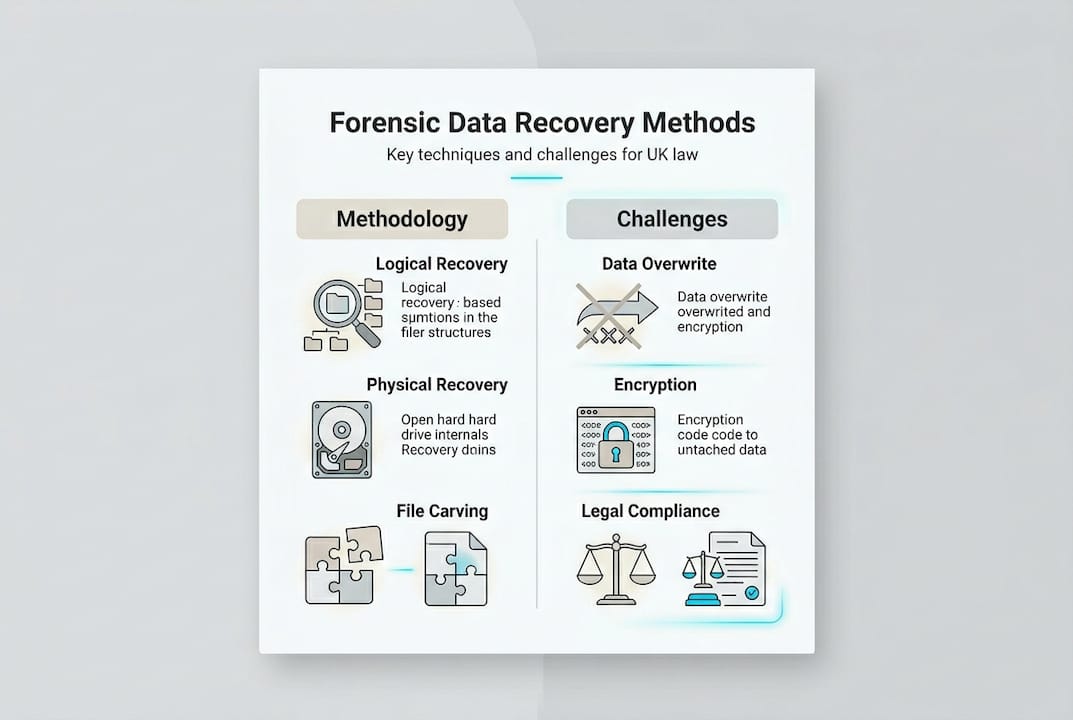

Logical recovery focuses on file system structures and metadata. This method works when the file system remains intact but files have been deleted or corrupted. Logical recovery tools parse directory structures, allocation tables, and journals to locate and reconstruct files. It is fast and effective for recently deleted data that has not been overwritten.
Physical recovery operates at the sector level, bypassing file systems entirely. This approach is essential when file systems are severely damaged or deliberately wiped. Physical recovery examines raw disk sectors, identifies file signatures, and reconstructs data based on known file formats. It is more time-consuming but can retrieve data that logical methods cannot access.
File carving represents a specialised physical recovery technique. It searches for file headers and footers within raw disk data, reconstructing files without relying on file system metadata. File carving proves invaluable when recovering data from formatted drives or fragmented storage.
Memory forensics captures and analyses volatile data from RAM. This methodology recovers encryption keys, running processes, network connections, and other transient information that disappears when devices power down. Memory forensics is crucial for investigating malware, detecting anti-forensic techniques, and accessing encrypted data.
| Recovery method | Best for | Limitations |
|---|---|---|
| Logical recovery | Recently deleted files, intact file systems | Cannot recover overwritten data |
| Physical recovery | Formatted drives, damaged file systems | Time-intensive, requires expertise |
| File carving | Fragmented data, wiped drives | May produce incomplete files |
| Memory forensics | Encryption keys, volatile evidence | Requires live system access |
Forensic examiners rely on industry-standard tools including EnCase, FTK Imager, Autopsy, and Cellebrite. Commercial tools like EnCase and FTK offer comprehensive features, extensive file format support, and strong legal acceptance, but carry significant licensing costs. Open-source alternatives like Autopsy provide robust functionality at no cost, though they may require more technical expertise. Mobile-specific tools like Cellebrite specialise in extracting data from smartphones and tablets.
Several technical challenges complicate data recovery:
- Encryption: Without decryption keys, encrypted data remains inaccessible regardless of recovery technique
- Solid-state drives: SSD TRIM commands permanently erase deleted data, making recovery impossible
- Overwritten data: Once storage sectors are reused, original data cannot be recovered
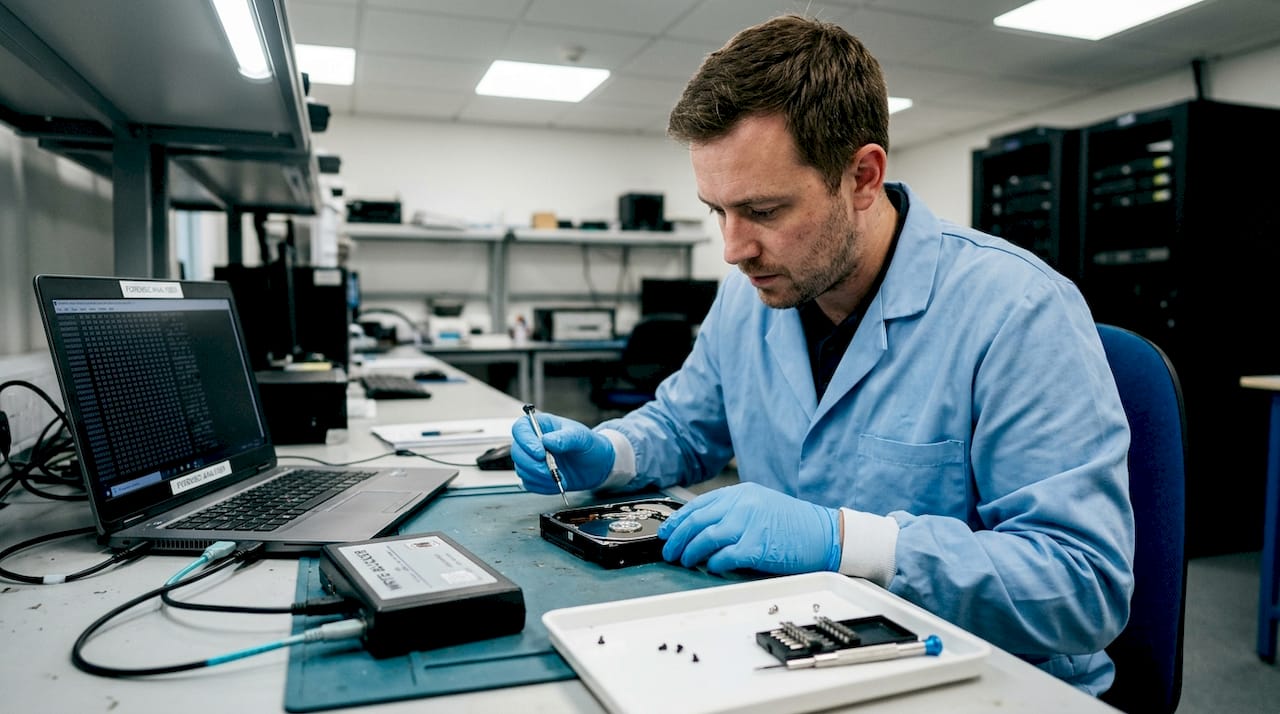
- Physical damage: Severely damaged devices may require cleanroom procedures and specialist hardware repair
Pro Tip: Act quickly when data loss occurs. Every hour of continued device use increases the risk of data overwriting, particularly on SSDs.
Maintaining forensic integrity and legal admissibility during data recovery
Recovering data is only half the challenge. Ensuring that recovered evidence remains legally admissible requires strict adherence to forensic standards and chain of custody protocols.
Chain of custody documentation tracks every person who handles evidence, every action performed, and every location where evidence is stored. This creates an auditable trail proving that evidence has not been tampered with or contaminated. UK courts scrutinise chain of custody records closely, and gaps or inconsistencies can lead to evidence exclusion.
Essential chain of custody elements include:
- Timestamped logs recording all evidence transfers and examinations
- Unique identifiers for each piece of evidence
- Tamper-evident seals and secure storage facilities
- Signatures from all individuals handling evidence
- Detailed descriptions of all procedures performed
The Association of Chief Police Officers (ACPO) principles, whilst not legally binding, heavily influence UK digital forensic practice. These principles emphasise that no action should change data on seized devices, that persons accessing original data must be competent, that all processes must be documented and reproducible, and that the person in charge remains responsible for ensuring compliance.
“Chain of custody requires timestamped logs and tamper-evident procedures; forensic soundness must be prioritised over speed; legal principles like ACPO guide data change avoidance and documentation.”
Documentation extends beyond chain of custody to encompass detailed technical reports. These reports must explain recovery methodologies in terms that non-technical legal professionals and judges can understand, whilst providing sufficient technical detail for peer review. Expert witness testimony often accompanies complex data recovery cases, requiring forensic examiners to defend their methods and findings under cross-examination.
In civil litigation, proportionality considerations balance the value of potential evidence against recovery costs. Courts may refuse to order expensive forensic recovery if the likely benefit does not justify the expense. This makes early case assessment and realistic cost-benefit analysis crucial.
Forensic soundness always takes precedence over speed. Rushing recovery procedures to meet tight deadlines risks compromising evidence integrity. Legal professionals should engage forensic specialists early in investigations, allowing adequate time for proper evidence handling and analysis.
Pro Tip: Request detailed methodology reports from forensic providers. These documents prove invaluable if opposing counsel challenges evidence admissibility or recovery procedures.
Explore forensic data recovery services and expertise
Navigating the technical and legal complexities of data recovery requires specialist expertise. Professional digital forensics services ensure that evidence collection adheres to UK legal standards whilst maximising recovery success rates. Engaging qualified forensic examiners early in investigations prevents evidence contamination and establishes robust chain of custody from the outset.
Specialist forensic data recovery providers offer access to advanced tools, cleanroom facilities for physically damaged devices, and expert witness testimony to support litigation. Their experience with diverse data loss scenarios and deep understanding of digital forensics data sources enables them to identify evidence that less experienced practitioners might miss. Early consultation helps legal teams assess the feasibility and costs of data recovery, informing strategic litigation decisions.
Frequently asked questions
What are the most common causes of data loss in legal cases?
Accidental deletion remains the leading cause, often occurring when employees attempt to free storage space or remove personal files. Hardware failures, including drive crashes and controller malfunctions, rank second. Deliberate data destruction by individuals attempting to conceal evidence poses significant challenges, particularly when sophisticated wiping tools are used. Encryption without proper key management also creates data loss scenarios when passwords are forgotten or key storage devices fail. Early forensic intervention significantly improves recovery prospects across all scenarios.
Can encrypted or overwritten data always be recovered?
Encrypted data requires the correct decryption keys or passwords for recovery. Without these credentials, even the most advanced forensic techniques cannot access encrypted content, as modern encryption algorithms are mathematically sound. Overwritten data presents different challenges. Once storage sectors are reused and new data written, the original information becomes unrecoverable. This is particularly true for SSDs, where TRIM commands actively erase deleted data to optimise performance. Traditional hard drives offer slightly better prospects if overwriting is minimal, but recovery success diminishes rapidly with each overwrite cycle.
Why is chain of custody critical in data recovery?
Chain of custody documentation proves that evidence has not been tampered with, altered, or contaminated between collection and presentation in court. UK courts require clear evidence trails showing who handled digital evidence, when they accessed it, what actions they performed, and how it was stored. Any gaps or inconsistencies in chain of custody records provide grounds for opposing counsel to challenge evidence admissibility. Without proper chain of custody, even perfectly recovered data may be excluded from proceedings, potentially undermining an entire case. Meticulous record-keeping from initial seizure through final analysis is therefore essential.
What tools are commonly used in forensic data recovery?
EnCase and FTK Imager dominate commercial forensic recovery, offering comprehensive features, extensive file format support, and strong legal acceptance in UK courts. Autopsy provides a powerful open-source alternative, particularly suitable for budget-conscious investigations. Cellebrite specialises in mobile device forensics, extracting data from smartphones and tablets. X-Ways Forensics offers advanced capabilities for experienced practitioners. Tool selection depends on case requirements, budget constraints, and examiner expertise. Commercial tools generally provide better technical support and training, whilst open-source options offer cost savings for organisations with skilled personnel. UK courts accept evidence from any properly validated tool when accompanied by appropriate methodology documentation.