

Social media platforms are now involved in over 80 percent of British criminal investigations, transforming how courts handle digital evidence. For forensic experts and legal professionals in London, understanding robust social media forensics is essential for building credible cases and securing convictions. This guide clarifies the complex steps, proven techniques, and legal standards British practitioners need to navigate social media investigations with confidence and precision.
Table of Contents
- Defining Social Media Forensics And Core Concepts
- Types Of Social Media Evidence And Platforms Covered
- Evidence Extraction And Forensic Analysis Procedures
- Legal Frameworks And Evidential Admissibility In The UK
- Chain Of Custody, Reporting, And Common Pitfalls
Key Takeaways
| Point | Details |
|---|---|
| Importance of Social Media Forensics | Social media forensics is essential for collecting and analysing evidence from digital platforms, supporting legal proceedings in various cases. |
| Challenges in Evidence Collection | Investigators face challenges such as data privacy regulations and maintaining the integrity of evidence during the investigative process. |
| Role of Legal Frameworks | A robust legal framework governs social media evidence handling in the UK, balancing investigative needs with privacy rights and ensuring evidential admissibility. |
| Significance of Chain of Custody | Maintaining a strict chain of custody is crucial for the integrity of digital evidence throughout the investigative process to withstand legal scrutiny. |
Defining Social Media Forensics and Core Concepts
Social media forensics represents a critical digital investigation discipline that focuses on collecting, preserving, and analysing digital evidence from social media platforms to support legal proceedings. Advanced forensic techniques enable investigators to reconstruct digital interactions and trace critical information across complex digital landscapes.
The discipline involves systematic processes of evidence extraction and analysis from various social media platforms including Facebook, Twitter, WhatsApp, Instagram, and emerging digital communication channels. Forensic experts must navigate complex challenges such as data privacy regulations, massive data volumes, and maintaining evidentiary integrity throughout the investigative process. Key methodological approaches include metadata evaluation, user interaction mapping, geolocation tracking, and advanced text mining algorithms that can uncover hidden contextual relationships.
Primary objectives of social media forensics include identifying potential suspects, corroborating witness statements, establishing digital timelines, and providing legally admissible evidence for criminal and civil litigation. The field addresses emerging digital crimes like cyberbullying, online harassment, financial scams, and coordinated digital misconduct, requiring sophisticated technological and analytical capabilities.
The following table summarises key forensic methods and their main applications in social media investigations:
| Forensic Method | Main Application | Example Platform |
|---|---|---|
| Metadata analysis | Verifying post authenticity | |
| Geolocation tracking | Tracing user location | |
| User interaction mapping | Revealing communication networks | |
| Text mining algorithms | Detecting hidden links |
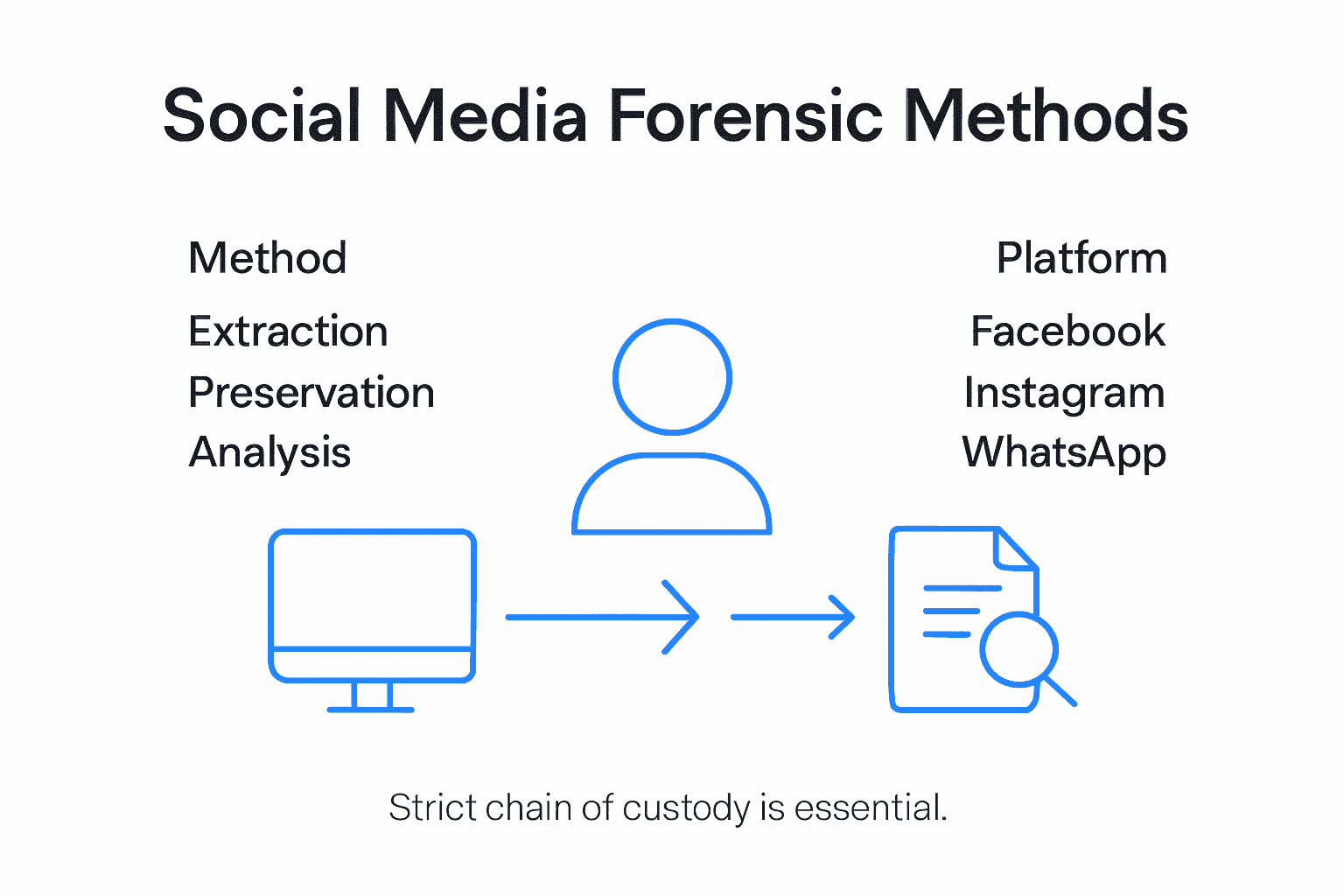

Expert Tip: Always maintain strict chain of custody protocols when collecting social media evidence to ensure its admissibility in legal proceedings.
Types of Social Media Evidence and Platforms Covered
Social media evidence encompasses a diverse range of digital artefacts that forensic investigators can leverage for legal proceedings. These data types include text posts, images, videos, audio recordings, and geolocation information drawn from multiple digital communication platforms, providing comprehensive insights into digital interactions and potential criminal activities.
The primary social media platforms relevant to forensic investigations include Facebook, Instagram, Twitter, WhatsApp, Snapchat, LinkedIn, and TikTok. Each platform offers unique evidentiary characteristics: Facebook provides detailed user profiles and interaction histories, Instagram offers visual evidence through images and stories, Twitter captures real-time communications, and messaging platforms like WhatsApp reveal direct interpersonal communications. Investigators must understand the specific data structures, privacy settings, and retention policies of each platform to effectively extract and preserve digital evidence.

Specific types of social media evidence include user-generated content, metadata, geolocation tags, timestamp information, user interaction logs, private messaging transcripts, shared media files, and account connection networks. These digital artefacts can help establish timelines, corroborate witness statements, identify potential suspects, and provide critical context in both criminal and civil legal proceedings. Forensic experts must employ sophisticated technological tools and analytical methodologies to extract, authenticate, and interpret these complex digital traces.
Here is a comparison of typical social media evidence types and their primary value in legal investigations:
| Evidence Type | Primary Value | Legal Relevance |
|---|---|---|
| Text posts | Chronology of statements | Establishes intent |
| Images/videos | Visual corroboration | Supports alibi or accusation |
| Metadata | Evidence authenticity | Confirms timestamps |
| Private messages | Context for interactions | Documents direct intent |
Expert Tip: Always document the exact extraction methodology and maintain comprehensive digital chain of custody to ensure the forensic evidence remains legally admissible.
Evidence Extraction and Forensic Analysis Procedures
Digital forensic analysis requires meticulous and scientifically rigorous procedures to ensure the integrity and admissibility of social media evidence. Systematic collection techniques involve complex metadata analysis, network mapping, and advanced text mining methodologies designed to handle massive and volatile digital datasets, addressing the intricate challenges of modern digital investigations.
Forensic evidence extraction follows a structured methodology comprising four critical stages: identification, acquisition, preservation, and comprehensive analysis. Initially, investigators identify relevant digital artefacts across social media platforms, employing sophisticated public content scrapers and legal access protocols. The acquisition phase involves capturing data through court-approved mechanisms, ensuring all evidence is obtained legally and without compromising its potential use in judicial proceedings. Preservation demands creating forensically sound, unalterable copies of digital evidence, protecting against potential tampering or degradation.
The analysis stage represents the most complex component of social media forensics, involving intricate techniques such as timestamp cross-referencing, network connection mapping, and contextual content evaluation. Forensic experts must navigate challenges including deleted posts, privacy restrictions, and rapidly changing platform algorithms. Advanced technological tools powered by artificial intelligence and machine learning enable investigators to reconstruct digital interactions, authenticate user identities, and establish comprehensive digital narratives that can withstand rigorous legal scrutiny.
Expert Tip: Develop a standardised documentation protocol that meticulously records every step of evidence extraction to maintain forensic integrity and legal admissibility.
Legal Frameworks and Evidential Admissibility in the UK
Legal frameworks for social media forensics in the United Kingdom represent a complex intersection of digital investigation protocols, privacy protections, and judicial requirements. The contemporary legal landscape carefully balances investigative needs with individual privacy rights, establishing rigorous standards for digital evidence collection and presentation, ensuring that forensic methodologies meet stringent evidential standards.
The UK’s legal framework encompasses multiple legislative instruments, including the Police, Crime, Sentencing and Courts Act 2022, which provides comprehensive guidance for digital evidence handling. Key considerations include maintaining a delicate equilibrium between law enforcement capabilities and individual privacy protections. Investigators must navigate complex procedural requirements, ensuring that all digital evidence is obtained through legally sanctioned methods, with explicit attention to consent, data protection regulations, and potential human rights implications.
Evidentiary admissibility in British courts demands meticulous documentation and forensic integrity. Social media evidence must demonstrate provenance, authenticity, and an unbroken chain of custody. Forensic experts are required to provide comprehensive methodological explanations that validate the reliability of extracted digital artefacts. This includes detailed technical documentation explaining extraction processes, forensic tools utilised, and comprehensive verification procedures that conclusively establish the evidence’s legitimacy and prevent potential challenges to its credibility.
Expert Tip: Develop a comprehensive documentation protocol that explicitly records every technical and procedural step in social media evidence extraction to withstand potential judicial scrutiny.
Chain of Custody, Reporting, and Common Pitfalls
Chain of custody represents the fundamental procedural backbone of forensic evidence management, particularly in social media investigations. This critical documentation process tracks every interaction with digital evidence, creating an unbroken chronological record that demonstrates the integrity and authenticity of collected data from initial acquisition through final analysis.
Forensic reporting demands meticulous documentation that comprehensively details the entire investigative process. Successful reports must include precise metadata about evidence collection, including timestamps, extraction methods, forensic tools utilised, and explicit explanations of each investigative step. Digital forensic experts must anticipate potential legal challenges by providing transparent, reproducible documentation that withstands rigorous judicial scrutiny.
Common pitfalls in social media forensic investigations often stem from inadequate preservation techniques, incomplete documentation, or failure to maintain strict procedural protocols. Critical errors can include improper evidence handling, insufficient metadata preservation, neglecting platform-specific extraction complexities, and failing to demonstrate the direct chain of evidence. Investigators must be particularly cautious about dynamic social media environments where content can be rapidly modified, deleted, or manipulated, requiring sophisticated forensic approaches that capture comprehensive contextual information.
Expert Tip: Implement a standardised digital evidence log that records every single interaction, tool, and process used during social media forensic investigation to create an impenetrable chain of custody.
Enhance Your Legal Investigations with Expert Social Media Forensics
Navigating the complex challenges of social media forensics requires advanced expertise in evidence extraction, chain of custody maintenance, and digital forensic analysis. At Computer Forensics Lab, we understand the critical need to authenticate digital artefacts, preserve metadata integrity, and provide admissible evidence that withstands rigorous legal scrutiny. Whether you face issues with user interaction mapping, geolocation tracking, or metadata verification, our tailored services support legal professionals and law enforcement with precise and reliable forensic solutions.
Discover how our specialised Social Media Forensics services can uncover hidden digital evidence and establish trustworthy timelines for your investigations. Backed by extensive experience in Digital Forensic Investigation and a track record of assisting high-stakes cases, we are ready to help you tackle cybercrime and digital misconduct. Take control of your case today by visiting Computer Forensics Lab and requesting expert consultation that ensures your digital evidence stands strong in court.
Frequently Asked Questions
What is social media forensics?
Social media forensics is a discipline that focuses on collecting, preserving, and analysing digital evidence from social media platforms to assist in legal investigations.
What types of evidence can be extracted from social media?
Types of social media evidence include text posts, images, videos, audio recordings, geolocation information, and metadata from various platforms such as Facebook, Twitter, and Instagram.
How is evidence extracted from social media for legal purposes?
Evidence extraction from social media typically involves four stages: identification, acquisition, preservation, and analysis, ensuring that all data is collected and handled in a legally sound manner.
What challenges do forensic experts face when working with social media evidence?
Forensic experts encounter challenges such as data privacy regulations, high volumes of data, deleted posts, and the need to maintain the integrity of the evidence throughout the investigative process.