

Challenging a suspect’s digital footprint in a London courtroom can quickly unravel if evidence integrity is questioned. For digital forensics specialists, robust verification is not just a best practice but the foundation of criminal prosecution. With evidence ranging from encrypted mobile devices to data spanning international cloud networks, the techniques you use to authenticate and preserve digital records are under constant scrutiny. This guide unpacks the methodical process of digital evidence verification, arming you with strategies to protect your findings and professional credibility.
Table of Contents
- Digital Evidence Verification Explained
- Types of Digital Evidence in Forensics
- Legal Standards and Admissibility Requirements
- Verification Techniques and Best Practices
- Risks of Relying on Unverified Evidence
Key Takeaways
| Point | Details |
|---|---|
| Digital Evidence Verification is Essential | The verification process confirms that digital data is authentic, intact, and suitable for court, forming a crucial part of forensic investigations. |
| Rigorous Methodology is Required | Each phase of the verification process must be meticulously documented to withstand scrutiny during trials, particularly regarding the chain of custody. |
| Admissibility Criteria Must be Met | Evidence must prove authenticity, integrity, relevance, legal authorisation, and follow reliable methodologies to be admissible in court. |
| Unverified Evidence is Risky | Relying on unverified digital evidence can lead to case collapses, wrongful acquittals, and damage to professional credibility in forensic work. |
Digital Evidence Verification Explained
Digital evidence verification is the methodical process of confirming that digital data collected from devices, networks, and storage systems is authentic, unaltered, and legally admissible. For you as a forensics specialist in London supporting criminal prosecutions, this process forms the backbone of your case evidence.
Unlike physical evidence, digital data presents unique challenges. It’s volatile, easily modified, and invisible to the naked eye. A single keystroke can change timestamps, overwrite files, or destroy metadata that proves chain of custody. This is why verification isn’t optional—it’s fundamental to your credibility in court.
What Digital Evidence Verification Involves
The verification process encompasses three critical phases:
- Acquisition: Capturing data from devices without alteration, using write-blockers and forensically-sound methods
- Authentication: Confirming the evidence hasn’t been tampered with since collection, typically through hash values and cryptographic validation
- Preservation: Maintaining the evidence in a secure, documented state throughout investigation and prosecution
Each phase requires meticulous documentation. Crown Prosecution Service solicitors will scrutinise every step, asking how you know the evidence is genuine.
Digital evidence verification is not a one-time checkbox—it’s a continuous process of documentation and validation from seizure through courtroom presentation.
The reality in London courtrooms is stark: defence counsel will challenge your evidence if any link in the verification chain appears weak. They’ll question your methods, your tools, your procedures. Solid verification eliminates these attack vectors before trial.
Why Verification Matters for Criminal Cases
Consider a cybercrime investigation where recovered emails form the prosecution’s case. Without proper verification, defence lawyers argue the emails were fabricated, timestamps were altered, or the data was compromised during handling. One successful challenge to your evidence integrity collapses the entire case.

Chain of custody documentation ensures every person who touched the evidence is recorded, every transfer logged, and every access justified. This creates an unbreakable link between the scene and the courtroom.
Proper verification also protects you professionally. It demonstrates you followed industry standards and best practices, demonstrating due diligence in your forensic work.
Common Verification Challenges
You’ll encounter obstacles specific to digital forensics:
- Encrypted devices requiring specialist decryption techniques
- Cloud-based evidence spanning multiple jurisdictions
- Rapidly evolving technologies outpacing standard procedures
- Pressure to deliver results quickly without compromising thoroughness
Each challenge demands careful methodology and thorough documentation. There’s no shortcut that survives cross-examination.
Pro tip: Document your verification procedures obsessively—not just what you did, but why you did it that way. Your written methodology becomes your defence in court when the opposing counsel questions your methods.
Types of Digital Evidence in Forensics
Digital evidence comes in many forms, and understanding each type is critical for your forensic investigations. The evidence you recover from a suspect’s laptop differs fundamentally from cloud data or mobile phone records. Each type requires different extraction methods, preservation techniques, and analytical approaches.
The heterogeneous nature of digital evidence means no single methodology fits all scenarios. What works for recovering deleted files from a hard drive won’t work for extracting WhatsApp messages from a smartphone. This complexity is precisely why specialisation matters in London-based forensic practice.
Common Types of Digital Evidence
You’ll encounter several distinct categories in criminal investigations:
- Computer and storage devices: Hard drives, SSDs, USB drives, external storage containing files, documents, and system artefacts
- Mobile devices: Smartphones and tablets holding messages, call logs, location data, and application databases
- Network evidence: Router logs, firewall records, internet service provider data, and packet captures showing communication patterns
- Cloud-based data: Email accounts, cloud storage services, social media platforms, and backup files stored remotely
- System artefacts: Registry entries, temporary files, cache data, and log files revealing user activity and system events
Each category presents unique challenges. Mobile devices encrypt data differently than computers. Cloud providers operate across multiple jurisdictions, complicating legal access.
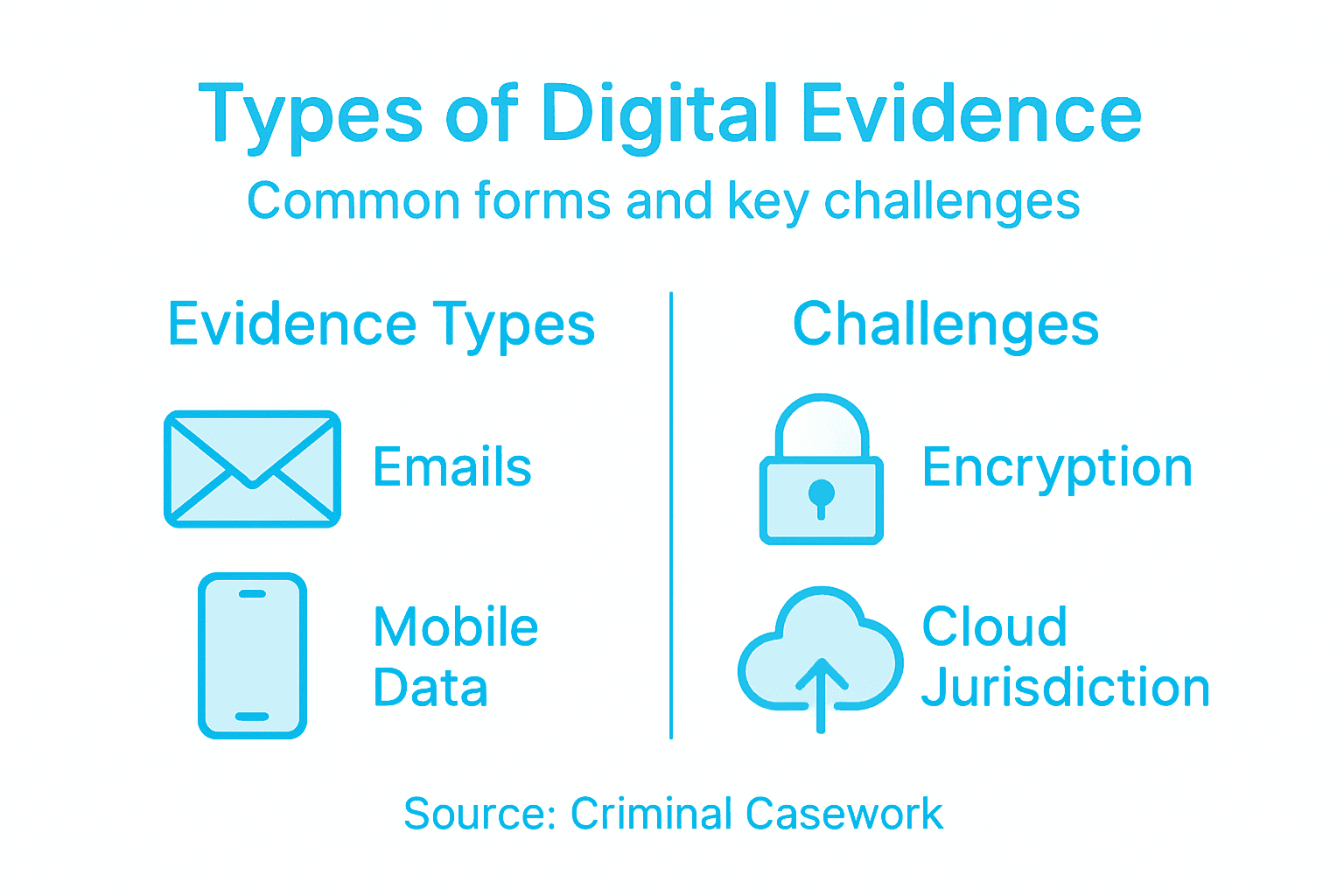

The main types of digital evidence differ not only in their origin but also in handling requirements and verification complexities:
| Evidence Type | Common Source | Primary Handling Challenge | Verification Risk |
|---|---|---|---|
| Computer storage | Laptops, USB drives | Risk of file alteration | Accidental overwriting |
| Mobile device | Smartphones, tablets | Volatile app data | Encryption barriers |
| Network data | Routers, ISP records | Large data volume | Incomplete capture |
| Cloud storage | Email, drives online | Cross-jurisdiction access | Authenticity checks |
| System artefacts | Registries, log files | Finding relevant entries | Context misinterpretation |
Digital evidence types are not interchangeable—treating cloud data like a local hard drive will compromise your investigation from the start.
Why Evidence Type Matters in Court
Defence counsel will challenge not just your findings, but your methodology for that specific evidence type. They’ll ask: “Did you use industry-standard tools for extracting that data? Can you demonstrate the evidence wasn’t altered?”
Proper understanding of diverse forensic collection techniques ensures you employ the right approach for each evidence source. Using incorrect extraction methods weakens your entire case.
Consider a case involving recovered emails from a corporate server. The prosecution needs to prove authenticity, chain of custody, and that the emails match what the defendant actually sent. Without proper understanding of email storage formats and recovery procedures, defence lawyers exploit weaknesses in your methodology.
Practical Challenges by Evidence Type
You’ll need to adapt your approach based on what you’re examining:
- Encrypted devices require specialist decryption knowledge or court orders for access
- Cloud evidence demands understanding of service provider architectures and data location
- Mobile devices need specific tools that preserve volatile memory and databases
- Legacy systems require knowledge of obsolete file formats and storage mechanisms
Pressure to deliver results quickly must never override thorough, defensible methodology.
Pro tip: Document which evidence type you’re examining and explicitly state the extraction methodology before you begin analysis. This written foundation becomes your shield when cross-examination challenges your technique in court.
Legal Standards and Admissibility Requirements
Digital evidence doesn’t automatically become admissible in court just because you recovered it. Courts apply strict legal standards to determine whether your evidence can be presented to a jury. Understanding these standards from the outset shapes every decision you make during your investigation.
The Crown Prosecution Service and defence teams will scrutinise your evidence against specific admissibility criteria. Fail to meet these standards, and months of forensic work becomes inadmissible. This isn’t theoretical—it happens regularly in London courtrooms.
Core Admissibility Criteria
Your digital evidence must satisfy several foundational requirements before it enters the courtroom:
- Authenticity: Proving the evidence is genuine and hasn’t been altered or fabricated
- Integrity: Demonstrating the evidence remained unchanged from collection through analysis
- Relevance: Showing the evidence directly relates to the alleged crime
- Legal authorisation: Confirming you obtained the evidence through lawful search and seizure
- Reliable methodology: Using recognised forensic techniques and qualified analysts
Each requirement demands documentary evidence. You need written procedures, audit trails, and expert testimony demonstrating compliance.
Here is a quick comparison of admissibility criteria with real-world implications for digital evidence:
| Criterion | What Is Required | Typical Evidence Provided |
|---|---|---|
| Authenticity | Proof data is genuine | Hash values, forensic images |
| Integrity | Data unchanged since collection | Chain of custody forms |
| Relevance | Connection to the crime | Timeline, narrative links |
| Legal authority | Lawful search/seizure | Warrants, authorisation letters |
| Reliable methods | Standard-compliant processes | Tool validation docs |
Digital evidence admissibility isn’t about what you found—it’s about proving how you found it and why it’s trustworthy.
Standards for Authenticity and Integrity
Defence counsel will demand proof that your evidence reflects reality. Hash values (cryptographic fingerprints) serve as your primary defence here. By calculating SHA-256 or MD5 hashes before and after analysis, you prove the evidence hasn’t changed by even a single bit.
European court standards emphasise authenticity and evidentiary reliability across cross-border investigations. This means your London-based methodology must align with international best practices, particularly when cases involve European Union nationals or cross-border data flows.
Chain of custody documentation proves integrity. Every person who touched the evidence, every access logged, every transfer documented. A single gap in this chain gives defence lawyers ammunition to challenge your entire case.
Legal Authorisation and Procedural Safeguards
You cannot simply seize devices without proper authority. Police must obtain warrants or operate under specific legislative powers. Understanding the legal basis for your evidence collection is non-negotiable.
Proper authorisation for search and seizure determines whether evidence is admissible. A detective without a warrant who recovers evidence becomes a liability, not an asset. Solicitors will challenge the legality of your seizure before examining your findings.
Procedural requirements also encompass right to fair trial considerations. Suspects have rights regarding access to evidence and expert witnesses. Your documentation must reflect these protections.
Qualified Expert Testimony
Courts will challenge your credentials. Can you demonstrate relevant qualifications? Have you given expert evidence before? What professional standards govern your work?
Your ability to survive cross-examination depends on documented training, certifications, and adherence to recognised standards like those from the International Organisation on Computer Evidence (IOCE).
Pro tip: Before beginning any forensic investigation, obtain written confirmation of the legal authority authorising the examination. Preserve this documentation alongside your technical findings—it forms the evidentiary foundation the prosecution needs to admit your evidence.
Verification Techniques and Best Practices
Verification isn’t a single step—it’s a continuous process woven through every phase of your forensic investigation. From the moment you seize a device in a London office to presenting findings in court, verification safeguards your evidence integrity.
The difference between admissible and inadmissible evidence often comes down to whether you followed recognised verification protocols. Courts expect you to use validated tools, maintain controlled environments, and document everything obsessively.
The Multi-Phase Verification Process
International standards outline a structured approach that courts recognise:
- Identification: Documenting what evidence exists and where it’s located before touching anything
- Collection: Using write-blockers and forensically-sound acquisition methods to prevent alteration
- Preservation: Storing evidence securely with controlled access and environmental protection
- Acquisition: Creating forensic images using validated tools and calculating hash values
- Examination: Analysing evidence in isolated, monitored environments
- Analysis: Interpreting findings against investigation objectives
- Reporting: Documenting methodology, findings, and limitations transparently
Internationally recognised standards and best practices emphasise that each phase requires rigorous documentation. Defence counsel will scrutinise your adherence to these phases, looking for gaps that suggest carelessness.
Critical Verification Techniques
You need concrete mechanisms to prove evidence hasn’t been tampered with:
- Cryptographic hashing: Calculating SHA-256 or MD5 values before and after analysis creates mathematical proof of integrity
- Write-blockers: Physical or software devices that prevent any modification to source devices during acquisition
- Chain of custody logs: Detailed records showing every person with evidence access and the exact time
- Forensic images: Complete, bit-for-bit copies of storage media analysed instead of originals
- Audit trails: System logs documenting every action taken during examination
These aren’t optional extras. They’re your defence against accusations of evidence tampering.
Controlled Environments Matter
Where you conduct analysis influences evidence reliability. Secure, monitored facilities with documented access controls demonstrate you took contamination seriously.
Your examination environment should be isolated from the internet, restricted to authorised personnel, and equipped with appropriate security measures. Courts understand that evidence examined in secure facilities commands more credibility than evidence analysed on a technician’s personal laptop.
Validated Tools and Documentation
You must use tools that courts recognise as forensically sound. EnCase, FTK, and similar industry-standard platforms have undergone peer review and validation. Using obscure or unvalidated tools weakens your credibility.
More importantly, document why you chose each tool. What does it do? Why is it appropriate for this evidence type? This explanation becomes your expert testimony foundation.
Verification techniques mean nothing if you haven’t documented them. Your written methodology becomes the evidence that your evidence is genuine.
Pro tip: Create standardised verification checklists for each evidence type before investigations begin. Use these checklists consistently across cases, creating a defensible pattern that demonstrates your commitment to systematic verification protocols.
Risks of Relying on Unverified Evidence
Unverified evidence doesn’t just weaken your case—it destroys it. A single piece of unvalidated digital evidence in your prosecution can collapse the entire investigation, damage your professional reputation, and compromise future cases.
The stakes in criminal prosecution are absolute. Innocent people cannot be convicted on weak evidence. Guilty people cannot escape justice because your shortcuts undermined admissibility. Verification isn’t bureaucracy—it’s the foundation of fair justice.
Case Collapse Through Unverified Evidence
Consider a real scenario: A detective seizes a laptop without following proper acquisition protocols. No write-blocker used. No forensic image created. Analysis performed directly on the original device. When defence counsel cross-examines you, they ask one simple question: “Can you prove the evidence wasn’t altered during your examination?”
You cannot. Your entire case becomes suspect. The Crown Prosecution Service may decide the evidence is too compromised to present. Months of investigation, wasted.
Consequences for Criminal Justice
Unverified evidence creates cascading problems:
- Acquittals of guilty defendants: Weak evidence presentation allows criminals to escape responsibility
- Wrongful convictions: Poor verification may mask contaminated or fabricated evidence
- Retrials and appeals: Cases collapse during appeals when evidence integrity is challenged
- Institutional damage: Law enforcement loses credibility when cases fail due to forensic negligence
- Defence dominance: Legal teams learn to exploit your shortcuts in future cases
Reliance on unverified information disrupts public trust in institutions like police services and courts. When evidence verification fails repeatedly, the public questions whether the entire justice system is reliable.
The Admissibility Cliff
There’s no middle ground with unverified evidence. You either meet legal standards for admissibility, or you don’t. Courts don’t award partial credit for “mostly correct” verification procedures.
Defence lawyers will identify any gap in your verification chain and exploit it relentlessly. A single missing signature on a chain-of-custody form. An unexplained delay between evidence seizure and examination. A tool you used without documented validation. These gaps don’t make your evidence merely questionable—they make it inadmissible.
Professional and Legal Liability
Your reputation as a forensics specialist depends entirely on demonstrated reliability. One case where you cut corners and the evidence is excluded damages your credibility in all future cases.
Law firms will stop instructing you. Police forces will question your work. Expert witness fees dry up. The professional consequences of unverified evidence extend far beyond a single failed prosecution.
Client Impact
Law firms defending suspects rely on your evidence integrity to build their cases. Prosecution solicitors depend on your rigorous methodology to present compelling evidence. Neither can work effectively with unverified digital evidence.
Unverified evidence isn’t just weak—it’s toxic to the entire criminal justice process, damaging defendants, prosecutors, and institutions alike.
Pro tip: Before accepting any forensic examination, establish written verification protocols with the instructing solicitor. Document these protocols in your case notes from day one. This creates an explicit agreement about standards, protecting you when defence counsel challenges your methodology.
Secure Your Case with Expert Digital Evidence Verification
Ensuring the authenticity and integrity of digital evidence is critical for anyone involved in criminal prosecutions and legal investigations. The challenges around maintaining proper verification, preserving chain of custody, and using recognised forensic techniques cannot be understated. If you face pressure to deliver timely results without compromising thoroughness or worry about how defence scrutiny might challenge your evidence, professional support is essential.
At Computer Forensics Lab, we specialise in comprehensive Digital Evidence Preservation and Digital Forensic Investigation. Our expert team adheres to rigorous standards that defend your evidence integrity from acquisition through court presentation. Trust our proven methodology and verified tools to safeguard your case and professional reputation.
Take control of your digital investigations now. Contact Computer Forensics Lab today for trusted forensic services designed to meet the highest legal standards and withstand the toughest challenges in court.
Frequently Asked Questions
What is digital evidence verification?
Digital evidence verification is the process of confirming that digital data collected from devices is authentic, unaltered, and legally admissible. It involves three critical phases: acquisition, authentication, and preservation.
Why is digital evidence verification important in criminal cases?
Verification is crucial because it ensures the integrity of evidence. If any part of the verification process is inadequate, defence lawyers may successfully challenge the evidence’s authenticity, potentially leading to the collapse of the case.
What are common challenges faced during digital evidence verification?
Common challenges include dealing with encrypted devices, handling cloud-based evidence across jurisdictions, adapting to rapidly evolving technologies, and managing the pressure to deliver results quickly without compromising thoroughness.
What techniques are used in the verification of digital evidence?
Key techniques include cryptographic hashing to ensure data integrity, using write-blockers to prevent modification during acquisition, maintaining detailed chain of custody logs, and creating forensic images to analyse data without impacting the original evidence.