

Too many investigations falter when key principles of digital forensics are misunderstood or overlooked. For UK government cybersecurity officials and digital forensics experts, a clear grasp of evidence acquisition, preservation, and analysis is crucial for case success. This article cuts through misconceptions and highlights proven methods, giving your teams the scientific grounding needed to strengthen prosecutions and uphold public security in a world of evolving digital threats.
Table of Contents
- Digital Forensics: Core Concepts And Misconceptions
- Types Of Digital Evidence Used In Government Cases
- Digital Forensics Processes And Investigative Methods
- Legal Frameworks And Evidential Requirements
- Risks, Challenges, And Government Responsibilities
Key Takeaways
| Point | Details |
|---|---|
| Understanding Digital Forensics | Digital forensics involves evidence acquisition, preservation, and analysis—it’s a structured process, not guesswork. |
| Mitigating Misconceptions | Common myths, such as deleted data being permanently lost, can create unrealistic expectations during investigations. |
| Importance of Legal Compliance | Adhering to legal frameworks, including proper warrants and chain of custody, is critical for maintaining evidence admissibility. |
| Addressing Challenges in Digital Forensics | The increasing volume and complexity of data necessitate standardisation and continuous training to ensure effective investigations. |
Digital forensics: core concepts and misconceptions
Digital forensics is the disciplined application of science and technology to uncover digital evidence. It’s not magic or guesswork—it’s a methodical process grounded in scientific principles. Too many people misunderstand what digital forensics actually does, which can lead to unrealistic expectations in investigations.
At its core, digital forensics involves three critical stages:
- Evidence acquisition: capturing data from devices without altering the original
- Preservation: maintaining the integrity of evidence through proper chain of custody
- Analysis: examining artefacts to reconstruct events and establish facts
Many misconceptions cloud the field. Here are the most common ones that professionals encounter:
To clarify misconceptions and realities in digital forensics, see the table below:
| Misconception | Reality in Practice | Impact on Investigations |
|---|---|---|
| Deleted data is permanently lost | Deleted files often recoverable | May prompt unnecessary panic |
| Forensics yields instant results | Careful, time-consuming analysis | Unrealistic deadlines set |
| Any IT expert can conduct forensics | Specialist training is required | Risk of errors, evidence loss |
| Forensics reveals every fact | Context and interpretation vital | Evidence might be misapplied |
Myth One: Deleted data is gone forever. In reality, deleted files often remain recoverable on storage media until overwritten. Your team knows this—the misconception comes from users and sometimes from non-technical stakeholders in legal cases.
Myth Two: Digital forensics is instantaneous. Investigations require careful, methodical work. Rushing through analysis introduces errors that compromise evidence admissibility in court.
Myth Three: Any IT professional can perform digital forensics. This fundamentally misunderstands the discipline. Proper training covers digital forensics methodology, legal frameworks, and evidence handling protocols. Without this expertise, investigations fail.
Myth Four: Digital forensics proves everything. It doesn’t. Forensics reveals what happened to data, but interpretation requires context. Evidence supports conclusions—it doesn’t make them automatically.
Understanding these misconceptions is essential for government agencies seeking to strengthen investigations and maintain credibility before the courts.
The discipline also faces genuine challenges. Data volumes have exploded exponentially. Cloud storage, encryption, and device diversity complicate investigations. Mobile phones alone contain evidence across numerous applications, each with unique storage mechanisms.
For UK law enforcement and government cybersecurity officials, the stakes are high. Digital forensics directly impacts case outcomes by providing the technical foundation for prosecutions. Proper understanding of core concepts prevents costly investigative missteps.
The scientific approach matters. Forensic examination must follow established procedures, maintain rigorous documentation, and preserve chain of custody throughout. This isn’t bureaucracy—it’s what keeps evidence valid in court.
Pro tip: Ensure your teams receive regular training on current digital forensics tools and techniques, as technologies and storage mechanisms evolve constantly. Outdated knowledge leads to missed evidence.
Types of digital evidence used in government cases
Digital evidence comes in many forms, and understanding each type is crucial for effective investigations. Government cases increasingly rely on diverse digital sources—from computers and mobile devices to cloud services and network logs. Each type requires specific collection and analysis techniques to maintain integrity.
Common types of digital evidence include:
- Computer hard drives: contain operating system files, application data, user documents, and deleted files recoverable through forensic analysis
- Mobile devices: store communications, location data, photos, and application-specific information across encrypted storage
- Network communications: email, messaging platforms, and internet activity logs that reveal intent and coordination
- Cloud services: documents, backups, and synchronised data stored across distributed servers
- Server logs: system events, access records, and transaction histories that establish timelines
- Social media data: posts, messages, and metadata revealing relationships and communications
Digital evidence in modern investigations plays an instrumental role in reconstructing events and establishing facts. Each source provides different perspectives on what occurred.

The challenge lies in recognising that evidence types vary dramatically in nature. A deleted email fragment differs fundamentally from a server log entry. One requires recovery techniques; the other requires careful extraction and authentication. Your investigators need to understand these distinctions.
Below is a quick comparison of key digital evidence sources, highlighting their unique investigative value:
| Evidence Source | Key Data Types | Unique Investigation Challenge |
|---|---|---|
| Computer hard drives | Documents, system, deleted files | Large data volume, hidden data |
| Mobile devices | Chats, location, apps, photos | Encrypted, scattered information |
| Network traffic | Emails, logs, web access | Spoofing risks, authentication |
| Cloud services | Backups, synchronised files | Jurisdictional/legal complications |
| Social media | Public posts, messages, metadata | Privacy, platform limitations |
Mobile devices present unique complexity. They integrate multiple applications, each storing data differently. Messaging apps, banking applications, and social platforms all maintain separate databases. A single phone may contain evidence scattered across dozens of locations.
Cloud storage introduces cross-border considerations. Data may reside in multiple jurisdictions, each with different legal frameworks. Accessing evidence requires understanding both technical architecture and legal permissions.
Digital evidence is only valuable if properly collected, preserved, and presented with clear chain of custody documentation throughout the investigative process.
Network evidence requires authentication. Server logs and email headers can be spoofed or manipulated. Your team must verify authenticity through technical means before relying on them for prosecution.
For UK government agencies, the practical reality is straightforward: modern crime leaves digital footprints everywhere. The first responders who identify and secure these sources directly impact case outcomes. Proper understanding prevents contamination, unauthorised access, and inadmissibility in court.
Pro tip: Document the condition of each device immediately upon seizure, photograph storage locations before removal, and establish chain of custody records before any forensic examination begins—these foundational steps protect evidence admissibility later.
Digital forensics processes and investigative methods
Digital forensics follows a structured process designed to extract evidence whilst maintaining its integrity. Government investigations depend on these standardised procedures—deviation compromises admissibility in court and undermines prosecution. The methodology separates careless work from professional investigation.
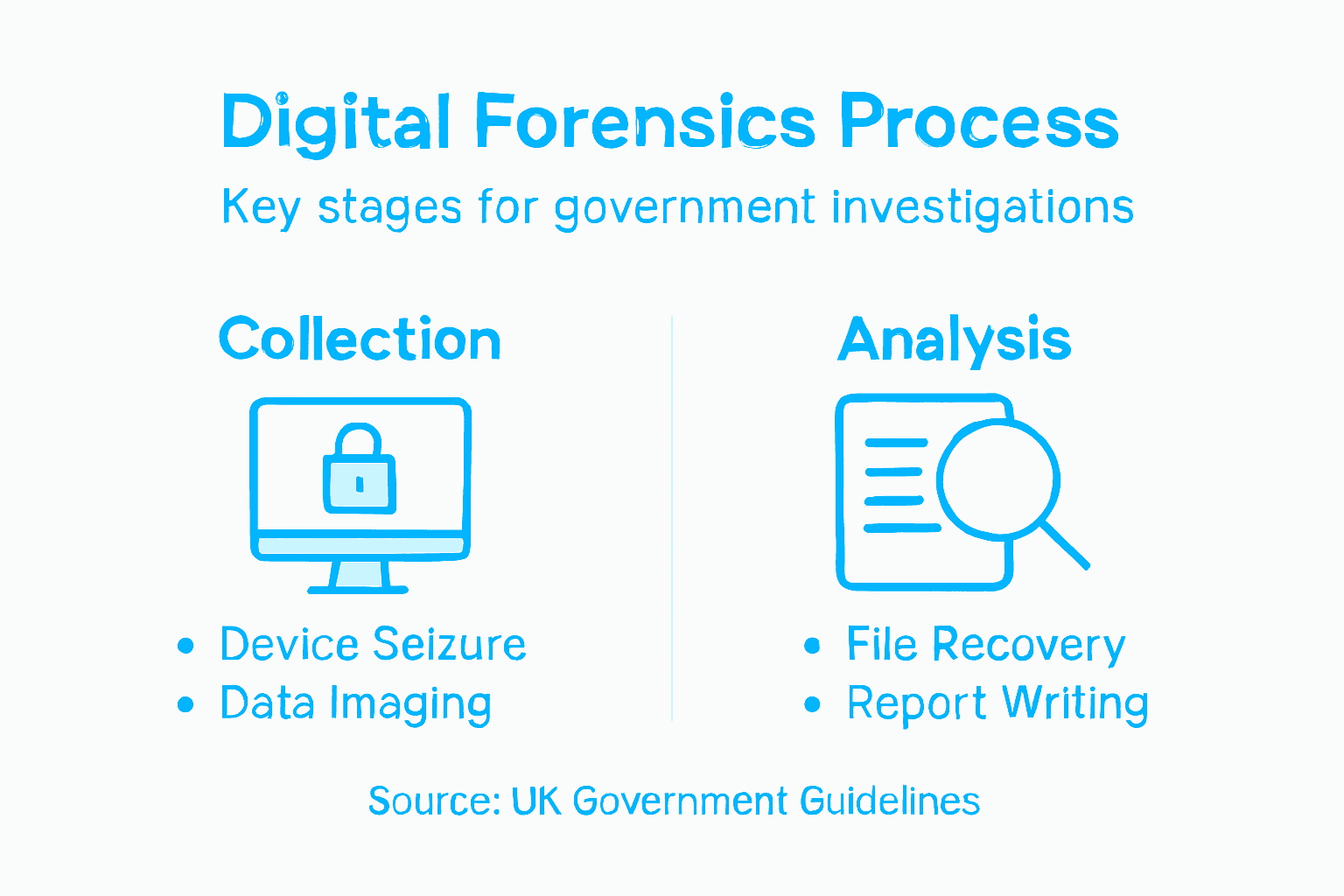
The core investigation process consists of five stages:
- Identification: recognising potential sources of digital evidence and securing the scene before contamination occurs
- Preservation: protecting evidence from alteration, deletion, or unauthorised access through proper documentation
- Collection: acquiring data using forensically sound methods that create verifiable copies
- Analysis: examining evidence systematically to extract facts, timelines, and relationships
- Presentation: communicating findings to legal professionals and courts with supporting documentation
Formal investigative procedures ensure consistency across agencies and cases. These standardised frameworks prevent investigator bias and provide transparent methodologies that withstand legal scrutiny.
Each stage demands specific skills and tools. Hard drive examination differs fundamentally from network analysis. Memory forensics requires different techniques than mobile device extraction. Your teams must understand which methods apply to which evidence types.

Chain of custody is non-negotiable. Every person who handles evidence must be documented. Every access, every examination, every transfer requires recorded justification. A broken chain destroys evidence value regardless of what the data reveals.
Preservation happens before analysis. Create forensically sound copies—exact bit-level duplicates—before touching original devices. Analyse only the copies. Original evidence remains untouched, available for independent verification if defence teams challenge your findings.
Professional digital forensics requires methodical processes, proper documentation, and transparent procedures that withstand legal challenge and expert scrutiny.
Emerging tools reshape investigative capability. Artificial intelligence now assists in pattern recognition, anomaly detection, and data correlation across vast datasets. However, AI findings still require human analysis and verification before use in prosecution.
Cross-jurisdictional investigations demand awareness. Different regions have different legal frameworks governing evidence collection and access. International cases require understanding data sovereignty laws, mutual legal assistance treaties, and encryption regulations across jurisdictions.
For UK government cybersecurity officials, the practical reality is clear: proper procedures prevent case collapse. Shortcuts during collection, analysis, or documentation lead to inadmissible evidence and failed prosecutions. Invest in training, maintain documentation discipline, and follow established processes consistently.
Pro tip: Document your entire forensic examination process photographically and in writing—create a detailed record of every step, every tool used, and every finding, because your methodology becomes evidence itself during cross-examination.
Legal frameworks and evidential requirements
Digital evidence holds no value in court without proper legal foundation. UK government agencies must understand the specific frameworks governing collection, handling, and presentation of digital evidence. Failure here doesn’t just waste investigative effort—it collapses cases entirely.
The legal landscape involves multiple layers of protection:
- Evidence admissibility standards: courts require proof that evidence is authentic, reliable, and collected through approved methods
- Search and seizure laws: proper warrants and authorisation must precede device seizure and data access
- Chain of custody requirements: documented control of evidence from collection through presentation
- Data protection compliance: GDPR and UK data laws restrict how personal information is handled during investigation
- Privacy considerations: proportionality between investigative need and interference with fundamental rights
Legal and ethical challenges in digital forensics investigations create complexity across jurisdictions. Different regions define admissibility differently. What’s acceptable evidence in one country may be inadmissible in another.
UK courts demand technical rigour. Examiners must demonstrate proper forensic methodology, tool validation, and analysis transparency. Defence counsel will challenge every step. Your documentation must withstand expert cross-examination.
Warrants matter absolutely. Obtaining proper legal authorisation before accessing devices or data isn’t bureaucratic overhead—it’s constitutional foundation. Warrantless searches contaminate evidence and expose investigations to legal challenge.
Encryption introduces complications. Accessing encrypted data requires either proper decryption authority or cooperation from device owners. You cannot bypass encryption without explicit legal permission and documented procedures.
Evidence collected without proper legal authorisation, documented procedures, and transparent methodology will be excluded from court regardless of what it proves.
International cooperation requires treaties. Cross-border investigations demand mutual legal assistance agreements specifying what evidence transfers are permitted. Data sovereignty laws restrict moving information across borders without proper channels.
Ethical standards protect investigations. Investigator bias, unauthorised access, and breaches of fundamental rights don’t just violate ethics—they create grounds for case dismissal and damage prosecutorial credibility.
For UK cybersecurity officials, the reality is straightforward: invest in legal compliance before starting investigations. Secure proper authorisation. Maintain meticulous documentation. Follow established procedures precisely. These aren’t constraints—they’re the infrastructure that makes prosecution possible.
Pro tip: Before seizing any device, consult with your legal team to ensure you have proper warrant authority, understand applicable privacy laws, and document your legal basis for every investigative step—this prevents case collapse at trial.
Risks, challenges, and government responsibilities
Digital forensics faces mounting pressures. Data volumes explode exponentially. Devices multiply in type and complexity. Resources remain constrained. Without deliberate government action, investigations fail and cases collapse. The stakes are too high for passive acceptance of these challenges.
The primary obstacles confronting UK agencies include:
- Technical complexity: device diversity, encryption, cloud storage, and rapid technological change outpace traditional forensic methods
- Data volume: modern devices contain terabytes of information; analysing everything becomes practically impossible
- Procedural gaps: lack of standardised approaches across agencies creates inconsistency and admissibility risks
- Resource constraints: insufficient funding, staffing, and training undermine investigative capability
- Organisational silos: poor inter-agency collaboration duplicates effort and fragments evidence gathering
- Human factors: investigator fatigue, cognitive bias, and skill gaps introduce errors that compromise cases
Digital forensics challenges require systematic institutional responses beyond individual investigator capability. Government must act deliberately and comprehensively.
Data volume demands strategic triage. Investigators cannot examine everything. Develop protocols identifying high-value evidence first. Use keyword searches, pattern matching, and targeted analysis before attempting comprehensive examination.
Standardisation prevents case collapse. When agencies follow different procedures, defence counsel exploits inconsistency. Governments must mandate unified forensic standards, tool validation protocols, and documentation requirements across all agencies.
Training determines investigator quality. Skill gaps accumulate over time. Government must fund regular training, certification programmes, and continuing education. Outdated knowledge leads to missed evidence and procedural errors.
Government responsibility extends beyond investigation—it encompasses policy development, capability investment, standardisation, inter-agency coordination, and maintaining practitioner competence through systematic training.
Inter-agency collaboration multiplies capability. Information sharing between police, tax agencies, intelligence services, and cybersecurity teams reveals connections individual agencies miss. Governments must establish formal collaboration frameworks and secure data-sharing protocols.
Encryption challenges require policy clarity. Governments must establish legal frameworks addressing lawful access to encrypted data, cooperation with technology companies, and decryption authority limits. Ambiguity paralyses investigations.
Privacy laws constrain but don’t prevent investigation. GDPR and data protection legislation require proportionality, not abandonment of digital forensics. Governments must develop clear guidance on balancing investigative needs against privacy rights.
For UK cybersecurity officials, the message is clear: advocate for these systemic changes within your organisations. Undersourced forensics capabilities fail cases and allow criminals to escape justice. Government investment in standardisation, training, inter-agency coordination, and technology infrastructure isn’t optional—it’s fundamental to effective investigations.
Pro tip: Document resource gaps and training deficiencies within your agency, present evidence of investigation failures linked to these gaps, and use this data to justify budget requests and policy changes to senior leadership.
Strengthen Your Government Investigations with Expert Digital Forensics Support
The article highlights critical challenges faced by government agencies such as managing vast data volumes, maintaining chain of custody, and navigating complex legal frameworks. These pain points often jeopardise the integrity and admissibility of evidence. At Computer Forensics Lab, we understand the importance of precise evidence acquisition, preservation, and comprehensive analysis to ensure investigations meet stringent scientific and legal standards.
Our London-based digital forensics specialists support government and law enforcement through advanced data recovery, mobile device examination, cloud evidence extraction, and expert witness reporting. We help you overcome obstacles like encrypted data, jurisdictional complexities, and procedural gaps with proven methodologies tailored to UK legal requirements. Explore our professional digital forensics services and learn how our expertise can safeguard your case from collapse.
Ready to secure your digital evidence with confidence today Act now to partner with trusted experts committed to protecting your investigations and upholding justice Visit Computer Forensics Lab to discover comprehensive solutions designed for government cybersecurity and law enforcement needs.
Frequently Asked Questions
What is digital forensics?
Digital forensics is the disciplined application of science and technology to uncover digital evidence, focusing on methods that preserve the integrity of data during acquisition, analysis, and presentation.
Why is chain of custody important in digital forensics?
The chain of custody is crucial because it documents every person who handles the evidence, ensuring that it remains intact and unaltered. This is vital for maintaining the evidence’s admissibility in court.
How do misconceptions about digital forensics impact investigations?
Misconceptions can lead to unrealistic expectations, such as believing that deleted data is irretrievable or that results can be produced instantly. This can cause panic, rush decisions, and ultimately compromise case outcomes.
What challenges do government agencies face in digital forensics?
Government agencies struggle with the exponential growth of data, the complexity of modern devices, insufficient resources, and the need for consistent investigative procedures across different organisations.