

Complex financial fraud rarely leaves a physical trail, but in London, digital forensics professionals and criminal lawyers know that every online interaction tells a story. Fraud investigations rely on a systematic approach that applies scientific disciplines such as computer science, chemistry, and engineering to expose deception and present reliable, court-ready findings. Understanding the role of forensic science in uncovering digital and financial evidence can make the difference between a case won or lost, guiding you to interpret patterns, follow digital traces, and ensure every piece of evidence stands up to legal scrutiny.
Table of Contents
- Defining Forensics In Fraud Investigations
- Key Types Of Fraud Uncovered Forensically
- Digital Techniques For Collecting Evidence
- Legal Standards And Admissibility In The UK
- Risks, Challenges And Common Pitfalls
Key Takeaways
| Point | Details |
|---|---|
| Forensic Science Foundation | Forensic science applies scientific methods to analyse evidence systematically, ensuring objectivity and reliability in fraud investigations. |
| Digital vs Traditional Forensics | Fraud investigations focus on digital evidence, requiring tailored techniques distinct from those used in traditional crime scenes. |
| Importance of Documentation | Maintaining a strict chain of custody and thorough documentation is critical for the admissibility of evidence in legal proceedings. |
| Challenges and Pitfalls | Analysts must navigate common challenges, such as data volatility and potential bias, to uphold the integrity of forensic investigations. |
Defining Forensics in Fraud Investigations
Forensic science isn’t some abstract concept reserved for crime dramas. In fraud investigations, it’s a systematic approach that applies scientific methods to uncover financial deception and gather admissible evidence. For legal professionals and forensic specialists in London, understanding this definition shapes how you approach cases from day one.
At its core, forensic science applies scientific disciplines—physics, chemistry, biology, computer science, and engineering—to analyse evidence in legal matters. The goal is straightforward: develop reliable, cost-effective methods that identify, analyse, and interpret physical evidence with precision and objectivity.
Fraud investigations differ from traditional crime scenes. Instead of examining fingerprints or DNA, you’re often working with digital traces, financial records, email communications, and data artefacts. These require specialised forensic techniques adapted to the nuances of financial crime.
Key characteristics of forensic science in fraud:
- Applies scientific methodology to analyse evidence objectively
- Maintains strict chain of custody documentation
- Produces findings suitable for legal proceedings and expert testimony
- Integrates multiple scientific disciplines (digital forensics, data analysis, pattern recognition)
- Relies on established principles and repeatable methods
The discipline rests on foundational concepts like Locard’s Exchange Principle—the idea that every contact leaves a trace. In fraud cases, this means examining how suspects interacted with systems, documents, and financial platforms. That interaction always produces evidence.
When you’re dealing with employee misconduct or financial crime cases, forensic analysis moves beyond surface-level investigation. It demands rigorous examination of deleted files, metadata timestamps, access logs, and communication records. These digital traces tell the story of fraud.
To clarify the application of forensics in fraud, here is a comparison of digital versus traditional forensic evidence:
| Aspect | Digital Forensics | Traditional Forensics |
|---|---|---|
| Primary Evidence Types | Log files, emails, transactions | Fingerprints, blood samples |
| Key Tools Used | Forensic imaging, data analysis | Microscopes, chemical tests |
| Main Challenges | Encryption, data volatility | Contamination, degradation |
| Typical Investigation Sites | Servers, cloud platforms | Crime scenes, physical objects |
Forensic science transforms raw evidence into legally defensible findings through scientific rigour and objectivity.
Your role as a forensics professional or criminal lawyer is to apply these principles strategically. Cases succeed or fail based on how thoroughly you’ve gathered and analysed evidence using established forensic methods.
Pro tip: Document your forensic methodology and reasoning at every step—courts scrutinise the process as rigorously as the findings, so transparency in your scientific approach strengthens your case significantly.
Key Types of Fraud Uncovered Forensically
Fraud takes many forms, and forensics reveals them all. Whether you’re investigating corporate misconduct or financial crime, understanding the specific fraud types that forensic analysis uncovers helps you know what evidence to pursue and how to interpret findings.
Digital forensics detects various corporate fraud types—email scams, unauthorised transactions, hacking, phishing, and financial manipulations. Each leaves distinct digital traces that forensic accountants can extract, examine, and analyse to build solid cases.
The most common fraud types you’ll encounter include:
-
Email fraud and phishing scams: Fraudsters impersonate trusted contacts to manipulate victims into transferring funds or revealing sensitive information. Forensic analysis examines email headers, metadata, and communication patterns to identify spoofed accounts and trace the perpetrator.
-
Unauthorised transactions: Employees or external actors access financial systems without permission and execute fraudulent transfers. Forensic investigators review access logs, transaction histories, and system audit trails to establish who performed what actions and when.
-
Hacking and cybersecurity breaches: Attackers exploit system vulnerabilities to gain unauthorised access to financial data or systems. Digital forensics recovers evidence of intrusion methods, malware, and data exfiltration techniques.
-
Insider fraud and embezzlement: Trusted employees manipulate records, create fictitious vendors, or misappropriate assets. Forensic accountants analyse financial records, communication logs, and system access patterns to expose deliberate deception.
-
Sophisticated financial scheme manipulation: Complex fraud involving account reconciliations, invoice manipulation, or fund movement concealment. These cases demand detailed forensic reconstruction of financial flows.
Forensic analysis transforms scattered digital evidence into a coherent narrative that proves intentional fraud beyond reasonable doubt.
Emerging fraud types now include misuse of government funds, cryptocurrency-based schemes, and cloud-based financial manipulation. Forensic techniques adapt continuously to address these evolving methods, ensuring detection remains effective regardless of how fraudsters innovate.
Your investigation approach should start by identifying which fraud category applies to your case. This shapes what evidence you prioritise, which systems you examine, and how you structure your forensic analysis.
Pro tip: Map fraud indicators to specific evidence sources—email fraud points to email servers and metadata, whilst transaction fraud requires financial system logs and access controls—targeting your forensic investigation efficiently from the outset.
Digital Techniques for Collecting Evidence
Collecting digital evidence correctly is non-negotiable. One mistake—a rushed acquisition, improper documentation, or broken chain of custody—can render months of investigation inadmissible in court. For forensic professionals and criminal lawyers, mastering digital collection techniques determines whether your case succeeds or collapses.

Digital forensics involves four critical steps: collection, examination, analysis, and reporting. Collection comes first because everything depends on getting it right from the start.
Proper evidence collection requires identifying all potential sources. You’re looking at more than just hard drives. Consider these common sources:
- Hard drives and solid-state drives (SSDs) from computers and servers
- Network logs and traffic captures from firewalls and routers
- Application data from accounting systems, email servers, and cloud platforms
- Mobile devices including smartphones and tablets
- USB drives, external storage, and removable media
- RAM dumps and volatile memory data
- Cloud service logs and backup files
But identifying sources is just the beginning. You must collect evidence whilst maintaining chain of custody documentation—every person who touches the evidence, when they touched it, and what they did with it.
Advanced digital techniques ensure evidence integrity through careful preservation, preventing data corruption and maintaining legal admissibility. This means creating forensically sound copies using write-blocker devices, never modifying original media, and documenting file hashes to prove nothing changed.
The collection process demands precision and methodical documentation:
- Photograph the scene and device state before touching anything
- Isolate devices from networks to prevent remote data manipulation
- Use forensically approved tools and write-blockers for all acquisitions
- Create verified copies with matching hash values
- Document timestamps, locations, and handling procedures
- Maintain sealed evidence with signed custody logs
Proper collection technique transforms raw digital data into courtroom-admissible evidence that survives cross-examination.
You’ll encounter challenges—encrypted drives, cloud-based data, fragmented files—but these don’t justify shortcuts. They require specialist techniques and documentation explaining your methodology.
Realise that opposing counsel will scrutinise your collection process ruthlessly. They’ll question your tools, your procedures, and your reasoning. Only meticulous documentation and adherence to established forensic standards allows your evidence to withstand that scrutiny.
Pro tip: Photograph and document the original device state, network connections, and surrounding environment before collection begins—this creates visual evidence supporting your chain of custody narrative if challenges arise later.
Legal Standards and Admissibility in the UK
UK courts are unforgiving about forensic evidence that doesn’t meet strict legal standards. Your evidence can be technically sound but still inadmissible if you haven’t followed the right procedures. Understanding what the courts expect determines whether your investigation succeeds or fails.
In the UK, forensic evidence must satisfy several key criteria before judges admit it into court proceedings. These standards exist to protect defendants’ rights whilst ensuring only reliable evidence influences verdicts.
The core requirements include:
- Reliability: Evidence must come from scientifically valid methods that produce consistent, repeatable results.
- Relevance: The evidence must directly address a material issue in the fraud case.
- Chain of custody: Unbroken documentation proving evidence integrity from collection through court presentation.
- Expert qualification: Those providing forensic analysis must possess recognised credentials and expertise.
- Proper documentation: Detailed records explaining methodology, findings, and reasoning.
Forensic science standards emphasise reliability, specificity, and quality management to ensure admissibility in legal proceedings. The UK courts apply these principles rigidly, scrutinising every aspect of your forensic process.
UK criminal procedure rules require that expert witnesses comply with Part 19 of the Criminal Procedure Rules. You must provide written expert reports that include your qualifications, methodology, assumptions, and limitations. Crucially, you must declare conflicts of interest and confirm you understand your duty to the court—not to the party instructing you.
Civil fraud cases involving financial investigations demand equally strict adherence to standards. The Civil Evidence Act 1995 permits expert evidence, but judges assess reliability carefully, particularly when evidence is complex or contested.
Courts dismiss forensic evidence based on procedural failures, not factual disputes—follow process flawlessly.
Common admissibility challenges you’ll face:
- Questioning whether your tools were validated and approved for forensic use
- Examining whether you followed established protocols correctly
- Challenging your expert qualifications and independence
- Scrutinising your documentation for gaps or inconsistencies
- Testing whether your methodology is scientifically accepted
Defence counsel will exploit any weakness in your process. They’ll argue your collection method was contaminated, your analysis was biased, or your conclusions exceeded your expertise. Only meticulous adherence to standards protects your evidence.
UK courts increasingly expect digital forensics to meet the same rigorous standards as traditional forensic disciplines. This means using industry-recognised tools, following established protocols, maintaining comprehensive documentation, and being prepared to justify every decision you made.
This table summarises the main legal requirements for admissibility of forensic evidence in UK courts:
| Requirement | Application in Fraud Cases | Example Breach |
|---|---|---|
| Reliability | Use validated scientific methods | Unapproved software used |
| Chain of Custody | Document every handover step | Missing custody log |
| Expert Qualification | Analyst must show credentials | Lacking certifications |
| Proper Documentation | Record findings and methodology | Incomplete reporting |
Pro tip: Before submitting expert evidence, review UK criminal procedure rules and ensure your report includes detailed methodology, qualified conclusions, and explicit declarations that you understand your duty to the court—not to the instructing solicitor.
Risks, Challenges and Common Pitfalls
Forensic investigations rarely follow textbook procedures. Real cases involve encrypted data, missing systems, resource constraints, and tight deadlines. Understanding common pitfalls helps you avoid mistakes that could derail your case.
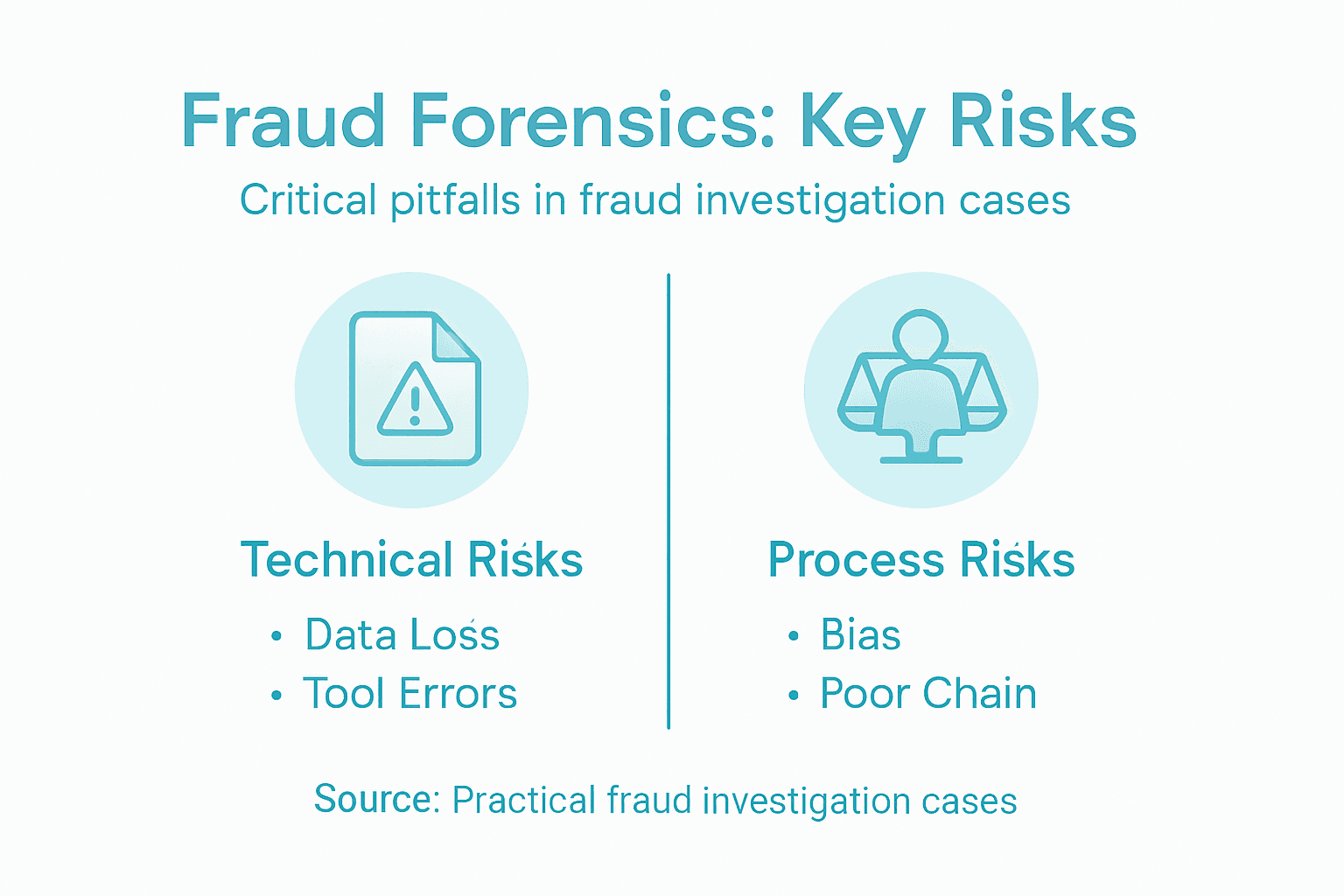

Forensic science faces challenges including ensuring method validity, avoiding bias, and staying current with technological advances. These aren’t abstract concerns—they directly impact whether your evidence survives courtroom scrutiny.
One major risk is evidence degradation and data loss. Delays in processing, improper storage, or environmental damage can compromise evidence integrity. If you can’t prove the evidence remained unchanged from collection to court, judges exclude it entirely.
Common pitfalls in fraud investigations include:
- Failing to isolate devices promptly, allowing remote deletion of evidence
- Using unapproved or outdated forensic tools that courts won’t recognise
- Incomplete documentation creating gaps in chain of custody
- Analyst bias influencing interpretation of ambiguous evidence
- Rushing collection without proper methodology, risking contamination
- Overlooking cloud-based data sources entirely
- Insufficient expertise in emerging fraud techniques
Resource constraints create genuine problems. Many forensic labs face backlogs lasting months or years. Budget limitations prevent purchasing current tools and software. Limited staff means investigators juggle multiple cases simultaneously, reducing thoroughness.
Technological changes outpace forensic capability. Encryption, cloud services, and anti-forensics tools evolve constantly. Yesterday’s techniques become obsolete. You risk using methodology courts consider unreliable or outdated.
Rushing forensic analysis to meet case deadlines compromises accuracy and admissibility—plan investigations with realistic timescales.
Analyst bias is insidious. You begin investigation believing a suspect guilty. Unconsciously, you prioritise evidence supporting that view and minimise contradictory findings. Courts expect forensic analysts to remain objective—bias destroys credibility.
Communication failures between forensic teams and legal counsel create avoidable problems. Lawyers don’t understand technical limitations. Forensic specialists don’t grasp legal requirements. This disconnect leads to missing evidence, incomplete reports, or findings that don’t address legal questions.
Cloud forensics presents distinctive challenges. Data may reside across multiple jurisdictions. Service providers restrict access. Encryption prevents acquisition. Traditional forensic approaches fail entirely, yet many investigators haven’t adapted their practices.
Pro tip: Establish realistic investigation timescales upfront, validate all tools and methodology before case work begins, and document your reasoning transparently—this mitigates resource pressure, bias, and admissibility challenges simultaneously.
Strengthen Your Fraud Investigations with Expert Digital Forensics
Fraud cases demand meticulous forensic methods that uphold strict chain of custody and apply validated scientific techniques to withstand legal scrutiny. The article highlights common challenges such as encrypted data, fragmented evidence, and evolving cyber threats that can weaken your case if not handled expertly. If you need precise collection and in-depth analysis of digital evidence—whether from computers, mobile devices, cloud platforms, or networks—rely on proven specialists who understand these complexities.
At Computer Forensics Lab, we bring advanced digital forensic solutions tailored to secure legal outcomes. With services ranging from data recovery and malware analysis to expert witness reporting and comprehensive documentation, we empower legal professionals and investigators across London to uncover the truth efficiently. Don’t let procedural missteps or technical pitfalls jeopardise your case. Discover how our team supports litigation and investigations with transparent and defensible forensic expertise.
Ready to fortify your fraud investigation with trusted digital forensic services Visit Computer Forensics Lab today and ensure your evidence meets UK courts high standards for admissibility. Take the critical next step in securing success and protecting your client’s interests now.
Frequently Asked Questions
What is the role of forensic science in fraud investigations?
Forensic science applies scientific methods to analyse evidence in fraud cases, utilising disciplines such as digital forensics and data analysis to uncover financial deception and gather admissible evidence for legal proceedings.
How does forensic analysis differ in digital versus traditional fraud investigations?
Digital forensics focuses on digital traces like log files and emails, while traditional forensics examines physical evidence such as fingerprints and blood samples. Each type requires specialised techniques adapted to the nature of the evidence.
What are the key steps in collecting digital evidence for fraud cases?
The key steps include identifying potential sources, maintaining chain of custody documentation, using forensically approved tools, and creating verified copies of data while documenting every action taken during the collection process.
What must forensic evidence satisfy to be admissible in court?
Forensic evidence must be reliable, relevant to the case, maintain an unbroken chain of custody, be provided by qualified experts, and have proper documentation explaining the methodology and findings.
Recommended
- Role of Forensics in Legal Cases: Evidentiary Impact
- Role of Forensics in Litigation: Ensuring Reliable Evidence
- Understanding the Role of Forensic Science in Criminal Cases
- Role of Forensic Analysis in Court: Why It Matters for Defence
- Governance & Security – IronByte Consulting and Training
- Stride Social | Case Studies
- Rights Protection Insurance Compare 2025 – Legal Coverage