

TL;DR:
- Chain of custody ensures digital evidence remains authentic, admissible, and legally reliable in court.
- Proper procedures include documentation, hashing, sealing, and secure transfers to maintain integrity.
- Failures in chain of custody can lead to evidence exclusion, case collapse, and professional consequences.
Digital evidence now sits at the heart of most criminal and civil proceedings in the UK, yet its value is far more fragile than many assume. 80-90% of UK cases rely on digital evidence, but gaps in chain of custody result in frequent exclusions that can unravel an entire prosecution. A video file, a deleted message, a server log: none of these mean anything in court if you cannot prove they were handled correctly from the moment they were found. This article explains what chain of custody means in practice, how it works, where it breaks down, and why getting it right is non-negotiable for legal professionals, compliance officers, and law enforcement alike.
Table of Contents
- What chain of custody means in the UK context
- How the chain of custody process works
- Why chain of custody failures undermine cases
- Chain of custody in corporate compliance and data regulation
- A fresh take: Why chain of custody diligence sets leaders apart
- How our expertise protects your digital evidence
- Frequently asked questions
Key Takeaways
| Point | Details |
|---|---|
| Evidence integrity safeguard | A reliable chain of custody is essential for maintaining the validity of digital evidence in UK legal proceedings. |
| Legal compliance is critical | Failing to follow chain of custody protocols can exclude evidence and jeopardise entire cases. |
| Corporate benefits | Robust chain of custody procedures support compliance and reduce the risk of regulatory fines for organisations. |
| Step-by-step documentation | Every handling stage should be recorded and secured to ensure admissibility and transparency. |
What chain of custody means in the UK context
The term gets used often, but its precise meaning matters enormously. In the context of digital evidence, chain of custody refers to the chronological, documented record of every person who has accessed, handled, transferred, or stored a piece of evidence from the point of seizure to its presentation in court. Every action leaves a mark, and that mark must be accounted for.
The core elements are straightforward but demanding:
- Documentation: Every interaction with the evidence must be logged, timestamped, and signed.
- Validation: The evidence must be verified as unaltered, typically through cryptographic hashing.
- Continuity: There must be no unexplained gaps in the record. Any break, however brief, creates a vulnerability.
UK courts treat this audit trail as foundational. Chain of custody ensures digital evidence integrity, authenticity, and admissibility by providing a documented record that judges and opposing counsel can scrutinise. Without it, even the most damning evidence becomes legally unreliable.
Two pieces of legislation frame this in the UK. PACE 1984 governs how evidence is seized and handled by police, while CPIA 1996 requires full disclosure of material that may assist the defence. Breaches of either can lead to evidence being excluded or, in serious cases, entire proceedings collapsing.
“The integrity of digital evidence is not just a technical matter. It is a legal obligation. Courts will not accept what cannot be verified.”
For a deeper grounding in what this means operationally, the concept of digital chain of custody covers the full scope of obligations. Those responsible for evidence handling in the UK must treat every step as if it will be challenged in court, because it very likely will be.
The consequences of failure are not abstract. Evidence gets thrown out. Cases collapse. Defendants walk free not because they are innocent, but because the evidence against them was mishandled. For law enforcement and legal teams, that outcome represents a serious professional and institutional failure.
How the chain of custody process works
Knowing what chain of custody is and knowing how to maintain it are two different things. The process is methodical, and each stage carries specific requirements.
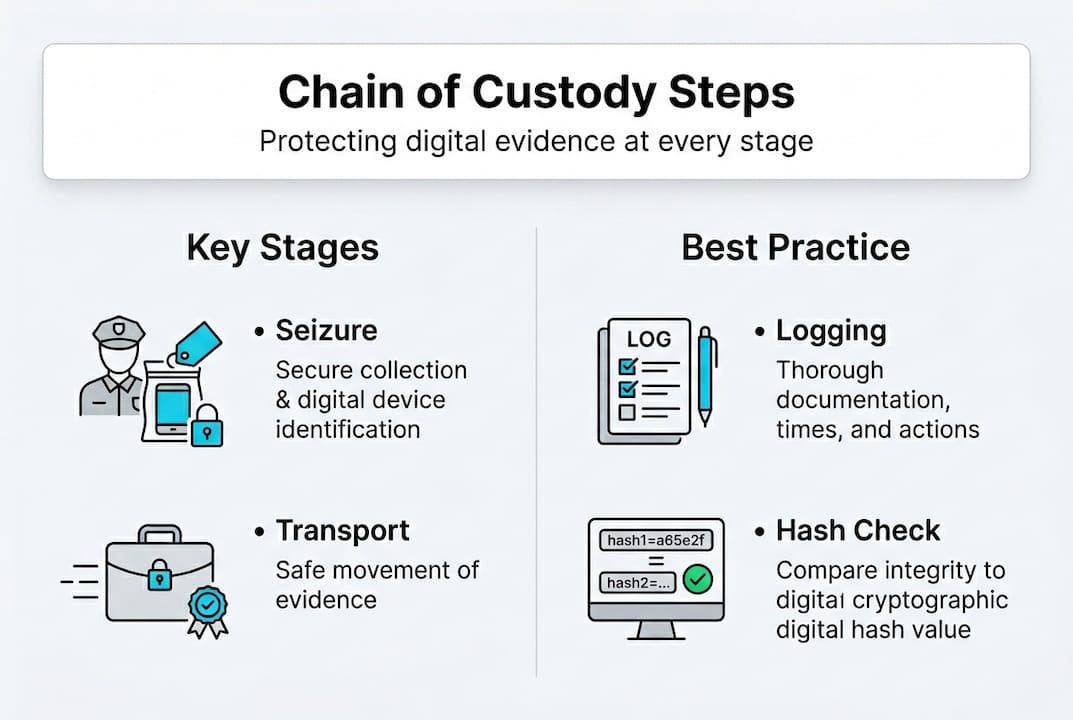
The key stages are:
- Seizure: The device or data source is photographed in situ, logged with full details (make, model, serial number, condition), and packaged securely.
- Isolation: Mobile devices are placed in Faraday bags to block wireless signals and prevent remote wiping. Computers may be kept powered on or off depending on the circumstances.
- Imaging: A forensic bit-for-bit copy of the storage media is created. All analysis is conducted on this copy, never the original.
- Hashing: A cryptographic hash (typically SHA-256) is generated for both the original and the copy. Matching hashes confirm the copy is identical and unaltered.
- Sealing: Tamper-evident seals are applied to physical media. Any subsequent access must be logged and justified.
- Transfer and storage: Every movement of the evidence is documented, including who transported it, when, and where it was stored.
Seizure, isolation, hashing, and tamper-evident seals are not optional extras. They are the minimum standard expected by UK courts.
| Stage | Key action | Purpose |
|---|---|---|
| Seizure | Photograph and log device | Establishes original condition |
| Isolation | Faraday bag or network block | Prevents remote tampering |
| Imaging | Forensic copy created | Protects original from analysis damage |
| Hashing | SHA-256 generated | Proves data integrity |
| Sealing | Tamper-evident packaging | Detects unauthorised access |
| Transfer | Signed handover logs | Maintains continuity |
Pro Tip: Always generate and record your hash values immediately after imaging, before any transfer takes place. A hash mismatch discovered later, without a baseline record, is almost impossible to explain to a court.
For those managing live investigations, preserving chain of custody across multiple devices simultaneously requires a structured intake process. Equally, following digital evidence collection steps in sequence reduces the risk of procedural errors that are difficult to correct after the fact.
Why chain of custody failures undermine cases
Procedural rigour sounds straightforward in theory. In practice, failures happen regularly, and the consequences are severe.
Typical failure points include:
- Incomplete logging: An officer handles a device without signing the log, creating an unexplained gap.
- Unsecured transfers: Evidence is moved between locations without a formal handover record.
- Delayed imaging: A device sits unimaged for days, raising questions about whether data was altered.
- Inadequate storage: Evidence is kept in an environment that is not properly secured or climate-controlled.
- Missing seals: Packaging is opened without documentation, making it impossible to confirm the evidence was not interfered with.
Frequent exclusions from chain gaps are a well-documented problem in UK courts, particularly as the volume of digital evidence grows. Device backlogs in police digital forensics units mean evidence sometimes waits months before being properly processed, increasing the window for procedural error.

| Failure type | Likely outcome | Severity |
|---|---|---|
| Missing log entry | Evidence questioned in court | Moderate |
| Unsecured transfer | Evidence potentially excluded | High |
| No tamper-evident seal | Integrity challenged | High |
| Hash mismatch | Evidence ruled inadmissible | Critical |
| Unexplained access | Case may collapse | Critical |
The judicial impact is not theoretical. Defence counsel routinely scrutinise chain of custody records looking for exactly these weaknesses. A single unexplained gap can be enough to persuade a judge to exclude a piece of evidence entirely. When that evidence is central to the prosecution, the case can fall apart.
For those building or reviewing internal protocols, the chain of custody procedures that courts expect are well-established. Using a digital evidence checklist at every stage is one of the most effective ways to prevent the kind of omissions that defence teams exploit.
Chain of custody in corporate compliance and data regulation
The importance of chain of custody does not stop at the courtroom door. For corporate compliance officers and HR teams, the same principles apply whenever digital evidence is gathered during internal investigations.
Under GDPR and the Data Protection Act 2018, organisations handling personal data must be able to demonstrate exactly how that data was accessed, processed, and stored. Chain of custody aligns with GDPR and DPA requirements by creating the audit trail that regulators expect to see during an investigation or enforcement action. Without it, organisations risk significant fines and reputational damage.
In the context of internal investigations, whether involving employee misconduct, data breaches, or intellectual property theft, a poorly managed evidence trail can:
- Undermine disciplinary proceedings if the evidence is challenged by an employment tribunal.
- Expose the organisation to counter-claims of data mishandling.
- Compromise any parallel criminal investigation being conducted by law enforcement.
- Weaken the organisation’s position with regulators such as the ICO.
Pro Tip: Treat every internal investigation as if it will end up in an employment tribunal or regulatory review. If your evidence handling would not survive that scrutiny, your process needs strengthening before you begin.
Audit trails also serve a strategic function. When regulators or opposing counsel request records, an organisation that can produce a clear, timestamped log of every action taken with relevant data is in a far stronger position than one that cannot. For guidance on the legal dimensions of this work, digital forensics compliance covers the key obligations that organisations face in 2026.

Common compliance mistakes include treating digital evidence as an IT matter rather than a legal one, failing to involve forensically trained personnel early enough, and not establishing a formal evidence management policy before an incident occurs.
A fresh take: Why chain of custody diligence sets leaders apart
Most chain of custody failures are preventable. That is not a comforting thought; it is a challenging one. It means that collapsed cases and excluded evidence are, in the majority of instances, the result of process failures rather than unavoidable circumstances.
The professionals who consistently get this right share one characteristic: they treat every action as if it will be audited. Not because they expect to be challenged, but because that mindset produces the kind of documentation that withstands challenge when it comes.
There is a tendency in busy investigations to treat chain of custody as administrative overhead, something to be completed after the important work is done. That instinct is exactly backwards. The documentation is the important work. Without it, everything else becomes legally worthless.
We have seen cases where meticulous evidence chain of custody tips were followed to the letter, and that rigour was what made the difference in court. Conversely, we have seen strong evidence excluded because a log was incomplete. The gap between those two outcomes is almost always a matter of culture and habit, not resources or complexity. Building that culture is what distinguishes genuinely effective practitioners from those who are merely competent.
How our expertise protects your digital evidence
For those who want absolute certainty with evidence handling and compliance, the right forensic partner makes all the difference. At Computer Forensics Lab, we work with legal professionals, law enforcement, and corporate clients across the UK to ensure that every piece of digital evidence is handled to the standard courts and regulators demand. Our digital forensics services cover the full chain from seizure through to expert witness reporting, with documented procedures at every stage. We understand that digital footprints exist across devices, cloud platforms, and networks, and we have the tools to recover and preserve them correctly. If you are facing an investigation, a compliance review, or simply want to strengthen your evidence management processes, speak to our experts for a bespoke consultation.
Frequently asked questions
What is the purpose of chain of custody in digital evidence?
It creates a documented trail ensuring digital evidence remains authentic and admissible by detailing every step from collection to courtroom. Chain of custody ensures courts can trust the integrity of what is presented to them.
Which UK laws cover chain of custody for digital evidence?
PACE 1984 governs evidence seizure and handling, while CPIA 1996 mandates disclosure obligations. Breaches of either can result in evidence being excluded from proceedings.
How can gaps in chain of custody affect a prosecution?
Missing steps create vulnerabilities that defence counsel will exploit, often resulting in key evidence being ruled inadmissible. Chain gaps frequently cause vital evidence to be excluded, regardless of how significant it is.
What are common mistakes that break the chain of custody?
Typical errors include incomplete logging, unsecured transfers between locations, and the absence of tamper-evident seals. Documentation, storage, and transfer failures are the most frequently cited causes of chain breakdown.
Is chain of custody relevant outside criminal cases?
Yes. Internal investigations, HR proceedings, and regulatory reviews all require the same standard of evidence management. Chain of custody supports GDPR and DPA compliance by providing the audit trail that regulators and tribunals expect.