

TL;DR:
- UK incident response requires timely actions, legal privilege, and compliance with multiple overlapping regimes.
- Building a multidisciplinary team with legal, IT, and communication roles ensures an effective, legally protected response.
- Regular testing, documentation, and post-incident review improve preparedness and regulatory compliance.
It is Friday afternoon. Your IT manager flags unusual network activity, and within the hour, your organisation suspects a significant data breach. The clock is already running. Failure to act within 72 hours can trigger ICO penalties of up to 4% of global annual turnover, plus serious reputational damage. For UK legal and corporate teams, incident response is not merely a technical exercise; it is a legally regulated, privilege-sensitive process where every decision carries consequence. This guide walks you through every essential step, from regulatory obligations and team structure to containment, notification, and post-incident audit, so your organisation is never caught without a defensible plan.
Table of Contents
- Understanding the incident response landscape in the UK
- Essential preparation: Building your multidisciplinary response team
- Step-by-step response: Containment, investigation and notification workflow
- Verification and compliance: Post-incident improvement and audit
- What most incident response playbooks overlook
- Strengthen your organisation’s incident defence with expert support
- Frequently asked questions
Key Takeaways
| Point | Details |
|---|---|
| First actions matter | Immediate containment and legal instruction protect privilege and determine compliance timelines. |
| Multiple reporting duties | UK incidents often trigger several parallel notification regimes with strict deadlines. |
| Privilege is protection | Engage legal teams early so forensic findings are shielded and obligations managed safely. |
| Audit for improvement | Every incident should prompt a review of technical steps, communication, and legal documentation. |
Understanding the incident response landscape in the UK
To lay the groundwork, let us clarify what incident response actually entails in the UK compliance and legal risk context. The term incident response refers to the structured approach an organisation takes when it detects, contains, investigates, and recovers from a cybersecurity or data incident. A data breach, specifically, is any event that leads to the accidental or unlawful destruction, loss, alteration, or unauthorised disclosure of personal data. Understanding these definitions is not pedantic; regulators will scrutinise them closely.
The UK operates under multiple overlapping reporting regimes, and the obligations vary significantly depending on your sector and the nature of the incident. Notification obligations differ by sector: the ICO must be notified within 72 hours under UK GDPR, PECR, and the NIS Regulations; Ofcom requires telecoms providers to report as soon as practicable; and the FCA mandates reporting under SUP 15.3 for regulated financial firms. Parallel obligations are common, and missing one does not excuse the other.
The NIS Regulations (Network and Information Systems) impose additional requirements on operators of essential services and relevant digital service providers (RDSPs). NIS Regulations require proportionate security measures and incident reporting for RDSPs, distinct from but sometimes overlapping with GDPR obligations. For a fuller picture of how these regimes interact, see the ICO’s guidance on NIS and GDPR differences.
| Regime | Who it covers | Reporting deadline | Regulator |
|---|---|---|---|
| UK GDPR | All data controllers | 72 hours | ICO |
| PECR (telecoms) | Telecoms providers | 24 hours | ICO / Ofcom |
| NIS Regulations | Essential services / RDSPs | Without undue delay | ICO / sector body |
| FCA SUP 15.3 | Regulated financial firms | As soon as practicable | FCA |
Key terminology to keep front of mind:
- Data incident: Any event potentially affecting the confidentiality, integrity, or availability of data.
- Legal privilege: The protection that shields communications between lawyers and clients from disclosure in proceedings.
- RDSP: Relevant digital service provider, as defined under the NIS Regulations.
- Incident response: The end-to-end process of detecting, containing, investigating, and recovering from an incident.
For organisations seeking to strengthen their approach, understanding incident response improvement is an essential starting point, as is grounding your team in response in a legal context.

Essential preparation: Building your multidisciplinary response team
With the regulatory complexity mapped out, the next priority is to ensure the right people are in place before an incident hits. A reactive scramble to find the right expertise during a live breach is one of the most common and costly mistakes UK organisations make.
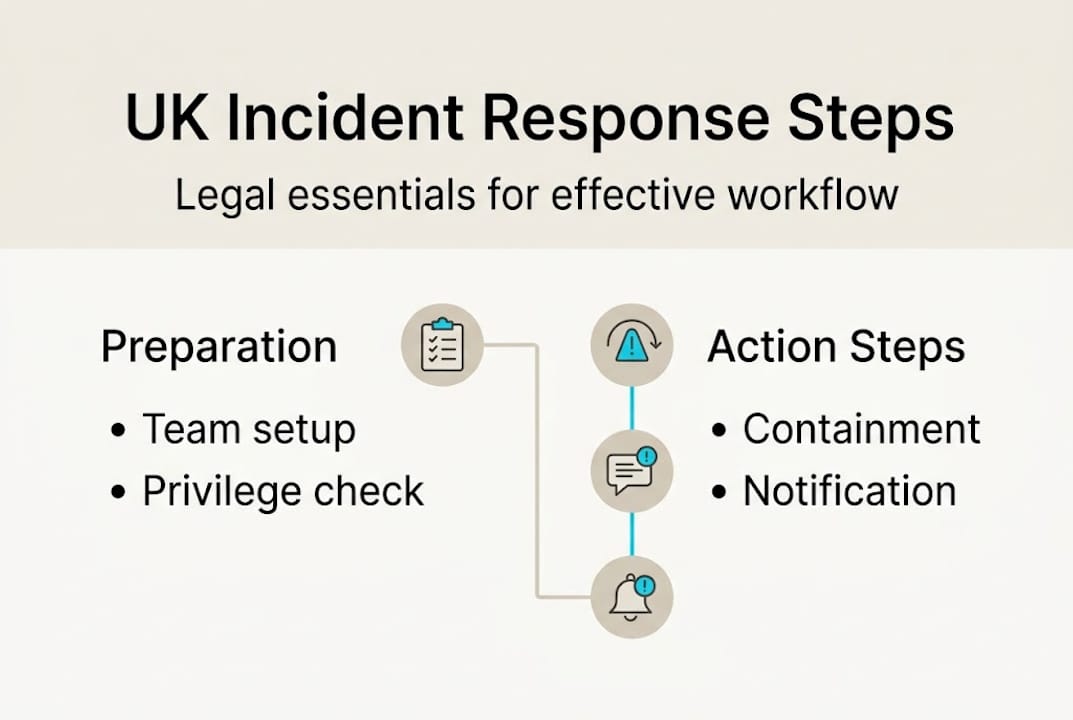
Your core incident response team should include the following roles:
- Legal counsel / external solicitors: Lead privilege decisions and instruct forensic investigations.
- Data Protection Officer (DPO): Assess notification obligations and liaise with the ICO.
- IT and digital forensics specialists: Contain the incident and preserve evidence with chain of custody.
- Communications lead: Manage internal and external messaging to avoid inadvertent admissions.
- Cyber insurance representative: Confirm coverage triggers and authorise approved vendors.
- Senior business leader: Authorise decisions and resource allocation.
| Role | Primary responsibility | UK legal obligation |
|---|---|---|
| Legal counsel | Privilege, notification strategy | Solicitors Act 1974 / UK GDPR |
| DPO | ICO liaison, breach assessment | UK GDPR Article 37-39 |
| IT / forensics | Containment, evidence preservation | NIS Regulations |
| Communications | Messaging control | Reputational risk management |
| Insurer | Coverage, vendor approval | Policy terms |
One aspect that separates resilient organisations from vulnerable ones is the question of legal privilege. Expert practice includes instructing forensics via lawyers to preserve legal privilege from the outset. If your IT team commissions the forensic investigation directly, any findings may be disclosable in subsequent litigation or regulatory proceedings. That is a risk no corporate client should accept.

Pro Tip: Always instruct your digital forensics provider through external legal counsel, not through your internal IT department. This single step can determine whether your investigation findings remain protected in court.
Coordination with your cyber insurer and the National Cyber Security Centre (NCSC) should also be built into your pre-incident planning. Many insurers require notification within hours of a suspected breach, and the NCSC offers early-warning support for critical infrastructure sectors. For legal teams wanting deeper guidance, our resources on incident response for legal teams and digital forensics for compliance provide practical frameworks.
Step-by-step response: Containment, investigation and notification workflow
Preparation is only half the story; flawless execution begins the moment an incident is detected. The first 72 hours are decisive, and every action must be deliberate.
UK GDPR Article 33 requires notification to the ICO within 72 hours of becoming reasonably certain that a notifiable breach has occurred. The countdown does not begin at the moment of suspicion, but at the point of reasonable certainty.
Breach response must start with containment and a legally privileged forensic investigation to avoid triggering premature notification obligations. Here is the stepwise process every UK legal and corporate team should follow:
- Detection and initial triage: Identify the nature, scope, and likely cause of the incident. Do not delete or alter any data.
- Immediate containment: Isolate affected systems to prevent further data loss or spread. Preserve forensic images before any remediation.
- Legal instruction: Engage external solicitors immediately. They will formally instruct the forensic team, establishing privilege over all investigation findings.
- Privileged forensic investigation: The forensics team, working under legal instruction, analyses affected systems, identifies compromised data, and establishes the breach timeline.
- Breach assessment: With forensic findings in hand, legal counsel and the DPO assess whether the incident meets the threshold for notification under UK GDPR, PECR, NIS, or sector-specific rules.
- Notification: Where required, notify the ICO within 72 hours for significant breaches, and telecoms providers must notify under PECR within 24 hours. Notify affected individuals where there is high risk to their rights and freedoms.
- Documentation: Record every decision, action, and communication throughout. Regulators will expect a clear audit trail.
Edge cases do arise. Notifications can sometimes be delayed where there is genuine uncertainty about breach scope, or where parallel criminal investigations are active. Always take legal advice before delaying a notification. For a detailed breakdown of each stage, our step-by-step incident process guide and what is incident response resource are practical references. The NIS reporting obligations page also clarifies the specific thresholds for digital service providers.
Pro Tip: Set up a secure, out-of-band communication channel for your response team before an incident occurs. Compromised email systems should never be used to coordinate a live breach response.
Verification and compliance: Post-incident improvement and audit
With the immediate incident managed, effective organisations seek to turn lessons learned into ever-stronger preparedness. Post-incident review is not optional; it is a regulatory expectation and a practical necessity.
The NCSC provides technical support, resilience frameworks including the Cyber Assessment Framework (CAF), and incident coordination for critical infrastructure organisations. Engaging with NCSC guidance post-incident can strengthen both your technical posture and your regulatory standing.
Your post-incident review should cover the following:
- Documentation review: Ensure all incident records, forensic reports, and notification correspondence are preserved under legal privilege where applicable.
- Lessons learned meeting: Convene legal, IT, and business leadership within two weeks of incident closure.
- Technical report preservation: Retain all forensic images and investigation outputs in accordance with your data retention policy.
- Legal privilege update: Review whether any communications or findings need reclassifying following the incident’s resolution.
- Policy and control updates: Amend incident response plans, access controls, and training programmes based on audit findings.
| Common audit finding | Recommended action |
|---|---|
| No legal instruction at outset | Revise response plan to mandate solicitor instruction at detection |
| Incomplete forensic preservation | Implement forensic imaging protocol before any remediation |
| Late ICO notification | Introduce automated breach assessment checklist |
| Inadequate staff training | Schedule annual tabletop exercises with legal and IT teams |
| Missing documentation trail | Deploy incident management platform with audit log |
For ongoing improvement, revisiting your improving incident response strategy regularly ensures your organisation stays ahead of evolving threats and regulatory expectations.
What most incident response playbooks overlook
Reflecting on compliance audit outcomes reveals a consistent pattern: the organisations that fare worst in regulatory scrutiny are not those that suffered the most severe breach. They are the ones that followed a generic playbook without understanding the legal architecture beneath it.
Most off-the-shelf incident response templates do not address UK privilege rules with any precision. They treat forensic investigation as a purely technical matter, when in reality it is a legal one. Teams that fail to prioritise legal privilege expose their findings to disclosure in adversarial proceedings, sometimes turning a manageable incident into a protracted legal liability.
Multi-regime reporting is another blind spot. When an incident triggers obligations under UK GDPR, NIS, and FCA rules simultaneously, a single reporting tree will not suffice. Integrated team readiness, with legal and technical leads operating in parallel, is not a luxury. It is the minimum standard.
The most important lesson: always scenario-test your notification decisions with legal counsel before an incident occurs. Build dual-track technical and legal reporting frameworks so that neither stream is dependent on the other.
Pro Tip: Run a tabletop exercise at least once per year that specifically tests your privilege preservation process. Most organisations test containment. Very few test the legal instruction chain.
Strengthen your organisation’s incident defence with expert support
For organisations ready to turn robust guidance into actionable defences, expert support is a practical next step. At Computer Forensics Lab, we work directly with UK legal teams and corporate clients to provide digital forensics services that are privilege-aware, court-ready, and built around your compliance obligations. Whether you need rapid evidence preservation, a defensible chain of custody, or specialist analysis of digital evidence support, our London-based team is equipped to engage at any stage of an incident. Our digital forensic investigations are conducted to the highest evidential standards, ensuring your organisation’s response is both technically sound and legally defensible. Contact us to discuss how we can support your incident response capability.
Frequently asked questions
What is the most critical first action in an incident response?
Contain the incident and instruct your forensic team through legal counsel to preserve privilege before assessing breach scope. The first 72 hours are decisive, and establishing privilege from the outset protects your investigation findings.
When must the ICO be notified of a data breach?
You must notify the ICO within 72 hours of becoming reasonably certain a notifiable breach has occurred, unless it is unlikely to result in risk to individuals. UK GDPR Article 33 sets out the full threshold criteria.
How do NIS obligations differ from GDPR?
NIS reporting relates to service disruption incidents affecting digital infrastructure, while GDPR focuses on personal data breaches. NIS Regulations require reporting for incidents affecting digital services, and both regimes can apply simultaneously.
What is the advantage of privilege in incident response?
Holding investigations under legal privilege helps shield findings in potential court proceedings and gives you greater control over the notification timeline. Instructing forensics via lawyers is critical for UK corporates facing regulatory or adversarial risk.
Who can provide technical support during a major cyber incident?
The National Cyber Security Centre (NCSC) acts as a central contact for technical support, threat notifications, and resilience guidance. NCSC as CSIRT/SPOC means it monitors incidents and provides early warnings for critical infrastructure operators.