

TL;DR:
- Mishandled digital evidence can lead to inadmissibility and case failure.
- Following established forensic standards and early expert collaboration ensures evidence integrity.
- Proper documentation, scope definition, and preservation protocols are crucial for court readiness.
Mishandled digital evidence has derailed more than one promising case. A solicitor discovers that browser history was accessed without a write-blocker, or that no hash verification was performed, and suddenly the evidence is challenged before it reaches a judge. Evidence inadmissibility from poor chain-of-custody is one of the most common failures in digital litigation. For legal professionals conducting internet activity investigations, the margin for procedural error is extremely narrow. This guide walks you through each critical step, from establishing the legal framework to producing court-ready reports, so your evidence stands up when it matters most.
Table of Contents
- Understanding the legal and forensic framework
- Preparation: Defining objectives and scoping the investigation
- Evidence collection: Securing and preserving internet activity
- Analysing and reporting: Transforming findings into court-ready evidence
- Avoiding common mistakes and maximising the value of digital evidence
- Why early collaboration with forensic experts changes the outcome
- Strengthen your legal cases with expert digital forensics
- Frequently asked questions
Key Takeaways
| Point | Details |
|---|---|
| Always start with a legal plan | Clear preparation and scoping are crucial for compliant and effective internet activity investigations. |
| Preserve evidence integrity | Chain of custody and proper tools safeguard evidence admissibility in court. |
| Collaborate with forensic experts early | Engaging specialists from the outset ensures both technical and legal requirements are met. |
| Beware common mistakes | Documentation errors and tool misuse can render evidence useless. |
| Report findings clearly | Analysis and reporting should always translate technical details into court-ready evidence. |
Understanding the legal and forensic framework
Before a single piece of data is touched, the investigation must be grounded in authoritative standards. Digital evidence operates under strict admissibility rules: it must be relevant, reliable, and obtained lawfully. Proportionality also matters, particularly in civil proceedings, where courts expect evidence collection to be targeted rather than sweeping. Getting this wrong at the outset can render everything that follows inadmissible.
Best practices for attorneys working with forensic analysts confirm that standard steps in legal digital investigation follow established digital forensics methodology. Two frameworks dominate the field: SWGDE (Scientific Working Group on Digital Evidence) and NIST (National Institute of Standards and Technology). Both provide structured guidance on evidence handling, tool validation, and documentation. Referencing SWGDE best practices during your investigation is not optional; it is the baseline for defensible practice.
The scope of an investigation varies considerably between criminal and civil matters. The table below illustrates the key differences:
| Factor | Criminal investigation | Civil investigation |
|---|---|---|
| Imaging approach | Full device imaging | Targeted, proportionate collection |
| Legal authority | Police warrant or court order | Court order or consent |
| Privacy threshold | Lower, broader scope | Higher, narrower scope |
| Analyst involvement | Mandatory from the outset | Strongly recommended early |
Engaging a certified digital forensic analyst at the earliest opportunity is not simply good practice. It is a strategic decision that shapes the entire investigation. Analysts understand which cybercrime investigation steps apply to your specific matter and can advise on tool selection, documentation requirements, and jurisdictional considerations before collection begins.
Common pitfalls at this stage include:
- Failing to document the legal basis for the investigation
- Using unvalidated or consumer-grade forensic tools
- Neglecting to establish chain of custody preservation from the very first action
- Assuming that screenshots or printouts constitute forensic evidence
Pro Tip: Always confirm your forensic analyst holds recognised certifications such as EnCE, CCE, or GCFE. Certification is not a formality; it is what courts look for when assessing expert credibility.
Preparation: Defining objectives and scoping the investigation
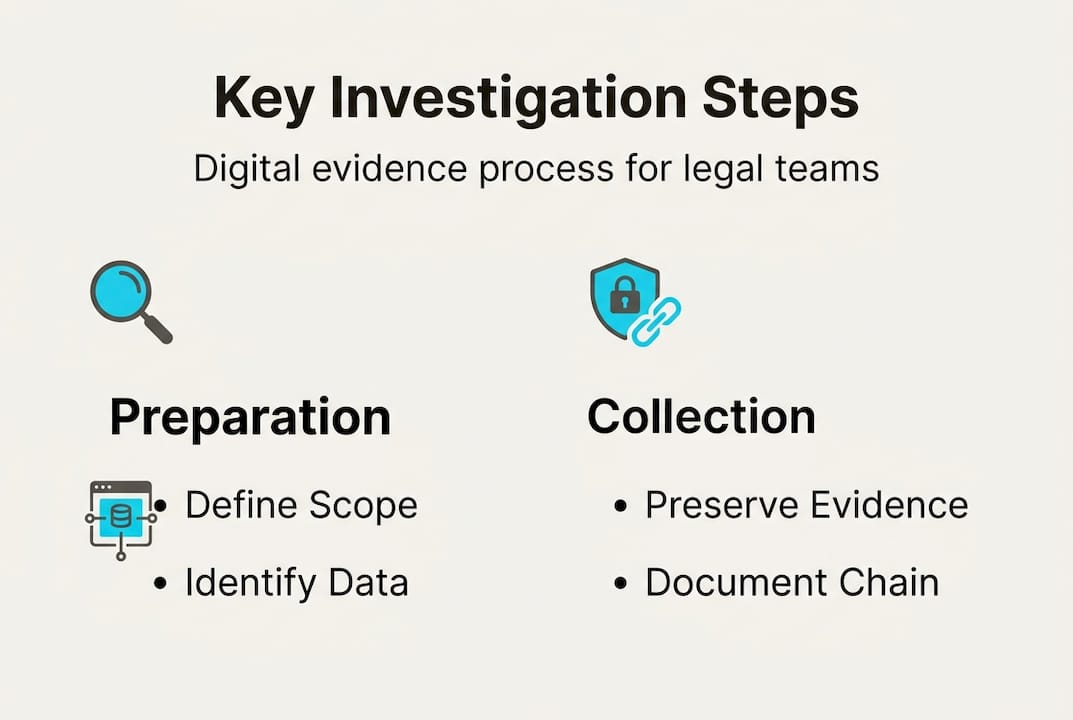
Once the legal and best-practice context is clear, the investigation itself must begin with meticulous preparation. Rushing into evidence collection without a defined scope is one of the fastest ways to compromise a case. Every effective internet activity investigation starts with a clear set of objectives.
Ask yourself: what exactly are you trying to establish? Common goals include proving or disproving a timeline of activity, attributing specific online actions to an individual via IP address, identifying communications between parties, or establishing intent through browsing behaviour. Each objective shapes which data sources you prioritise and how you approach collection.
Preparation and scoping include defining goals, confirming legal authority, and identifying sources such as logs, browsers, email accounts, and network data. Before any collection takes place, verify that you hold the appropriate judicial authorisation or consent. Operating without this exposes your client and your case to serious legal risk.
Potential digital sources for internet activity investigations include:
- Browser history, cookies, and cached files
- Email headers and server logs
- Cloud storage and synchronisation records
- Router and ISP logs
- Social media activity and messaging platforms
- Device timestamps and geolocation data
The table below maps investigation objectives to their most relevant data sources:
| Objective | Primary data source |
|---|---|
| Timeline of online activity | Browser history, system logs |
| IP attribution | ISP records, router logs |
| Communication between parties | Email headers, messaging apps |
| Intent or knowledge | Search history, downloads |
| Location at a given time | Geolocation, Wi-Fi connection logs |
For digital evidence collection steps, building a written investigation plan before collection begins is essential. This document should capture the objectives, authorised scope, identified sources, assigned personnel, and expected timelines. It becomes part of your audit trail.

Pro Tip: In civil matters, always apply a proportionality test before expanding your scope. Courts are increasingly critical of over-broad evidence collection, and a targeted approach is easier to defend under cross-examination.
Evidence collection: Securing and preserving internet activity
With objectives and scope mapped out, it is time to move into the critical stage of evidence collection. This is where procedural discipline is most important, and where errors are hardest to recover from.


The first priority is volatile data. RAM contents, active network connections, and running processes disappear the moment a device is powered down. These must be captured first, before any imaging of storage media takes place. Failure to do so can mean losing evidence of active sessions, encryption keys, or live communications.
Secure evidence collection requires write-blockers, volatile data capture, and hash verification as core steps. Write-blockers prevent any data from being written to the original device during imaging, preserving its integrity. Every forensic image must then be verified using cryptographic hash values, typically MD5 or SHA-256, to confirm that the copy is an exact replica of the original.
A defensible collection process follows this sequence:
- Document the scene: photograph devices, note their state (on or off), and record all visible details
- Capture volatile data using approved forensic tools before powering down
- Apply a write-blocker to all storage media before imaging
- Create a forensic image and generate hash values for verification
- Store originals securely and work only from verified copies
- Maintain a contemporaneous digital evidence chain of custody log recording every person who handles the evidence
A chain of custody is not bureaucratic paperwork. It is the legal thread that connects your evidence to the original source. Break it once, and opposing counsel will exploit it.
The consequences of omitting any of these steps are severe. Evidence may be ruled inadmissible, your expert witness may be discredited, and your client’s case may collapse. Digital forensics best practices are unambiguous on this point: early expert involvement is not a luxury.
Pro Tip: Never allow a non-specialist to power down a device that may contain volatile evidence. A single incorrect action at this stage can permanently destroy data that cannot be recovered.
Analysing and reporting: Transforming findings into court-ready evidence
Once evidence is collected and preserved, its real value lies in expert analysis and credible, accurate reporting. Raw data means nothing without context. The analyst’s role is to reconstruct what happened, when it happened, and who was responsible.
Forensic imaging and analysis includes timeline reconstruction and artefact extraction covering browser history, IP logs, and downloaded files. Analysts work across multiple data sources simultaneously to build a coherent picture. A timestamp from a browser cache, cross-referenced with a router log and a messaging app record, can place a specific individual at a specific location performing a specific action.
Key artefacts extracted during analysis include:
- Browser history and search queries
- IP address logs and connection timestamps
- Downloaded files and their metadata
- Chat logs and email threads
- Social media activity records
- Deleted file remnants recovered from unallocated space
The forensic analysis process must be fully documented. Every analytical step, every tool used, and every finding must be recorded so that another qualified analyst could independently verify the results. Courts expect this level of rigour.
When reviewing a forensic report, legal teams should look for:
| Report element | What to check |
|---|---|
| Analyst credentials | Certifications and relevant experience |
| Methodology section | Tools used and their validation status |
| Hash verification records | Confirming evidence integrity |
| Timeline of findings | Clear, chronological reconstruction |
| Plain-language summary | Accessible to judge and jury |
A well-constructed report from a social media investigation checklist perspective will also address privacy considerations, confirming that analysis was limited to the authorised scope. Over 90% of digital evidence challenges in court relate to process failures rather than the evidence itself, which is why documentation quality is as important as the findings.
Avoiding common mistakes and maximising the value of digital evidence
Analysis and reporting are not the end; avoiding critical mistakes and leveraging expert partnerships can make all the difference for case outcomes. Even experienced legal teams make procedural errors that undermine otherwise strong cases.
Risks include inadmissibility from poor chain-of-custody management and over-reliance on tools without the expertise to interpret their output correctly. A tool can generate a report; only a qualified analyst can explain what it means in a legal context.
The most frequent mistakes include:
- Accessing devices or accounts without proper authorisation
- Failing to document actions taken before a forensic analyst arrives
- Relying on screenshots as primary evidence without forensic backing
- Allowing multiple people to handle original devices without logging access
- Misinterpreting technical findings without specialist input
- Overlooking social media investigation tips that could surface relevant activity
To avoid evidence contamination, establish a clear protocol from the moment a device is identified as potentially relevant. No one should access, copy, or attempt to preview data without forensic oversight.
The question is never just whether the evidence exists. It is whether you can prove it was collected, preserved, and analysed without compromise.
A defensible internet activity investigation checklist should confirm:
- Legal authority verified and documented
- Forensic analyst engaged before collection
- Volatile data captured first
- Write-blocker used for all imaging
- Hash values generated and recorded
- Chain of custody log maintained throughout
- Report reviewed for methodology and clarity
Pro Tip: Brief your forensic analyst on the legal issues in the case, not just the technical task. An analyst who understands what you are trying to prove will structure their report to address those specific questions directly.
Why early collaboration with forensic experts changes the outcome
In our experience working alongside legal teams, the single most consistent predictor of a strong digital evidence outcome is when the forensic analyst is brought in before anything is touched. Not after. Not once a problem has been identified. Before.
Legal professionals often wait until evidence collection is underway, or worse, until a challenge arises, before engaging specialist support. By that point, volatile data may be gone, chain of custody may be broken, and the investigation is already on the back foot. Lawyers should collaborate with certified analysts early to ensure admissibility, and this is advice that consistently proves its value in practice.
There is also a persistent myth that having access to forensic software is sufficient. It is not. Tools produce output; analysts produce evidence. The difference matters enormously in court. A digital forensics guide can outline the process, but only a qualified specialist can execute it in a way that withstands cross-examination. Early partnership is not a cost; it is the most reliable risk mitigation available to your case.
Strengthen your legal cases with expert digital forensics
To ensure your case stands on the firmest ground, partnering with expert forensic services provides proven advantages. At Computer Forensics Lab, we work directly with solicitors, barristers, and legal teams across the UK to provide forensic-grade evidence handling, expert witness reports, and full chain of custody documentation. Our digital forensics services cover everything from device imaging and browser history analysis to cloud data recovery and social media investigations. Whether you are building a case around digital footprints for litigation or responding to a disclosure request, our analysts are ready to support your legal strategy from the very first step.
Frequently asked questions
What are the first steps in an internet activity investigation for legal cases?
Begin by defining your investigation objectives, confirming legal authority, and identifying all relevant digital sources such as browser logs, email records, and network data. A written investigation plan should be in place before any collection begins.
Why is chain of custody so important for digital evidence?
Maintaining chain of custody proves that evidence has not been altered or tampered with between collection and court. Poor chain-of-custody is one of the most cited reasons for evidence being ruled inadmissible.
How do civil and criminal digital investigations differ?
Criminal cases typically require full device imaging for comprehensiveness, while civil cases are more targeted to respect privacy and proportionality requirements set by the court.
What tools are commonly used for forensic analysis?
Certified tools such as Cellebrite and Magnet AXIOM are industry standard, but correct interpretation of their output requires qualified forensic expertise, not just access to the software.
When should a forensic analyst be involved in a legal investigation?
A forensic analyst should be involved from the very start of an investigation to ensure that evidence is collected, preserved, and documented in a legally defensible manner.