

TL;DR:
- Certification verifies digital investigators’ technical skills, ethical standards, and procedural compliance.
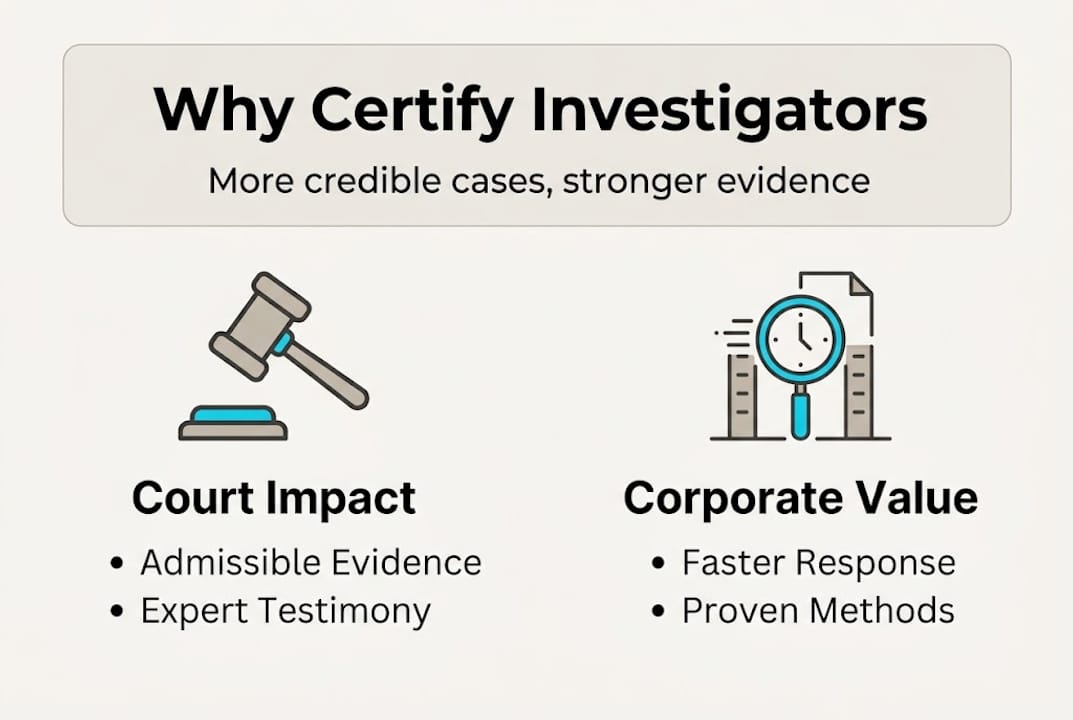
- Certified experts are more credible in court, leading to higher evidence admissibility and stronger testimony.
- Maintaining evidence integrity and chain of custody is critical and best ensured by certified professionals.
Digital evidence does not speak for itself. A common misconception among legal teams and corporate clients is that raw data recovered from a device is inherently reliable in court. It is not. The moment an uncertified investigator touches that evidence, the entire chain of trust is at risk. Courts can exclude findings, opposing counsel can demolish credibility under cross-examination, and cases that should have been won are lost on procedural grounds. Certification is not a bureaucratic formality. It is the technical and ethical backbone that determines whether your digital evidence stands up or falls apart when it matters most.
Table of Contents
- What does certification mean for digital investigators?
- Legal admissibility and credibility: Certification in UK courts
- Safeguarding evidence integrity and the chain of custody
- Certification’s impact in corporate cybercrime and litigation
- What happens when certification is lacking?
- Why certification really matters: Lessons the industry ignores
- Work with certified digital forensics professionals
- Frequently asked questions
Key Takeaways
| Point | Details |
|---|---|
| Certification builds trust | Courts and clients rely on certified investigators for robust evidence handling and expert opinion. |
| Admissibility depends on expertise | Certified professionals are more likely to have their evidence and testimony accepted in UK legal proceedings. |
| Integrity is non-negotiable | Chain-of-custody and technical validation are best ensured by certified experts, especially with complex data. |
| Corporate value is rising | Companies increasingly prioritise certified investigators as cyber risks and regulatory expectations grow. |
| Uncertified risks are real | Failing to use certified investigators increases the chance of losing evidence, cases, or business reputation. |
What does certification mean for digital investigators?
Certification in digital forensics is a formal, independently verified confirmation that an investigator has mastered specific technical skills, ethical standards, and procedural protocols. It is not a course completion certificate. It is evidence that the investigator has been tested, assessed, and validated by a recognised professional body.
In the UK and internationally, several credentials carry significant weight. CFCE, GCFA, CHFI enhance investigator credibility as expert witnesses, making them far more effective in both litigation and corporate investigation contexts. Each credential targets a different area of expertise:
- CFCE (Certified Forensic Computer Examiner): Issued by the International Association of Computer Investigative Specialists (IACIS). Best suited for law enforcement and legal proceedings requiring rigorous examination methodology.
- GCFA (GIAC Certified Forensic Analyst): Issued by GIAC. Highly regarded for incident response and advanced threat investigation in corporate environments.
- CHFI (Computer Hacking Forensic Investigator): Issued by EC-Council. Widely recognised in UK corporate and legal sectors for cybercrime investigation and evidence handling.
- CREST Certified: Particularly valued in UK penetration testing and incident response contexts, with strong recognition among government and financial sector clients.
Courts and corporate clients demand certified experts for a straightforward reason: accountability. A certified investigator has a professional body to answer to. Their methods are standardised, their reports are reproducible, and their expert witness testimony carries the weight of verified competence rather than self-declared skill.
Pro Tip: When selecting a digital forensics expert, always ask which professional body issued their certification and whether it requires ongoing renewal. Certifications that demand continuing professional development are far more reliable indicators of current competence.
Legal admissibility and credibility: Certification in UK courts
British courts apply strict standards when assessing digital evidence and the experts who present it. Judges evaluate whether an investigator’s methodology is sound, whether their tools are validated, and whether their conclusions are defensible under scrutiny. Certification is one of the clearest signals that these standards have been met.
Certified investigators provide more credible testimony under cross-examination, because their methods are grounded in documented, peer-reviewed protocols rather than personal habit or improvisation.
“The difference between a certified and uncertified investigator in court is often the difference between evidence that stands and evidence that is struck out.”
The practical consequences are significant. Consider the following comparison:
| Factor | Certified investigator | Non-certified investigator |
|---|---|---|
| Evidence admissibility | High likelihood of acceptance | Frequently challenged or excluded |
| Cross-examination resilience | Methodology is defensible | Methods easily undermined |
| Judicial perception | Viewed as credible expert | Credibility questioned |
| Professional accountability | Governed by certifying body | No formal oversight |
| Report reproducibility | Standardised and verifiable | Inconsistent, hard to verify |
The expert witness roles that certified investigators fill are not simply about presenting findings. They require the ability to explain complex technical processes in plain language, withstand aggressive questioning, and demonstrate that every step followed accepted forensic practice. An uncertified investigator, however technically capable they may be, lacks the formal framework to do this convincingly.
Pro Tip: Before any proceedings begin, verify your investigator’s certification status directly with the issuing body. Do not rely solely on a CV. A courtroom expert witness whose credentials cannot be independently confirmed is a liability, not an asset.
Safeguarding evidence integrity and the chain of custody
Beyond the courtroom, certified professionals also excel in maintaining evidence integrity from the very first moment of collection. Chain of custody refers to the documented, unbroken sequence of possession and handling of digital evidence. Any gap in that chain gives opposing parties grounds to challenge the evidence entirely.

Encrypted data or international evidence requires certified expertise for chain-of-custody maintenance and tool validation, particularly in cross-border disputes where differing legal standards apply.
The risks of improper handling are severe. Evidence can be declared inadmissible. Cases built on months of investigation can collapse. In criminal matters, this can mean a miscarriage of justice. In civil litigation, it can mean a lost claim worth millions.
Certified investigators follow a structured process:
- Scene assessment: Identifying all potential sources of digital evidence before touching anything.
- Forensic imaging: Creating verified, bit-for-bit copies of storage media using validated tools, preserving the original.
- Hash verification: Generating cryptographic hashes to confirm that copied data is identical to the original and has not been altered.
- Secure storage: Storing evidence in tamper-evident packaging with documented access logs.
- Documentation: Recording every action taken, every tool used, and every person who handled the evidence.
- Reporting: Producing a detailed, reproducible report that can be scrutinised by opposing experts.
You can find detailed chain of custody guidance and practical evidence integrity tips that reflect the standards certified investigators apply in live cases.
Pro Tip: Certified investigators are trained in tool validation protocols, meaning they can demonstrate that the software they used to extract or analyse data is forensically sound. This is critical when dealing with encrypted devices or evidence gathered across jurisdictions.
Certification’s impact in corporate cybercrime and litigation
Courtrooms are not the only arenas where certification makes a difference. Corporate clients also reap real benefits from insisting on certified investigators, particularly as the volume and sophistication of cybercrime continues to grow.
UK demand for certified digital forensic investigators is rising, with 10 to 15% projected job growth by 2025, driven by cybercrime. Salaries ranging from £29,000 to £67,000 reflect the value placed on certified expertise in both legal and corporate sectors.

| Certification level | Typical salary range (UK) | Primary sector demand |
|---|---|---|
| Entry-level certified | £29,000 to £38,000 | Law enforcement, SME corporate |
| Mid-level (GCFA/CHFI) | £38,000 to £52,000 | Legal firms, financial sector |
| Senior certified specialist | £52,000 to £67,000+ | Enterprise, government, litigation |
For corporate clients, the business case for certified investigators is straightforward:
- Regulatory compliance: Certified investigators understand data protection law and can produce reports that satisfy ICO requirements.
- Insurance claims: Many cyber insurance policies require forensic reports produced by certified professionals.
- Internal investigations: Employee misconduct and intellectual property theft cases require investigators whose findings will withstand legal scrutiny.
- Incident response: Certified professionals can identify the scope of a breach faster and more accurately, limiting business disruption.
- Supplier and partner disputes: Third-party investigations require investigators whose neutrality and competence are beyond question.
The statistic is telling: a salary ceiling of £67,000 for senior certified specialists reflects what the market believes their expertise is worth. For corporate clients, the cost of a certified investigator is almost always less than the cost of a failed investigation.
What happens when certification is lacking?
Understanding the benefits is only half the picture. What is actually at stake when an uncertified investigator is brought in?
Uncertified investigators can compromise crucial evidence, risking miscarriages of justice and leaving organisations exposed to regulatory penalties, reputational damage, and failed litigation.
The case types most vulnerable to uncertified practice include:
- Intellectual property theft: Where technical analysis must be precise and legally defensible to support injunctions or damages claims.
- Financial fraud: Where transaction data and device analysis must meet strict evidentiary standards.
- Regulatory inspections: Where findings may be reviewed by the FCA, ICO, or other bodies with their own technical standards.
- International disputes: Where cross-border evidence handling requires knowledge of multiple legal frameworks.
- Employee misconduct: Where procedural errors can expose the employer to counter-claims of unlawful surveillance.
“Every oversight in digital forensics is not merely a mistake. It is a risk transferred directly to the client, the case, and ultimately to justice itself.”
The expert witness responsibilities that certified investigators carry are substantial, and they exist precisely because the consequences of getting it wrong are so serious. An uncertified investigator has no professional framework to enforce those responsibilities.
Why certification really matters: Lessons the industry ignores
There is a persistent belief in some quarters that experienced practitioners with years of hands-on work are just as reliable as certified ones. We disagree, and we have seen why that belief fails in practice.
Experience without certification means methods that have never been formally validated. It means a report that opposing counsel can pick apart because there is no recognised standard to defend it against. We have seen cases where an investigator’s genuine technical skill was entirely undermined in court because they could not point to a professional body, a code of conduct, or a validated methodology. The judge was not questioning their ability. The judge was questioning their accountability.
Smart clients, whether legal professionals or corporate risk managers, always insist on visible certification. Not because they distrust the investigator, but because they understand that the digital forensics expert perspective must be defensible to people who were not in the room when the evidence was collected.
Certification is ultimately about reputation, not compliance. It tells every party in a case or investigation that this professional has been tested, is governed, and is accountable. That is the real competitive edge, and it is one that no amount of informal experience can replicate.
Work with certified digital forensics professionals
If certification is your non-negotiable standard, then the team you work with must reflect that. At Computer Forensics Lab, our investigators hold recognised certifications and operate to the highest standards of evidence handling, chain of custody, and expert witness practice. Whether you need support for litigation, a corporate cybercrime response, or a complex digital forensic investigation, we provide certified expertise that holds up under scrutiny. Explore our full range of professional digital forensics services or learn how we analyse digital footprints to build robust, admissible evidence. Contact us to discuss your case with a certified expert.

Frequently asked questions
What are the main certifications for digital investigators in the UK?
Key certifications include CFCE, GIAC GCFA, and CHFI, all of which are recognised in UK courts and corporate investigations. CREST certification is also widely respected, particularly in government and financial sector contexts.
Does certification really affect legal outcomes?
Certified investigators provide more credible testimony under cross-examination, improving the likelihood that digital evidence is accepted and that the expert’s conclusions carry weight with the judge or jury.
How does certification help with chain of custody issues?
Certified investigators are trained to maintain chain-of-custody integrity using validated tools and documented procedures, reducing the risk of evidence dispute even in complex encrypted or cross-border cases.
Why are corporate clients prioritising certified investigators?
Certification signals greater technical reliability and professional accountability, which directly lowers corporate risk. With salaries reaching £67,000 for senior certified specialists, the market clearly reflects the premium that legal and corporate sectors place on verified expertise.