
TL;DR:
- Remote evidence collection is now a mainstream digital investigation method that offers speed, cost efficiency, and flexibility, especially across multiple jurisdictions. It involves acquiring digital evidence over networks while the device remains in its original location, following strict forensic and legal procedures. Proper planning, validation, and custodian cooperation are essential to ensure admissibility, integrity, and success in remote investigations.
Remote evidence collection is transforming how investigators, solicitors, and corporate security teams gather digital proof. Gone are the days when every investigation required physical device seizure or a forensic examiner flying to a remote office. Yet a persistent misconception remains: that remote collection is somehow a compromise, a second-best option when on-site access is impractical. The reality is far more nuanced. Understanding what is remote evidence collection, how it works, and when to use it is now a core competency for anyone involved in digital investigations.
Table of Contents
- Key takeaways
- What is remote evidence collection and how it works
- Legal and procedural considerations
- Remote vs on-site collection
- Best practices for remote evidence collection
- Where remote collection makes the biggest difference
- My perspective on where remote collection stands today
- How Computerforensicslab supports your remote investigations
- FAQ
Key takeaways
| Point | Details |
|---|---|
| Remote collection is mainstream | 71% of DFIR practitioners cite remote collection as a significant workflow challenge, confirming its central role. |
| Speed is a genuine advantage | Targeted remote collection completes in hours, not the days required by traditional device shipping or in-person visits. |
| Legal authority comes first | You must establish clear legal scope, consent, or warrant authority before any remote collection begins to protect admissibility. |
| Scoping reduces risk | Filtering by date range, file type, and application reduces privacy exposure and downstream review costs significantly. |
| On-site remains necessary | Complex, encrypted, or physically damaged devices still require hands-on forensic examination that remote tools cannot replicate. |
What is remote evidence collection and how it works
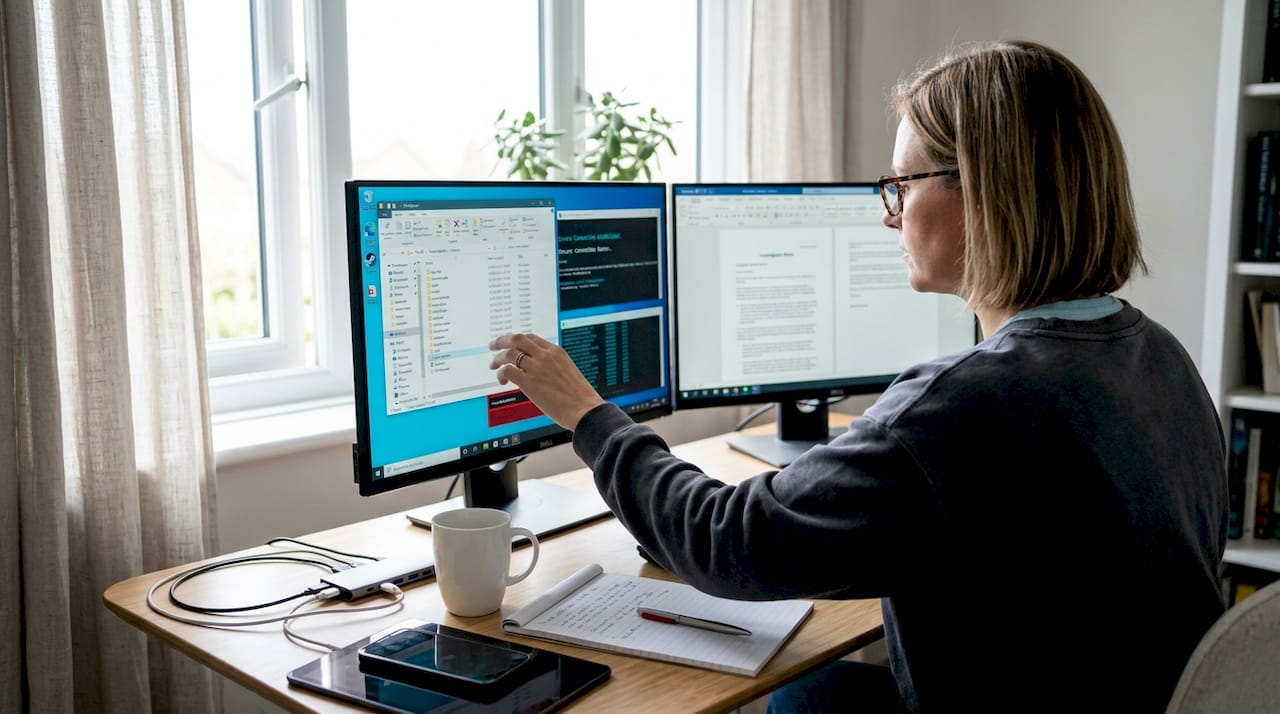
Remote evidence collection is the process of acquiring digital evidence from a device, system, or cloud environment without physical access to the hardware. A forensic examiner or investigator connects to the target device over a network, extracts specified data, and preserves it in a forensically sound manner. The device stays where it is. The custodian, whether an employee, suspect, or witness, may remain at home or in another country entirely.
The methods used span several distinct categories. Server-based collection targets data held centrally on corporate servers or cloud platforms. Endpoint-based collection focuses on individual computers or laptops accessed remotely. Network-based collection captures traffic or logs at the network level. Removable media collection and BYOD (bring your own device) approaches handle personal devices connected to corporate infrastructure.
Understanding what is remote forensics requires recognising that tool selection matters enormously. Two primary tool types exist in practice. Agent-based tools run as pre-installed services on endpoints, making them well suited to ongoing monitoring and integrated alert escalation. Standalone executable tools require no prior installation. A forensic examiner sends a small executable to the custodian’s machine, it runs, collects specified data, and transfers the output securely. This flexibility makes standalone tools particularly useful for ad-hoc or urgent investigations where pre-installation was never an option.
Maintaining forensic soundness during remote data retrieval is non-negotiable. The collection process must not alter the source data. Cryptographic hash values are generated before and after collection to verify integrity. Timestamps, access logs, and collection reports are preserved as part of the evidential record.
Pro Tip: Always confirm that your chosen tool generates a full audit log and cryptographic hash of every collected item. Without this, defending the integrity of your evidence in court becomes significantly harder.
Legal and procedural considerations
Remote evidence gathering carries the same legal obligations as any forensic collection. The fact that you are operating remotely does not reduce the standard of care required. It may actually increase it, because the physical separation between examiner and device introduces additional complexity around verification and documentation.
Before any collection begins, you must establish the legal basis for it. For corporate investigations, this typically means written authorisation from senior management and a defined scope within the employment contract or investigation policy. For law enforcement, a warrant or equivalent legal authority is required. Collecting beyond the authorised scope, even inadvertently, can render evidence inadmissible and expose the investigating party to legal liability.
Chain of custody documentation in remote settings requires particular attention. Strict chain-of-custody documentation and validated tools are the baseline standard. Every step must be recorded, including who initiated the collection, which tools and versions were used, what data was collected, and when. Computerforensicslab recommends a structured remote evidence procedure that includes the following steps:
- Obtain written legal authority and define the precise scope of collection.
- Select and validate the forensic tool to be used, confirming it does not modify source data.
- Prepare a detailed collection plan specifying data types, date ranges, and target devices.
- Brief the custodian with clear, written instructions on what they need to do and why.
- Execute the collection and generate cryptographic hash values for all acquired data.
- Produce a contemporaneous collection report documenting every action taken.
- Securely transfer and store collected data with access controls and an updated custody log.
Privacy and data protection obligations add another layer. Under UK GDPR, personal data collected during remote evidence gathering must be proportionate to the investigation’s purpose. Collecting everything indiscriminately is not only inefficient. It exposes the collecting party to regulatory risk. Jurisdictional complexity arises when custodians are located abroad, as local laws may impose additional restrictions on what can be collected and transferred.
Pro Tip: For cross-border remote collections, seek legal advice specific to the custodian’s jurisdiction before you begin. What is lawful in the UK may require additional steps or restrictions in other countries.
Custodian cooperation is fundamental to remote collection success. Unlike on-site examination, you cannot simply take control of the device. The custodian must authenticate, run the collection client, and follow instructions correctly. Clear, jargon-free guidance documents and a point of contact for questions reduce errors and protect the integrity of the process.

Remote vs on-site collection
The choice between remote and on-site collection is not simply about convenience. Each approach carries distinct advantages and limitations that must be weighed against the specific needs of the investigation.
Remote collection wins on speed and cost. Targeted remote collection completes in hours, compared to the days or weeks consumed by shipping devices or arranging on-site visits. Travel costs, accommodation, and examiner time are substantially reduced. For matters involving multiple custodians spread across different offices or countries, remote collection may be the only proportionate option.
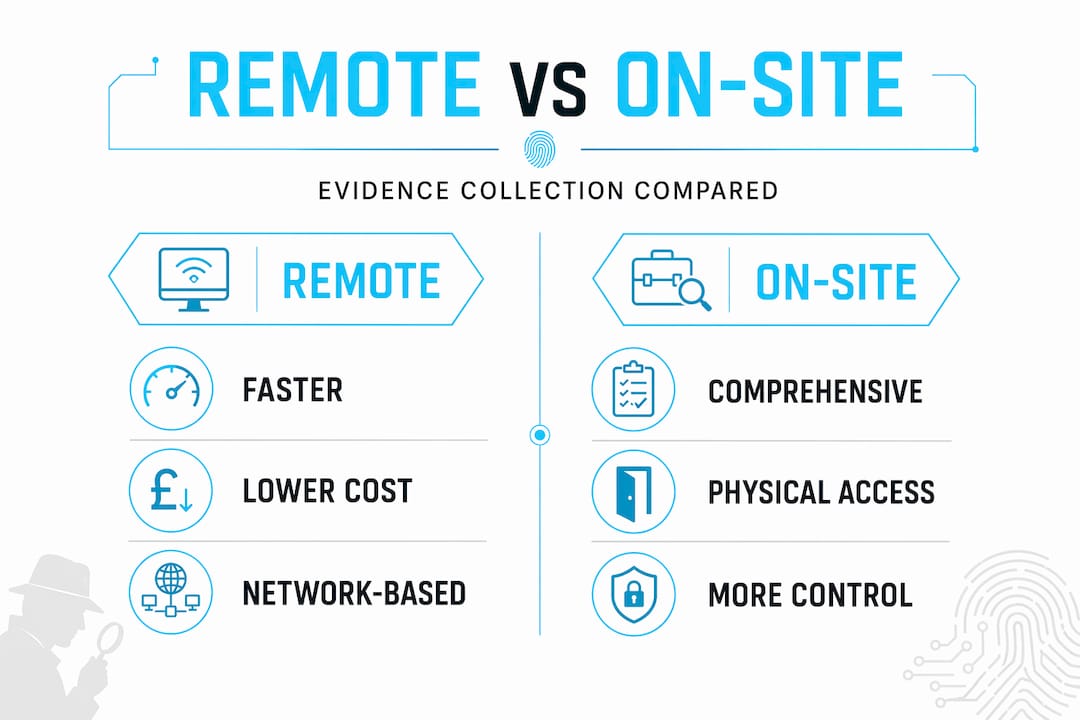

On-site collection offers depth and control. A forensic examiner physically present with a device can image entire drives, examine physical connections, access encrypted volumes with custodian assistance, and respond in real time to unexpected findings. If a device is damaged, encrypted with an unknown key, or connected to specialised hardware, on-site examination provides options that remote tools simply cannot replicate.
| Factor | Remote collection | On-site collection |
|---|---|---|
| Speed | Hours | Days to weeks |
| Cost | Lower | Higher |
| Scope of data | Targeted and defined | Broader, full-image possible |
| Encrypted devices | Limited capability | Full capability with assistance |
| Custodian disruption | Minimal | Potentially significant |
| Forensic depth | Sufficient for most matters | Maximum depth available |
| Geographic flexibility | Excellent | Constrained by travel |
Both approaches are defensible when executed properly, which is the most important point many practitioners overlook. The deciding factors include the investigation scope, the technical complexity of target devices, how sensitive the matter is for the custodian, and the time and budget available.
Consider a corporate misconduct investigation involving three employees working from home in different UK cities. Remote targeted collection of their work laptops and email accounts can yield the critical data within a day. The same investigation conducted on-site would require three separate examiner visits, significant disruption to the employees and their managers, and considerably higher cost.
Best practices for remote evidence collection
Getting remote collection right requires preparation before the examiner connects to a single device. The following practices reflect what separates forensically sound remote collection from rushed, defensible-in-name-only exercises.
- Scope tightly from the outset. Targeted acquisition by date range, file type, and application reduces the volume of irrelevant data, protects custodian privacy, and lowers review costs. Collecting broadly because you are unsure what you need is a red flag in any legal proceeding.
- Verify network reliability before collection. Auto-resume capabilities in your chosen tool are not optional extras. Interrupted transfers that cannot be resumed risk producing incomplete and potentially inadmissible evidence sets.
- Prepare custodians thoroughly. Clear documented procedures and user-friendly guidance reduce errors significantly. Send step-by-step instructions in plain language, schedule a time when the custodian can dedicate their attention to the process, and provide a direct contact for questions.
- Validate your tools. Use only validated forensic software with a documented testing history. This protects you when opposing counsel questions your methodology.
- Document everything contemporaneously. Notes written after the fact are far weaker than records made in real time. Your chain of custody documentation should be able to withstand cross-examination.
Common pitfalls to avoid include: starting collection without written authorisation, failing to brief the custodian adequately, choosing tools that modify metadata, and neglecting to account for cloud-synchronised data that may not reside on the endpoint at all.
Pro Tip: Post-collection, always verify hash values and run a completeness check against the scope of your collection plan. A missing folder or application is far easier to address immediately than after the data has entered the review process.
Where remote collection makes the biggest difference
The practical value of remote evidence gathering becomes clearest in specific investigative scenarios. Multi-jurisdiction investigations, where custodians are spread across countries or continents, make on-site collection impractical and extraordinarily expensive. Remote collection allows a single examiner to coordinate data acquisition across multiple locations simultaneously.
Time-sensitive matters benefit enormously. When early data insight can determine whether litigation is worth pursuing, or whether a security breach is still active, cloud-native and collaboration platform extraction delivers rapid results. For cybercrime investigations, remote triage tools can identify indicators of compromise on an endpoint within hours of an incident being reported, without requiring the device to leave the employee’s hands.
Corporate internal investigations involving employee misconduct frequently benefit from remote collection precisely because it avoids the visible disruption of an examiner arriving at a desk. Collecting evidence without alerting the subject, or without causing alarm amongst colleagues, protects the integrity of the investigation. You can find practical examples of the types of digital evidence in legal cases that remote collection regularly surfaces. Remote forensics also integrates naturally with cloud forensics strategies, where data may exist in Microsoft 365, Google Workspace, or enterprise collaboration tools rather than on any single device.
My perspective on where remote collection stands today
I’ve watched remote evidence collection move from a niche workaround to a central part of investigative practice, and the shift has been faster than most practitioners anticipated. The COVID-19 period accelerated adoption, but what kept it was the results.
What I’ve learned from working through complex matters is that the biggest risk is not the technology. It is the assumptions people bring to it. Some legal professionals still treat remote collection as inherently less rigorous than on-site work. That view is simply wrong when the process is executed correctly. The more uncomfortable truth is that poorly planned on-site collection is far more damaging to a case than well-executed remote collection.
The balance I’ve come to value is informed selectivity. Remote collection is not always the right answer. For devices with complex encryption, physical damage, or unusual configurations, on-site examination remains the gold standard. The expertise lies in reading the situation and choosing the right approach, not defaulting to one because it is faster or cheaper.
Custodian preparation is the area I see organisations underinvest in most consistently. A custodian who does not understand why they are being asked to run a collection tool, or who makes an error during authentication, can compromise months of careful planning. Investing thirty minutes in a clear briefing call pays for itself many times over.
— Computer
How Computerforensicslab supports your remote investigations
Computerforensicslab provides end-to-end digital forensics services for legal professionals, law enforcement, and corporate security teams across the UK and internationally. Our team conducts targeted remote collections from endpoints, cloud platforms, mobile devices, and enterprise collaboration tools, maintaining full chain of custody and producing court-ready evidence packages.
Every remote collection we conduct follows validated forensic procedures, meets UK legal admissibility standards, and is supported by detailed documentation. We also provide expert witness reports and consultation on remote evidence procedures for matters heading to litigation. If you are planning a digital investigation and need to determine whether remote or on-site collection is right for your case, contact us for a confidential consultation. You can also explore how digital footprints across cloud and device environments factor into your investigative strategy.
FAQ
What is remote evidence collection in simple terms?
Remote evidence collection is the process of acquiring digital evidence from a device or system over a network, without physically handling the hardware. The device remains with the custodian while forensic data is extracted securely and preserved for investigation or legal proceedings.
Is remotely collected evidence admissible in court?
Yes, provided the collection follows validated forensic procedures, maintains a documented chain of custody, and was conducted under proper legal authority. Both remote and on-site collection are legally defensible when executed correctly.
How long does remote evidence collection take?
Targeted remote collection typically completes within hours, compared to the days or weeks required by traditional device shipping or in-person examination. The timeframe depends on data volume, network speed, and the scope of collection defined in advance.
When should I choose on-site collection over remote?
On-site collection is preferable when dealing with encrypted devices, physically damaged hardware, or situations requiring a full forensic image of a drive. If the technical complexity of the device exceeds what remote tools can handle, hands-on examination delivers results that remote methods cannot.
What are the main legal risks in remote evidence gathering?
The principal risks include collecting beyond the authorised scope, failing to document chain of custody adequately, and breaching data protection obligations under UK GDPR. Seeking legal authority and defining a precise collection scope before any acquisition begins mitigates these risks substantially. For cross-border matters, consult remote forensics principles specific to the relevant jurisdiction.