

TL;DR:
- Evidence preservation encompasses physical items, digital records, and testimonial accounts, starting as soon as litigation is reasonably anticipated. Proper procedures—including securing scenes, documenting evidence, ensuring chain of custody, and using specialized workflows—are essential to prevent loss or contamination, especially for digital evidence vulnerable to tampering. Maintaining rigorous preservation practices safeguards admissibility, upholds legal obligations, and ensures the integrity of investigations and courtroom outcomes.
Evidence preservation is one of the most consequential disciplines in modern legal practice, yet it is routinely misunderstood as being limited to bagging physical items at a crime scene. What is evidence preservation, in reality, covers a far broader obligation. It spans physical exhibits, digital records, testimonial accounts, and electronically stored information. It triggers the moment litigation is reasonably anticipated, not when proceedings formally begin. Loss or mishandling of evidence can obstruct investigations, cause wrongful convictions, and fundamentally undermine public trust in the justice system.
Table of Contents
- Key takeaways
- Core principles and legal foundations
- Preserving physical evidence: processes and protocols
- Preserving digital evidence: challenges and strategies
- Chain of custody: the legal backbone of preservation
- Implementing effective preservation policies
- My perspective on evidence preservation in 2026
- How Computerforensicslab can help you preserve digital evidence
- FAQ
Key takeaways
| Point | Details |
|---|---|
| Preservation triggers early | Legal holds must be imposed the moment litigation is reasonably anticipated, before proceedings commence. |
| Chain of custody is non-negotiable | Every transfer, handler, and time-stamp must be recorded to keep evidence admissible. |
| Digital evidence carries unique risks | Deletion, encryption, and remote wiping require specialised technical workflows and tools. |
| AI is reshaping forensic verification | Deepfakes and AI-generated content now demand rigorous authentication of digital originals. |
| Custodian-level compliance matters | Courts scrutinise individual hold compliance, not just organisation-wide policies. |
Core principles and legal foundations
At its most precise, evidence preservation means taking all necessary measures to prevent the loss, alteration, or destruction of material that is relevant to anticipated or ongoing legal proceedings. Preservation requires action from the moment litigation is reasonably anticipated, including suspending routine data retention schedules and purging processes that would otherwise operate automatically.
The legal duties underpinning preservation are not merely procedural. They reflect constitutional and common law obligations rooted in due process and the right to a fair trial. In criminal proceedings, Brady obligations in jurisdictions following that doctrine require prosecutors to disclose and preserve material that could be exculpatory. Failure to do so does not simply weaken a case. It can result in prosecutorial misconduct findings and the collapse of charges entirely.
Three distinct categories of evidence attract preservation obligations:
- Physical evidence: Tangible objects including weapons, documents, clothing, biological samples, and fingerprints recovered from crime scenes or civil incidents.
- Digital evidence: Electronically stored information on computers, mobile devices, cloud platforms, social media accounts, and network logs.
- Testimonial evidence: Witness statements, interview recordings, and expert reports that must be secured and attributed accurately.
Spoliation, meaning the negligent or intentional destruction of evidence subject to a hold, can attract serious judicial consequences. Courts regularly impose adverse inference instructions, striking of pleadings, or even case-dispositive sanctions when preservation obligations are breached.
Preserving physical evidence: processes and protocols
The steps in evidence preservation at a physical crime scene follow a disciplined sequence, and deviation at any point risks rendering material inadmissible. Law enforcement officers who understand this sequence do not just collect evidence more effectively. They protect the integrity of entire prosecutions.
- Secure the perimeter. Establish a controlled boundary immediately. Unauthorised access introduces contaminants and destroys trace evidence before it can be collected.
- Document the scene before touching anything. Photographs, video walkthroughs, and detailed written logs must capture the scene in its original state. Sketches with measurements provide context that photographs alone cannot.
- Use appropriate protective equipment. Fresh latex or nitrile gloves must be used for each separate piece of evidence to prevent cross-contamination and protect officers from biological hazards.
- Collect evidence using designated tools. Swabs, tweezers, paper bags, and sealed containers each serve specific purposes depending on evidence type. Biological samples require breathable paper packaging to prevent bacterial degradation, whereas firearms must be secured unloaded in rigid containers.
- Label and seal immediately. Every exhibit receives a unique reference number, a description, the collector’s name, the date, the time, and the exact location of recovery.
- Transfer under chain of custody documentation. Every movement of the exhibit, from scene to lab to court, requires a signed and dated transfer record.
Pro Tip: Never rely on memory when documenting a scene. Contemporaneous written notes made at the time of collection carry far greater evidential weight than notes reconstructed hours later, particularly under cross-examination.
Specialised forensic units bring additional expertise for complex scenes. Blood pattern analysts, firearms examiners, and digital forensics officers do not simply replicate general collection procedures. They apply discipline-specific techniques that require training, accreditation, and up-to-date equipment.
Preserving digital evidence: challenges and strategies
Digital evidence is fundamentally different from physical exhibits. A blood-stained garment does not alter itself overnight. A smartphone, by contrast, can be remotely wiped, encrypted, or overwritten within seconds of seizure if the correct isolation steps are not followed. Understanding these risks is central to understanding the importance of evidence preservation in the modern investigative context.
The vulnerabilities are real and immediate:
- Files can be permanently deleted or overwritten if a device is powered on without proper precautions.
- Metadata, including creation dates, modification times, and geolocation data, can be corrupted by routine system processes.
- Devices connected to mobile networks can receive remote wipe commands from a suspect or a third party.
- AI can create convincing fake evidence requiring rigorous forensic verification to confirm the authenticity of original data.
| Physical evidence | Digital evidence |
|---|---|
| Degraded by physical contamination | Altered by software processes and remote access |
| Secured by controlled storage | Secured by Faraday bags and network isolation |
| Chain of custody via physical logs | Chain of custody via cryptographic hashing and audit logs |
| Examined by forensic specialists on-site | Examined via forensic imaging of original media |
| Limited risk of post-seizure alteration | High risk unless network connection is severed immediately |
The technical workflow for preserving digital evidence follows a structured sequence. Investigators first identify and isolate the device, placing mobile phones in Faraday bags to block network signals. They then create a forensic image, a bit-for-bit copy of the original storage media, using write-blocking hardware to prevent any data being written to the original during acquisition. Digital preservation workflows require complex technical validation, metadata corroboration, and geographically dispersed redundant storage to protect against data loss over time.

Pro Tip: Always validate forensic images using cryptographic hash values such as SHA-256. A matching hash before and after imaging confirms that not a single bit of data has changed, giving you defensible proof of integrity in court.
Software tools must be kept current. Outdated acquisition programs may fail to extract data from newer operating system versions or encrypted containers, leaving investigators unable to access material that is technically still present on the device. The critical role of digital evidence in modern litigation means that any gap in technical capability translates directly into evidential gaps in the courtroom.
Chain of custody: the legal backbone of preservation
Chain of custody is not a bureaucratic formality. It is the legal mechanism by which every piece of evidence is tracked from the moment of collection to its presentation before a tribunal. A precise documented chain of custody is critical to admissibility, recording the date, time, location, reason for transfer, and the identity of every person who handled the exhibit.
The essential components of a complete custody record are:
- Exhibit reference number tied to the original collection documentation.
- Date and time of every transfer, examination, and return to storage.
- Identity and role of each individual who received, handled, or analysed the exhibit.
- Reason for transfer, whether for forensic analysis, legal review, or court presentation.
- Condition notes recording any visible changes to packaging or the exhibit itself.
Pro Tip: Treat every gap in your custody record as a potential avenue for defence challenge. Courts have excluded otherwise compelling evidence because a single transfer was undocumented. Completeness is not optional.
| Custody failure | Likely legal consequence |
|---|---|
| Missing transfer signature | Evidence excluded from proceedings |
| Unrecorded gap in possession | Adverse inference by the tribunal |
| Broken or resealed packaging | Tampering allegation, credibility damage |
| No record of examination access | Challenge to forensic findings |
When chain of custody breaks occur, the consequences extend beyond individual cases. They erode confidence in the broader investigative process. Courts have overturned convictions on appeal where chain of custody records were incomplete, even when the underlying forensic evidence was sound. Proper digital chain of custody documentation, supported by audit trails and access logs, offers the most defensible record available.
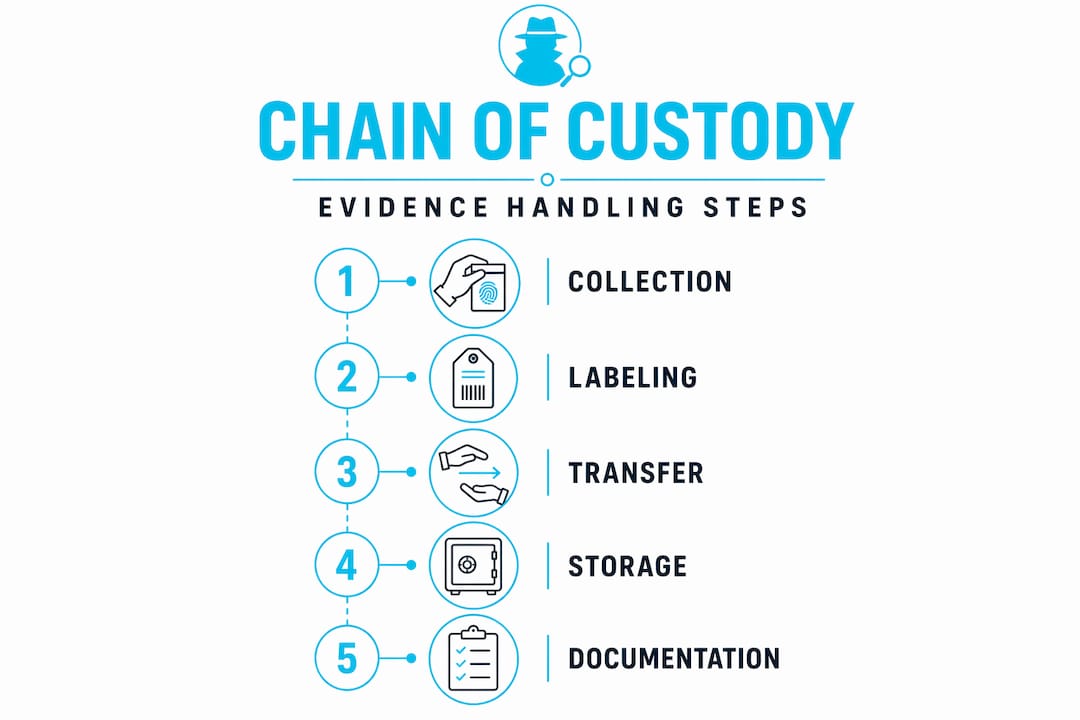

Technology now assists considerably. Evidence management software generates automatic time-stamps, logs every access event, and flags unauthorised handling attempts. For organisations managing large volumes of exhibits, these systems are no longer optional. They are a practical necessity.
Implementing effective preservation policies
Written preservation plans are a legal professional’s most practical defence against spoliation claims. Relying solely on organisational policy to evidence preservation compliance is insufficient. Courts routinely scrutinise whether individual custodians received, understood, and followed specific hold instructions, separate from any general company-wide guidance.
Effective implementation requires several integrated commitments:
- Issue custodian-specific legal holds as soon as litigation is reasonably anticipated. Formal written preservation demands must be served proactively to prevent routine data overwriting, particularly in healthcare and regulated industries where systems automatically age out records.
- Integrate eDiscovery and information governance platforms to automate hold notifications, track compliance, and generate audit reports that demonstrate good faith preservation efforts to the court.
- Train all relevant personnel not just legal teams. IT administrators, records managers, and department heads who control data repositories all carry preservation responsibilities and must understand what those responsibilities mean in practice.
- Review and update policies regularly. Legal developments and technological changes in 2025 and 2026 have accelerated the pace at which existing guidance becomes outdated. A preservation policy written three years ago may not account for cloud synchronisation behaviours, ephemeral messaging applications, or AI-generated records.
- Document all preservation decisions, including the reasoning behind decisions not to preserve certain categories of data. Courts have found that documented, reasoned decisions support good faith defences even when some data was ultimately lost.
For matters involving truck accident evidence or other vehicle-related litigation, the same rigour applies to electronic logging device data, dashcam footage, and GPS records, all of which require prompt hold instructions to fleet operators before routine data cycles overwrite them.
My perspective on evidence preservation in 2026
I’ve worked on enough digital forensic cases to say this with confidence: the single greatest risk in evidence preservation today is not malicious tampering. It is complacency built on the false belief that following a standard procedure is sufficient without understanding why each step exists.
In my experience, evidence preservation has evolved into a genuinely multidisciplinary task. Legal knowledge alone is not enough. Neither is forensic technical skill without legal grounding. What actually protects cases is the intersection of both, applied consistently and documented rigorously.
The AI challenge concerns me most looking ahead. Deepfakes and AI-generated synthetic content are now sophisticated enough to deceive untrained reviewers. The forensic verification burden on practitioners is growing faster than most training programmes recognise. The professionals who will protect their clients’ interests effectively are those who stay ahead of the tools being used against them, not those who assume yesterday’s protocols handle today’s threats.
My advice: treat every preservation decision as though it will be scrutinised by a judge who has already read the opposing counsel’s challenge to it. That mindset produces better records, better admissibility outcomes, and ultimately better justice.
— Computer
How Computerforensicslab can help you preserve digital evidence
When legal proceedings hinge on digital evidence, the quality of your preservation process determines what the court can actually consider. Computerforensicslab provides specialist digital forensics services to legal professionals, law enforcement, and private clients across the United Kingdom, covering everything from forensic device imaging and metadata recovery to full expert witness reporting.
Our team has extensive experience in maintaining chain of custody for digitally acquired evidence, working to standards that withstand rigorous cross-examination. Whether you are dealing with a cybercrime investigation, employee misconduct matter, or complex civil dispute, our digital forensic investigations service provides the technical rigour and legal grounding your case requires. We also offer guidance on implementing legal holds and evidence preservation frameworks that reflect current 2026 procedural standards. Speak with our team to understand how professional forensic support can protect the admissibility and integrity of your evidence from the very first day of an investigation.
FAQ
What is evidence preservation in law?
Evidence preservation is the process of identifying, securing, and maintaining evidence in its original condition from the moment legal proceedings are anticipated. It applies to physical, digital, and testimonial evidence and is legally required to prevent loss, alteration, or destruction.
When does the duty to preserve evidence begin?
The duty to preserve arises the moment litigation is reasonably anticipated, not when proceedings formally commence. At that point, organisations must suspend routine data purging and issue legal holds to relevant custodians.
What happens if evidence is not preserved correctly?
Improperly preserved evidence may be ruled inadmissible, and courts can impose adverse inference instructions, strike pleadings, or sanction the responsible party. In criminal cases, failures in preservation have contributed to wrongful convictions and overturned appeals.
What is forensic evidence and how is it preserved?
Forensic evidence is material collected and analysed using scientific methods to establish facts in legal proceedings. Preservation involves controlled collection with protective equipment, documented chain of custody, and, for digital material, forensic imaging with hash value validation.
How does chain of custody protect evidence?
Chain of custody creates a complete, auditable record of every person who handled a piece of evidence, every transfer made, and every examination conducted. Any gap in this record creates an opportunity for admissibility challenges and can result in evidence exclusion.