

TL;DR:
- Effective cloud forensics depend on pre-incident configuration of immutable logs and dedicated forensic accounts. Investigators must follow strict response sequences, use model-specific techniques, and maintain cryptographically verified chain-of-custody records to ensure evidence admissibility. Proper preparation and automation reduce evidence loss, especially for ephemeral resources, and clarify the shared responsibility model in cloud environments.
Cloud forensics is defined as the application of digital forensic science to evidence stored, processed, or transmitted within cloud environments. Effective cloud investigation strategies depend on three foundations: immutable logging configured before any incident occurs, a structured response that preserves volatile evidence, and chain-of-custody documentation that satisfies court admissibility standards. Legal professionals, corporate security teams, and private individuals who skip any one of these foundations risk losing evidence that cannot be recovered. Industry frameworks such as AWS CloudTrail, Microsoft Purview, and Google Vault each address different parts of the evidence chain, but none of them work without deliberate pre-configuration by the customer. The shared responsibility model makes that customer obligation non-negotiable.
What are the essential pre-incident preparations for cloud investigations?
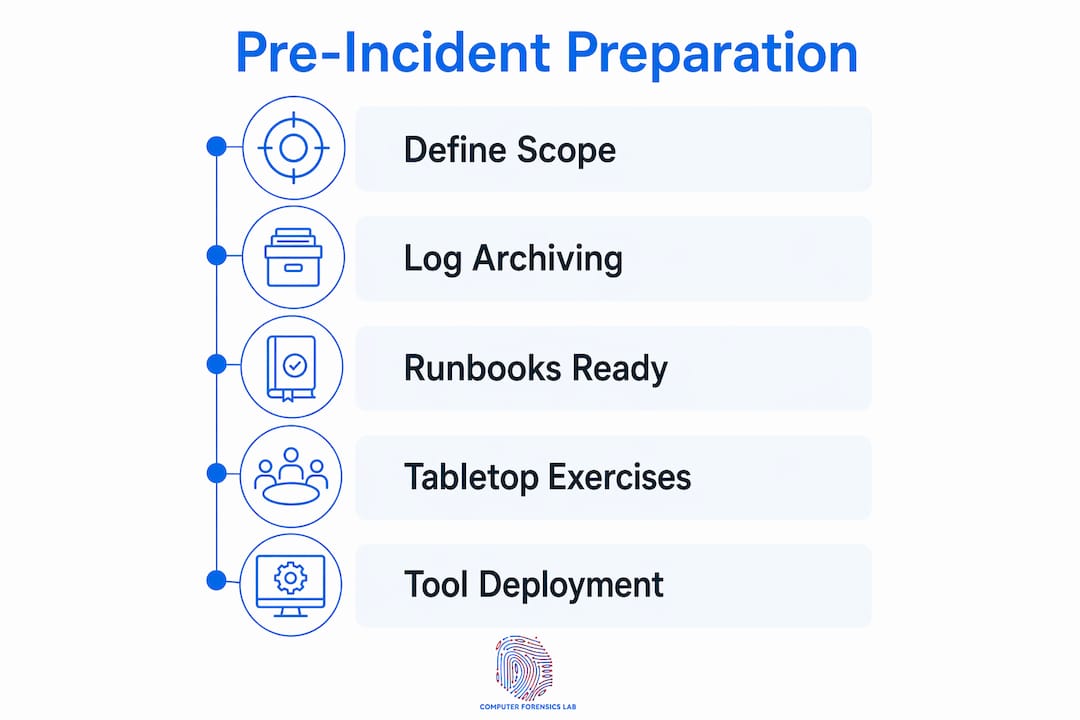
Pre-incident preparation is the single most important factor in any cloud investigation. Approximately 80% of successful cloud incident response work depends on immutable logging and a dedicated forensic account being in place before an attack occurs. That figure means the majority of investigations are won or lost before the first alert fires.
The core technical requirement is an immutable cross-account log archive. AWS CloudTrail logs, for example, should feed into an S3 bucket with Object Lock enabled in a separate account that production workloads cannot touch. This prevents an attacker who compromises the primary account from deleting or altering log records. Microsoft Azure and Google Cloud Platform offer equivalent write-once storage configurations.
Failure to pre-configure logs frequently leads to evidence loss before investigations even begin. Cloud providers do not preserve evidence by default. The shared responsibility model places log retention, immutable storage, and access controls squarely on the customer. Legal teams and security managers who assume the provider handles this will find themselves with nothing to present in court.
A dedicated forensic account is the second pillar of preparation. This account should contain:
- Pre-staged forensic virtual machines with approved tooling already installed
- Snapshot pipelines that can pull disk images from production accounts without touching live systems
- Strict IAM policies that prevent any action that could destroy evidence
- Runbooks and automation scripts tested and ready for immediate deployment
- Audit logging enabled across IaaS, PaaS, and SaaS layers within the organisation
Pro Tip: Run a tabletop exercise at least twice a year using your runbooks. The exercise will expose gaps in IAM permissions and snapshot pipelines before a real incident does.
Attempting to deploy forensic tools during a breach is frequently impossible because attackers often compromise the accounts needed to install them. Pre-staging eliminates that risk entirely. For a detailed breakdown of log immutability and forensic readiness, Computerforensicslab covers cloud data forensic preservation in depth.

How should incident response and evidence collection be conducted?
Structured incident response follows a strict sequence designed to contain the threat without destroying the evidence. The two goals conflict if you act without a plan. Deleting a compromised virtual machine immediately stops the attacker, but it also destroys memory contents, running process lists, and network connection state that are unrecoverable once the instance is gone.
The correct sequence is:
- Apply a restrictive “Deny All” IAM policy to the compromised identity or resource to cut off attacker access without deleting anything.
- Capture a memory snapshot and disk image using provider APIs before any credential rotation or resource termination.
- Export all relevant audit logs to immutable storage immediately, covering the period from 90 days before the incident to the present.
- Document every action taken, with timestamps and the identity of the person performing each step, in a contemporaneous log.
- Rotate credentials and terminate compromised resources only after all evidence has been secured and verified.
Deleting VMs or IAM roles prematurely destroys unrecoverable forensic evidence. That is not a recoverable mistake. Best practice dictates applying restrictive policies and capturing snapshots before any credential rotation to avoid losing live session evidence.
Automated Cloud Investigation and Response Automation (CIRA) platforms execute pre-authorised containment actions via cloud APIs, reducing containment and evidence preservation from hours to seconds. That speed matters because cloud resources are ephemeral. An auto-scaling group can terminate and replace instances within minutes, taking forensic evidence with it.

Pro Tip: Store your contemporaneous action log in a separate write-protected location from your evidence archive. If your documentation is ever challenged in court, you need to show it was recorded in real time, not reconstructed after the fact.
What techniques differ across cloud service models?
Forensic technique varies significantly depending on whether the environment is Infrastructure as a Service (IaaS), Platform as a Service (PaaS), or Software as a Service (SaaS). Each model gives investigators a different level of access to the underlying infrastructure, which directly affects what evidence is available and how it must be collected.
Cloud investigation approaches vary by service model: IaaS supports disk and memory snapshots; PaaS relies on service telemetry and API activity logs; SaaS investigations centre on identity-centric audit logs and eDiscovery tools. Investigators should review audit logs covering at least 90 days to identify unauthorised actions such as privilege escalations.
| Service model | Primary evidence sources | Key forensic technique |
|---|---|---|
| IaaS | Disk images, memory snapshots, VPC flow logs | Provider API snapshot capture; network flow analysis |
| PaaS | Service telemetry, API gateway logs, container logs | Log aggregation; API call timeline reconstruction |
| SaaS | Identity audit logs, admin activity logs, email metadata | eDiscovery export via Microsoft Purview or Google Vault |
SaaS investigations present a particular challenge. Attackers who use legitimate, stolen credentials leave no malware signature. The entire investigation pivots on distinguishing normal user behaviour from malicious use of authorised access. Microsoft Purview’s Content Search and Google Vault’s export functions provide structured eDiscovery outputs, but the investigator must still build a behavioural timeline from identity logs to make the case. Understanding cloud compliance obligations for log retention is a prerequisite before any SaaS investigation begins.
How to maintain chain of custody and evidential integrity in cloud investigations?
Chain of custody in cloud investigations differs from physical evidence handling in one critical way: there is no physical object to seal in a bag. The integrity of cloud evidence rests entirely on cryptographic proof and contemporaneous documentation. Hashing exported artefacts with SHA-256 and capturing provider-signed metadata and timestamps is the accepted standard for court admissibility.
Every exported artefact requires the following documentation:
- The SHA-256 hash of the file at the moment of export
- The API endpoint called, the parameters used, and the timestamp of the call
- The identity of the account that performed the export and its IAM permissions at that time
- The provider-signed metadata confirming the artefact’s origin and integrity
- The storage location of the artefact and the access controls applied to it
Documenting export timestamps, API endpoints, and hashing algorithms is not optional. Courts require this level of detail to authenticate cloud evidence. A chain-of-custody record that cannot account for every step from acquisition to presentation will be challenged, and the evidence may be ruled inadmissible.
Pro Tip: Use a dedicated evidence management system rather than a shared folder or email thread to store chain-of-custody records. The system’s own audit log becomes part of your provenance documentation.
The acquisition environment itself must be documented. Record the forensic workstation or cloud instance used, the software version of any acquisition tool, and the network path between the source and destination. Computerforensicslab provides detailed guidance on maintaining digital evidence integrity throughout the acquisition and storage process. For legal practitioners, the challenges specific to cloud forensics in legal cases are worth reviewing before preparing evidence for court.
Key takeaways
Effective cloud investigation strategies require pre-incident preparation, structured response sequencing, model-specific forensic techniques, and SHA-256-verified chain-of-custody documentation to produce court-admissible evidence.
| Point | Details |
|---|---|
| Pre-incident preparation is decisive | Immutable cross-account log archives and pre-staged forensic accounts must exist before any incident occurs. |
| Containment before deletion | Apply restrictive IAM policies and capture snapshots before rotating credentials or terminating resources. |
| Technique follows service model | IaaS, PaaS, and SaaS each require different evidence sources and collection methods. |
| Chain of custody is cryptographic | SHA-256 hash every exported artefact and record API call details, timestamps, and provider metadata. |
| Automation accelerates response | CIRA platforms reduce containment and evidence preservation from hours to seconds in live incidents. |
What practitioners consistently get wrong about cloud forensics
The most persistent misconception in cloud investigations is that the provider handles evidence preservation. Cloud forensic practitioners consistently identify this as the leading cause of failed investigations. The shared responsibility model is unambiguous: the customer configures logs, sets retention policies, and enables immutable storage. The provider supplies the infrastructure to do it. Nothing is preserved by default.
The second issue I see regularly is treating cloud investigations as a purely technical exercise. Identity-first attacks in SaaS environments do not leave traditional forensic traces. There is no malware, no exploited vulnerability, and no unusual process running. The entire case rests on behavioural analysis of legitimate credential use. That requires collaboration between the forensic examiner, the legal team, and the compliance function from the very start, not as an afterthought once the technical work is done.
Ephemeral resources compound both problems. Auto-scaling groups, serverless functions, and containerised workloads can disappear within minutes of an incident. Without pre-staged snapshot pipelines and automation, that evidence is gone permanently. Tabletop exercises that simulate ephemeral resource loss are the only reliable way to test whether your preparation is actually sufficient.
The organisations that handle cloud investigations well share one characteristic: they treat forensic readiness as an ongoing operational requirement, not a project they complete once. Regular reviews of log coverage, IAM policies, and runbooks are what separate a successful investigation from a blind one.
— Computer
How Computerforensicslab supports cloud investigations
Computerforensicslab provides professional digital forensics services to legal professionals, corporate security teams, and private clients dealing with cloud-based incidents. The team handles evidence acquisition across IaaS, PaaS, and SaaS environments, applying SHA-256 verified chain-of-custody documentation that meets UK court admissibility standards. Computerforensicslab supports clients through the full investigation lifecycle, from pre-incident forensic readiness reviews to expert witness reporting. For cases involving cloud data breaches, employee misconduct, or intellectual property theft, the team’s cloud forensics expertise provides the technical and legal rigour that complex matters demand.
FAQ
What is the first step in a cloud investigation?
The first step is securing and exporting all relevant audit logs to immutable storage before taking any containment action. Logs deleted or overwritten during response cannot be recovered.
How long should cloud audit logs be retained for investigations?
Investigators should review audit logs covering at least 90 days to identify unauthorised actions such as privilege escalations. Retention policies should be configured before any incident occurs.
What makes cloud chain of custody different from physical evidence handling?
Cloud chain of custody relies on cryptographic hashing with SHA-256 and provider-signed metadata rather than physical seals. Every API call made during evidence export must be timestamped and recorded.
How do cloud investigation techniques differ between IaaS and SaaS?
IaaS investigations use disk and memory snapshots captured via provider APIs. SaaS investigations rely on identity-centric audit logs and eDiscovery tools such as Microsoft Purview or Google Vault, with no access to underlying infrastructure.
Can cloud evidence be admitted in UK courts?
Cloud evidence is admissible in UK courts when it is properly authenticated through SHA-256 hashing, contemporaneous documentation, and a complete chain-of-custody record covering every step from acquisition to presentation.