

TL;DR:
- Honing data examiners involves structured training in forensic techniques, regulatory standards, and documentation practices. Skilled examiners produce repeatable, legally admissible findings, which are essential for successful legal and investigative outcomes.
Honing data examiners is defined as the structured process of developing specialised skills in forensic data analysis, regulatory compliance, and evidence handling to meet the demands of legal and investigative work. For legal professionals, corporate clients, and law enforcement agencies, the quality of a digital investigation depends almost entirely on examiner proficiency. Standards from NIST and the EU AI Act now set concrete benchmarks for how examiners must document, analyse, and report findings. Computerforensicslab works directly within this framework, supporting clients who need examiners capable of producing court-admissible, repeatable results.
What are the essential skills data examiners must master?

The ability to train data examiners effectively starts with identifying the right technical foundations. Forensic data analysis draws on at least 12 proven data examination techniques, including anomaly detection, cohort analysis, regression analysis, and time-series decomposition. Each method targets a specific type of irregularity, from financial fraud patterns to unauthorised data access.
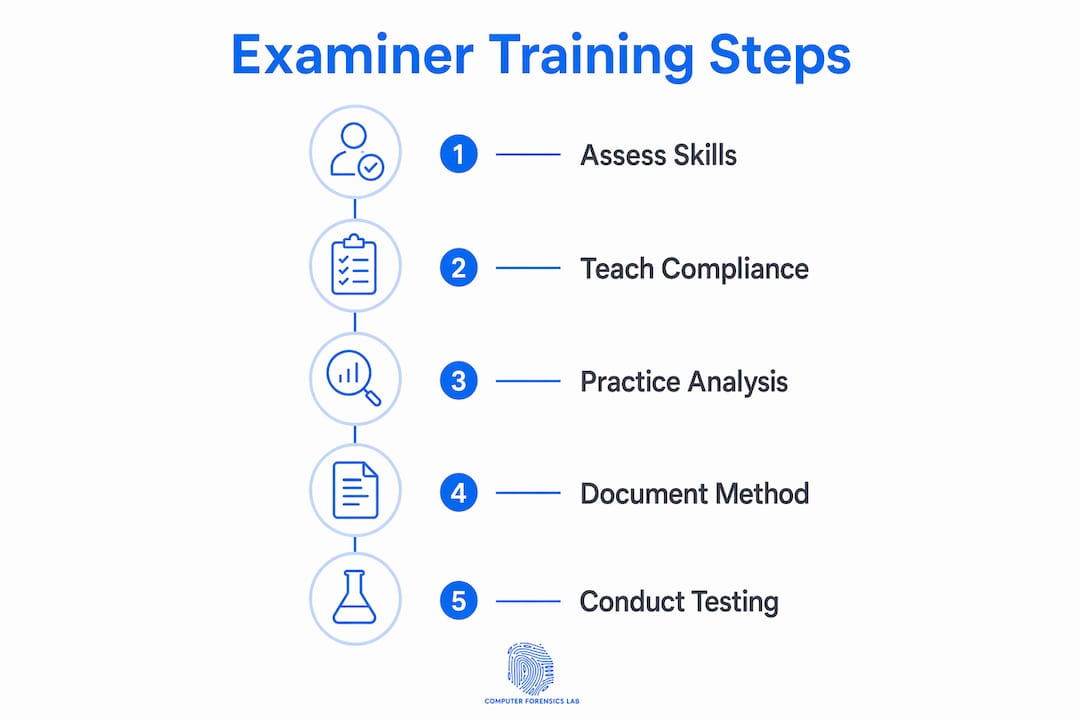

Exploratory data analysis (EDA) is the starting point for any serious forensic investigation. EDA is hypothesis-free, meaning the examiner searches for hidden patterns and anomalies before any formal model is applied. This contrasts with initial data analysis (IDA), which checks whether data meets the assumptions of a pre-existing hypothesis. EDA and IDA serve distinct roles in forensic workflows, and conflating them leads to missed evidence or flawed conclusions.
The skills for data examiners extend beyond technical methods into statistical awareness. Two traps consistently undermine forensic conclusions.
- Simpson’s Paradox: A trend visible in the full dataset reverses when the data is split into subgroups. Failing to segment data properly causes examiners to report the opposite of what the evidence actually shows.
- Anscombe’s Quartet: Four datasets can share identical summary statistics yet have completely different shapes. Examiners who rely on correlation coefficients without visualising the data risk drawing false conclusions.
- Automated versus manual analysis: AI agents handle 70% of repetitive data analysis tasks. Human judgement remains essential for choosing the right technique, interpreting ambiguous results, and communicating findings to courts.
- Visualisation as a discipline: Every examiner must treat data visualisation as a verification step, not a presentation tool. Graphs expose what statistics conceal.
Pro Tip: Before running any statistical model, plot the raw data. A single scatter plot can reveal outliers, clusters, or non-linear relationships that a correlation coefficient will never flag.
How do current standards and regulations shape examiner training?
Regulatory frameworks now define the minimum standard for how data examiners must work. Two bodies set the clearest requirements in 2026: NIST and the EU AI Act.
In March 2026, NIST released a standard collection of 10,000 annotated fingerprints to train both human examiners and AI forensic tools for accuracy and consistency. That scale matters because examiner training without standardised reference data produces inconsistent results across cases. A fingerprint conclusion reached in one laboratory should be reproducible in another. NIST’s release directly addresses that gap.
The EU AI Act introduces equally specific obligations for examiners working with AI-assisted analysis. Article 10 requires a bias examination report that must include:
- The version of the dataset used in the analysis.
- The examiner’s role and the exact date of examination.
- The methodology applied, documented step by step.
- All bias mitigations considered or implemented.
- Justification for any data excluded from the analysis.
These Article 10 requirements became effective in march 2026 for AI teams operating under EU regulations. For legal professionals, this means any forensic report produced with AI assistance must now meet a documentation standard that courts can scrutinise. An examiner who cannot produce this record risks having their findings challenged or excluded.
Key regulatory principle: Examiner methodology documentation, covering role, exact date, tools used, and process steps, is the foundation of legally defensible forensic findings. Without it, even accurate conclusions become inadmissible.
The practical implication for training programmes is direct. Data analysis training must now include documentation practice as a core module, not an afterthought. Examiners who understand why they record each step are more consistent than those who treat documentation as administrative overhead.
What are the best practices for training and developing data examiners?
The most effective approach to data analysis training combines automated profiling with manual interrogation. Expert practitioners recommend blending these two methods to understand data completeness and relationships thoroughly. Automated tools accelerate the initial scan; manual drill-downs catch what automation misses.
Practical training for data examiners should cover the following areas:
- Forensic tool proficiency: Examiners must be comfortable with the forensic analysis tools used in their specific case types, whether that involves mobile device extraction, cloud data analysis, or network traffic review.
- Chain of custody discipline: Every piece of evidence must be logged at acquisition, transfer, and analysis. A break in the chain invalidates the evidence regardless of how accurate the analysis is.
- Bias recognition training: Examiners must learn to identify their own analytical assumptions. Confirmation bias, where an examiner looks for evidence that supports an initial theory, is the most common source of flawed forensic conclusions.
- Report writing for legal audiences: A technically correct report that a judge or jury cannot follow serves no purpose. Examiners need practice translating complex findings into plain language without losing accuracy.
- Continuous validation: Skills degrade without practice. Examiners should regularly test their conclusions against known datasets to verify that their methods remain calibrated.
Pro Tip: Run periodic blind tests where examiners analyse datasets with known outcomes. Compare their conclusions against the ground truth. This reveals systematic errors in technique before those errors appear in live cases.
The data analysis best practices that legal teams rely on increasingly require examiners to understand AI compliance obligations alongside technical forensic skills. Examiners who understand AI compliance considerations relevant to their work are better placed to produce reports that withstand regulatory scrutiny.
How do honed data examiners improve legal and investigative outcomes?
Skilled examiners produce findings that are repeatable, documented, and defensible. Those three qualities determine whether digital evidence survives cross-examination. An examiner who cannot explain their methodology in court, or whose conclusions cannot be reproduced by a second examiner, creates a vulnerability that opposing counsel will exploit.
The impact of examiner skill on case outcomes is clearest in fraud detection and cybercrime investigation. Anomaly detection applied to financial records can identify irregular transaction patterns that manual review would miss over months of work. Time-series decomposition applied to access logs can pinpoint the exact moment an insider threat began exfiltrating data. These techniques only produce reliable results when the examiner understands both the method and its limitations.
“The difference between a finding that holds in court and one that collapses under cross-examination is almost always the quality of the examiner’s documentation and the rigour of their analytical method.”
The table below summarises how examiner skill level affects key investigative outcomes.
| Outcome area | Trained examiner | Undertrained examiner |
|---|---|---|
| Evidence admissibility | Documented methodology supports court acceptance | Gaps in records create admissibility challenges |
| Fraud detection accuracy | Correct segmentation prevents Simpson’s Paradox errors | Aggregated data masks subgroup patterns |
| Investigation speed | Structured EDA identifies relevant data early | Unstructured review wastes time on irrelevant datasets |
| Bias mitigation | Documented bias checks meet EU AI Act Article 10 | Undocumented assumptions risk regulatory non-compliance |
| Report clarity | Plain-language findings accessible to legal teams | Technical language obscures conclusions for courts |
The benefits of forensic data analysis in legal casework are only realised when the examiner behind the analysis has the skills to apply methods correctly and document them completely. Examiner quality is the variable that determines whether a technically sound investigation produces usable evidence.
Key takeaways
Honing data examiners requires structured training in forensic techniques, regulatory compliance, and documentation discipline to produce legally admissible, repeatable findings.
| Point | Details |
|---|---|
| Regulatory compliance is non-negotiable | EU AI Act Article 10 and NIST standards define minimum documentation requirements for examiner reports in 2026. |
| EDA precedes formal modelling | Exploratory data analysis must run before hypothesis-driven methods to avoid missing hidden patterns in forensic datasets. |
| Visualisation prevents statistical errors | Plotting raw data before applying correlation methods protects against Anscombe’s Quartet and similar traps. |
| Hybrid training produces better examiners | Combining automated profiling with manual drill-downs builds the depth of understanding that courts require. |
| Documentation is the foundation of admissibility | Recording examiner role, date, tools, and methodology at every step is what makes findings legally defensible. |
Why examiner skill development cannot be treated as optional
Working with legal teams and law enforcement over many years, I have seen the same pattern repeat. A technically capable examiner produces accurate findings, but the case collapses because the documentation is incomplete or the methodology cannot be explained under cross-examination. The analysis was right. The record was wrong. That distinction costs cases.
The 2026 regulatory environment makes this problem harder to ignore. The EU AI Act’s Article 10 requirements mean that any examiner using AI-assisted tools must now produce a bias examination report that meets a specific standard. Examiners who were trained before these requirements came into force often have no idea what that standard looks like. Closing that gap is not a theoretical exercise. It is a practical necessity for every organisation that relies on digital evidence.
What I have observed at Computerforensicslab is that the examiners who perform best in legal contexts are those who treat documentation as part of the analysis, not a separate administrative task. They record their reasoning as they work, not after the fact. That habit, more than any single technical skill, is what separates findings that hold in court from those that do not. The importance of forensic best practices in UK investigations is not abstract. It shows up in verdicts.
— Computer
Computerforensicslab’s expert forensic data examination services
Computerforensicslab provides expert-led digital forensics services to legal professionals, corporate clients, and law enforcement agencies across the UK. The team applies the full range of data examination techniques covered in this article, from exploratory data analysis through to court-ready documentation that meets EU AI Act and NIST standards. Every examination follows a documented methodology that supports chain of custody and legal admissibility. For organisations that need examiners who can produce findings that hold under scrutiny, Computerforensicslab offers forensic data analysis and digital forensic investigations tailored to the demands of complex legal and investigative cases.
FAQ
What does it mean to hone data examiners?
Honing data examiners means developing their technical skills, analytical methods, and documentation practices through structured training aligned with current forensic and regulatory standards.
What qualifications or certifications support data examiner development?
Recognised frameworks include NIST guidelines and EU AI Act compliance training. Examiners working with AI-assisted tools must demonstrate competency in bias examination and methodology documentation under Article 10.
Why is documentation so critical in forensic data examination?
Examiner methodology documentation, covering role, date, tools, and process steps, is what makes forensic findings repeatable and admissible in court. Incomplete records create grounds for evidence exclusion.
What is the difference between EDA and IDA in forensic work?
Exploratory data analysis (EDA) searches for hidden patterns without a prior hypothesis. Initial data analysis (IDA) verifies whether data meets the assumptions of an existing hypothesis. Both serve distinct roles in forensic examination workflows.
How does AI affect the role of human data examiners?
AI handles a significant proportion of repetitive analysis tasks, but human examiners must select the appropriate technique, interpret ambiguous results, and communicate findings clearly to legal audiences. Human judgement remains the critical variable.