
TL;DR:
- A crime scene investigation follows a strict 10-step process to ensure evidence remains legally admissible.
- Deviating from this sequence or rushing documentation can lead to evidence being invalidated in court.
A crime scene investigation is defined as a structured, legally mandated sequence of steps that transforms a chaotic scene into admissible court evidence. The stages of crime scene investigation follow a precise 10-step protocol, from the moment investigators arrive to the point evidence reaches a laboratory. Skip one step, or perform them out of order, and the entire case can collapse before cross-examination begins. This guide breaks down each phase clearly, covering both physical and digital forensic best practices, so you understand exactly what happens at a crime scene and why every action matters.
What are the stages of crime scene investigation?
A comprehensive crime scene investigation follows 10 structured steps, from responding safely to submitting evidence for laboratory analysis. Training programmes in 2026 confirm that skipping any step can invalidate evidence, with typical investigator curricula running to 40 hours of procedural instruction. The sequence is not a suggestion. It is a legal framework that courts expect investigators to follow without deviation.
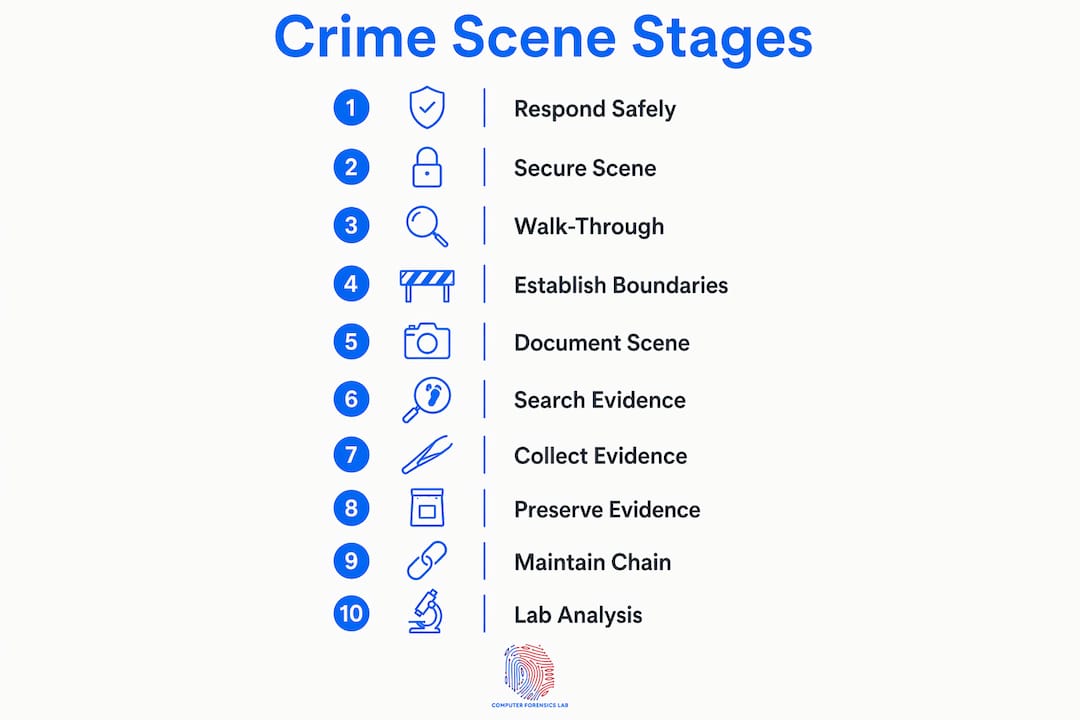
The 10 steps are:
- Respond safely to the scene
- Secure and control the scene
- Conduct a preliminary survey and walk-through
- Establish scene dimensions and boundaries
- Document the scene thoroughly
- Conduct a systematic search for evidence
- Collect, package, and label evidence
- Maintain and document chain of custody
- Submit evidence to the laboratory
- Compile and submit the final report
Each step builds directly on the one before it. A contaminated scene in step two makes every subsequent step unreliable. A poorly documented scene in step five makes laboratory findings difficult to defend in court.
What happens when investigators first arrive at a crime scene?
Scene safety is the first priority for any investigator arriving at a crime scene. Before anything else, the lead investigator assesses for hazards such as unstable structures, chemical exposure, or active threats. Only once the scene is declared safe does the formal investigation begin.

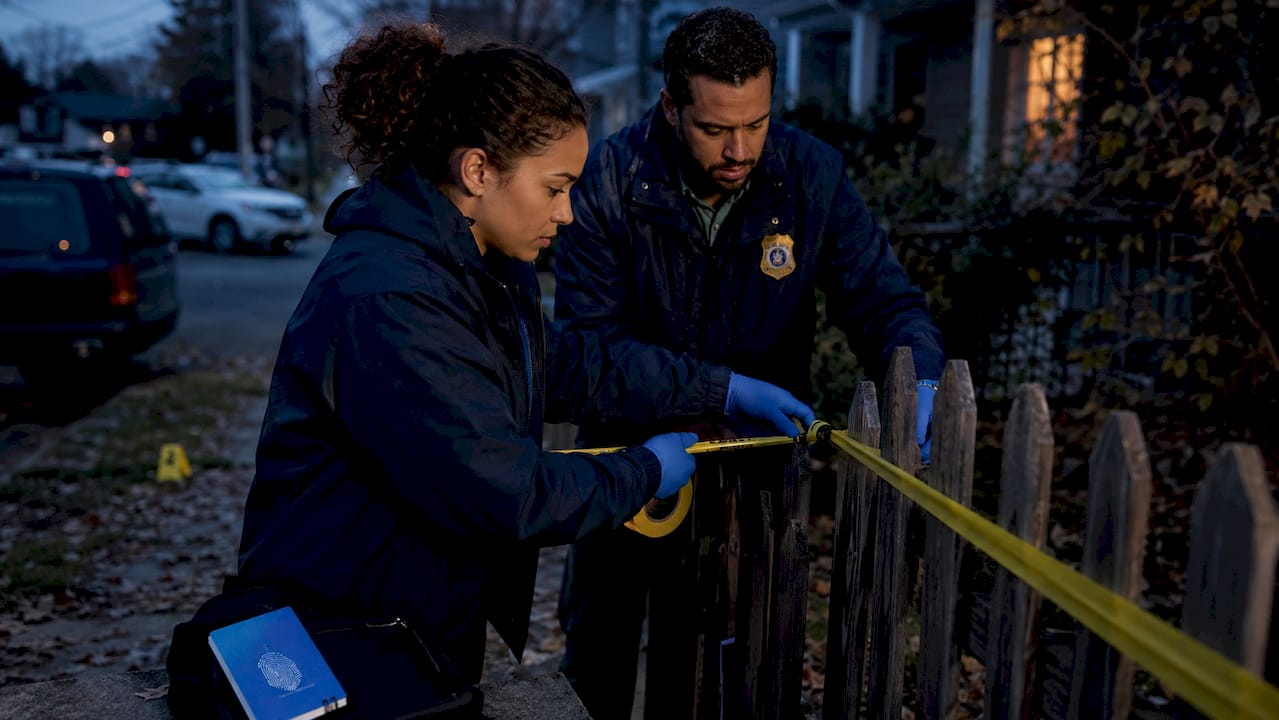
Securing the perimeter comes immediately after. Unauthorised entry is the greatest single risk to evidence integrity, and investigators treat the scene as frozen in time from the moment they arrive. Physical barriers, crime scene tape, and a log of everyone who enters or exits are all standard practice. A single unrecorded visitor can introduce fibres, fingerprints, or biological material that contaminates the evidence pool permanently.
The preliminary walk-through follows scene control. This step is a critical legal requirement because transient evidence such as odours, temperature variance, and the position of objects degrades or disappears quickly. The walk-through allows the lead investigator to identify this perishable evidence before documentation or collection disturbs it. Nothing is touched during this phase.
Establishing scene dimensions and boundaries rounds out the initial actions. The investigator defines the primary scene, any secondary scenes, and the routes between them. This prevents evidence from being missed and gives the entire team a shared understanding of the area they are processing.
Pro Tip: Assign specific roles to each team member before entering the scene. One person documents, one collects, and one logs. Overlapping responsibilities cause confusion and increase the risk of accidental contamination.
How is a crime scene methodically documented before collecting evidence?
Documentation is the legal backbone of any investigation. Errors in documentation are a primary cause of evidence being ruled inadmissible in court, which means this phase carries as much legal weight as the evidence itself. No item is moved, touched, or collected until the scene has been fully recorded.
Effective documentation uses three overlapping methods:
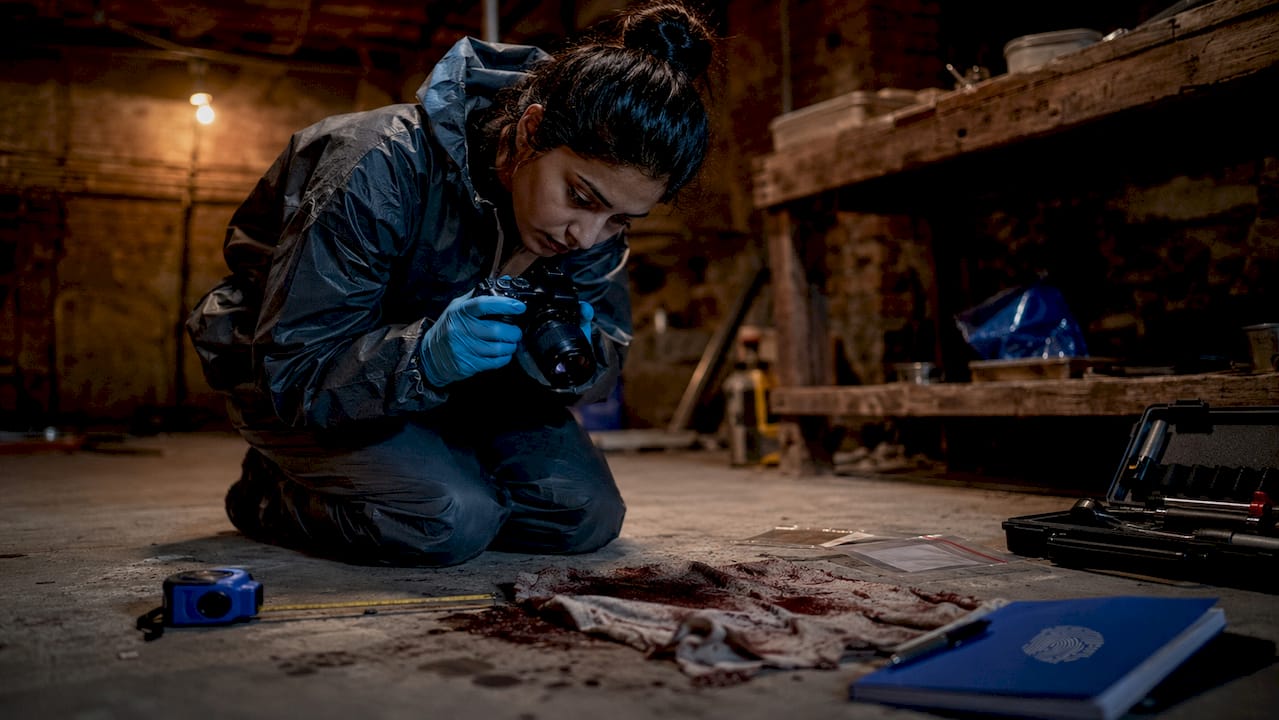
- Photography: Capture wide, medium, and close-up shots of every item. Photograph evidence “as found” before any movement, because this record prevents legal challenges to the original position of objects.
- Sketching: Hand-drawn or digital sketches record spatial relationships between items that photographs alone cannot convey. Measurements between key items must be included.
- Written notes: The investigator records observations in real time, including time, weather, lighting conditions, and anything that cannot be captured visually.
Each method compensates for the weaknesses of the others. A photograph shows what something looks like but not its exact distance from another item. A sketch shows spatial layout but not fine detail. Written notes capture context that neither image nor drawing can record.
Transient evidence demands particular attention during this phase. The walk-through identifies temperature anomalies, smells, and the precise positioning of objects before any disturbance. These observations must be recorded immediately, as they are gone the moment the scene is processed.
Pro Tip: Always include a scale marker in close-up photographs and annotate sketches with compass orientation. Courts rely on these details to reconstruct the scene accurately.
What are the procedures for searching, collecting, and preserving evidence?
A systematic search is the foundation of evidence collection. The method chosen depends on the crime type and scene complexity, with common approaches including grid, spiral, zone, and strip patterns. Each method divides the scene into manageable sections so nothing is overlooked.
Evidence collection follows a strict priority order:
- Transient evidence first: Anything that will degrade, evaporate, or be destroyed by environmental conditions is collected before stable evidence.
- Biological evidence: Blood, hair, saliva, and skin cells require specific collection tools and packaging to prevent degradation. Bloodstain pattern mapping and chemical enhancements are performed as final processing steps to avoid contaminating other biological material. Premature processing can destroy latent or touch DNA evidence entirely.
- Trace evidence: Fibres, glass fragments, and soil samples are collected with clean tools and packaged separately to prevent cross-contamination.
- Digital evidence: Devices are seized without powering them on where possible, using write-blockers to prevent data alteration during acquisition.
Packaging standards are non-negotiable. Biological samples go into breathable paper bags, not plastic, which traps moisture and accelerates degradation. Each item receives a unique label recording the exhibit number, location found, time of collection, and the name of the collecting officer. Legal authority and search warrants are mandatory before investigators touch anything, as no general crime scene exception to the warrant requirement exists, even for serious crimes.
Common mistakes at this stage include collecting items without photographing them first, using the same tool for multiple samples, and failing to seal packaging correctly. Each error creates a point of attack for the defence during trial.
How is the chain of custody maintained and why does it matter?
Chain of custody is defined as an unbroken, documented record of every person who handles a piece of evidence from the moment of collection to its presentation in court. Without an intact chain of custody, evidence is effectively useless in court, regardless of how significant it is.
“The chain of custody is the essential proof to courts that evidence has not been tampered with. Every transfer, every storage period, and every examination must be documented with timestamps and the names of responsible individuals. A single gap in that record gives the defence grounds to challenge the entire exhibit.”
Every handover of evidence requires a signed entry in the custody log. The log records who transferred the item, who received it, the date and time, and the reason for the transfer. This applies equally to movement between the scene, the evidence store, and the forensic laboratory.
Digital evidence requires an additional layer of verification. SHA-256 hashing is the standard method for proving that a digital file has not been altered between collection and laboratory analysis. A hash value is generated at the point of collection and verified again after every transfer. Any discrepancy indicates tampering or corruption.
Pro Tip: Use digital evidence management software that generates automatic audit trails and timestamps. Manual logs introduce human error. Automated systems create a verifiable record that is far harder to challenge in court.
What is the role of laboratory analysis and reporting?
Laboratory analysis converts physical and digital evidence into findings that courts can act upon. Each type of evidence goes through a specific analytical process, and the results are compiled into a formal report that must meet strict standards of clarity and factual accuracy.
| Forensic test | Purpose |
|---|---|
| DNA analysis | Links biological material to a specific individual |
| Fingerprint comparison | Identifies individuals who touched surfaces at the scene |
| Toxicology screening | Detects substances in biological samples from victims or suspects |
| Ballistics examination | Matches projectiles or casings to specific weapons |
| Digital forensics | Recovers deleted data, analyses device activity, and traces communications |
Laboratory reports must be factual, non-speculative, and written to withstand cross-examination. A report that overstates certainty or omits methodology gives the defence an opening to discredit the entire analysis. Digital forensic investigations follow a seven-phase process of identification, preservation, collection, examination, analysis, documentation, and presentation, running parallel to the physical investigation. The role of forensic analysis in court depends entirely on the quality of this documentation.
The final report ties every stage together. It references the original scene documentation, the chain of custody log, the laboratory findings, and the analytical conclusions. Judges and juries rely on this document to understand what the evidence means and how it was obtained.
Key takeaways
The stages of crime scene investigation form a legally mandated sequence where each step directly determines whether evidence survives scrutiny in court.
| Point | Details |
|---|---|
| Sequence is legally binding | Deviating from the 10-step order risks evidence being ruled inadmissible during cross-examination. |
| Documentation precedes collection | Photography, sketching, and written notes must be completed before any item is moved or collected. |
| Chain of custody is non-negotiable | Every evidence transfer requires a signed, timestamped log entry to maintain legal validity. |
| Digital evidence needs hashing | SHA-256 verification confirms a digital file was not altered between collection and laboratory analysis. |
| Biological processing comes last | Bloodstain mapping and chemical enhancements are performed after other evidence is collected to prevent contamination. |
What I have learned from years of forensic investigation work
The most common failure I see is not incompetence. It is impatience. Investigators who rush the documentation phase to get to collection create problems that no amount of laboratory analysis can fix. A photograph taken after an item has been moved is legally worthless, and courts know it.
New investigators consistently underestimate the chain of custody. They treat it as paperwork rather than as the legal spine of the entire case. Every gap in that log is a gift to the defence. I have seen strong cases weakened not by bad evidence, but by a missing signature on a transfer form.
The integration of digital forensics has changed the work significantly. Physical scenes now almost always have a digital component, whether that is a mobile phone, a laptop, or cloud-stored communications. The digital forensic process steps mirror the physical ones in their procedural rigour, and investigators who understand both disciplines produce far stronger case files.
Teamwork and training remain the two factors that separate good outcomes from poor ones. Procedures only work when every person on the team follows them without exception. One person cutting corners contaminates the work of everyone else.
— Computer
How Computerforensicslab supports forensic investigations
Computerforensicslab provides professional digital forensic investigations for legal professionals, law enforcement, businesses, and private clients across the UK. The team handles evidence acquisition, chain of custody documentation, laboratory analysis, and expert witness reporting to the standards courts require. Whether the case involves a physical crime scene with a digital component, a data breach, or employee misconduct, Computerforensicslab applies the same procedural rigour described throughout this article. For tailored support with evidence collection and analysis, contact the team directly to discuss your case.
FAQ
What are the 10 stages of crime scene investigation?
The 10 stages are: respond safely, secure the scene, conduct a walk-through, establish boundaries, document the scene, search for evidence, collect and package evidence, maintain chain of custody, submit to the laboratory, and compile the final report.
Why does the order of crime scene investigation steps matter?
The order is legally mandated. Deviations risk having evidence ruled inadmissible during cross-examination, which can result in cases being dismissed entirely.
What is chain of custody in a crime scene investigation?
Chain of custody is an unbroken, documented record of every person who handles evidence from collection to court. Without it, evidence cannot be relied upon in legal proceedings.
How is digital evidence handled differently at a crime scene?
Digital devices are seized without powering them on where possible, and SHA-256 hashing is used to verify that files have not been altered between collection and laboratory analysis.
What causes evidence to be ruled inadmissible in court?
Errors in documentation, gaps in the chain of custody, and deviations from the legally required investigation sequence are the primary causes of evidence being excluded from court proceedings.