

TL;DR:
- Immediate legal and forensic coordination is crucial for effective breach response and compliance.
- Proper evidence preservation and privilege protection are essential to defend against regulatory and legal actions.
- Early integration of legal counsel improves outcomes and minimizes risks during breach investigations.
A breach is suspected. Somewhere in your organisation, personal data has been exposed, stolen, or lost, and the 72-hour notification clock is already running. For legal professionals and corporate cybersecurity officers, this moment is not just a technical crisis. It is a regulatory and litigation event that demands immediate, structured action. Missteps in the first hours, whether that means powering down a server, failing to assert legal privilege, or missing the Information Commissioner’s Office (ICO) window, can turn a manageable incident into a costly enforcement action or a lost civil claim. This guide sets out the precise legal, forensic, and procedural steps your team must follow.
Table of Contents
- What you need before starting a data breach investigation
- Step-by-step data breach investigation process
- Ensuring evidence integrity and legal privilege during breach analysis
- Notification, documentation and post-incident learning
- Our take: why early legal integration is the difference-maker in UK breach investigations
- Specialist support for complex data breach investigations
- Frequently asked questions
Key Takeaways
| Point | Details |
|---|---|
| Prepare your team | Form a cross-functional incident response team before a breach occurs. |
| Follow legal process | Initiate investigations with legal counsel to protect privilege and ensure compliance. |
| Document every step | Record each action to defend against regulatory and litigation risks. |
| Notify on time | Meet the 72-hour ICO deadline, using phased reporting if facts are still emerging. |
| Learn and improve | Conduct post-breach reviews so future incidents are less likely and less severe. |
What you need before starting a data breach investigation
Before anyone touches an affected system, you need the right people in the room and the right documents in hand. The UK breach investigation process follows a structured sequence: preparation and detection, containment, forensic analysis, risk assessment, ICO notification within 72 hours, and full documentation of every breach regardless of severity. Skipping the preparation stage is where most organisations create problems for themselves.
Your core incident response team should include your Data Protection Officer (DPO), in-house or external legal counsel, IT security leads, a communications or PR representative, and your cyber insurance broker. Each role carries specific accountability. Legal counsel, in particular, must be involved from the outset because instructing forensic investigators under legal privilege protects findings from disclosure in subsequent litigation or regulatory proceedings.
Pro Tip: Never instruct a forensic firm directly as a business. Route the engagement through your solicitors so that the forensic report attracts legal professional privilege from day one, not retrospectively.
Before any investigative action, secure the following:
- Your organisation’s incident response plan and contact list
- Network topology diagrams and asset registers
- Access logs, firewall records, and backup inventories
- Cyber insurance policy details and insurer notification requirements
- Evidence preservation tools or access to a qualified forensic provider
| Requirement | Who is responsible | Why it matters |
|---|---|---|
| Incident response plan | CISO or IT lead | Sets authorised procedures |
| Legal privilege instruction | General counsel | Protects forensic findings |
| DPO notification | DPO | Triggers regulatory obligations |
| Evidence preservation | Forensic team | Maintains chain of custody |
| Insurer notification | Risk or legal team | Preserves coverage rights |
Good evidence documentation best practice starts at this stage, not after analysis is complete. Equally, having a tested preservation checklist means your team acts consistently under pressure rather than improvising.
Step-by-step data breach investigation process
With preparation in place, the investigation itself must follow a disciplined sequence. Deviation from this order is one of the most common causes of evidence contamination and regulatory non-compliance.
- Detection and initial triage. Confirm that a breach has occurred or is suspected. Identify affected systems, data types, and approximate scope.
- Containment without destruction. Isolate affected systems from the network. Do not power them down. Volatile memory, running processes, and temporary files contain critical forensic data that is lost the moment a machine is switched off.
- Forensic imaging and analysis. A qualified forensic examiner creates verified bit-for-bit images of affected systems. Forensic analysis involves creating system images, examining logs, and building event timelines to establish exactly what was accessed, exfiltrated, or altered.
- Impact and risk assessment. Determine which categories of personal data were affected, how many individuals are involved, and what harm could result.
- Regulatory notification. Report to the ICO and any relevant sector regulator.
- Full documentation. Record every action taken, by whom, and when.
Regulatory note: ICO notification must occur within 72 hours where the breach is likely to result in a risk to individuals’ rights and freedoms. Phased reporting is permitted, meaning you can submit an initial notification and provide further detail as the investigation progresses.
| Step | Responsible party | Critical warning |
|---|---|---|
| Detection | IT security or SOC | Do not alert the attacker |
| Containment | IT and forensic team | Never power down systems |
| Forensic imaging | Qualified forensic examiner | Use validated write-blockers |
| Risk assessment | DPO and legal counsel | Err towards notification |
| ICO notification | DPO | 72-hour deadline is strict |
| Documentation | Legal and IT | Record everything in real time |
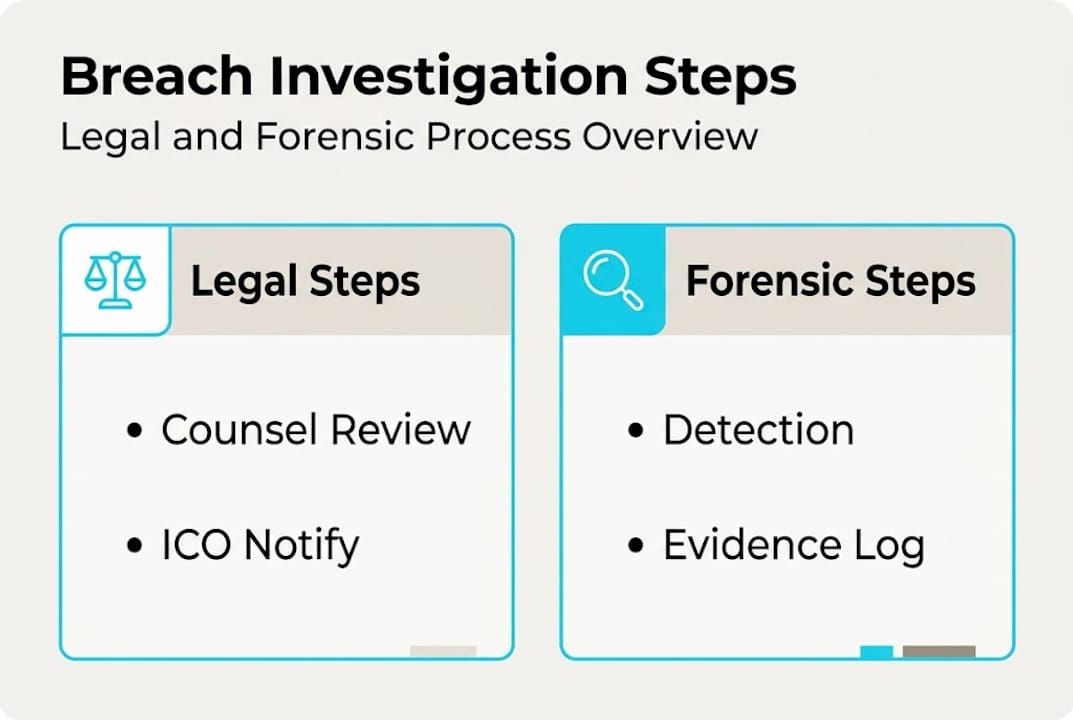

Pro Tip: The most damaging mistake we see in post-breach litigation is IT teams running antivirus scans or applying patches before forensic images are taken. This overwrites the very artefacts that prove how an attacker entered. Coordinate your incident response strategy so that forensics always precedes remediation. Legal teams should also review compliance steps for legal teams to understand their specific obligations at each stage.
Ensuring evidence integrity and legal privilege during breach analysis
Evidence integrity and legal privilege are not administrative formalities. They are the foundations upon which any subsequent regulatory defence or civil litigation rests.
Legal professional privilege (LPP) protects communications and documents created for the dominant purpose of obtaining legal advice or preparing for litigation. Privilege protects forensic reports when they are instructed by lawyers in contemplation of legal advice or proceedings. If a forensic firm is engaged directly by the business, that protection may not apply, and the report could be disclosable to the ICO or an opposing party.
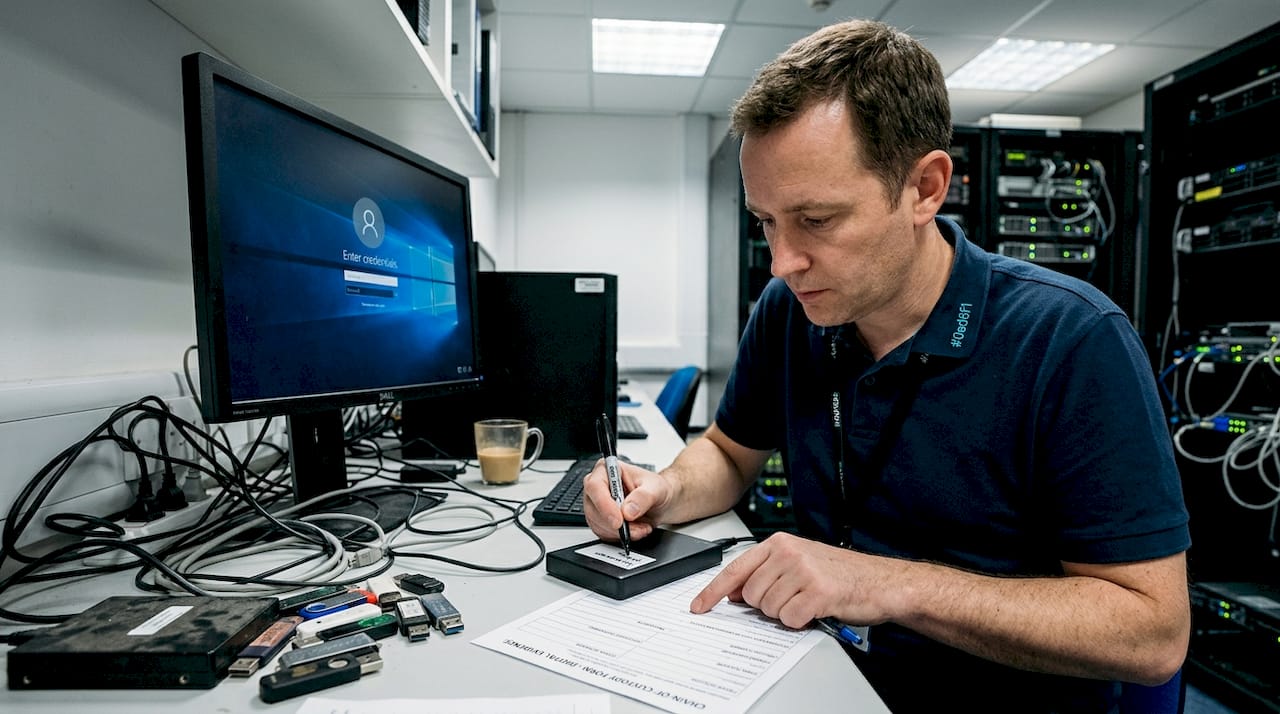
Chain of custody is equally non-negotiable. Every piece of digital evidence must be forensically imaged, logged, and tracked from collection through to court or regulatory submission. Any gap in the chain undermines the credibility of the entire investigation.
Pro Tip: Establish privilege at the very start of the engagement. Attempting to apply it retrospectively, after a report has already been shared internally or with third parties, is unlikely to succeed and may waive privilege entirely.
Actions that risk breaking privilege or contaminating evidence:
- Sharing forensic findings with non-legal staff before privilege is confirmed
- Allowing IT teams to remediate systems before imaging is complete
- Failing to label communications as “legally privileged and confidential”
- Using unvalidated forensic tools that cannot produce court-admissible outputs
- Storing forensic images on the same infrastructure that was compromised
For counsel managing complex matters, understanding the mechanics of preserving legal evidence and documenting digital evidence correctly is essential before instructing any technical expert.
Notification, documentation and post-incident learning
Once evidence is secured and the investigation is under way, regulatory and individual notification obligations become the immediate priority.
In the UK, the primary notification recipients are:
- The ICO within 72 hours of becoming aware of a breach that poses a risk to individuals.
- Sector regulators such as the Financial Conduct Authority (FCA) for financial services firms, or Ofcom for communications providers, where their own rules apply.
- Affected individuals where the breach is likely to result in a high risk to their rights and freedoms, without undue delay.
- Cyber insurers in accordance with your policy terms, which often require prompt notification.
Phased reporting to the ICO is permitted. Submit what you know within 72 hours and follow up with a complete account as the forensic picture becomes clearer.
Documentation must cover every breach, not only those that meet the reporting threshold. The ICO requires all breaches to be documented internally, including those assessed as low risk and not reported externally. This internal record demonstrates accountability and supports any future regulatory enquiry.
Post-incident review actions your team should take:
- Conduct a root cause analysis and document findings formally
- Update your incident response plan based on what failed or was absent
- Deliver targeted training to staff involved in or affected by the breach
- Brief the board on systemic vulnerabilities and remediation timelines
- Review third-party supplier contracts for security obligations
Board-level accountability and human error reduction through training are identified by the National Cyber Security Centre as central to reducing recurrence. Boards that treat breach reviews as a learning exercise, rather than a blame exercise, consistently achieve better long-term outcomes. Ensuring compliant documentation throughout this process also protects the organisation if the ICO later scrutinises your response.
Our take: why early legal integration is the difference-maker in UK breach investigations
After working across dozens of breach investigations, the pattern is consistent. Organisations that involve legal counsel and forensic specialists in the first hour fare dramatically better than those that treat the breach as a purely technical problem until regulators come knocking.
The uncomfortable truth is that technical competence alone does not determine outcomes in UK breach litigation or ICO enforcement. Privilege, process, and documentation discipline are often more decisive than the sophistication of the forensic tools used. A technically flawless investigation that lacks privilege protection can hand the opposing party exactly the evidence they need.
We would go further: treat every breach as potentially contentious from the moment it is suspected. That mindset changes how you instruct experts, how you communicate internally, and how you document decisions. The organisations that regret their breach response rarely say they moved too carefully. They say they assumed it would not become a legal matter. For counsel and cybersecurity officers who want to understand what this looks like in practice, our guidance on recovering data for litigation illustrates how early forensic coordination changes case outcomes.
Specialist support for complex data breach investigations
For legal teams and corporate security officers managing a live breach or preparing for potential litigation, the value of a specialist forensic partner cannot be overstated. Computer Forensics Lab provides end-to-end digital forensic investigations designed to integrate with legal privilege frameworks from the outset. Our experts produce court-admissible reports, maintain rigorous chain of custody, and work directly with instructing solicitors to protect findings. Whether you need urgent triage or a full digital forensics service for a complex multi-system breach, we can support your matter. Explore how digital footprints and forensic data can be used to build a defensible, evidence-led account of exactly what occurred.
Frequently asked questions
What counts as a reportable data breach in the UK?
A breach is reportable to the ICO if it is likely to result in a risk to individuals’ rights or freedoms, typically involving the loss, exposure, or theft of personal data. Not every breach meets this threshold, but all must be documented internally.
What is phased reporting to the ICO?
Phased reporting allows organisations to submit an initial notification to the ICO within the 72-hour window and then provide fuller details as the investigation develops. This prevents the deadline from being missed while facts are still being established.
How do you maintain legal privilege over forensic findings?
Instruct forensic experts through legal counsel rather than directly as a business, so that the resulting report is covered by privilege and protected from disclosure in litigation or regulatory proceedings.
What common mistakes jeopardise evidence in breach investigations?
Powering down affected systems, running remediation tools before imaging, or failing to document actions in real time can all destroy critical artefacts. Incident response must preserve systems and evidence before any remediation takes place.