
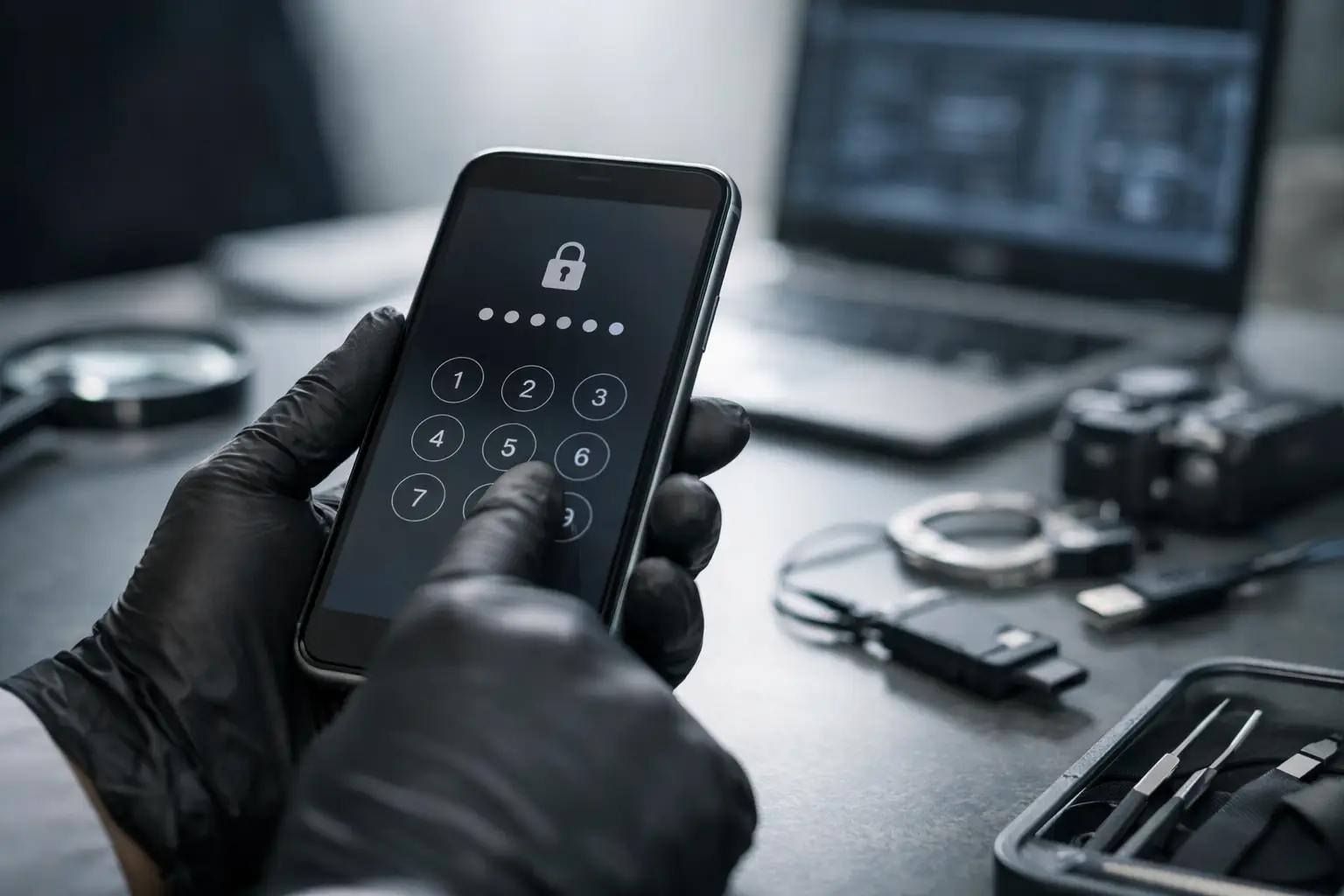
When a key witness, employee, spouse or suspect says, “I cannot access the phone,” the issue is rarely just technical. A password protected phone examination is often the point at which a dispute turns from allegation into evidence. Messages, app data, deleted material, location records and user activity may all exist on the device, but whether they can be identified, preserved and presented properly depends on the method used from the outset.
For solicitors, businesses and private clients, the real risk is not simply that a handset is locked. It is that poor handling destroys opportunities, contaminates evidence or produces findings that will not withstand scrutiny. Mobile phones are now central to fraud allegations, matrimonial disputes, harassment cases, employee misconduct investigations, conspiracy matters and disclosure exercises. The examination of a protected device therefore has to be approached as a forensic process, not an improvised attempt to gain entry.
What a password protected phone examination actually involves
A password protected phone examination is not a single technique. It is a structured forensic exercise designed to establish what can be acquired from the handset, what legal authority exists, which recovery options are proportionate, and how all activity will be documented.
That matters because not every locked device can be examined in the same way. The make and model, operating system version, condition of the handset, presence of biometric security, encryption status, cloud connectivity and the circumstances of seizure all affect the available route. A recent iPhone with full-disk encryption presents very different challenges from an older Android device, and a phone that remains powered on may offer opportunities that disappear once it is switched off.
In practice, the examination begins with preservation. The device should be secured, isolated where appropriate to prevent remote alteration, and recorded with clear chain of custody. From there, a forensic examiner assesses whether access can be obtained lawfully through known credentials, user cooperation, biometrics, logical acquisition, file-system extraction, specialist tooling, chip-level approaches in limited scenarios, or analysis of associated sources such as backups, paired computers, cloud data and application artefacts.
Why legal authority and evidential handling matter more than speed
There is usually pressure to move quickly. That pressure is understandable. Mobile data can be volatile, synced, overwritten or remotely altered. Yet urgency does not excuse weak procedure.
A locked phone often sits at the centre of contested facts. If the other side argues that data was changed, selectively viewed or extracted by an unqualified party, the value of the evidence can reduce sharply. That is why legal authority, scope of instruction and forensic logging matter from the start. In civil matters, the examiner may be instructed under agreed terms, court order or controlled disclosure protocol. In corporate investigations, authority may arise from device ownership, policy, consent and employment context. In criminal defence work, the approach must align with disclosure strategy, privilege concerns and the need for independent review.
A proper forensic process does more than seek access. It preserves the examiner’s independence and creates a transparent record of what was done, when, by whom and with what result. That record can be as important as the recovered data itself.
The main challenges in password protected phone examination
The phrase “locked phone” sounds straightforward, but the underlying issues vary considerably.
Sometimes the obstacle is the passcode itself. In other matters, the passcode is known but the handset is disabled, damaged, encrypted or configured with security features that restrict acquisition. In still other cases, the core issue is not access to the handset but access to encrypted apps, deleted content, secondary user accounts or cloud-linked data stored outside the device.
There is also a common misconception that if the phone cannot be fully unlocked, there is no evidential value in examining it. That is often wrong. Valuable evidence may still exist in notifications, lock-screen artefacts, SIM records, backup data, paired devices, service provider records, app remnants, cloud repositories or metadata generated elsewhere in the user’s digital estate.
Equally, there are cases where a full extraction is neither possible nor proportionate. A disciplined examiner should say so plainly. Overclaiming capability is dangerous in forensic work. Courts and legal teams need accurate advice on what is technically achievable, what remains uncertain and what alternative evidence sources should be pursued.
Password protected phone examination in civil, criminal and corporate matters
The purpose of the examination shapes the method.
In civil litigation, the key issue is often whether communications, photographs, app usage or deleted material support or undermine a party’s account. Proportionality is especially important. The court may require targeted extraction and review rather than broad trawling through a person’s private life. Date ranges, keyword limitations, app-specific review and privilege filtering may all be necessary.
In criminal matters, the defence may need an independent assessment of what the device shows, what was not pursued by the original investigators, or whether usage patterns are consistent with the allegation. Timing can be critical here, particularly where disclosure failings, attribution disputes or third-party device use are in issue.
In corporate investigations, password protected phones frequently arise in allegations of insider misconduct, data exfiltration, breach of restrictive covenants, harassment, expense fraud or unauthorised communications. The legal basis for examination must be carefully aligned with policy, ownership, employee expectations and the scope of the internal investigation. An employer-owned device does not create unlimited entitlement to review every item without regard to privacy, relevance and employment law risk.
What can still be recovered from a protected phone
Clients often ask a simple question: can anything useful actually be recovered?
The honest answer is that it depends on the device, the security settings and the available authority. However, a protected handset may still yield significant material. Depending on the case, that may include call data, contact information, message content, deleted fragments, media files, app databases, browser history, location artefacts, Wi-Fi connection history, notification remnants, account identifiers and usage timestamps. Sometimes the strongest evidence is not a dramatic deleted message but a pattern – when a handset was active, which apps were used, whether data transfers occurred, or whether a stated timeline is credible.
This is where forensic interpretation matters. Raw extraction alone is not enough. The evidence must be assessed in context, cross-referenced with external records and explained in a way that a solicitor, tribunal or court can understand.
What clients should avoid when a phone is password protected
The instinct to “have a go” is one of the most expensive mistakes in mobile forensics. Repeated failed passcode attempts, consumer software, unrecorded access attempts and ad hoc handling can alter the state of the device or trigger further security restrictions. Even well-meaning IT staff can compromise the evidential position if they act outside forensic protocol.
It is also unwise to narrow the issue too early. A locked handset may be only one evidence source among many. If the objective is to prove contact between parties, unauthorised disclosure, stalking, employee coordination or hidden communications, associated cloud accounts, backups, app records, laptop sync data and network logs may be equally important.
A sound instruction therefore starts with the question being asked, not just the device in hand. What needs to be proved or disproved? What date range matters? What standard of reporting is required? Is the output for advice, negotiation, disciplinary action or court? Those questions determine the right forensic approach.
Choosing a forensic provider for password protected phone examination
Not every technical provider is equipped for evidential mobile work. The difference lies in procedure, reporting and independence.
A credible examiner should be able to explain the legal basis for examination, the likely acquisition options, the limitations of the device, the chain of custody measures, and the form of report that will follow. They should be equally clear about what they cannot promise. No serious forensic expert should guarantee access to every protected phone.
For legal professionals, the practical question is whether the work product will stand up when challenged. That means defensible methods, transparent notes, controlled handling of private material, and reporting that separates fact, inference and technical limitation. Computer Forensics Lab approaches password protected phone examination on that basis – as evidential work that must withstand scrutiny, not merely as a technical exercise.
The best outcomes usually come from early instruction. If a protected handset may matter to the case, preserve it promptly, define the issues carefully and obtain specialist advice before anyone tries to force access. A locked phone does not end the enquiry. It simply raises the standard required to uncover the truth properly.