
TL;DR:
- Forensic validation verifies that methods and tools produce reliable, legally admissible results in digital investigations.
- It involves structured, repeatable testing, documentation, and independent verification to ensure evidence integrity and courtroom acceptance.
Forensic validation is defined as the process of rigorously testing forensic methods, tools, and techniques to confirm they produce reliable, reproducible, and legally admissible results. In practice, it is the scientific foundation upon which all forensic evidence stands or falls in court. Without it, even the most sophisticated analysis is vulnerable to challenge under standards such as the Daubert criteria, Federal Rule of Evidence 702, and ISO/IEC 17025. For legal professionals, law enforcement, and corporate decision-makers, understanding what forensic validation means and how it operates is not optional. It is the difference between evidence that holds up and evidence that collapses under cross-examination.
What is the forensic validation process?
The forensic validation process is a structured sequence of activities designed to confirm that a method or tool performs as intended across a defined range of conditions. The industry term most practitioners use is method validation, though “forensic validation” is now widely adopted in both legal and laboratory contexts.

A 10-step iterative framework developed for digital and multimedia forensics covers the full cycle: from defining the scope and purpose of a method, through pilot phase calibration and custom dataset control, to formalized error mapping and community review. Each step builds on the last, and the process loops back when new tool versions or case types introduce variables not previously tested.
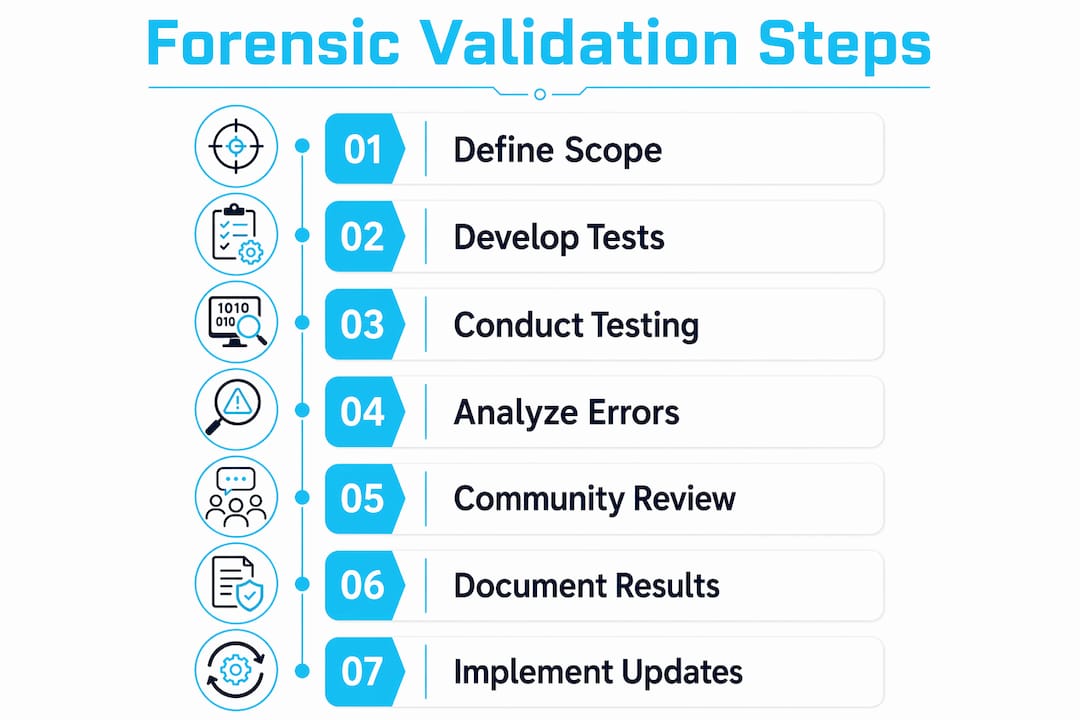

The distinction between full validation and interim validation matters significantly in practice. Full validation is conducted before a method enters routine use and involves exhaustive testing against known datasets. Interim or litigation-focused validation is narrower, conducted to address a specific challenge raised in proceedings. Both are legitimate, but courts increasingly expect full validation records to be available on demand.
Pro Tip: Retain all validation records as standalone lab documents, separate from case notes. These records must be available for court production at any point, so treat them as permanent institutional assets rather than administrative paperwork.
Pilot studies, error mapping, and community review are not optional refinements. They are the mechanisms through which a method earns scientific credibility. A method that has not been subjected to independent replication by parties outside the originating lab carries a measurably higher risk of challenge.
How does forensic validation ensure evidence integrity and legal admissibility?
Validation underpins evidence integrity at every stage of a forensic investigation. The most direct mechanism in digital forensics is hash verification. Pre- and post-acquisition hash values must be recorded and compared to confirm that a forensic copy is bit-for-bit identical to the original. Courts treat this as a digital fingerprint. If the values do not match, or if the comparison was never performed, the authenticity of the copy is immediately in question.
Beyond hashing, validation supports admissibility through several interconnected practices:
- Write-blocking: Hardware or software write-blockers must themselves be validated to confirm they prevent any modification to source media during acquisition.
- Tool testing: Forensic software such as FTK or Cellebrite must be tested against known datasets before deployment in casework, not simply trusted on the basis of vendor documentation.
- Process reproducibility: A validated process is one that another qualified examiner, using the same method and inputs, would reach the same conclusion. This is the core of the Daubert standard’s reproducibility requirement.
- Documentation: Lab validation records must capture test results against known datasets and be retained indefinitely, distinct from case-specific notes.
“Verification transforms an imaging run into a legally sound forensic copy by matching pre- and post-acquisition hash values and documenting results explicitly. Failure to verify jeopardises evidence authenticity claims.”
When validation is absent or inadequate, opposing counsel has a clear line of attack. They can argue the method lacks scientific basis, that results are not reproducible, or that the tool used has not been independently verified. Each of these arguments, if successful, can render evidence inadmissible or significantly undermine its weight with a jury.
What are the challenges and pitfalls in forensic validation?
The most persistent challenge in forensic validation is overreliance on vendor-supplied reports. Many practitioners treat a manufacturer’s validation documentation as sufficient proof that a tool works correctly in their specific lab environment. It is not. Independent practitioner-led testing is necessary to demonstrate method reliability under the actual conditions of each laboratory, and to protect against admissibility challenges based on bias or lack of external verification.
Other significant pitfalls include:
- Lack of intersubjective testability: Feature-comparison methods such as fingerprint analysis and toolmark examination are particularly vulnerable here. If a method cannot be replicated by independent researchers using the published protocol, it fails a fundamental scientific requirement.
- Incomplete documentation: Validation that was performed but not recorded is legally equivalent to validation that was never performed. Gaps in lab records are exploited routinely in cross-examination.
- Evolving tool versions: Digital forensics tools are updated frequently. Each significant update requires re-validation, because the underlying algorithms may have changed. Many labs fail to track this systematically.
- Insufficient detail for replication: Many existing studies lack sufficient methodological detail for independent replication, which undermines their scientific credibility and their value as validation evidence.
Pro Tip: When a new version of a forensic tool is released, treat it as a new tool for validation purposes. Run it against your existing known datasets before using it in live casework, and document the results in a dated lab record.
The digital forensics field faces a particular validation gap because tools evolve faster than validation frameworks. A method validated in 2023 against a specific operating system may produce different results against a 2026 device configuration. Staying current requires a systematic review cycle, not a one-time exercise.
What standards and frameworks guide forensic validation in 2026?
Several authoritative frameworks now shape how forensic validation is conducted and assessed. Understanding which applies to your context is the starting point for building a defensible validation programme.
| Framework | Scope | Key requirement |
|---|---|---|
| ISO/IEC 17025 | All accredited forensic labs | Mandates method validation; does not prescribe how to conduct it |
| NIST/RTI 10-step framework | Digital and multimedia forensics | Iterative empirical validation with error mapping and community review |
| SWGDE guidelines | Digital evidence | Standardised practices for tool testing and documentation |
| NIST Federated Testing project | Forensic software tools | Standardised test suites for disk imaging, write-blocking, and media preparation |
| Federal Rule of Evidence 702 | US federal courts | Requires scientific reliability, peer review, and known error rates |
| Daubert criteria | US federal and many state courts | Five-factor test for admissibility of expert scientific testimony |
ISO/IEC 17025 accreditation mandates method validation but does not specify how to conduct it, which has created a recognised gap. RTI and NIST have collaborated to develop a generalised forensic validation framework that promotes consistency across labs and disciplines. This collaboration directly addresses the community need created by ISO/IEC 17025’s silence on methodology.
For UK practitioners, the Forensic Science Regulator’s Codes of Practice and Conduct sit alongside ISO/IEC 17025 as the primary compliance framework. The Codes require that methods are fit for purpose and that validation is documented to a standard that supports independent scrutiny. The legal considerations for digital forensics in the UK context add further procedural requirements that practitioners must integrate into their validation planning.
How can forensic professionals implement effective validation?
Effective forensic data validation requires a systematic approach that goes beyond ticking compliance boxes. The following practices define what rigorous implementation looks like in operational forensic laboratories.
Establish a dedicated validation record system. Validation records must be distinct lab documents, not embedded in case files. They should capture the tool or method tested, the known dataset used, the results obtained, the date, and the examiner’s identity. Retain them indefinitely.
Use standardised test suites. The NIST Federated Testing project supplies ISO images and known datasets covering disk imaging, write-blocking, and media preparation tools. Using these datasets means your validation results are comparable across labs and defensible in court.
Conduct independent testing. Do not rely solely on vendor reports. Run the tool yourself, in your lab, against known inputs, and record what it produces. This is the only way to confirm the tool performs correctly in your specific environment.
Verify every acquisition with hash comparison. Record the hash value before and after imaging. Document both values explicitly in the case record. This single step is the most frequently cited validation requirement in digital evidence proceedings, and the most frequently omitted.
Apply validation to the full forensic workflow, not just individual tools. The digital forensic methods used by UK legal teams must be validated end to end, from acquisition through analysis to reporting. A validated imaging tool paired with an unvalidated analysis process does not produce validated results.
For corporate decision-makers commissioning forensic investigations, the practical implication is straightforward. Ask your forensic provider to produce their validation records for any tool or method used in your matter. If they cannot, that is a material risk to the admissibility and reliability of any evidence they produce.
Key takeaways
Forensic validation is the process that transforms forensic analysis from opinion into science, and its absence is the single most exploitable weakness in any evidence chain.
| Point | Details |
|---|---|
| Definition and purpose | Forensic validation confirms that methods and tools produce reliable, reproducible, and legally admissible results. |
| Hash verification is non-negotiable | Pre- and post-acquisition hash values must be recorded and matched to establish an unbroken chain of evidence integrity. |
| Independent testing over vendor reports | Practitioner-led validation in your own lab environment is required; vendor documentation alone is insufficient for court. |
| Standards require methodology | ISO/IEC 17025 mandates validation but not how to do it; the NIST/RTI 10-step framework fills this gap. |
| Documentation is the legal record | Validation records must be retained indefinitely as standalone lab documents, separate from case notes. |
Why validation gaps are the forensic profession’s most avoidable problem
Having worked alongside legal teams and investigators on cases where digital evidence has been challenged, the pattern that emerges is consistent. The evidence itself is often sound. The method that produced it is often reliable. But the documentation that would prove both of these things in court is missing, incomplete, or buried in case notes where it cannot be produced efficiently under cross-examination.
The forensic science community has known about this problem for years. The lack of detailed validation guidance within ISO/IEC 17025 has spurred collaborative efforts between RTI and NIST to establish consistent frameworks, but uptake across smaller labs remains uneven. The tools exist. The frameworks exist. The gap is almost always procedural, not technical.
What concerns me more is the growing complexity of digital evidence. Mobile devices, cloud storage, and encrypted communications each introduce validation challenges that did not exist a decade ago. A lab that validated its imaging tools in 2020 and has not revisited that process is operating on assumptions, not evidence. The importance of verifying digital evidence has never been greater, and the cost of getting it wrong has never been higher.
My view is that validation should be treated as a continuous professional obligation, not a one-time accreditation exercise. The labs and practitioners who understand this are the ones whose evidence survives scrutiny. The ones who do not are creating problems for their clients that no amount of technical skill can fix after the fact.
— Computer
How Computerforensicslab supports validated forensic investigations
Computerforensicslab provides digital forensics services built on documented validation processes, chain of custody protocols, and court-ready evidence handling. Every investigation conducted by Computerforensicslab applies hash verification, write-blocking, and tool testing against known datasets, with validation records maintained to the standard required for legal proceedings in the UK. Whether you are a solicitor preparing for litigation, a law enforcement agency handling digital evidence, or a corporate team responding to a data breach, Computerforensicslab delivers forensic analysis that is technically sound and legally defensible. Contact Computerforensicslab to discuss your investigation requirements and how validated forensic methods can protect the integrity of your evidence.
FAQ
What is forensic validation in simple terms?
Forensic validation is the process of testing and confirming that a forensic method or tool produces accurate, consistent, and legally defensible results before it is used in a real investigation or court proceeding.
Why is forensic validation required under ISO/IEC 17025?
ISO/IEC 17025 requires accredited forensic laboratories to validate their methods to demonstrate fitness for purpose, though it does not specify how validation must be conducted. Frameworks such as the NIST/RTI 10-step process provide the methodological detail the standard lacks.
How does hash verification relate to forensic validation?
Hash verification is a core validation step in digital forensics. Matching pre- and post-acquisition hash values confirms that a forensic copy is an exact, unaltered duplicate of the original, which is a prerequisite for legal admissibility.
Can a forensic investigation rely on vendor validation reports alone?
No. Independent practitioner-led testing within the specific lab environment is required. Vendor reports do not account for local conditions, tool configurations, or the specific datasets a lab encounters, and courts may reject evidence where only vendor documentation is available.
What happens when forensic validation is inadequate?
Inadequate validation gives opposing counsel grounds to challenge the reliability and admissibility of evidence. Under the Daubert criteria and Federal Rule of Evidence 702, methods that cannot demonstrate reproducibility, peer review, or known error rates may be excluded from proceedings entirely.