

Metadata provides the hidden context investigators need to reconstruct what happened, when, and by whom. When a document is created, modified, or transmitted, it accumulates a layer of embedded attributes — timestamps, author fields, device identifiers, IP addresses — that users rarely see but forensic examiners rely on as primary evidence. In UK digital forensic practice, the role of metadata in investigation spans three core functions:
- Timeline reconstruction: establishing the precise sequence of file creation, access, modification, and deletion across devices and accounts.
- Authentication and provenance: confirming or challenging whether a document is genuine, unaltered, and contemporaneous with the events it purports to record.
- Linking actors and devices: connecting a suspect, account, or machine to specific files, communications, or locations through corroborating artefacts.
Chain of custody and admissibility are immediate concerns from the moment a device is seized. Metadata that has not been preserved through forensically sound imaging is vulnerable to challenge in court, and in some cases may be excluded entirely.
Table of Contents
- What metadata is and why it matters in forensic investigations
- Common metadata types investigators rely on
- How metadata supports investigative goals
- Where investigators find metadata: devices, servers, and cloud services
- Collecting and preserving metadata so it remains admissible
- UK legal and disclosure considerations for metadata
- Limitations, manipulation risks, and validation approaches
- Which forensic tools and techniques should you use for metadata analysis?
- A practical seven-step checklist from scene to court
- Key takeaways
- Why metadata evidence is only as strong as the process behind it
- How Computerforensicslab supports metadata-led investigations
- Useful sources and further reading
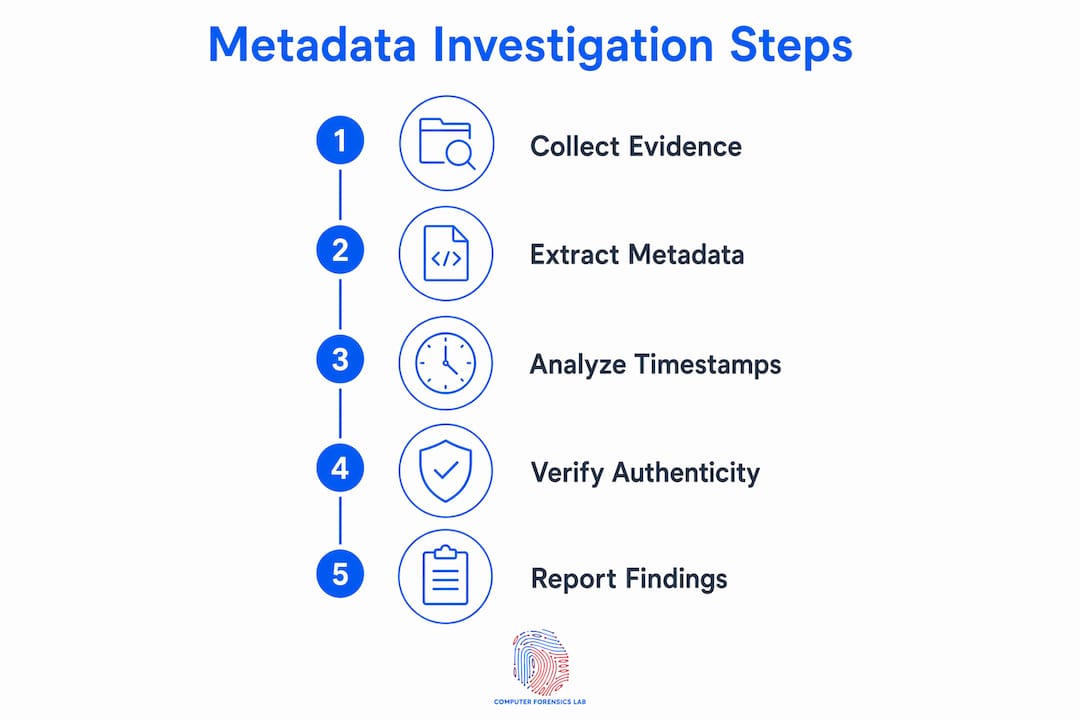
What metadata is and why it matters in forensic investigations
Metadata is, at its simplest, data about data. For a forensic practitioner, that definition carries significant weight: metadata describes the attributes of a digital object rather than its content, yet those attributes often carry more evidential value than the content itself. A Word document’s text may be disputed; its creation timestamp, author field, and revision history are considerably harder to fabricate convincingly.
The attributes investigators typically examine include timestamps (created, modified, accessed, changed), authorship and editor fields, cryptographic hashes, file size and path, application version strings, embedded GPS coordinates, email routing headers, and system-level artefacts such as Master File Table (MFT) entries on NTFS volumes or Inodes on Linux systems. Each of these constitutes a discrete data point that can be cross-referenced against other evidence to build or challenge a narrative.
Research by Alanazi and Jones at Edith Cowan University confirms that metadata in forensic investigations can provide collaboration evidence between groups of people, precisely because individuals are often unaware of what information is embedded in the files they create and share. That unawareness is an investigative advantage: metadata is rarely sanitised before evidence is seized.
Pro Tip: Treat metadata as primary evidence from the outset of any investigation, not as supplementary context. When the content of a file is contested, the metadata record of its creation and modification history may be the only objective arbiter available to the court.

Common metadata types investigators rely on
Different source systems generate different artefacts, and understanding which type answers which investigative question is fundamental to efficient evidence collection. The National Institute of Justice describes metadata as information stored below the surface of documents and productivity files, noting its use in establishing links between criminal suspects and identifying improper access to sensitive material.
- File system metadata (MFT/Inodes): NTFS Master File Table entries and Unix Inodes record timestamps, file size, permissions, and cluster allocation. These artefacts answer when a file existed and where it was stored.
- Application properties: Microsoft Office and PDF files embed author names, organisation fields, revision counts, editing duration, and template paths. These answer who created or modified a document.
- Email headers: Full header data records the originating IP address, mail transfer agent hops, message identifiers, and send/receive timestamps. These answer how and from where a message was sent.
- EXIF and media metadata: Digital photographs and video files embed camera model, lens settings, GPS coordinates, and capture timestamp. These answer where and when an image was taken.
- Mobile application metadata: Call logs, SMS databases, app-specific caches, and location history files on iOS and Android devices record communication patterns and physical movement.
- Network and log artefacts: Firewall logs, DHCP leases, VPN connection records, and web proxy logs record IP address assignments and access events, providing corroboration that is difficult for end-users to alter.
| Metadata type | Common artefacts | Primary investigative value |
|---|---|---|
| File system (NTFS/Inodes) | MFT entries, timestamps, cluster allocation | Timeline reconstruction, deletion evidence |
| Application properties | Author field, revision history, template path | Provenance, authorship attribution |
| Email headers | Originating IP, MTA hops, message ID | Sender identification, routing verification |
| EXIF / media | GPS coordinates, camera model, capture time | Geolocation, device linking |
| Mobile device | Call logs, SMS DB, location history | Communication patterns, movement tracking |
| Network / logs | DHCP leases, firewall logs, VPN records | IP attribution, access corroboration |
How metadata supports investigative goals
Metadata aids investigations by enabling four distinct workstreams: timeline reconstruction, provenance and authentication, linking actors and devices, and geolocation analysis. Each workstream draws on different artefact types, but all depend on the same underlying principle: metadata records system events independently of user intent.
Timeline reconstruction is typically the first task. An investigator extracts MFT timestamps, email header dates, and application save events, then plots them against a master timeline. Discrepancies — a file “created” before the operating system was installed, or an email header timestamp that contradicts the sender’s claimed location — become the focal points of further examination. File system metadata research published in the Journal of Digital Investigation notes that timestamps have high forensic value for event reconstruction precisely because they allow ordering of file operations into a sequence, provided the system clock has not been manipulated.
Authentication and provenance rely on metadata to confirm or refute whether a document is what it purports to be. Legal analysis cited in the Arizona State Law Journal confirms that courts increasingly rely on metadata to resolve disputes about the provenance and timing of electronic documents, and that metadata can both authenticate and challenge the authenticity of digital evidence.
Linking actors and devices often depends on artefacts that users do not know exist. Registry keys such as USBSTOR record every USB device ever connected to a Windows machine. LNK files log the path and timestamp of recently accessed documents. Shellbags record folder navigation history. These residual artefacts in unallocated space can place a specific device in a specific user’s hands at a specific time, even after the primary files have been deleted.
Geolocation analysis draws on EXIF GPS data, mobile tower records, and IP address logs. When cross-referenced, these sources can construct a pattern-of-life profile showing where a device was at given times. Comparative research confirms that the combination of phone, telematics, and GPS data allows investigators to build a precise picture of an individual’s social and personal habits.
A landmark illustration of metadata’s investigative power is the 2005 arrest of Dennis Rader, the BTK serial killer in Wichita, Kansas. Rader sent a floppy disk to a television station; the disk contained a deleted Word document whose metadata revealed the author field “Christ Lutheran Church” and a username linked to Rader. That single embedded field, invisible to the sender, provided the decisive link between the communication and the suspect. The case is cited by the National Institute of Justice as a definitive example of metadata solving a major criminal investigation.
For practitioners working on digital evidence in criminal cases, this kind of artefact recovery from residual data is a routine but critical capability.
Where investigators find metadata: devices, servers, and cloud services
Metadata does not reside in a single location. A thorough evidence collection plan must account for multiple storage layers, each with its own access requirements and preservation considerations.

Local file systems on computers and laptops hold the richest file-level metadata, including MFT entries, prefetch files, and application logs. Mobile devices carry call records, location databases, and app-specific caches that are often more current than desktop equivalents. Mail servers retain full header data and server-side timestamps that differ from client-side records, making them an independent corroboration source.
Cloud storage and collaboration platforms present particular challenges. Services such as Microsoft 365, Google Workspace, and Dropbox maintain their own metadata layers, including version histories, access logs, and sharing records, but these are held by third-party providers. Accessing them requires either the account holder’s cooperation or a lawful request under the Investigatory Powers Act 2016 or a court order. Preservation notices should be issued promptly, because cloud providers apply retention policies that may delete logs within days or weeks of an event.
Several pitfalls are worth noting. Metadata is frequently stripped when documents are exported to PDF or uploaded to public-facing platforms; a file posted to a website may have had its author and revision fields removed by the publishing tool. Server-side and client-side timestamps can diverge due to time-zone differences or clock synchronisation issues. Organisations also inadvertently expose metadata in publicly shared documents, revealing network paths, usernames, and software versions that are useful for investigators but also for adversaries conducting reconnaissance.
Collecting and preserving metadata so it remains admissible
Forensic imaging and preservation at the point of seizure are non-negotiable because even opening a file on a live system can alter its last-accessed timestamp and compromise evidential integrity. Legal scholarship and practice guidance are unambiguous: immediate forensic imaging on receipt of a device, combined with logged chain-of-custody documentation, is the standard required to protect metadata from admissibility challenges.
“Failure to preserve metadata early can render evidence vulnerable to exclusion. Litigation practitioners regard metadata as the primary means of authenticating electronic evidence.” — Rosenberg, Metadata’s Shadows in the Courtroom, Arizona State Law Journal.
The following numbered procedure reflects accepted UK forensic practice for evidence seizure and preservation:
- Secure the device. Prevent further use, network access, or power changes. Photograph the screen state before any interaction.
- Document the device state. Record make, model, serial number, operating system version, and visible date/time display. Note any running processes or open applications.
- Apply write-blocking. Connect a hardware write-blocker before attaching any storage media to an examination machine. Software write-blockers are acceptable where hardware is unavailable, but the choice must be documented.
- Create a forensic image. Produce a sector-by-sector image of the storage media using validated imaging software. Record the tool name and version.
- Calculate and log cryptographic hashes. Generate MD5 and SHA-256 hashes of both the source media and the forensic image immediately after acquisition. Any subsequent mismatch indicates tampering or corruption.
- Document chain of custody. Record who handled the evidence, at what time, for what purpose, and where it was stored at each stage. Every transfer requires a signed entry.
- Store original media securely. Place the original device in an anti-static, tamper-evident bag in a secure, access-controlled environment. The image, not the original, is used for analysis.
- Extract metadata with versioned tools. Run extraction using documented, validated tools. Log the tool name, version, configuration, and output file hashes.
Pro Tip: Use automated case-management platforms that log tool versions, analyst actions, and hash values automatically at each step. Manual logging introduces transcription errors; automated audit trails are considerably more defensible under cross-examination.
UK legal and disclosure considerations for metadata
Admissibility of metadata evidence in UK proceedings depends on three factors: preserved integrity, documented provenance, and lawful access. Courts will scrutinise whether the evidence was obtained lawfully, whether its integrity has been maintained throughout the chain of custody, and whether the extraction methodology is reproducible and documented.
The key legal framework governing metadata access and retention in the UK includes:
- UK GDPR and the Data Protection Act 2018: Metadata constitutes personal data when it identifies or is capable of identifying an individual. Processing for law enforcement purposes must comply with Part 3 of the Data Protection Act 2018, which requires a lawful basis, purpose limitation, and data minimisation. The tension between investigative utility and privacy rights is a defining challenge of metadata-led investigations, and UK practitioners must document their legal basis for each category of metadata accessed.
- Investigatory Powers Act 2016: Governs bulk and targeted access to communications data, including metadata held by telecommunications operators. Warrants and authorisations must be obtained before accessing third-party metadata.
- Criminal Procedure Rules 2020: Part 27 governs the use of expert evidence, including digital forensic reports. Expert witnesses must comply with their overriding duty to the court, and reports must set out the methodology used, the tools relied upon, and the limitations of the findings.
- Disclosure obligations: Under the Criminal Procedure and Investigations Act 1996, prosecutors must disclose material metadata that is capable of undermining the prosecution case or assisting the defence. In civil proceedings, the disclosure of electronically stored information (ESI) including embedded metadata is governed by Practice Direction 31B.
Practical disclosure actions for legal teams include:
- Preserve original ESI in its native format before any processing or conversion.
- Produce metadata fields where they are material to the issues in dispute.
- Annotate any redactions clearly, noting that metadata fields have been withheld and the legal basis for doing so.
- Liaise with disclosure counsel and the forensic examiner at the outset to agree a metadata protocol.
- Consult UK compliance guidance for digital forensics when structuring a disclosure plan.
For a detailed treatment of disclosure obligations, the guide to disclosure of metadata provides practical guidance aligned with current UK practice.
This article provides general information for practitioners and does not constitute legal advice. Confirm current rules with a qualified solicitor or the relevant primary source for your specific matter.
Limitations, manipulation risks, and validation approaches
Metadata is not infallible. Practitioners who treat it as self-evidently reliable expose their analysis to effective cross-examination. Understanding where metadata can fail, be manipulated, or be lost is as important as knowing how to extract it.
The principal limitations are:
- Timestamp manipulation: System clocks can be altered, and some file operations legitimately update timestamps in ways that appear suspicious. A file “modified” after a suspect claims not to have touched it may reflect an automated backup process rather than deliberate tampering.
- Metadata stripping: Many document-sharing workflows, including email clients, content management systems, and PDF converters, remove embedded metadata during export. A document received by a third party may carry none of the original application properties.
- Anti-forensic tools: Freely available utilities can overwrite or falsify metadata fields, including author names, creation dates, and GPS coordinates. Detecting this requires cross-referencing with independent artefacts.
- Cloud normalisation: Cloud platforms may re-timestamp files on upload, replacing original metadata with server-side values that reflect the upload event rather than the original creation.
Validation steps that strengthen the analysis against these challenges include:
- Cross-reference file system artefacts (MFT entries, Inodes, prefetch) with application-level metadata. Inconsistencies between layers suggest manipulation.
- Corroborate file-level timestamps with network logs, mail server records, and backup snapshots, which are harder for an end-user to alter.
- Check cryptographic hashes and digital signatures where available. A valid hash confirms the file has not been altered since the hash was calculated.
- Examine unallocated space and the Windows Registry for residual artefacts. Deleted files and Registry entries often preserve earlier versions of metadata that contradict a falsified active record.
Pro Tip: Document every extraction step with the tool name, version, and configuration used, and retain the raw output alongside the analysis. Reproducibility is the cornerstone of admissibility: a defence expert who cannot replicate your results using the same tool and methodology will challenge the findings. Reproducible, version-logged extraction removes that avenue of attack.
Which forensic tools and techniques should you use for metadata analysis?
Tool selection in metadata analysis is governed by the principle of reproducibility: the chosen tool must produce consistent, verifiable output that a second examiner can replicate independently. The following categories cover the main approaches, from full laboratory imaging to lightweight triage:
- Forensic imaging suites: Full-disk imaging platforms create sector-by-sector copies and calculate hash values automatically. They are the standard for laboratory examination where chain-of-custody integrity is paramount.
- Metadata extraction tools: Dedicated extraction utilities parse application properties, EXIF data, and file system artefacts from forensic images or live systems, producing structured output suitable for timeline analysis.
- EXIF viewers and media analysers: Lightweight tools that read embedded metadata from image and video files. Useful for rapid triage of media evidence to identify GPS-tagged content or device identifiers.
- Email header analysers: Web-based and standalone tools that parse full email headers, identify originating IP addresses, and map MTA routing paths. Valuable for sender attribution and timestamp verification.
- Log aggregation and timeline builders: Platforms that ingest multiple log sources (firewall, DHCP, VPN, application) and correlate them into a unified timeline. These are particularly useful for pattern-of-life analysis in complex investigations involving multiple devices or accounts.
- CLI utilities for triage: Command-line tools such as ExifTool, strings, and file system parsers allow rapid, scriptable extraction of metadata from large volumes of files. They are appropriate for initial triage but should be supplemented by full laboratory analysis before evidence is presented in court.
Selection criteria should include the tool’s audit logging capability, its acceptance in UK court proceedings, the availability of validation documentation from the developer, and whether its output can be exported in a format that a defence expert can independently review. For guidance on forensic data analysis best practices, practitioners should consult established methodology frameworks before committing to a toolset.
Lightweight triage tools are appropriate for initial scoping and prioritisation. Full laboratory imaging and analysis are required whenever evidence will be presented in proceedings, disclosed to a counterparty, or relied upon in an expert witness report.
A practical seven-step checklist from scene to court
The following checklist translates the principles discussed throughout this article into a field-usable workflow. It is designed for use by forensic practitioners, in-house legal teams, and instructing solicitors who need to confirm that metadata preservation meets the standard required for UK proceedings.
- Secure the scene. Prevent access to devices, isolate from networks where possible, and photograph the environment. Note: lawful authority (warrant, consent, or statutory power) must be confirmed before seizure.
- Document the device state. Record all visible information: screen content, date/time display, running applications, and network connections. This creates a baseline against which subsequent metadata can be verified.
- Image with a write-blocker. Apply a hardware write-blocker and create a forensic image using a validated, documented tool. Never work from the original media.
- Hash and log immediately. Calculate MD5 and SHA-256 hashes of the source and image. Record hashes, tool version, analyst name, date, and time in the case log before proceeding.
- Preserve originals securely. Seal original media in tamper-evident packaging and store in a secure, access-controlled location. Document every subsequent access in the chain-of-custody log.
- Extract metadata with versioned tools. Run extraction using tools whose versions are recorded. Retain raw output files alongside processed reports. For deleted-file metadata, examine unallocated space and Registry artefacts as standard.
- Prepare admissibility notes and expert report. Document methodology, tool versions, hash verification results, and any limitations. The expert report must comply with Criminal Procedure Rules Part 27 and set out the basis for each finding.
Pro Tip: At step 7, explicitly address any metadata anomalies or limitations in the report rather than omitting them. Courts and opposing counsel will find them regardless; proactive disclosure of limitations strengthens the expert’s credibility rather than undermining it.
For a comprehensive walkthrough of evidence collection steps, including remote and cloud scenarios, practitioners should review current procedural guidance before commencing any engagement.
Key takeaways
Metadata’s role in investigation is decisive when evidence is preserved correctly from the outset: without forensically sound imaging and documented chain of custody, even the most compelling artefact can be excluded.
| Point | Details |
|---|---|
| Preserve before analysing | Forensic imaging with write-blocking must precede any examination; simple file copying alters timestamps and risks admissibility. |
| Metadata authenticates documents | Courts rely on embedded metadata to resolve provenance and timing disputes; it can confirm or refute a document’s claimed origin. |
| Residual artefacts are decisive | Registry keys, LNK files, and unallocated space often preserve linking evidence after primary files are deleted. |
| UK law shapes every access decision | UK GDPR, the Investigatory Powers Act 2016, and Criminal Procedure Rules govern how metadata is obtained, retained, and disclosed. |
| Computerforensicslab provides end-to-end support | From forensically sound imaging and chain-of-custody documentation to expert witness reports for UK courts, Computerforensicslab covers the full workflow. |
Why metadata evidence is only as strong as the process behind it
The most common mistake in metadata-led investigations is not technical; it is procedural. Practitioners who understand EXIF data, MFT timestamps, and email header analysis sometimes underestimate how quickly that expertise becomes irrelevant if the acquisition process is not documented to the standard a court will accept.
The BTK case is instructive not just because metadata solved it, but because the metadata was recovered from a discarded floppy disk with no deliberate preservation process at all. In a contested UK proceeding, that approach would not survive disclosure. The defence would challenge the chain of custody, the tool versions, the hash verification, and the analyst’s methodology. Without documented answers to each of those challenges, the finding becomes inadvisable to rely upon, regardless of how technically correct it is.
There is also a tendency in corporate investigations to treat metadata analysis as a quick triage exercise rather than a forensic one. An IT administrator who opens a suspect file to check its properties has already altered the last-accessed timestamp. That single action, well-intentioned and apparently harmless, can undermine months of subsequent analysis. The discipline of treating every potential evidence source as a forensic exhibit from the first moment of suspicion is what separates investigations that hold up in court from those that do not.
Metadata management is also an organisational security matter. Businesses that share documents externally without stripping sensitive embedded fields are providing adversaries with network paths, usernames, and software version information. The same metadata that helps investigators reconstruct events can help attackers plan intrusions. Treating metadata hygiene as part of a corporate security programme is not a forensic luxury; it is a baseline control.
How Computerforensicslab supports metadata-led investigations
When metadata evidence needs to hold up in a UK court, the gap between a technically competent extraction and a legally defensible one comes down to process, documentation, and expert presentation. Computerforensicslab provides forensically sound imaging, write-blocked acquisition, and cryptographic hash verification as standard, with full chain-of-custody documentation at every stage. The team prepares expert witness reports that comply with Criminal Procedure Rules Part 27, addressing methodology, tool versions, and limitations in the format courts expect.
For legal teams and corporate clients who need immediate triage, Computerforensicslab offers rapid engagement with strict confidentiality protocols. Whether the matter involves digital forensic investigations for litigation, employee misconduct, data breach response, or criminal proceedings, the lab’s London-based team can advise on preservation strategy and commence acquisition without delay. Contact Computerforensicslab to discuss your matter and arrange a forensic engagement.
Useful sources and further reading
The following sources underpin the analysis in this article and are recommended for practitioners who need to examine the primary material.
| Source | What it offers |
|---|---|
| Alanazi & Jones, “The value of metadata in digital forensics,” ECU | Peer-reviewed overview of metadata types and their forensic value across document and network formats; useful for practitioners building an evidence taxonomy. |
| National Institute of Justice, “Technology Primer: Data About Your Data” | US government primer on metadata in criminal investigations, including the BTK case example; accessible introduction for non-technical stakeholders. |
| Rosenberg, “Metadata’s Shadows in the Courtroom,” Arizona State Law Journal | Legal analysis of metadata admissibility, authentication standards, and chain-of-custody requirements; essential reading for litigation counsel. |
| Buchholz & Falk, “The role of file system metadata in digital forensics,” JDI | Technical analysis of file system metadata artefacts and their forensic value for event reconstruction; recommended for forensic examiners. |
| Giangreco, “Leveraging metadata and big data for criminal investigations,” Sistema Penale | Comparative legal analysis of GDPR, data retention, and investigative metadata use across Europe, the US, and China; relevant for UK practitioners navigating privacy obligations. |
| Security Magazine, “How does metadata help in digital forensic investigations?” | Practitioner-facing summary of metadata types, leakage risks, and corporate security implications; useful for in-house security and legal teams. |
| Magnet Forensics, “That one artefact: metadata’s role in a complex case” | Case narrative demonstrating the use of Registry keys, LNK files, and unallocated space to link a suspect to deleted material; practical illustration of residual artefact recovery. |