
Expert testimony is opinion evidence given by a person with specialised knowledge, skill or experience, who explains a technical subject to a court so that the judge, magistrates or jury can decide the issues in dispute. Ordinary witnesses may only describe what they saw or heard. An expert witness may go further and state an opinion within their field, provided that opinion is independent, supported by stated facts and offered to help the court rather than the party who pays for it. In England and Wales the evidence usually reaches the court as a written report, and it may then be tested through questions, including cross-examination.
This guide explains what expert testimony is, how it differs from other evidence, the duty an expert owes, the rules that govern it in England and Wales, and what digital forensic testimony looks like in practice.
Key Takeaways
- Expert testimony is opinion evidence from a qualified specialist, given to assist the court on matters outside ordinary knowledge, and it is distinct from factual testimony.
- In England and Wales an expert owes an overriding duty to the court, which prevails over any duty to the party who instructs or pays them.
- Different procedure rules apply by court: Civil Procedure Rules Part 35, Criminal Procedure Rules Part 19 and Family Procedure Rules Part 25.
- Digital forensic experts typically explain how data was acquired, verified and interpreted, including imaging, hash comparisons, timestamps and deleted files.
- Instructing an expert early, with a clear scope and preserved evidence, protects the weight the court will give to their opinion.
Table of Contents
- What expert testimony means
- The role of an expert witness in court
- The duty owed to the court
- Rules that govern expert evidence in England and Wales
- How expert testimony is tested
- Examples of expert opinion
- Perspective: why method and independence decide weight
- Instructing an expert: what to get right
- Digital forensic expert witness support
- FAQ
- Sources
What expert testimony means
A court decides disputes on evidence. Most of that evidence is factual: a witness says what happened, what they saw, what they did. Some questions, however, cannot be answered from common experience: why a bridge failed, whether a signature is genuine, whether a deleted file was opened before a resignation. For these the court hears from an expert.
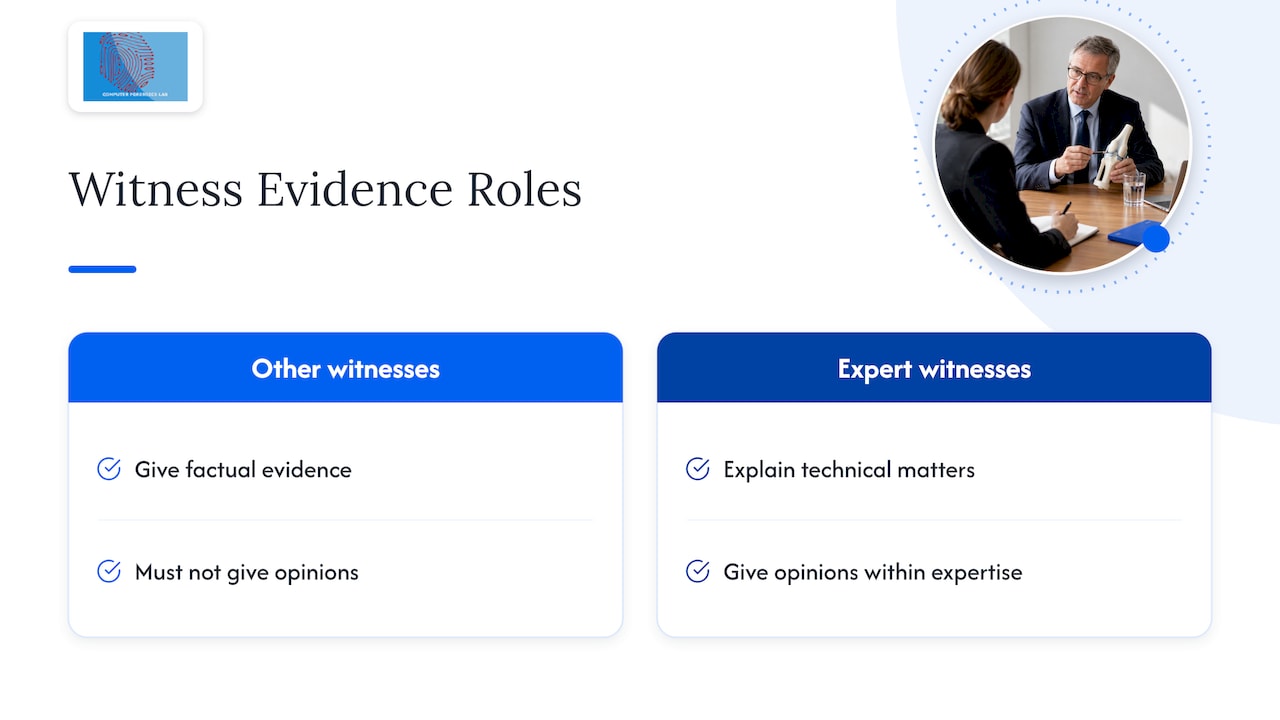
Official guidance from Victoria’s legal aid body describes the position plainly: unlike other witnesses, who must not give opinions, expert witnesses may explain technical matters and give opinions within their expertise to help the court reach a verdict. Although that guidance comes from Australia, the principle is shared across common law systems. The Legal Information Institute at Cornell describes expert testimony as an opinion stated under oath by a qualified individual, which can clarify complex concepts and help the court understand the evidence.
The phrases “expert testimony”, “expert evidence” and “expert witness testimony” are used almost interchangeably. Strictly, expert evidence is the broader term and covers the written report, any joint statement with another expert and oral evidence at a hearing. Testimony usually refers to what the expert says in person, though in England and Wales the report is frequently the most important part.
Expert witness versus lay witness
The difference lies in knowledge and in permission to give opinion:
| Feature | Lay (factual) witness | Expert witness |
|---|---|---|
| Basis of evidence | Personal knowledge of events | Specialised training, knowledge or experience |
| Opinion | Generally not permitted | Permitted within the area of expertise |
| Personal involvement | Needed | Not necessarily needed |
| Purpose | Describe what happened | Help the court understand technical matters |
The University of North Carolina’s evidence manual makes the same distinction: a lay witness must have personal knowledge of the subject matter, whereas an expert does not necessarily need it but must have the expertise to give an opinion in the case.
The role of an expert witness in court
The expert’s role is to assist the court with specialised reports, opinions and testimony, including explanations of technical matters, so that it can decide the case. The expert does not decide the case, and does not advocate for the instructing party. They identify what the material shows, explain how they reached that view, and state the limits of their conclusions.
In practice an expert may be asked to:
- Examine documents, devices, samples or records and establish the relevant facts from them.
- Apply recognised methods and explain why they are appropriate.
- State an opinion on questions within their field, with reasons.
- Identify any assumptions made and any matters outside their expertise.
- Meet other experts to agree and narrow the issues, where the court directs.
- Attend a hearing to explain the report and answer questions.
The duty owed to the court
Independence is the feature that separates expert testimony from advocacy. The Civil Justice Council’s guidance states that an expert owes an overriding duty to help the court, which takes priority over any obligation to the person instructing or paying them. This applies equally when the expert is chosen and paid by one side.
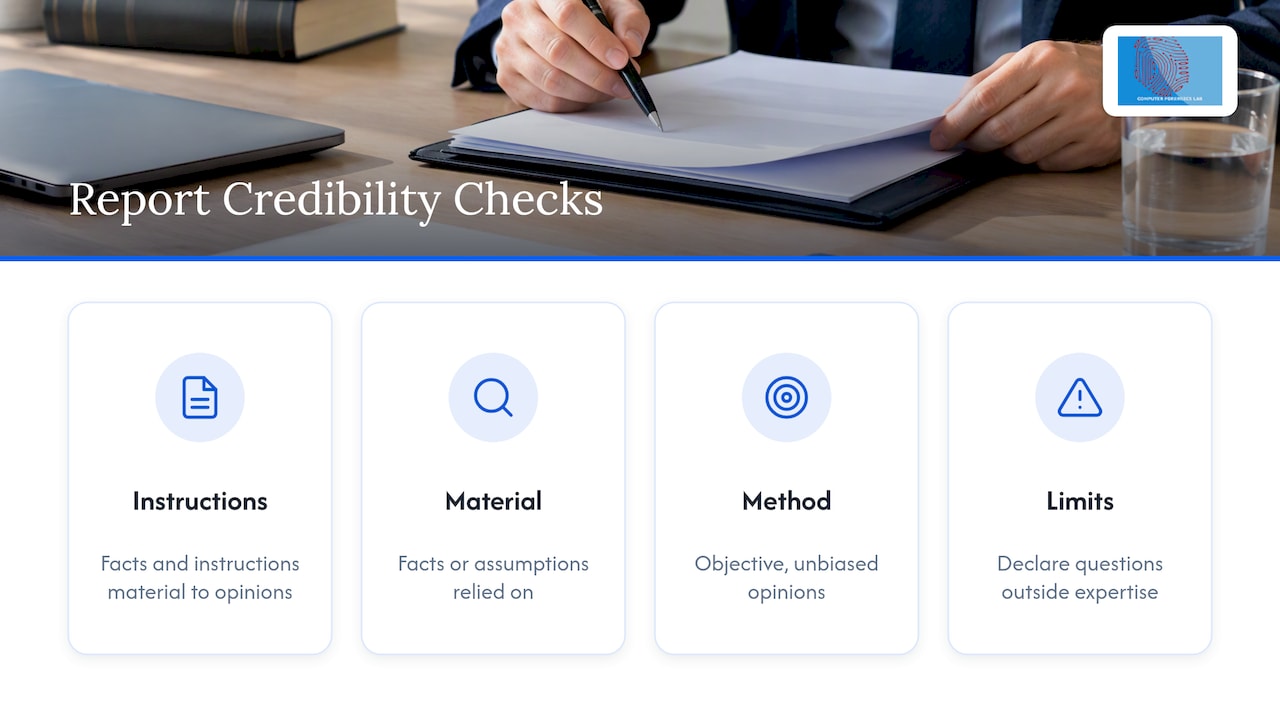
Practice Direction 35 of the Civil Procedure Rules adds that expert evidence should be independent, with objective, unbiased opinions on matters within the expert’s expertise. It also sets out what a civil expert report must contain, including the expert’s qualifications, the material relied on, the substance of the facts and instructions material to the opinions, and a statement that the expert understands and has complied with their duty to the court.
The duty is often traced to the Ikarian Reefer case. A professional guide on expert evidence from the Intellectual Property and Commercial Courts community notes that the principles require experts to state the facts or assumptions they rely on and to declare when a question falls outside their expertise. The same guide expects an expert to have the flexibility of mind to change an opinion when new evidence or a counter-argument warrants it.
For a reader deciding whether to rely on an expert, these requirements are a practical checklist. A credible report states its instructions, its material, its method and its limits, and it is written so that a court could accept it whichever party it favours.
Rules that govern expert evidence in England and Wales
There is no single code. The Expert Witness Institute lists Civil Procedure Rules Part 35 for civil cases, Criminal Procedure Rules Part 19 for criminal cases and Family Procedure Rules Part 25 for family cases. Scotland and the Republic of Ireland follow their own arrangements.
Two features of the civil regime matter to anyone planning litigation. First, Part 35 is intended to limit oral expert evidence to what is reasonably required, so the court’s permission is generally needed before expert evidence is relied on. Second, the rules encourage a single joint expert where possible, to keep cases proportionate and efficient.
Types of expert in the process
- Consulting (advisory) expert: helps a party and its lawyers understand the technical issues. Their advice is generally not served on the other side.
- Testifying expert: produces a report intended for the court and may give oral evidence.
- Single joint expert: instructed by both parties and owing the same duty to the court, often used in lower-value or narrower disputes.
A common and sensible route is to start with a consulting expert to assess the strength of the technical case, then decide whether a testifying or joint expert is needed.
How expert testimony is tested
An expert’s opinion is not accepted merely because of a title. In the United States, Federal Rule of Evidence 702 makes the judge a gatekeeper, who must be satisfied that the testimony rests on sufficient facts and reliable methods reliably applied to the case. The American Bar Association’s comparative review describes the United Kingdom as relying more on the adversarial process and cross-examination to test an expert’s credibility.
When an expert gives oral evidence, they present their opinions and answer questions from the calling party and the opposing advocate. Cross-examination can probe the expert’s assumptions, methods and possible bias. A report that clearly records its instructions, its sources and its reasoning is far easier to defend under that scrutiny.
The same logic applies whichever country’s rules are in play. Admissibility turns on whether the person is properly qualified, whether the subject is one on which expert help is needed, and whether the method and reasoning are sound. For readers outside England and Wales, the detail will differ by jurisdiction, and local rules should always be checked.
Examples of expert opinion
Experts appear in medical negligence, engineering, accountancy, handwriting, forensic science and many other fields. A simple illustration used in a legal factsheet is the contrast between a lay witness who can say a vehicle ended up in a ditch and an accident investigator who can analyse skid marks to offer an inferred opinion on what happened.
Digital forensic testimony
Digital evidence is a good example of a field where opinion depends on method. The Scientific Working Group on Digital Evidence describes testimony that may explain data extraction and processing, forensic imaging and hash comparisons used to confirm that a copy is reliable, together with messaging applications such as WhatsApp, deletion and recovery, and findings about messages, emails, photographs, videos, contacts and call records.
Typical questions a digital forensic expert addresses include:
- Is the copy of the device or account a faithful, verifiable image of the original?
- How were timestamps and time zones recorded, and what do they show about when something happened?
- Was a file deleted, and can it be identified or recovered?
- Who is likely to have created, altered, sent or accessed a document or message?
- Has a photograph, document or message been altered?
The answers can decide employment tribunal claims, fraud trials, divorce proceedings and intellectual property disputes. For a closer look at this field, see our guides on how a digital forensics expert witness works and the role of the expert witness in digital forensics.
Perspective: why method and independence decide weight
In our work with solicitors, law enforcement bodies, businesses and private clients, the pattern is consistent: digital evidence is rarely contested because the data is absent, but because the way it was collected and explained is open to challenge.
For that reason we treat expert testimony as the end product of a disciplined process. It begins with forensically sound acquisition and an unbroken chain of custody, continues with analysis that another competent examiner could repeat, and ends with a report that states its assumptions and limits without advocacy. Our approach is built on independent, impartial investigation, quality standards including ISO 17025, and peer review of findings.
We would encourage instructing parties to involve an expert before devices are handed over, switched on or reset. Early involvement preserves evidence, defines the questions the court will need answered, and allows an honest early assessment of what the data can and cannot show. An expert who can explain a technical process in plain terms, and who has a background that includes law enforcement and high-profile casework, gives the court the clearest help.
Computer
Instructing an expert: what to get right
The quality of expert testimony is largely settled before any report is written. Points that legal teams and private clients should consider:
- Define the questions. Write down the issues the expert must address. Vague instructions produce vague reports.
- Preserve the evidence. Avoid using, browsing or resetting devices. Early forensic imaging protects the original and allows verification by hash comparison.
- Check expertise and independence. Confirm that the expert’s qualifications match the specific question, and that they understand their duty to the court.
- Agree the scope in writing. Record instructions, the material supplied and any assumptions, because the report must set these out.
- Plan for disclosure and challenge. Expect the other side to examine methods, tools and records. Documentation is the best defence.
- Respect confidentiality. Experts must keep information acquired during an investigation confidential unless disclosure is authorised or required by law.
If the matter involves electronic disclosure, our guide on electronic discovery under UK practice explains how data is identified and reviewed before experts are asked for opinion.
Digital forensic expert witness support
Computer Forensics Lab is a London-based digital forensics provider assisting solicitors, law enforcement, businesses and private clients. Our services include expert witness provision and presentation, digital evidence acquisition, analysis and reporting, mobile phone forensics, cloud forensics, data recovery and e-disclosure, with chain of custody maintained throughout. Prices are agreed on the scope of each instruction, so please contact us with a summary of the matter.
See our specialist computer forensics services or our page on expert witness services for digital evidence.


If you already hold devices or accounts relevant to a dispute, contact our team before they are used further, so that evidence is preserved in a forensically sound way.
FAQ
What is expert testimony in simple terms?
Expert testimony is the opinion of a qualified specialist, given to help a court understand a technical issue. It differs from ordinary witness evidence because the expert may state opinions, not only facts. The opinion must be independent and based on stated facts and reasoning.
What is the role of an expert witness?
The expert assists the court by examining the material, applying recognised methods and reporting an impartial opinion within their field. Their duty to the court overrides any duty to the party paying them. They may be questioned on their report, including by the opposing side.
Which rules apply to expert witnesses in England and Wales?
Civil cases are governed by Civil Procedure Rules Part 35, criminal cases by Criminal Procedure Rules Part 19 and family cases by Family Procedure Rules Part 25. Each sets requirements for the content of reports and for the expert’s duty to the court. Your solicitor can confirm which applies to your case.
Can digital evidence be explained by an expert witness?
Yes. Digital forensic experts explain how data was copied and verified, how timestamps should be read, whether files were deleted or recovered, and what messages, emails and call records show. Their explanation helps the court judge how far the digital material can be relied upon. Our guide to the UK expert witness testimony process in digital forensics covers this in more detail.
Sources
- Expert witnesses, LawHub (Victoria Legal Aid)
- Expert testimony, Wex, Legal Information Institute
- Basic Guidelines, NC PRO
- Guidance for the instruction of experts in civil claims, Civil Justice Council
- Practice Direction 35, Experts and Assessors
- Guidance on the preparation, admission and examination of expert evidence
- Justifying appointment of an Expert Witness, Expert Witness Institute
- Rule 702, Testimony by Expert Witnesses, Federal Rules of Evidence
- The Adjudication of Expert Witness Testimony: A Comparative Perspective, American Bar Association
- Factsheet 02: Expert Evidence
- Introduction to Testimony in Digital and Multimedia Forensics, SWGDE