
A computer forensics report is the written record of what an examiner did to digital media, what was found and what the findings mean. SWGDE, the Scientific Working Group on Digital Evidence, describes it as a summary of the steps taken during the examination, drawn from the examiner’s case notes, photographs and tool-generated output. In practice it is the document that solicitors, directors, investigators and courts rely on, often long after the examiner has left the witness box or the case file has been closed.
This guide explains what forensic reporting is, which sections a sound report contains, how findings and limitations should be recorded, and how to read a report critically before relying on it.
Key takeaways
- A forensic report is the primary output of an examination: it turns technical findings into a form that people who were not present can understand, verify and act upon.
- A sound report records enough detail for another competent examiner to reproduce the process and reach the same results, including any deviations from standard procedures.
- Facts and opinions must be kept apart. A report should never state more than the examination established, and should say where uncertainty remains.
- Requirements for format vary by jurisdiction and instructing party, so the court rules and the instructions you hold are the starting point for any report.
- A technically correct analysis that is poorly reported is of limited use; a well-written report resting on flawed analysis is dangerous.
Table of Contents
- What forensic reporting means
- What a computer forensics report should contain
- How to document evidence, methods and findings
- Writing tips: clarity, objectivity and defensibility
- How a report is used, and challenged, in court
- Reading a sample report or template with care
- Our perspective
- Commissioning a forensic report
- FAQ
- Sources
What forensic reporting means
Forensic reporting is the process of preparing the written account of an examination. The Oslo Metropolitan University teaching material on forensic reporting calls the report the primary output of a digital forensic investigation, and says its job is to translate technical findings for readers who did not watch the analysis take place. Those readers typically include a solicitor reviewing the strength of a claim, a barrister preparing cross-examination, a judge, a jury, an HR panel or a board of directors.
The same material gives four purposes for a report:
- Communication: conveying what was found to a non-technical audience.
- Verifiability: allowing another examiner to check the work.
- Legal accountability: making the examiner answerable for what was done and concluded.
- Record-keeping: preserving the work for later review.
The last purpose matters more than it first appears. The US National Commission on Forensic Science noted in 2016 that reports are often the only document available if a case is reviewed years or decades later, so they must convey enough information to be understood without the examiner present. The same commission observed that more than 90% of criminal cases in the United States are disposed of through plea bargaining, which means a report can shape the outcome of a case without ever being tested in a courtroom. The figure is American, but the lesson applies anywhere: a report is read closely by people deciding whether to settle, plead or proceed.
Technical, investigative and evaluative reporting
Not every report does the same job. A 2022 paper on technical reporting in digital forensics, written in the context of England and Wales, distinguishes technical reporting from investigative and evaluative reporting. A technical report gives an objective, factual account of test outcomes and processes, with no opinion about what the data means. Investigative and evaluative reports may go further and offer opinions or inferences. The paper also notes that technical reports can supply early case intelligence, supporting charging decisions and shaping later forensic work.
Knowing which type you are reading, or commissioning, prevents a common error: treating a list of recovered artefacts as if it were a conclusion about who did what, and why.
What a computer forensics report should contain
Formats differ between organisations and courts, but the core content is consistent. SWGDE’s report-writing requirements say an examination report should include:
- a title, a case identifier and the name of the requester;
- the purpose of the examination;
- a description of the processes and results, with supporting data as needed;
- conclusions or opinions, where appropriate;
- the disposition of the evidence;
- the authorisation of the report.
In a typical commercial engagement, this translates into the following sections.
| Section | What it should do |
|---|---|
| Executive summary | State the instruction, the main findings and any limits in plain language, on one page where possible |
| Instructions and scope | Record who instructed the examiner, the questions asked and anything excluded from scope |
| Evidence items | List each device, image or account examined, with identifiers, condition and how it was received |
| Methods and tools | Describe acquisition and analysis steps, tools and versions, and any hash values recorded |
| Findings | Present the facts established, each tied to its source artefact |
| Opinion or interpretation | Where appropriate, give reasoned conclusions, clearly separated from the facts |
| Limitations and uncertainty | Record encryption, damaged media, missing logs and anything that could alter the conclusions |
| Disposition of evidence | State where originals and copies are held and how they were returned or retained |
| Appendices | Supply supporting data, tool output and a glossary |
The integrity of the evidence trail underpins several of these sections. A report that describes findings but cannot show who handled an item, and when, invites challenge. Our guide to preserving chain of custody for digital evidence sets out what the record should capture at each hand-over.
How to document evidence, methods and findings
Make the work reproducible
SWGDE’s position is that documentation should allow individuals to reproduce the forensic process and results. The report must describe the processes and results, include supporting data as needed, and disclose any applicable deviations from standard operating procedures. The Netherlands Register of Court Experts’ forensic report guideline makes a related point: it asks experts to describe anomalies in the research material, the remedial actions taken, the research methods and any departures from standard methods.
In a digital case, that means recording matters such as:
- the make, model and serial number of each device, and its physical state on receipt;
- how the forensic image was created, with the hash value of the source and the copy;
- the software used for processing, with version numbers;
- the search terms, date ranges and filters applied;
- any step that did not go as planned, and how it was handled.
Record what complicates the analysis
SWGDE’s best practices for computer forensic examinations state that methods and findings should be sound, supported by data, replicable and defensible, and that factors which may complicate an analysis, including encryption and anti-forensic tools, should be documented. A report that is silent about a locked partition or wiped free space gives the reader a false sense of completeness. The honest version says what could not be examined and what that means for the conclusions.
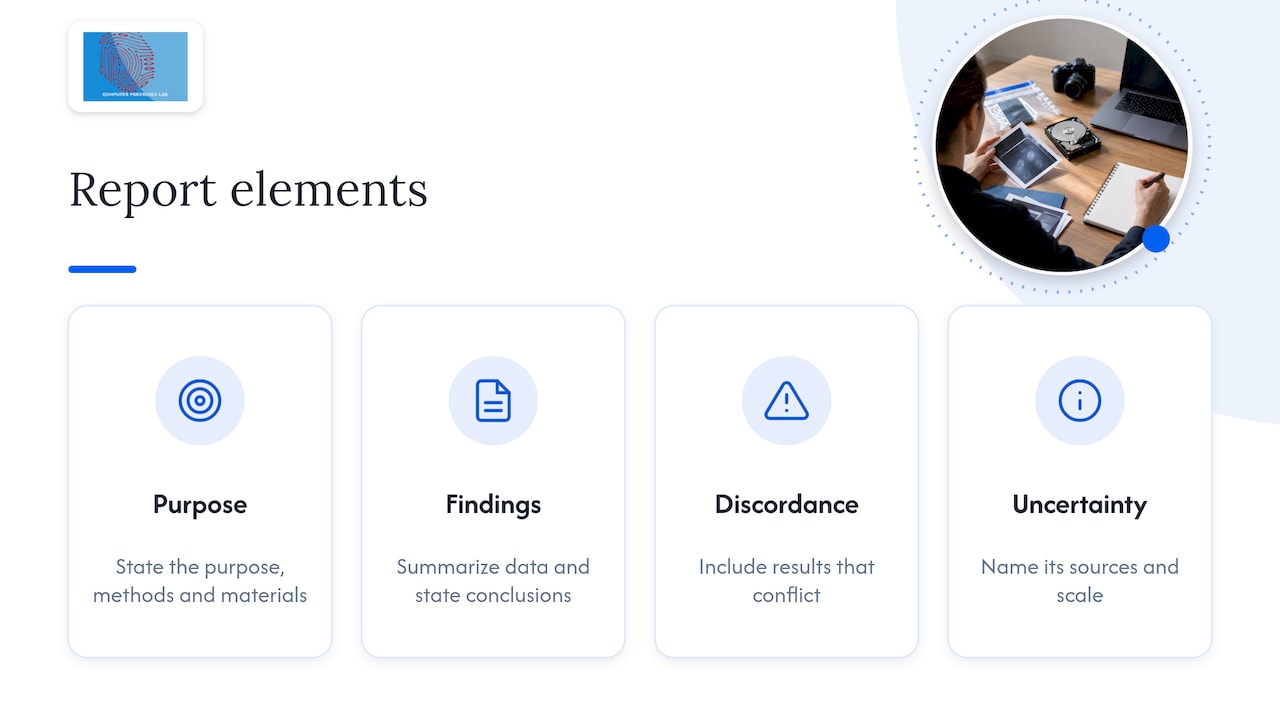
The National Commission on Forensic Science goes further. It recommends that reports convey the purpose of the examination, the methods and materials, a summary of the data, any conclusions, discordant results and, where necessary, the sources and scale of uncertainty. Discordant results are the ones examiners are most tempted to leave out, and the ones opposing experts most often find.
State what the report does not contain
The same commission recommends that every report say it does not contain all the documentation needed to understand and evaluate the work, or to independently analyse the data and draw conclusions, and that doing so requires review of the case record. This is not a disclaimer to shelter behind. It reminds the reader that the report is a summary, and that the underlying notes, images and logs are available for scrutiny.
Amending a report
Reports are sometimes wrong, or new material arrives. SWGDE’s requirements say that if a final examination report needs amendment after release, a new report must be issued which identifies and explains the edits and refers back to the original. Quietly replacing a page is not acceptable, because the reader who holds the first version needs to know what changed and why.
Writing tips: clarity, objectivity and defensibility
The question most practitioners ask is how to write a report that is both accurate and readable. The guidance converges on a few habits.
- Write for a layperson. SWGDE’s guidance on presenting digital evidence says to explain findings in layperson’s terms and to report what the data represents after thorough review, without omission, distortion or misrepresentation. Define each technical term once, in a sentence, and use it consistently.
- Keep facts and opinions apart. Put what was observed in one place and what it is taken to mean in another. A reader should be able to accept the facts while questioning the opinion.
- Do not exceed the evidence. SWGDE’s introduction to testimony says testimony should not go beyond the facts established through examination.
- Avoid false certainty. The same document advises against phrases such as “reasonable degree of scientific certainty” or “to the exclusion of all others”, since they imply levels of certainty that are generally unmeetable. Use graded, reasoned language and explain the basis for it.
- Stay neutral. The examiner should not advocate for a party or omit, distort or misrepresent facts. Reports that read as advocacy lose credibility with the court and damage the examiner’s standing.
- Tie every statement to an artefact. A reader should be able to move from a sentence in the findings to the file, log entry or message it came from.
- Read it as the opposing expert would. Ask which sentence could be challenged, and whether the report already contains the answer.
The Oslo Metropolitan University material puts the stakes plainly through its author, Thomas Sødring: a technically correct analysis poorly reported is of limited use, while a well-reported but technically wrong analysis is dangerous. Good reporting does not rescue weak examination, and good examination is wasted if it cannot be understood.
Writing for lawyers, judges and juries
The reader of a forensic report is usually a lawyer, and the lawyer in turn has to explain the findings to someone else. Material from a family dispute shows the point: when preserving social media posts in divorce cases, the legal team needs a record of where each post came from and when it was captured, written clearly enough to put before a court. A report that gives a lawyer the capture method, the date and time and a plain statement of what the post shows saves hours of follow-up questions.
How a report is used, and challenged, in court
SWGDE notes that digital evidence, tools, techniques and methodologies may be challenged in court or other formal proceedings, and that proper documentation helps others reproduce the process and results. It also points out that report formatting may be dictated by organisational policy or by the court rules of the jurisdiction. Academic work on standardising the digital forensic process argues that investigations must ensure the validity, reliability and soundness of evidence, and document processes and findings properly if the evidence is to be admissible.
For anyone instructing an expert in England and Wales, the practical consequence is to confirm the procedural requirements before the examination starts, not after the draft arrives. Ask the instructing solicitor or the court for the rules and directions that apply to the expert’s report, and make sure the examiner has them. Our article on creating expert witness reports for digital evidence covers the expert’s side of that process, and the role of the expert witness in digital forensics explains how the report relates to oral evidence.
When a report is challenged, the attack usually falls on one of four points:
- Provenance: was the evidence handled in a way that could have altered it?
- Method: were the tools and steps appropriate, and were they applied correctly?
- Interpretation: does the opinion follow from the facts?
- Completeness: were relevant items, or contrary results, left out?
A report that deals with each of these in its own text is far harder to undermine than one that leaves them to cross-examination.
Reading a sample report or template with care
Sample reports and templates are widely shared, from public repositories to document-hosting sites, and they are useful for seeing the shape of a report. They are not a standard to copy. Before relying on one, check these points:
- Who wrote it and for what purpose. A training exercise on a practice image is not a report prepared for a tribunal.
- Which jurisdiction it assumes. Rules on the form and content of expert reports differ between countries, and a template written elsewhere may omit declarations that a court in England and Wales expects.
- Whether it separates fact from opinion. Many templates mix them.
- Whether it records hash values, tool versions and limitations. If these are absent, the template will not meet the reproducibility standard described above.
- Whether it is dated. Tools and guidance change, and a template several years old may describe superseded practice.
Use a template as a checklist of headings, then fill it from the actual case record and the instructions you hold.
Our perspective
In our work for solicitors, businesses and private clients, the report is where an investigation succeeds or fails. We have seen sound examinations undermined by reports that blurred what was found with what was assumed, and we treat the report as a deliverable to be designed from the first instruction, not written at the end.
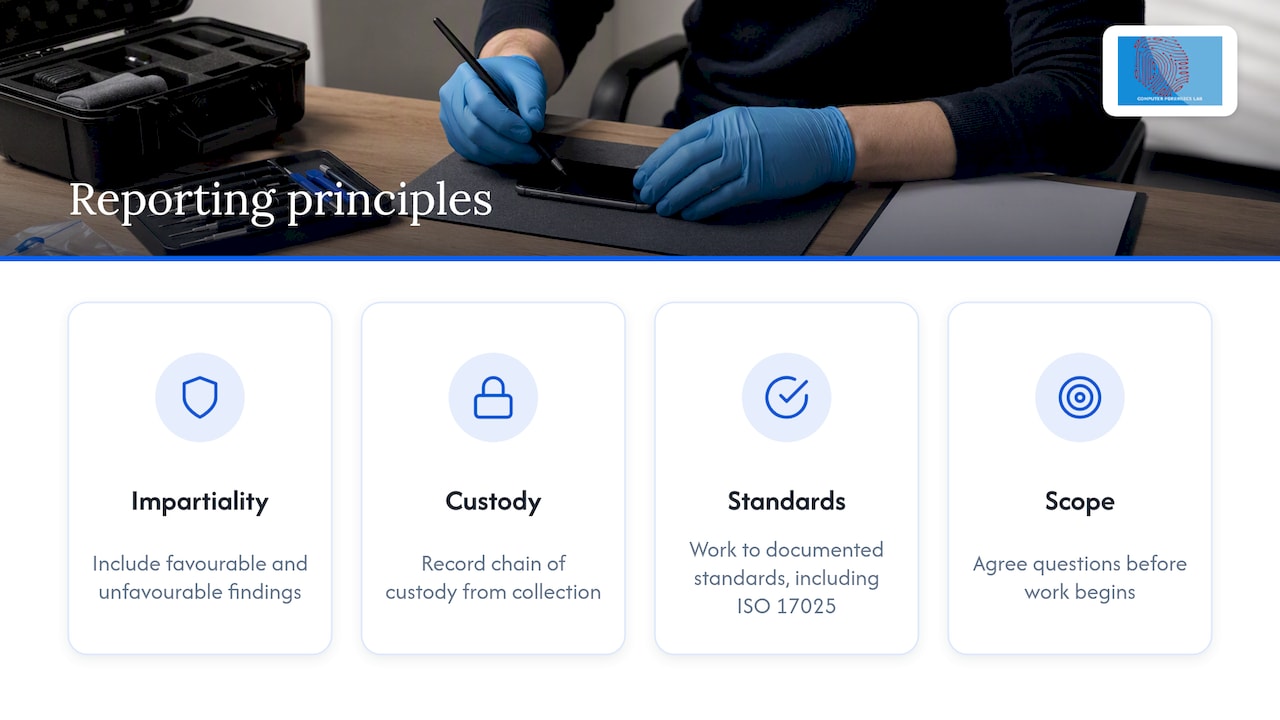
Our approach rests on independence and impartiality. We record chain of custody from the point of collection, we work to documented quality standards, including ISO 17025, and we write for the reader who must act on the report, whether that is a solicitor preparing a case, a director deciding on disciplinary action or a court weighing evidence. Findings that are favourable to the instructing party and findings that are not belong in the same report, because a report that omits the inconvenient point cannot be defended.
We also encourage clients to agree the questions to be answered before work begins. A tightly framed instruction produces a shorter, clearer report, and it makes the limits of the examination visible from the outset.
— Computer
Commissioning a forensic report
If you need a report for litigation, an internal investigation or a regulatory matter, our team provides digital evidence acquisition, analysis and reporting together with expert witness provision and presentation, covering computers, mobile phones, cloud accounts, email and social media. Instructions typically come from law firms, corporate legal departments, company directors, local authorities and private individuals. To discuss an instruction, use our contact page and tell us the devices involved and the questions the report must answer.
FAQ
What is the difference between a forensic report and an expert witness report?
A forensic report records the examination and its findings and may be written for any purpose, including an internal investigation. An expert witness report is prepared for legal proceedings and is written with the court’s requirements in mind, so it carries the expert’s opinion and the declarations the court expects. One examination can produce both, with the technical report supporting the expert’s opinion.
How long should a computer forensics report be?
Length follows the instruction, not a fixed number of pages. A single-device examination answering one question may need a short report with appendices, while a multi-device fraud investigation will run longer. A one-page executive summary at the front lets non-technical readers get the main points without reading the technical detail.
Can a forensic report include opinions?
Yes, where the instruction calls for it and the examiner is qualified to give one. A purely technical report stays with factual outcomes, while investigative and evaluative reports may include opinions or inferences. Whatever the type, opinions should be clearly separated from facts and should not claim more certainty than the examination supports.
What happens if a report contains an error?
The examiner should issue a new report that identifies and explains the changes and refers to the original. Replacing the earlier version without explanation leaves the reader unable to see what changed, which can damage confidence in the whole examination.
Sources
- SWGDE Requirements for Report Writing in Digital and Multimedia Forensics
- Forensic Reporting, Oslo Metropolitan University
- National Commission on Forensic Science, 2016
- Technical reporting in digital forensics, PMC
- Forensic Report Guideline, Netherlands Register of Court Experts
- SWGDE Best Practices for Computer Forensic Examinations
- SWGDE Best Practices for Personnel Presenting Digital Evidence in Legal Proceedings
- SWGDE Introduction to Testimony in Digital and Multimedia Forensics
- On the importance of standardising the process of digital forensics