
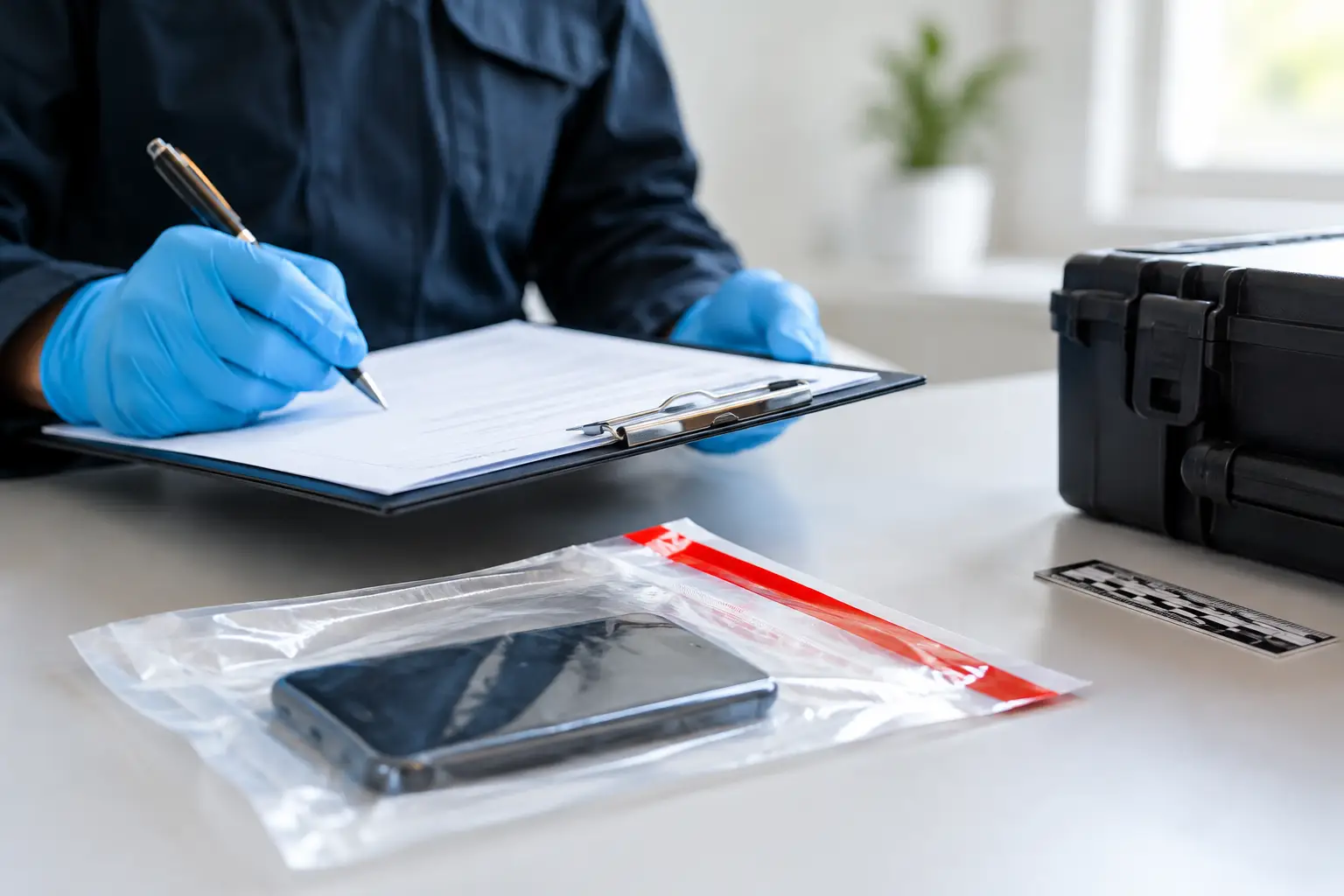
A phone passed between colleagues, a laptop switched on to “have a quick look”, or a USB stick left in an unlocked drawer can turn valuable material into disputed evidence. Knowing how to document evidence custody is therefore not administrative housekeeping. It is the process that allows a court, opposing party, regulator, or internal disciplinary panel to understand what was collected, who controlled it, what happened to it, and whether it remains reliable.
For digital evidence, custody records are especially significant. Devices can be altered by routine use, remote access, operating system activity, synchronisation, encryption, or well-intentioned attempts to recover files. A defensible record protects the evidence, the investigation, and the professional relying upon the findings.
What evidence custody records must prove
Chain of custody is the documented history of an item from the point of seizure, collection, or receipt through examination, storage, disclosure, and final return or disposal. The record should show continuous accountability, rather than merely a series of names on a form.
A good custody record answers several practical questions. What is the item? Where and when was it obtained? Who had authority to collect it? What was its condition at that time? Who held it at every stage? Why was it transferred, accessed, copied, or examined? Where was it kept? Can the item now produced be shown to be the same item, or a verified forensic copy of it?
The required level of detail depends on the matter. A corporate investigation involving an employee’s company laptop may require a different collection authority and retention process from a criminal case involving property seized under statutory powers. The underlying principle does not change: every material action must be capable of explanation and, where necessary, independent verification.
How to document evidence custody from the outset
Start the custody record at the first point of contact. Do not wait until forensic examination begins. If a solicitor, client, investigator, or IT manager receives a device or exports potentially relevant data, record the event immediately.
Allocate a unique exhibit or evidence reference that will remain attached to the item throughout the case. Avoid vague descriptions such as “John’s phone” or “office computer”. Identify the item precisely: for example, manufacturer, model, serial number, IMEI, asset tag, SIM details, visible condition, connected accessories, and the location from which it was obtained. Photographs can support the written record, particularly where damage, screen condition, cable connections, labels, or packaging may later matter.
Record the date, time, place, collector’s name, the person who surrendered or identified the item, and the legal or organisational basis for collection. In a workplace matter, that may include the relevant contractual policy, consent, instruction, preservation notice, or authority from the organisation. In litigation, it may be necessary to distinguish carefully between material voluntarily provided by a client and material obtained through formal disclosure or another authorised process.
The initial entry should also state the item’s status. Was the mobile phone powered on, powered off, locked, unlocked, charging, connected to a network, or receiving notifications? Was the laptop asleep, running, encrypted, damaged, or connected to external storage? These facts affect the preservation approach. They should be observed and recorded, not guessed later.
Preserve first, inspect later
The temptation to inspect a device immediately is understandable, particularly when the matter is urgent. Yet opening messages, searching folders, browsing photographs, or asking an employee to demonstrate what is on a device may alter timestamps, application data, access logs, cloud synchronisation records, and other material.
Where practical, isolate and secure the item before examining it. The exact method depends on the device, the risk of remote interference, safety considerations, and the authority available. Record every preservation action, including who performed it, when, how, and why. If a phone is placed into an appropriate evidence bag or a laptop is disconnected from a network, the custody log should identify that action and any change in condition.
Preservation is not always perfect. A live system may need urgent action to prevent data loss, a compromised network may require containment, or a cloud account may be at risk of deletion. In those situations, the record must explain the decision-making. A transparent account of a necessary intervention is far more defensible than an unexplained gap.
Record each transfer without exceptions
Every movement of evidence needs a contemporaneous entry. This includes transfers between offices, handovers to a forensic examiner, delivery to secure storage, release to counsel or another expert under an agreed process, and return to the owner.
For each transfer, record the evidence reference, date and time, name and signature or secure electronic confirmation of the person releasing the item, corresponding details for the recipient, the reason for transfer, and the location. State the packaging and seal condition at handover. If a seal number is used, record it. If the package is damaged or a seal is broken, document the condition, the reason, and the person authorising or undertaking any re-packaging.
Electronic custody records can be suitable and often improve traceability, provided access is controlled, entries are attributable to named users, and changes are auditable. A spreadsheet held in a shared folder with no version control is a weak substitute for a proper evidence management process. It may be possible to explain it, but it invites questions about whether entries were changed retrospectively.
Do not rely on email trails alone. Emails can support the chronology, but they rarely capture all the information needed to establish secure possession and condition. The formal custody record should remain the primary source, with related communications retained as supporting material where relevant.
Treat forensic copies as evidence in their own right
Digital forensic work commonly involves creating a forensic image, logical extraction, targeted collection, or exported dataset rather than examining the original device repeatedly. The relationship between the original and its derivative must be documented with precision.
Record the acquisition method, forensic tool and version where relevant, operator, date and time, source device reference, output media reference, and the resulting file or image identifiers. Forensic hash values are central here. A hash is a cryptographic value generated from data. Matching hash values provide strong evidence that a forensic image or exported file has not changed since the value was calculated.
The log should state which algorithm was used, such as SHA-256, the resulting value, when it was generated, and what it relates to. Do not simply write “hash verified”. Preserve the actual value and record the verification event. Where an acquisition cannot be hashed in the conventional way, such as certain live collections or some cloud-derived data, explain the limitation and preserve the available audit information, export metadata, account details, timestamps, and collection method.
A forensic working copy should be clearly differentiated from the master image and from the original exhibit. Analysts need working material, but the process must ensure that examination activity does not compromise the preserved master. This distinction often becomes critical when another expert is asked to review the work or when the methodology is challenged.
Secure storage is part of the chain
A custody log is only credible when it reflects real security. Store physical devices and media in controlled-access locations, with protection appropriate to the sensitivity of the case and the condition of the item. Record the storage location accurately enough that the item can be located, but avoid unnecessarily exposing sensitive case details in labels or routine communications.
For electronic evidence, access controls, encryption, audit logs, backup arrangements, and segregation between cases all matter. Sensitive personal data, legally privileged material, commercially confidential documents, and intimate images may require additional handling restrictions. A chain of custody does not override data protection, confidentiality, disclosure duties, or legal professional privilege. The collection and review plan must address those issues from the beginning.
Retention periods should be agreed and recorded. At the conclusion of an instruction, document whether evidence was returned, retained under a legal hold, transferred, securely deleted, or destroyed in accordance with authority and policy. The final disposal record closes the custody history. Without it, an organisation may be unable to account for highly sensitive material long after a matter has ended.
Common weaknesses that undermine custody evidence
Most chain-of-custody problems are not caused by sophisticated technical failures. They arise from ordinary shortcuts: undocumented handovers, unlabelled USB devices, inconsistent exhibit numbers, forensic images saved to personal drives, or devices accessed by several people without a recorded purpose.
Another recurring weakness is reconstruction after the event. A witness may honestly remember receiving a handset “around Tuesday”, but recollection is not a substitute for a contemporaneous record. If an entry is made late, it should be clearly identified as such, with the basis for the information stated. Never backdate a record or present reconstructed information as if it were contemporaneous.
The same discipline applies where a client has already handled the material before instructing an expert. Record what is known, what is not known, and any actions already taken. A prior handling issue does not necessarily make evidence unusable. Concealing it, or failing to assess its impact, creates the greater risk.
Build a record that can withstand challenge
The best custody documentation is clear enough for someone outside the investigation to follow without assumptions. A solicitor should be able to understand the material’s journey when advising a client. An opposing expert should be able to identify the source data, preservation steps, and verification points. A court should be able to see that the opinion offered rests on controlled evidence, not an uncertain collection of files.
Computer Forensics Lab applies this evidential discipline from receipt through examination and reporting, because a technically impressive finding has limited value if its provenance cannot be demonstrated. If the evidence may be relied upon in a dispute, preserve the original position now, document each decision, and obtain specialist forensic advice before routine handling turns a manageable issue into an evidential argument.