
Cell phone analysis covers two related disciplines: forensic examination of the handset itself, and cell site analysis of the records held by the network operator. The first recovers and interprets data stored on the device, such as messages, call logs, app records and location artefacts. The second uses network records to show which cell site and sector a phone used at a given time. Each answers different questions, and in many investigations the two are read together. This guide explains how both work, what can and cannot be recovered, and what solicitors, company directors and private clients should understand before instructing an examiner.
Key Takeaways
- Handset forensics examines the device; cell site analysis examines operator records. They are different evidence and can legitimately disagree.
- Early preservation matters: data on a powered-on phone changes constantly, and delay or a restart can make some data unrecoverable.
- Encryption, the phone’s lock state and the extraction method decide how much can be recovered, so the examiner’s method should be recorded in full.
- Location evidence has limits of accuracy, and a sound report states them rather than overstating what a record proves.
- In UK investigations, lawful authority and data minimisation shape what may be extracted in the first place.
Table of Contents
- What cell phone analysis means
- How a phone is preserved and acquired
- What data analysis can recover
- Encryption, device condition and software changes
- How reliable is phone evidence?
- Documenting findings for investigations and proceedings
- Lawful authority and the UK position
- Our perspective
- Instructing a phone analysis
- FAQ
- Sources
What cell phone analysis means
The phrase is used loosely, so it helps to separate the two meanings.
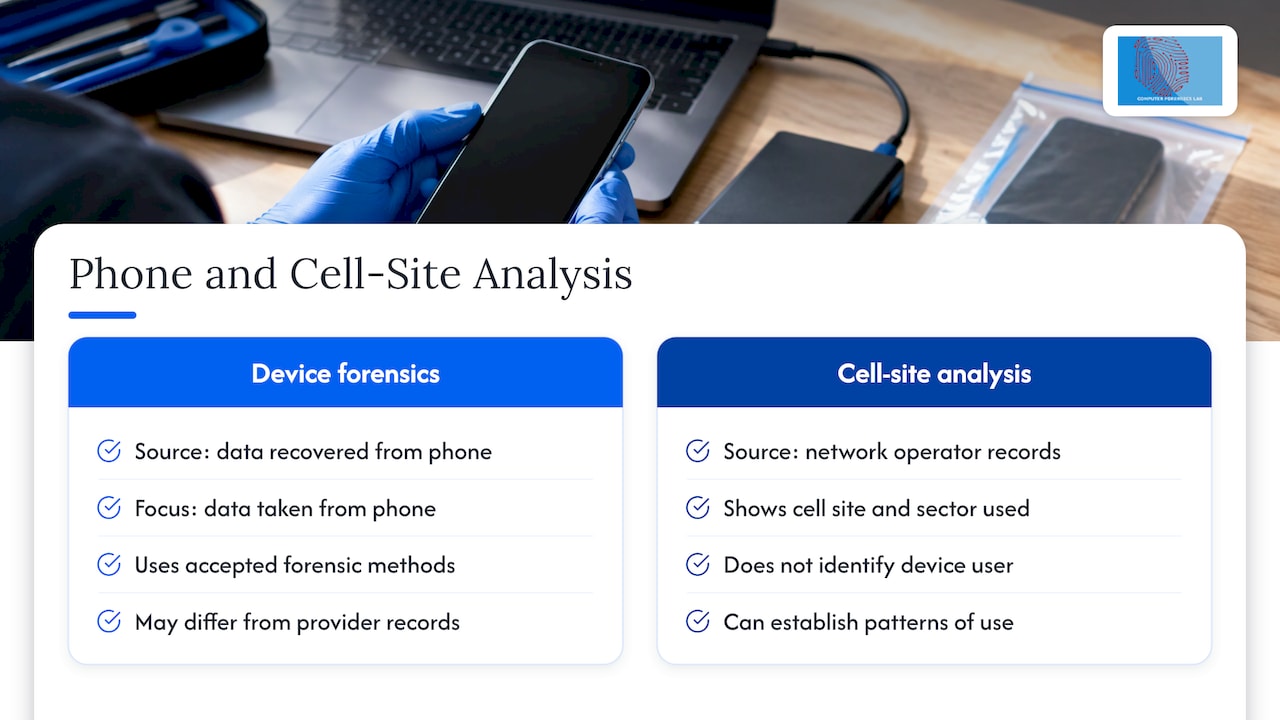
Mobile device forensics. The US National Institute of Standards and Technology defines mobile device forensics as the science of recovering digital evidence from a mobile device under forensically sound conditions using accepted methods. Its guidelines cover validation, preservation, acquisition, examination, analysis and reporting. Analysis here means working on the data taken from the phone.
Cell site analysis. This works from the records kept by the network operator. According to the SWGDE recommendations on cell site analysis, it demonstrates only the specific cell site and sector used by a particular device at a specific date and time. Call detail records do not conclusively show who was using the device, although they can establish patterns of use.
The two sources are recorded and stored differently. SWGDE’s best practice document on mobile device forensic analysis notes that location data recovered from a handset is distinct from provider records and that inconsistencies between them are to be expected. An inconsistency is therefore a point for the expert to explain, not automatically a flaw in either source.
How a phone is preserved and acquired
The quality of any later analysis rests on what happens in the first hours. Our guide to mobile phone forensic examination sets out the full process; the principal stages are as follows.
- Securing and documenting the device. SWGDE’s guidance on mobile device evidence collection says documentation may include the collection location, device state, any known PIN or password, the displayed time, network connections, physical characteristics and any examiner interactions.
- Recording custody. Chain-of-custody records should be contemporaneous and identify the items, their identifiers, each transfer and each custodian. See our article on how to preserve chain of custody for digital evidence.
- Controlling the device state. The same SWGDE document states that data on a powered-on device is constantly changing, that power cycles affect volatile data, and that delays in acquisition may make temporary data impossible to retrieve. It recommends maintaining consistent power where practical.
- Acquisition. The examiner takes a copy of the data using a method suited to the handset, its operating system and its lock state.
- Examination and analysis. Before analysis, the CEN/CENELEC workshop agreement CWA 17865 states that data should be decrypted with appropriate tools where possible, and that encoded data such as time stamps must be decoded properly.
- Reporting. Findings are documented so that another examiner could follow what was done (see below).
NIST stresses that failing to preserve evidence in its original state could jeopardise an entire investigation. For that reason, a phone that may matter in a case should be handed to a qualified examiner before anyone browses it, charges it repeatedly or tries to unlock it.
Acquisition methods in outline
Examiners choose between several levels of extraction, each trading invasiveness against the volume of data obtained. The principal ones are:
| Method | What it generally involves | Typical yield |
|---|---|---|
| Manual examination | Viewing content through the handset’s own interface | Only what is visible on screen |
| Logical acquisition | Requesting data through the operating system | Core user data such as contacts, messages and call logs |
| File system extraction | Copying the file system structure | Much more, including app data and location artefacts |
| Physical acquisition | Copying the storage at a lower level | Potentially unallocated space, where the device allows |
| Chip-level methods | Reading memory chips directly | Limited where encryption is enabled |
Our page on types of mobile phone forensic methods goes through them in more detail, and mobile phone physical data extraction and recovery covers the lower-level techniques.
What data analysis can recover
The data recovered depends on the handset, the method and the settings of the user. Typical categories include:
- Call logs, text messages and messages from instant messaging apps
- Contacts, calendar entries and notes
- Photographs and video, with their embedded metadata
- Browser history and application usage
- Location artefacts stored by the handset and its apps
- Device identifiers and account information
SWGDE’s 2026 best practice document explains that recovered data can establish ownership, possession and use of a device, and that identifiers such as IMEI, MEID, IMSI and ICCID can be used alongside records from cellular providers to supplement an investigation.
Deleted data
Deleted data is the question clients ask most often, and the answer is conditional. On iPhones, ElcomSoft’s technical analysis of iPhone extraction states that deleted files cannot be recovered from the iOS file system, although traces may remain in logs and system databases, and some deleted records in SQLite databases can often be recovered. The same source explains that a logical acquisition returns only the most critical data, whereas a full file system extraction provides far more, including detailed location history and third-party app data that a manual review would never reveal.
Cloud services add a further source. The Manhattan District Attorney’s Office notes in its 2015 report that Apple-device contents can be backed up and that cloud storage is used for photographs, videos, documents and messages. Where relevant, handset analysis is therefore combined with cloud forensics.
Encryption, device condition and software changes
Modern phones are far harder to examine than those of a decade ago. A 2026 acquisition overview states that full-disk encryption is enabled by default on Android and iOS, with decryption tied to a hardware key in the Secure Enclave or TrustZone. It adds that images taken at chip level may be ciphertext without the passcode, and that some 700 Android variants require tooling to be updated continuously.
Academic work points the same way. A DFRWS paper on water-damaged devices observes that chip-off analysis is becoming less promising as full-disk encryption spreads, and that in many cases the only route is to restore the device’s function and then enter the unlocking code. For damaged phones, this is why repair and data recovery skills sit alongside forensic ones.
Software behaviour matters as well. SWGDE notes that manufacturers have built automatic processes into operating systems that can make data inaccessible, for example an inactivity reboot or a move from an after-first-unlock to a before-first-unlock state. In practice this has two consequences for you:
- Do not leave a seized or relevant phone switched on and unattended without advice, because its state may change.
- Do not power it down on impulse either. NACDL’s guidance for defence lawyers points out that booting or shutting down can alter contents, but so can leaving a system running.
The right choice depends on the handset, which is why the decision belongs to an examiner.
How reliable is phone evidence?
Reliability is a matter of method and interpretation. Three points recur in the professional literature.
A sound extraction has defined properties. NACDL describes them as: the process does not alter the original media, it produces a complete and accurate duplicate, and it can be proved that original and copy match exactly. The same source accepts that all three cannot always be achieved on a phone, which is why the limitation must be recorded.
Repeat extractions may differ. SWGDE notes that hash values from multiple extractions of the same device may not match because mobile storage is dynamic, and that a single tool may not extract or present all the data on a device. Careful examiners therefore validate findings with more than one method where they can.
Location is an estimate. Eoghan Casey’s DFRWS paper on location-related evidence reports that GPS accuracy can range from 0.4 m to 40 m depending on technology and algorithm, and that accuracy depends heavily on the device, the method of movement and the environment. In one study cited there, GPS fell within the map circle shown 52% of the time, while 3G, 2G and Wi-Fi positions produced incorrect results.
For cell site work specifically, a technical paper on outdoor distributed antenna systems found Timing Advance values fluctuating widely even for stationary test phones, and advised that such data from outdoor sites should be treated with extreme caution and not used as the basis of an evidential location estimate. Anyone relying on a distance or coverage claim should ask how the examiner established the antenna and base station positions.
Documenting findings for investigations and proceedings
A report is only as useful as it is reproducible. CWA 17865 recommends that data recovered by tools be corroborated wherever possible if it is intended for court, that an independent third party should be able to replicate the processes and reach the same results, and that users keep an open audit log of their actions and of the tools used, including versions. It also requires evidence to be evaluated objectively for meaning and relevance, with errors and oversights identified.
A well-structured report therefore contains:
- The instruction, the scope of the questions asked and the legal basis for the examination
- A description of the device, its condition and its handling history
- The tools, versions and methods used
- The findings, with supporting data and stated limitations
- Alternative explanations the data may support
Our articles on mobile forensics in court and the step-by-step analysis of mobile devices for legal evidence show how this works in practice.
Lawful authority and the UK position
No examination should start without a clear legal footing. SWGDE lists the forms such authority can take: a signed search warrant, a court order, an engagement letter, consent, corporate policy, or an established absence of privacy rights. In England and Wales, the College of Policing’s guidance on extracting data from personal devices sets out ten principles, including strict necessity, clear information for the device owner and the owner’s right to refuse permission, with some exceptions. It also states that investigators extract and examine the minimum data needed for reasonable lines of enquiry, and delete irrelevant material without undue delay.
For solicitors, this has practical value. Scope and necessity can be tested, and a request for “everything on the phone” is worth questioning. Other jurisdictions apply different rules; for a US perspective on how handling and possession of evidence are challenged after a disputed search, see this piece on preserving evidence after an unlawful search, which concerns California law specifically. Our own summary of legal considerations in mobile forensics addresses the English context.
Our perspective
In our experience, the strongest phone evidence comes from instructions that are made early and framed precisely. A solicitor who tells us what questions the case turns on, which handsets are involved and what authority exists allows us to choose an acquisition method proportionate to those questions, rather than extracting everything and sorting it afterwards.
We work on the principle that an examination must be independent and impartial, whichever party instructs us. Our reports are written to be transparent: the method, tools and limitations are stated so that another examiner can test the conclusions. We maintain chain of custody from the moment a device reaches us, and we aim to meet the quality standards, including ISO 17025, that courts and regulators expect of forensic work.
Handset analysis and network records are most useful when read together. We therefore treat the phone and the cell site data as two witnesses that must be reconciled, and we explain any difference between them in plain terms for the court.
Computer
Instructing a phone analysis
Our team in London provides mobile phone forensics for law firms, businesses, public bodies and private clients, including acquisition, analysis, chain of custody and expert witness reporting. Where a handset is damaged or locked, our data recovery work can support the examination; the wider range of services is on our specialist computer forensics services page. Fees are agreed per instruction, so please contact us with the outline of your matter.


To discuss a device, send us the make and model, its current state (powered on, off, locked or damaged), the questions that matter and the authority under which it is held. You can reach us through the Computer Forensics Lab website.
FAQ
Is cell phone analysis the same as cell site analysis?
No. Phone analysis examines data stored on the handset, while cell site analysis uses operator records to show which site and sector a phone used at a given time. The two are recorded differently and may not match exactly, so an expert should reconcile them.
Can deleted messages be recovered from a phone?
Sometimes. On iPhones, deleted files cannot generally be recovered from the file system, but traces may remain in logs and databases, and some deleted database records are often recoverable. Results depend on the handset, the app, the extraction method and how long ago the deletion occurred.
Should I switch off a phone I think is evidence?
Do not decide in haste. Powering down can alter contents, and leaving a phone on can also change data or trigger security features. Keep it secure, avoid using it, and contact an examiner promptly for advice specific to the handset.
How accurate is the location evidence from a phone?
It varies. GPS can range from a fraction of a metre to tens of metres, and other technologies can be wrong. Cell site records show only the site and sector used, not a precise position, so a sound report states these limits.
Computerforensicslab
Sources
- NIST SP 800-101r1, Guidelines on Mobile Device Forensics
- SWGDE Recommendations for Cell Site Analysis
- SWGDE Best Practices for Mobile Device Forensic Analysis (20-F-005)
- SWGDE Best Practices for Mobile Device Evidence Collection (18-F-003-2.0)
- CEN/CENELEC CWA 17865:2022
- SWGDE Best Practices for Mobile Device Forensic Analysis (20-F-005-2.0, 2026)
- ElcomSoft, Extracting the iPhone
- Manhattan District Attorney’s Office report on smartphone encryption
- Mobile Phone Forensics: Acquisition Methods, ForensicSpot
- DFRWS, Forensic Analysis of Water Damaged Mobile Devices
- NACDL, Smartphone Forensics: What Defense Attorneys Should Know
- DFRWS, Structuring the Evaluation of Location-Related Mobile Evidence
- Forensic Analytics, Outdoor DAS Timing Advance
- College of Policing, The extraction of digital data from personal devices
- Rubin Law, preserving evidence after an unlawful search in California