
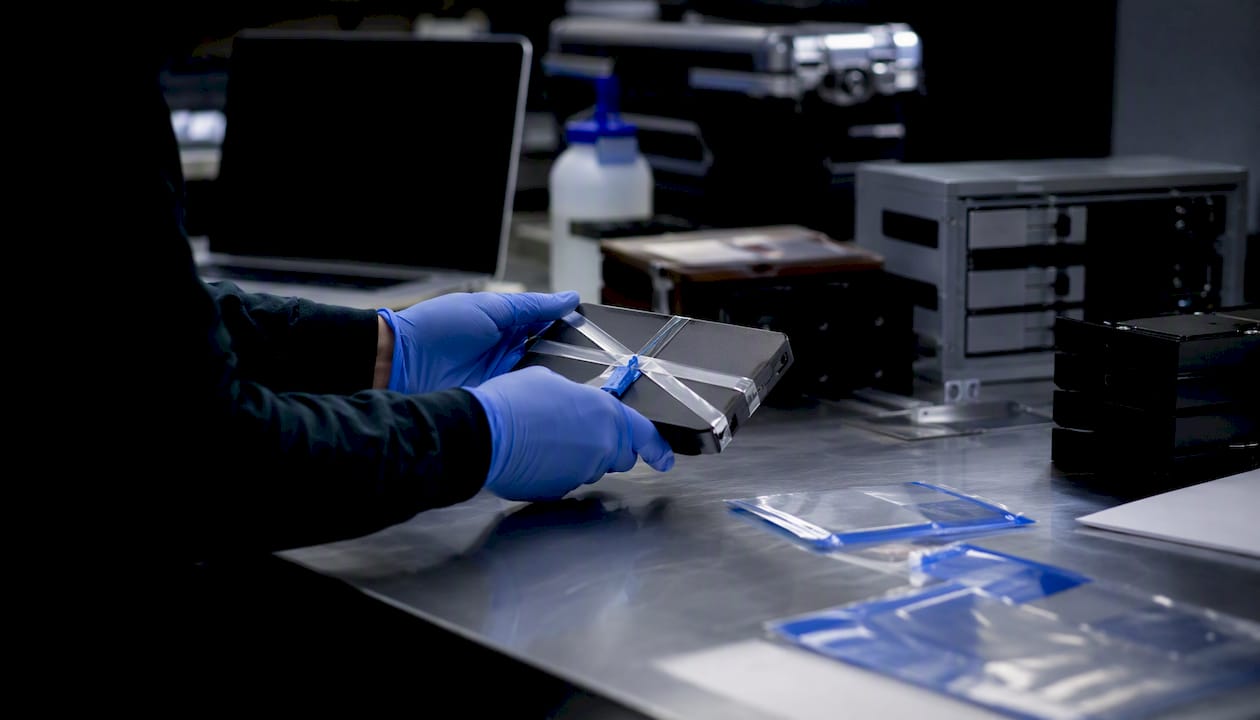
Electronic discovery, commonly abbreviated to e-discovery or ediscovery, is the process of identifying, preserving, collecting, processing, reviewing, and producing electronically stored information (ESI) for use as evidence in legal proceedings or investigations. In plain terms: when a dispute, criminal matter, or regulatory enquiry arises, any relevant data held in digital form must be handled through this structured process before it can be relied upon in court or presented to a regulator.
The typical use-cases span civil litigation between commercial parties, criminal investigations, internal misconduct enquiries, and responses to regulatory requests. In every scenario, the goal is the same: locate the relevant evidence, preserve its integrity, and produce it in a form the receiving party and the court can trust. UK practice is shaped by the Civil Procedure Rules Part 31 on disclosure, the UK GDPR and the Data Protection Act 2018, and recognised international standards such as The Sedona Conference Glossary. Computerforensicslab is a London-based practitioner that handles e-discovery work across civil, criminal, and corporate matters in the UK.
Key takeaways
E-discovery is the structured, legally governed process of identifying, preserving, collecting, processing, reviewing, and producing electronically stored information as evidence, and in the UK its practice is shaped by the Civil Procedure Rules, UK GDPR, and recognised forensic standards.
| Point | Details |
|---|---|
| Core definition | E-discovery covers all ESI, from email and documents to mobile messages, cloud files, and IoT data, handled through six defined stages. |
| UK legal framework | Civil Procedure Rules Part 31 and Practice Direction 31B govern civil disclosure; UK GDPR adds data-protection obligations for personal data within the ESI. |
| Preservation is time-critical | A legal hold notice must be issued as soon as a disclosure obligation arises; delayed holds risk spoliation findings and adverse court inferences. |
| Metadata is evidence | Digital files carry embedded metadata recording authorship, timestamps, and modification history; failure to preserve it can be as damaging as losing the document itself. |
| Computerforensicslab | Provides forensic acquisition, expert witness reports, and chain-of-custody management for e-discovery matters across UK civil, criminal, and corporate proceedings. |
Table of Contents
- What does e-discovery actually cover?
- How does the e-discovery process work, step by step?
- What types of data are typically in scope for e-discovery?
- What are the UK legal obligations governing e-discovery?
- What tools and techniques are used in e-discovery?
- What does e-discovery look like in practice?
- What drives e-discovery timescales and costs?
- How should organisations prepare for an e-discovery request?
- How Computerforensicslab supports e-discovery in the UK
- Computerforensicslab: practical e-discovery support from first instruction
- A practitioner’s view: the mistakes that cost cases
- Primary sources and further reading
- Sources
What does e-discovery actually cover?
E-discovery is broader in scope than traditional paper-based disclosure, and the distinction matters practically. Where paper discovery involved reviewing physical files and photocopying relevant documents, electronic discovery must account for data that exists in multiple locations simultaneously, carries hidden metadata, and can be altered or deleted without leaving an obvious trace.
ESI encompasses any information created, stored, or transmitted in digital form. Common categories include:
- Email and calendar data, including attachments and meeting records
- Office documents such as Word files, spreadsheets, and presentations
- Instant messages and collaboration platform data from tools like Microsoft Teams or Slack
- SMS, MMS, and mobile application data
- Social media posts, direct messages, and account activity
- Cloud storage files held in services such as OneDrive, Google Drive, or Dropbox
- Database records and transaction logs
- IoT device output, including access-control logs and vehicle telematics
The critical difference from paper discovery is metadata. Every digital file carries embedded information recording when it was created, who authored it, when it was last modified, and from which device or account it originated. That metadata is itself evidence, and it does not exist in a paper document. Failure to preserve it can be as damaging to a case as losing the document itself.
A practical illustration: a commercial dispute turns on whether a director knew about a defect before signing a contract. The contract itself is in paper form and says nothing. But an email thread, recovered with full metadata showing the director opened and forwarded a technical report three days before signing, can be decisive. That email thread, its timestamps, its read receipts, and the server logs confirming delivery are all ESI — and all subject to the e-discovery process.
How does the e-discovery process work, step by step?
The standard e-discovery workflow follows six sequential stages. Each stage has defined tasks, responsible parties, and practical checkpoints. Skipping or compressing any stage creates evidential risk.
1. Identification
Legal counsel and the client work together to identify the scope of potentially relevant ESI: which custodians (individuals) hold relevant data, which systems and devices are in scope, and what date ranges apply. IT teams provide a data map of systems, storage locations, and backup schedules. The output is a defined custodian list and a preliminary data inventory.
2. Preservation and legal hold
Once potentially relevant data is identified, a legal hold notice is issued to all custodians, instructing them to suspend normal deletion routines and preserve all relevant data. Defensible preservation requires written notices, acknowledgement records, and preservation logs. Automated deletion policies must be suspended for in-scope data. This stage is time-critical: any data destroyed after the duty to preserve arises can constitute spoliation, which courts treat seriously.
3. Collection
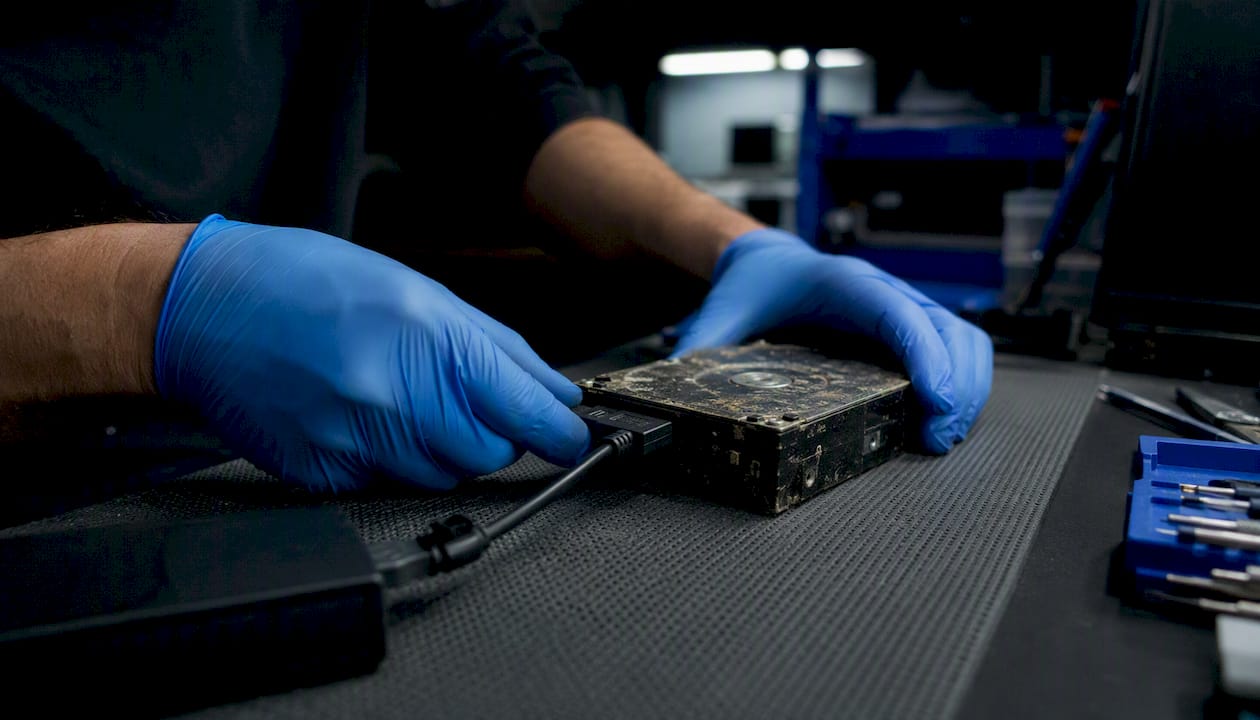
Data is gathered from identified sources using forensically sound methods. For straightforward matters, this may involve a targeted export from an email server. For complex or contentious matters, forensic imaging of devices creates a bit-for-bit copy of the storage media, preserving all data including deleted files and slack space. Chain-of-custody documentation begins here: every item collected is logged with its source, the method used, the date and time of collection, and the identity of the collecting examiner.
4. Processing and culling
Raw collected data is processed to extract text, index content, and apply de-duplication to remove identical copies. Date-range filters, keyword searches, and domain exclusions reduce the volume to a manageable review set. Early data assessment (EDA) at this stage, before full processing, can identify whether the data volume justifies the anticipated review cost and allows parties to agree a proportionate scope.
5. Review
Legal teams review the processed data set to identify documents that are relevant, privileged, or confidential. Technology-assisted review (TAR), also known as predictive coding, uses machine-learning algorithms trained on human reviewer decisions to prioritise and classify large document sets. The Sedona Conference endorses TAR and EDA as standard tools for controlling cost and improving consistency in large-scale review.
6. Production
Reviewed and approved documents are produced to the opposing party or regulator in an agreed format. Native files retain full functionality and metadata; PDF or TIFF conversions are common for production but strip some embedded data. The production set is accompanied by a load file and a privilege log identifying any withheld documents.
Pro Tip: Run an early data assessment before committing to full processing. A targeted sample review of the highest-volume custodians often reveals that a large share of the data is outside the relevant date range or clearly non-responsive, dramatically reducing processing and review costs before the meter starts running.
What types of data are typically in scope for e-discovery?
The range of ESI that may be relevant in any given matter has expanded considerably as working practices have shifted to cloud platforms, mobile devices, and ephemeral messaging applications. Electronic discovery can be performed on single devices or across entire networks, and the scope of collection must reflect where the relevant data actually resides.
Common ESI sources include:
- Corporate email systems (Microsoft Exchange, Google Workspace) and personal webmail accounts where business was conducted
- Office productivity files including spreadsheets with embedded formulae, presentation files, and version-tracked documents
- Collaboration and project management platforms such as Microsoft Teams, Slack, Jira, and Asana
- Mobile device data: SMS, iMessage, WhatsApp, Signal, and other messaging applications
- Social media accounts including LinkedIn, X (formerly Twitter), Facebook, and Instagram
- Cloud storage and file-sharing services such as SharePoint, OneDrive, Google Drive, and Dropbox
- Database records, including CRM systems, financial platforms, and HR systems
- System and application log files recording user activity, access events, and configuration changes
- IoT device data such as building access logs, vehicle GPS records, and smart device activity
Metadata deserves particular attention. A document’s metadata records its creation date, authorship, modification history, and the device on which it was created. In litigation, metadata can confirm or contradict a party’s account of events with a precision that no paper document can match.
Encrypted messaging is a growing practical issue. Where a custodian uses Signal or a similarly encrypted platform for work communications, collection requires physical or logical acquisition of the device itself, with appropriate legal authority. The absence of server-side retention means that delayed collection often means permanent data loss.
What are the UK legal obligations governing e-discovery?
In England and Wales, civil disclosure obligations are governed by Civil Procedure Rules Part 31, which sets out the duty to disclose documents, the standard of disclosure, and the court’s case management powers. Practice Direction 31B supplements Part 31 with specific procedural requirements for the disclosure of ESI, including expectations about the format of production and the specification of agreed search parameters.
The rules impose a duty of standard disclosure: each party must disclose documents on which it relies, documents that adversely affect its own case, and documents that support another party’s case. For ESI-heavy matters, the court expects parties to agree a disclosure protocol covering search terms, custodians, date ranges, and the format of production before the process begins. Proportionality is a governing principle: the cost and burden of disclosure must be proportionate to the value and complexity of the claim.
UK GDPR and the Data Protection Act 2018 add a further layer of obligation. Personal data within the ESI must be handled lawfully, and cross-border transfers of personal data to jurisdictions outside the UK require an appropriate transfer mechanism. Redaction of irrelevant personal data before production is standard practice and is expected by courts and regulators alike. The interaction between disclosure obligations and data-protection rights requires careful management, particularly in matters involving employee data or consumer records.
Criminal e-discovery in the UK operates under a different framework. The prosecution’s disclosure obligations are governed by the Criminal Procedure and Investigations Act 1996 (CPIA), which requires disclosure of unused material that might reasonably assist the defence. The volume of digital evidence in serious criminal cases, particularly those involving cybercrime or financial fraud, has made forensically sound collection and structured review processes as important in criminal proceedings as in civil litigation.
What tools and techniques are used in e-discovery?
E-discovery relies on a combination of forensic techniques and specialist software platforms. The choice of tool depends on the nature of the data, the complexity of the matter, and whether the collection is contested or potentially subject to challenge.
Core technique categories include:
- Forensic imaging: creating a verified, bit-for-bit copy of a storage device using tools such as FTK Imager or Cellebrite, preserving all data including deleted files and unallocated space
- Hashing and verification: generating cryptographic hash values (MD5, SHA-256) for collected data to confirm that no alteration has occurred between collection and production
- Indexing and full-text search: processing collected data to create a searchable index, enabling keyword and concept searches across large data sets
- De-duplication: identifying and removing exact or near-duplicate documents to reduce review volume
- Technology-assisted review (TAR): machine-learning-assisted classification of documents by relevance, privilege, or issue, trained on a seed set of human-reviewed documents
- Email threading: grouping email chains to present conversations in context and eliminate redundant review of earlier messages already captured in a later reply
- Metadata extraction and analysis: surfacing hidden file properties including creation dates, authorship, geolocation data, and revision history
- Data visualisation: timeline tools and communication-mapping software that reveal patterns of activity and relationships between custodians
Native file formats are generally preferred for initial review because they retain embedded objects, formulae, and version history that conversion to PDF or TIFF would destroy. Production in native format is increasingly common where the receiving party needs to interrogate the data rather than simply read it. Understanding forensic data analysis techniques is particularly relevant when the matter involves complex structured data or suspected data manipulation.
Pro Tip: When a matter involves suspected data tampering, encrypted media, or damaged storage devices, a general-purpose e-discovery platform is insufficient. Specialist forensic acquisition tools and an examiner with the technical expertise to interpret the results are needed — and the examiner’s methodology must be documented in sufficient detail to withstand cross-examination.
Specialist forensic involvement becomes necessary when dealing with digital asset enforcement actions or complex technical environments where standard processing tools cannot reliably acquire or interpret the data.
What does e-discovery look like in practice?
Commercial dispute: email and collaboration platform data
A technology company faces a breach-of-contract claim from a former client. The client alleges the company knew of a software defect before delivery. Legal counsel issues a legal hold to six custodians covering email, Teams messages, and SharePoint files for an 18-month period. Forensic collection from the corporate email server and a SharePoint export produces approximately 180,000 documents. After processing and de-duplication, the review set reduces to 42,000 items. TAR is applied, and the relevant set is identified at around 3,800 documents. Within that set, an internal Teams conversation thread shows two engineers discussing the defect six weeks before delivery, with a manager marked in the thread. That thread, with its metadata confirming the participants, timestamps, and read status, becomes the central exhibit.
Internal investigation: employee misconduct involving mobile data and cloud files
A financial services firm suspects a senior employee of copying client data to a personal cloud account before resigning. The firm instructs a forensic specialist to acquire the employee’s corporate laptop and mobile phone. Logical acquisition of the mobile device recovers deleted WhatsApp messages discussing the data transfer. A forensic examination of the laptop’s browser history and cloud sync logs confirms uploads to a personal Dropbox account on three dates. The role of forensics in employee misconduct cases of this type is to produce a documented, court-ready evidence set that can support both civil proceedings and a referral to the FCA.
Common pitfalls in both scenarios include:
- Delayed legal hold, allowing routine deletion to destroy relevant data before preservation notices are issued
- Failure to preserve metadata by exporting documents in a format that strips timestamps and authorship records
- Overly broad collection that captures entire server shares rather than targeted custodian data, inflating processing and review costs without improving the evidence set
- Relying on self-collection by custodians, which lacks the forensic rigour needed to defend the process if challenged
What drives e-discovery timescales and costs?
E-discovery costs are driven primarily by data volume, the number of custodians, and the complexity of the systems involved. A targeted, single-custodian matter involving one email account and a laptop can be scoped, collected, processed, and reviewed within days. A multi-party commercial dispute involving 20 custodians, multiple cloud platforms, and a legacy database may take several months from legal hold to production.
Key cost drivers include:
- Data volume: processing and hosting costs scale directly with gigabytes processed and stored
- Number of custodians: each additional custodian adds collection, processing, and review time
- System complexity: legacy systems, encrypted storage, and non-standard file formats require specialist handling
- TAR and privilege review: machine-learning review reduces per-document cost but requires setup and quality-control steps
- Cross-border data transfers: data held in overseas jurisdictions may require transfer agreements and additional legal review
- Iterative search refinement: poorly scoped initial searches that require multiple rounds of re-processing add cost at every stage
For straightforward matters, early data assessment before full processing is the single most effective cost-control measure. Agreeing search terms and custodian scope with the opposing party before collection begins avoids the expense of processing data that will never be reviewed. Fixed-fee arrangements for defined collection and processing tasks are available from specialist providers and give clients cost certainty at the outset. Enterprise digital asset legal risks and complex multi-jurisdictional matters tend to sit at the higher end of the cost and complexity spectrum, requiring careful scoping and phased collection strategies.
How should organisations prepare for an e-discovery request?
Preparation before a matter arises is significantly more effective than reactive scrambling once litigation is threatened. A practical readiness checklist covers the following steps:
- Trigger assessment: identify whether a litigation hold obligation has arisen, based on receipt of a claim, a regulatory notice, or a reasonable anticipation of proceedings
- Issue legal hold notices: send written notices to all identified custodians immediately, with clear instructions to preserve all potentially relevant data and suspend deletion routines
- Preserve system logs and backups: instruct IT to retain backup tapes and system logs that would otherwise be overwritten on a scheduled cycle
- Appoint custodian contacts: designate a point of contact for each custodian to confirm receipt of the hold notice and answer questions about data locations
- Scope data sources: map all relevant systems, devices, and cloud accounts for each custodian, including personal devices used for work purposes
- Run early data assessment: sample the highest-volume data sources to estimate total volume and identify obvious non-responsive material before committing to full collection
- Use defensible collection methods: engage a forensic specialist for device acquisition; avoid self-collection by custodians for any data that may be contested
- Document chain of custody: maintain a contemporaneous log of every collection action, including the examiner’s identity, the method used, the hash values of collected data, and the date and time of each step
Escalate to legal counsel as soon as a hold obligation arises. Engage a forensic specialist when the matter involves mobile devices, encrypted data, suspected deletion or tampering, or any situation where the collection method itself may be challenged. Proper evidence collection procedures are the foundation of a defensible process.
Pro Tip: Keep a contemporaneous log of every decision made during the e-discovery process: why a particular custodian was included or excluded, why a search term was chosen, and why a document was withheld on privilege grounds. Courts do not expect perfection, but they do expect a documented, reasonable process. A well-maintained decision log is the most effective defence against a spoliation allegation.
How Computerforensicslab supports e-discovery in the UK
Computerforensicslab is a London-based digital forensics practice providing e-discovery support across civil litigation, criminal proceedings, and corporate investigations in the UK. The lab’s services are designed to meet the evidential and procedural standards required by UK courts and regulators.
Core service capabilities include:
- Forensic device acquisition: bit-for-bit imaging of computers, servers, mobile phones, and removable media using forensically validated tools, with hash verification at every stage
- Mobile phone data recovery: extraction and analysis of SMS, messaging application data, deleted content, and application artefacts from iOS and Android devices
- Cloud and remote data collection: targeted acquisition from cloud platforms including Microsoft 365, Google Workspace, and third-party storage services
- Data recovery from damaged or deleted media: recovery of overwritten, deleted, or corrupted files using specialist techniques, relevant where evidence has been deliberately or accidentally destroyed
- Processing, indexing, and review support: preparation of data sets for legal review, including de-duplication, metadata extraction, and keyword search
- Expert witness reports: preparation of court-ready forensic reports setting out methodology, findings, and conclusions in a form suitable for use in proceedings, with the examiner available to give evidence if required
- Chain-of-custody management: documented, auditable records of every step in the collection and handling process, from initial acquisition through to production
The lab aligns its processes with UK legal requirements, including the data-protection obligations of the UK GDPR and the chain-of-custody standards expected in criminal proceedings. Privacy safeguards are built into the collection and review workflow: personal data outside the scope of the matter is identified and excluded, and cross-border data transfers are handled in accordance with applicable transfer mechanisms. The value of professional forensic involvement in civil and criminal litigation is most apparent when the integrity of the collection process is later scrutinised by the opposing party or the court.
Computerforensicslab: practical e-discovery support from first instruction
When a disclosure obligation arises or a digital investigation is needed, the difference between a defensible evidence set and a compromised one often comes down to how quickly a forensic specialist is engaged and how rigorously the collection process is documented.
Computerforensicslab offers digital forensic investigation services covering the full e-discovery workflow, from initial legal hold advice and scoping through to forensic acquisition, processing, and the preparation of expert witness reports. The lab works directly with solicitors, in-house legal teams, law enforcement, and private clients across the UK.
To instruct the lab, have the following information ready: the nature of the matter (civil claim, criminal investigation, internal enquiry, or regulatory response), the identity of the relevant custodians, the date range of potentially relevant activity, and the devices or systems believed to hold relevant data. The lab will provide an initial assessment of scope, a recommended collection methodology, a chain-of-custody plan, and a cost estimate before any work begins. Contact Computerforensicslab to discuss your matter and receive a scoped engagement proposal.
A practitioner’s view: the mistakes that cost cases
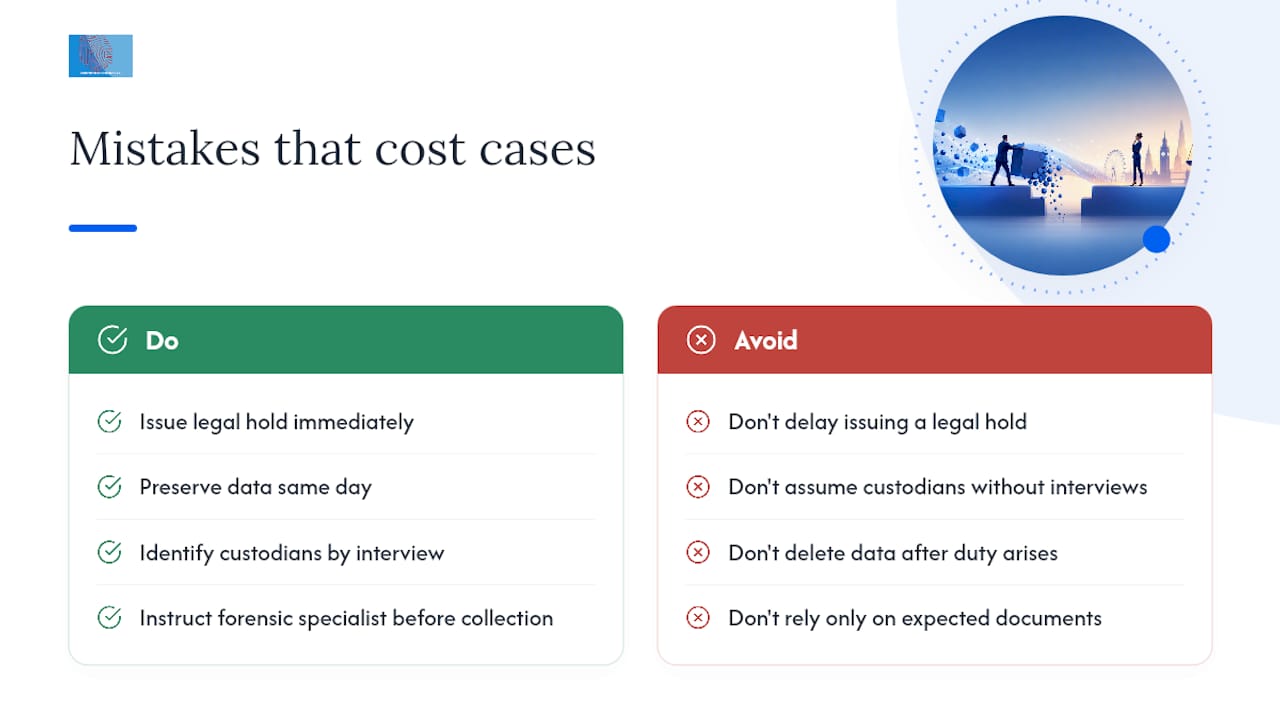
The pattern of errors seen in e-discovery matters is remarkably consistent, regardless of the size or complexity of the case. The most common is the late legal hold. A party receives a letter before action, discusses it internally for two weeks, and only then instructs solicitors. By that point, automated deletion has run twice, a custodian has left the business and had their account wiped, and a laptop has been reallocated. The data that would have been preserved with a same-day hold notice is gone.
The second recurring error is an incomplete custodian list. Parties focus on the obvious individuals and miss the peripheral ones: the PA who managed the relevant calendar, the IT administrator who configured the disputed system, the external consultant whose emails were copied to a personal account. Thorough custodian identification at the outset, based on a structured interview process rather than assumptions, consistently surfaces data that changes the shape of a matter.
Ad-hoc deletion after a hold obligation arises is the most serious error. Whether deliberate or inadvertent, destruction of potentially relevant data after the duty to preserve has arisen is spoliation. UK courts have the power to draw adverse inferences, strike out claims or defences, and award costs sanctions. The risk is not theoretical: spoliation findings have determined the outcome of commercial disputes where the underlying merits were otherwise finely balanced.
When the lab triages a new matter, the evidence that most frequently proves decisive is not the document the client expected. It is the metadata showing a file was modified after the date the client claims it was finalised, the deleted message recovered from unallocated space on a mobile device, or the cloud sync log confirming a file was uploaded to a personal account at 11pm on the day before resignation. The digital record is rarely as clean as the parties assume, and that cuts both ways.
Act promptly. Issue the hold notice before the first solicitor’s meeting. Instruct a forensic specialist before any collection takes place. The cost of getting the process right at the outset is a fraction of the cost of remedying a spoliation allegation or reconstructing a data set that should never have been deleted.

Primary sources and further reading
The following authoritative sources provide the primary rules, standards, and guidance referenced throughout this guide:
- Civil Procedure Rules Part 31 — Disclosure and Inspection of Documents: the primary UK statutory framework governing disclosure obligations in civil proceedings, including the standard of disclosure and the court’s case management powers.
- Practice Direction 31B — Disclosure of Electronic Documents: supplements Part 31 with procedural requirements specific to ESI, including format of production and agreed search specifications.
- The Sedona Conference Glossary: eDiscovery and Digital Information Management, Sixth Edition: the internationally recognised reference for e-discovery terminology and best-practice standards, widely used by legal and technical teams.
- Managing Discovery of Electronic Information: A Pocket Guide for Judges: judicial guidance on active case management for ESI-heavy matters, covering scope, cost allocation, and form of production.
- Electronic discovery — Wikipedia: a comprehensive overview of the standard e-discovery stages, ESI types, and key concepts including metadata and spoliation.
- Electronic discovery definition — TechTarget: a concise technical definition covering collection scope, data types, and network versus device-level collection.
- What is eDiscovery? — OpenText: an overview of e-discovery tool categories and use-cases beyond litigation, including data-breach response and regulatory matters.
- What is electronic discovery? — Computerforensicslab: the lab’s own practitioner guide covering UK-specific e-discovery services, evidence collection, and expert witness support.
Sources
- Electronic discovery
- The Sedona Conference Glossary: eDiscovery and Digital Information Management, Sixth Edition
- What is eDiscovery? | OpenText
- Electronic discovery
- Justice
- Justice
- Managing Discovery of Electronic Information: A Pocket Guide for Judges