Start with three files: the NIST scientific foundation review (IR.8354), the INTERPOL first-responder guidelines, and the ENFSI best practice manual. For a fast, credible overview, open NIST IR.8354 first. If you need procedural grounding for legal or first-response work, go to INTERPOL. For hands-on DFIR practice, pair either one with the SANS DFIR field manual. Details and verification checks follow below.
TL;DR:
- INTERPOL’s guidelines focus on initial evidence seizure and require legal checks based on jurisdictional rules.
- Most authoritative PDFs follow a six-phase structure: identification, preservation, collection, analysis, review, and reporting.
- Verifying a PDF’s authority involves checking its source, publication date, authorship, and its relevance to current tools and standards.
- PDF guides cannot replace professional forensic services when complex mobile, cloud, or legally sensitive cases require court-admissible evidence handling.
Table of Contents
- Which cyber forensic PDFs are worth downloading?
- What will a good digital forensics PDF actually teach you?
- How do you verify a PDF is authoritative before you rely on it?
- When PDFs stop being enough
- Why most people underestimate what a PDF can’t teach
- Take the next step with professional forensic support
- Sources
- FAQ
Which cyber forensic PDFs are worth downloading?
Not every PDF calling itself a “digital forensics guide” deserves shelf space. The five resources below cover distinct territory, from scientific validation to courtroom procedure to hands-on lab work, and knowing which is which saves hours of misdirected reading.
- NIST IR.8354 functions as a scientific foundation review rather than a how-to manual. It examines whether digital investigation techniques hold up against established computer science principles, which makes it the strongest reference when you need to justify a method’s reliability to a court or a sceptical colleague.
- INTERPOL’s Guidelines for Digital Forensics First Responders targets the earliest moments of an investigation, covering search, seizure, and initial handling of digital evidence. INTERPOL is explicit that its guidance requires checking against domestic legal procedures before anyone acts on it, since seizure powers and admissibility rules differ sharply between jurisdictions.
- The ENFSI Best Practice Manual operates at laboratory level. Rather than dictating rigid step-by-step scripts, it sets out a framework built on methodological validation, leaving labs room to adapt procedures while staying accountable to a consistent standard. Read this once you understand the basics and want to see how an accredited lab actually structures its work.
- SANS DFIR resources, including its field manual and starter guide, sit closer to a training syllabus than a policy document. SANS Institute recommends specific foundational courses and free tools for people entering the field, which makes its PDFs the right pick when you want a practical route into the discipline rather than a theoretical one.
- University lecture notes and course PDFs fill a different gap entirely: they condense a semester’s worth of material into digestible chapters, often with worked examples. They lack the institutional weight of NIST or INTERPOL, but they are frequently the clearest starting point for a newcomer who finds official documents dense.
Match the resource to the task. A defence solicitor preparing cross-examination questions needs NIST’s methodological rigour. A junior analyst building a first incident-response checklist needs SANS. A police officer arriving at a scene needs INTERPOL, filtered through their own force’s legal guidance.
What will a good digital forensics PDF actually teach you?
Every credible guide, regardless of publisher, builds around the same technical spine. Understanding that spine before you start reading means you can skim for what you need rather than working cover to cover.
- Identification — recognising which devices, accounts, or data sources are relevant before anything is touched.
- Preservation — locking down evidence so it cannot change, often the step where investigations are won or lost.
- Collection — the physical or logical acquisition of data using forensically sound methods.
- Analysis — interpreting what was collected, correlating artefacts, and reconstructing events.
- Review — a second pass, often by a peer, checking conclusions against the evidence.
- Reporting — documenting findings in a form that stands up to scrutiny, including in court.
NIST frames these as the six primary phases underpinning defensible digital investigation. Nearly every authoritative PDF you download will map onto this structure even when it uses slightly different labels.
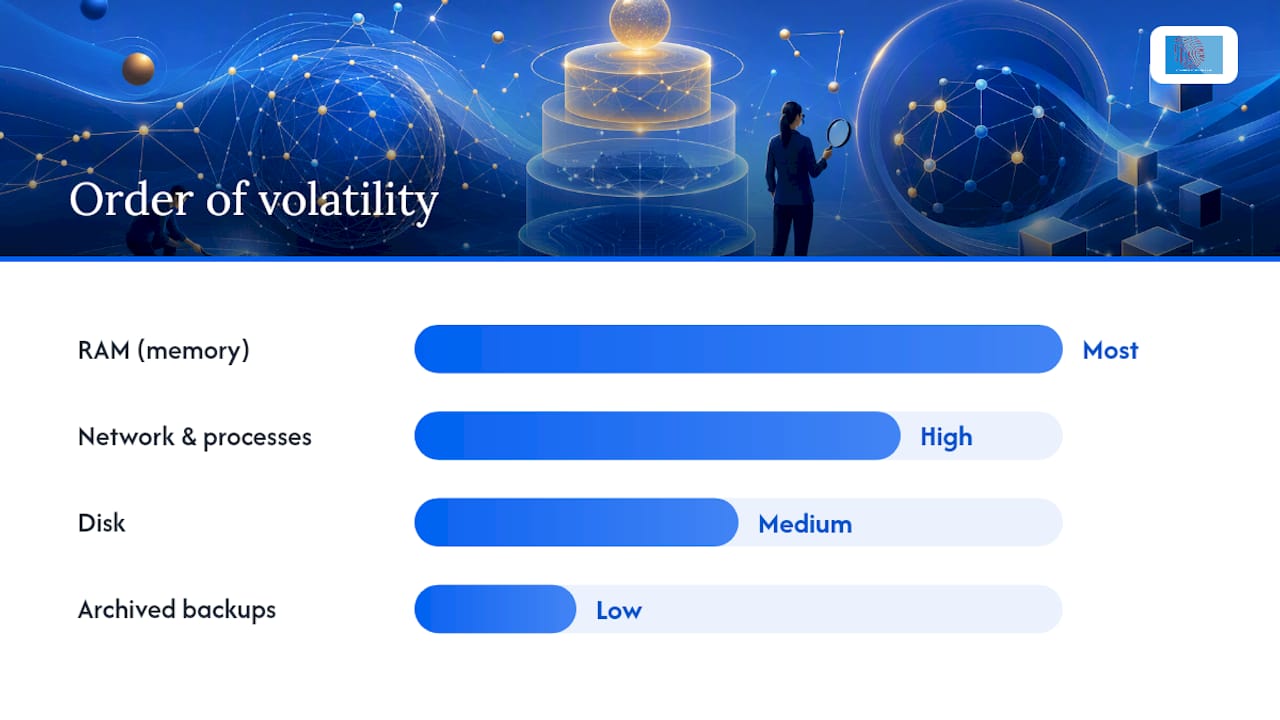
Within collection, order of volatility governs everything. RAM contents vanish the moment a machine powers down, so investigators collect the most volatile evidence first, typically memory, then network connections and running processes, then disk, with archived backups last. Skip this order and you can lose evidence that no later technique will recover.

Forensic imaging is the other pillar worth mastering early. A proper image is a bit-for-bit copy, not a file copy, usually saved in formats such as E01 or RAW, and verified with a cryptographic hash so anyone can confirm the image matches the original device exactly. Without that hash, an opposing expert can question whether the evidence was altered.
Memory and disk analysis diverge sharply in what they reveal. Memory captures what a system was doing at a single moment. Disk holds a longer historical record but can miss processes that never touched the drive. Mobile devices add encryption, app sandboxing, and cloud sync into the mix, and cloud data introduces jurisdictional headaches, since providers often require a subpoena or legal request before releasing account data, and that request has to target the correct legal entity in the correct country.
Pro Tip: Keep a running note of every tool version you use during study or practice. Artefact behaviour and even file formats can shift between software releases, so a technique that worked in one version may not reproduce cleanly in another.
Reproducibility is not a footnote. NIST’s review treats it as central to whether a technique counts as scientifically sound in the first place, which is precisely the standard a court will expect an expert to meet.
How do you verify a PDF is authoritative before you rely on it?
Treat every downloadable guide the way you would treat a witness statement: check where it came from before you trust what it says.
- Check the domain and issuing body. A
.gov,.int, or recognised university domain carries more weight than a marketing blog hosting a rebadged PDF. - Note the publication date and version number. Forensic techniques and tool behaviour move quickly; a guide from several years ago may reference software that no longer exists.
- Confirm authorship and credentials. Guides published by named institutions such as NIST, INTERPOL, or ENFSI carry institutional accountability that anonymous PDFs cannot match.
- Record download provenance. Save the original URL, note the download date, and where possible compute a checksum of the file itself, mirroring the same hash-and-log discipline that underpins defensible evidence handling.
- Use PDFs for study and orientation, not as a substitute for professional procedure. A guide can teach you what chain of custody means; it cannot preserve phone evidence on your behalf in a live case.
For efficient study, build a one-page checklist per chapter, extract any named procedures verbatim, and track every tool version the author mentions so you can spot when guidance has aged.
When PDFs stop being enough
A downloadable guide teaches method. It cannot appear in court, handle an encrypted device, or defend a chain of custody under cross-examination. Computerforensicslab exists for the point where reading ends and casework begins.
Some scenarios push past self-study by definition: an active breach still unfolding, pending litigation requiring expert witness testimony, or a locked device that no manual will unlock for you.
- Court-admissible reporting that stands up to challenge, not a summary written for personal notes.
- Chain-of-custody handling that satisfies evidentiary rules rather than good intentions.
- Expert witness testimony explaining findings to a judge or jury in plain terms.
- Complex mobile and cloud acquisitions involving encryption, sync data, or provider legal requests.
If your situation matches any of those, the PDF has done its job by teaching you what to expect next.
Why most people underestimate what a PDF can’t teach
Forensics, cybersecurity, and data recovery get treated as interchangeable online, and that confusion causes real problems. Cybersecurity stops an attack; forensics reconstructs what happened afterwards, methodically enough to survive scrutiny; data recovery just wants the file back, with no concern for evidentiary integrity.
No PDF replicates the muscle memory of imaging a live drive under pressure, and no reading list substitutes for accredited lab hours. Treat the guides as the theory exam, not the practical one, and version every procedure you write down. Tools change. Your notes should say which version you tested against.
— Computer
Take the next step with professional forensic support
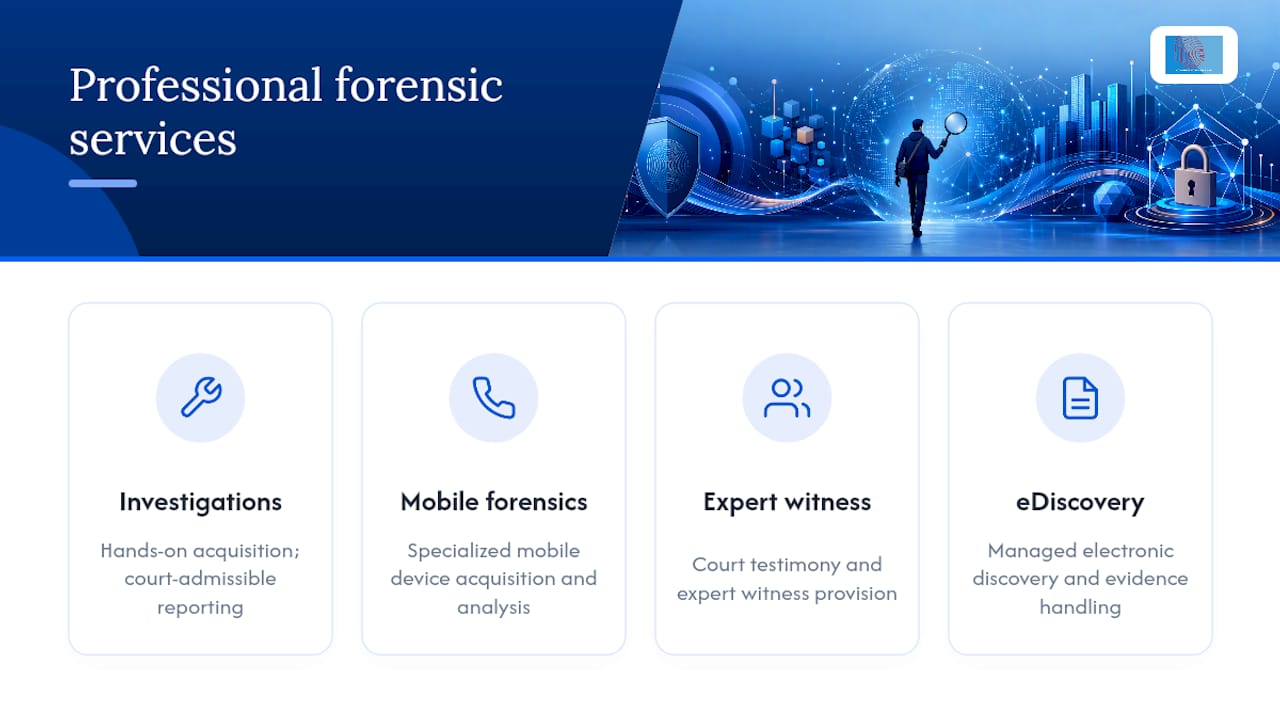
Reading NIST IR.8354 or the SANS field manual will take you a long way, but self-study has a ceiling. Professional digital forensic service providers offer court-admissible reporting, chain-of-custody discipline, and hands-on acquisition work that no downloadable guide can perform on your behalf. Such services often include digital forensics investigations, mobile phone forensics, expert witness provision, and electronic discovery, all handled by experienced practitioners rather than software alone. If you are facing an active incident, a legal deadline, or a device that needs proper acquisition rather than a guess, get in touch about your case and find out what a properly instructed investigation actually involves.
This article is general information, not a substitute for advice from a qualified lawyer. Consult a qualified legal professional about your own circumstances before acting on anything here.
Sources
- Digital Investigation Techniques: A NIST Scientific Foundation Review
- Guidelines for Digital Forensics First Responders
- Best Practice Manual for the Forensic Examination of Digital Technology
- How to Get Started in Digital Forensics & Incident Response (DFIR) | SANS Institute
FAQ
What Is the Best Cyber Forensic PDF for Beginners?
University lecture notes or the SANS DFIR starter guide work best for beginners, since both condense core concepts without assuming prior lab experience. Once the basics are familiar, move to NIST IR.8354 for the methodological depth needed at a professional level.
Are Free Digital Forensics PDFs Reliable for Legal Cases?
Free PDFs from institutions such as NIST, INTERPOL, or ENFSI are reliable for understanding method and terminology, but they cannot themselves serve as case evidence or replace instructed expert work. Legal reliance requires a properly documented, chain-of-custody process carried out by a qualified practitioner.
How Do I Check if a Forensic PDF Is Outdated?
Look at the publication date, version number, and whether it references current tools or file formats. If a guide describes software or hash standards that have since changed, treat its procedural detail as historical rather than current practice.
Does Computerforensicslab Offer Training Alongside Its Services?
Computerforensicslab’s core offering is investigative and consultancy work, including digital forensics investigations, mobile phone forensics, and expert witness reporting rather than standalone courses. Current service details are available directly on the site for anyone wanting a specific quote or scope.
What’s the Difference Between DFIR and Traditional Forensics PDFs?
DFIR guides blend investigation with active incident response, aimed at stopping and understanding an attack in real time, while traditional forensics PDFs focus on retrospective, evidentially sound reconstruction. The two overlap heavily, and Palo Alto Networks notes that DFIR increasingly merges both disciplines in modern practice.