

TL;DR:
- A data breach investigation is a forensic process that determines how unauthorized access occurred and what was compromised. It emphasizes identifying the breach’s scope through evidence collection, data lineage, and timeline reconstruction to inform regulatory reporting and prevent recurrence. External experts usually conduct investigations to ensure objectivity, accuracy, and regulatory credibility.
A data breach investigation is the formal forensic process of determining how unauthorised access to sensitive data occurred, what was compromised, and the full scope of impact on an organisation or individual. Known in the industry as a post-breach forensic investigation, this process sits at the intersection of digital forensics, regulatory compliance, and incident response. It is distinct from remediation. Fixing a vulnerability is not the same as understanding how it was exploited. Organisations that conflate the two risk missing critical evidence, failing regulatory obligations, and leaving the door open to repeat attacks.
What is data breach investigation and what does it involve?
A data breach investigation is a structured, evidence-led examination of a security incident. Its goal is to establish the facts: who gained access, when, how they moved through systems, and what data they touched or removed. Professional investigation prioritises evidentiary integrity and objective truth, which is why it frequently requires third-party expert involvement rather than relying solely on internal IT teams.

The distinction between investigation and remediation matters enormously in practice. Remediation patches the wound. Investigation answers why the wound happened, who inflicted it, and what they took. Without a thorough forensic investigation, organisations cannot accurately report to regulators, cannot defend themselves in litigation, and cannot build a credible prevention plan.
Modern breach investigations also focus on data lineage. Effective investigations now prioritise mapping exactly what sensitive content was touched, moved, or exfiltrated, not just which server was compromised. This shift reflects how attackers operate today: quietly, laterally, and with a focus on data exfiltration before detection.
What steps are involved in a data breach investigation?
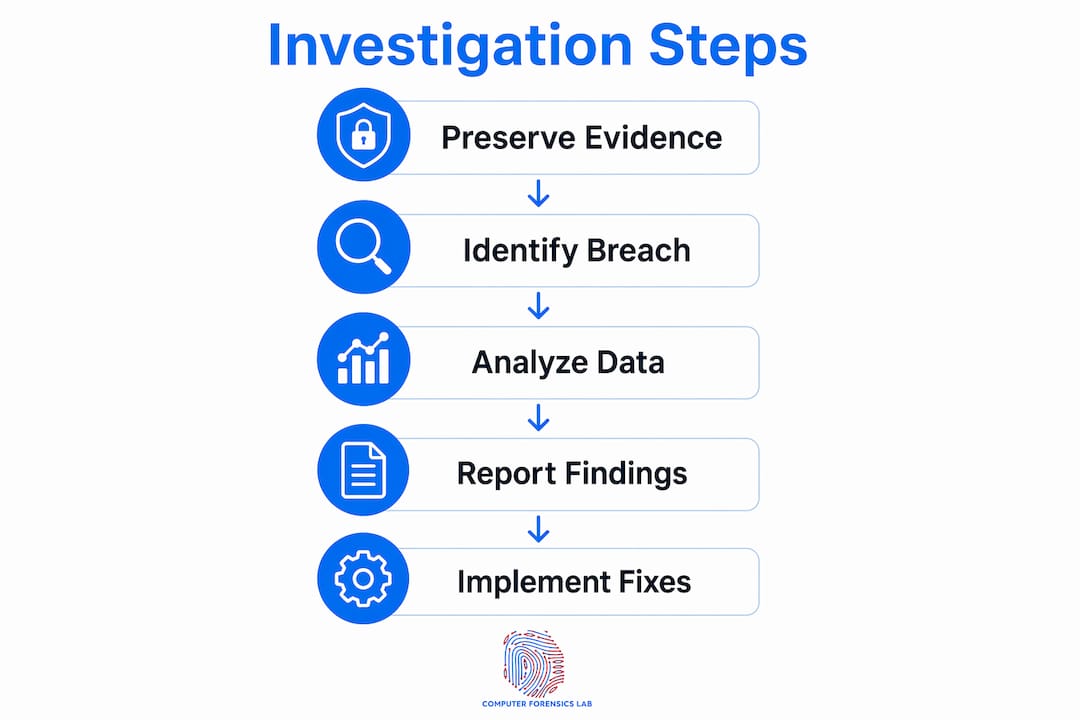
The data breach response process follows a defined sequence. Skipping steps or reordering them can destroy evidence and undermine any subsequent legal or regulatory action.
- Immediate containment. Isolate affected systems to stop further damage. This does not mean wiping or rebuilding machines. Containment preserves the environment for forensic examination.
- Evidence preservation. Create forensic images of affected drives and capture volatile data such as RAM contents, active network connections, and running processes. This step must happen before any remediation work begins.
- Forensic analysis. Examine logs, file system artefacts, network traffic records, and endpoint telemetry. Forensic investigation identifies not just what the attacker did, but every backdoor, rogue account, and modified configuration file they left behind.
- Timeline reconstruction. Build a chronological account of attacker activity. The average dwell time for an attacker in a network is measured in months, which means investigators must reconstruct activity over extended periods using log data, access records, and system artefacts.
- Data exposure assessment. Identify precisely which records, files, or databases were accessed or exfiltrated. This finding directly informs regulatory notification decisions.
- Documentation. Record every finding, method, and chain of custody step. Regulators and courts require this level of detail. Sloppy documentation can invalidate otherwise solid forensic work.
- Reporting. Produce a clear, factual report covering the breach timeline, data exposure, attacker methods, and recommended remediation steps.
Pro Tip: Never allow IT staff to begin patching or rebuilding systems before a forensic image has been taken. Remediation destroys evidence. The forensic image is your insurance policy for every regulatory and legal conversation that follows.
The legal and forensic steps involved in a UK breach investigation carry specific procedural requirements that differ from general incident response frameworks.

Why does a data-centric approach matter in breach analysis?
Traditional breach investigations focused on the attacker’s entry point: which vulnerability was exploited, which credential was stolen. That approach is no longer sufficient. Modern investigations shift focus from attacker methods to the data itself, prioritising the tracking of sensitive content through environments for effective containment.
A data-centric investigation asks different questions. Not just “how did they get in?” but “what did they read, copy, or destroy?” This distinction has direct consequences for regulatory reporting, litigation, and the actual harm suffered by individuals whose data was exposed.
The practical benefits of data-centric breach analysis include:
- Accurate scope definition. Knowing exactly which records were accessed prevents both under-reporting and over-reporting to regulators.
- Faster containment decisions. When investigators can track data movement in near real time, they can prioritise which systems to isolate first.
- Stronger legal evidence. Data lineage records provide a clear chain of custody for what was taken and when, which is far more compelling in court than a general statement about a compromised server.
- Regulatory precision. Under GDPR and similar frameworks, organisations must report on specific categories of personal data. Data-centric analysis produces exactly that level of detail.
“Effective investigations now prioritise data lineage — mapping exactly what sensitive content was touched, moved, or exfiltrated.” — Concentric AI, 2026
The data analysis best practices used in forensic investigations reflect this shift, combining file access logs, data loss prevention telemetry, and cloud audit trails to build a complete picture of data movement.
How do legal and regulatory requirements shape breach investigations?
Regulatory frameworks define the urgency and scope of every breach investigation. Under GDPR, organisations must notify the relevant supervisory authority within 72 hours of becoming aware of a breach involving personal data. That clock starts the moment awareness is established, not when the investigation concludes.
This creates a direct tension. Thorough forensic investigation takes time. Regulatory notification deadlines do not wait. Organisations must therefore run initial triage and evidence preservation in parallel with early regulatory assessment, rather than treating them as sequential tasks.
| Requirement | Detail |
|---|---|
| GDPR notification deadline | 72 hours from awareness of a personal data breach |
| Notification trigger | Confirmed or likely access to personal data |
| Scope of report | Nature of breach, categories of data, estimated individuals affected |
| Consequences of late notification | Regulatory fines, reputational damage, loss of regulatory goodwill |
| Role of forensic evidence | Confirms whether notification is required and supports the accuracy of the report |
Notification decisions should be based on assessing the potential for serious harm to affected individuals, not on a blanket policy of over-notification. Over-notification causes unnecessary anxiety and desensitises individuals to future alerts. Under-notification exposes organisations to regulatory sanction. Precise forensic evidence is the only reliable basis for making that call correctly.
Internal teams often lack objectivity, so third-party experts are standard in high-stakes breaches to satisfy regulators and stakeholders. An external forensic investigator carries no institutional interest in minimising the breach’s apparent severity, which makes their findings far more credible to the Information Commissioner’s Office or equivalent regulators.
Pro Tip: Engage a qualified third-party forensic investigator before you notify regulators. Their preliminary findings give you a factual basis for the notification and reduce the risk of having to issue corrections later, which regulators view very unfavourably.
The UK-specific obligations around reporting a data breach carry their own procedural requirements that go beyond the baseline GDPR framework.
What causes data breaches and how do investigations prevent recurrence?
Understanding what causes data breaches is central to the importance of data breach investigations. Common causes include compromised credentials, infected devices, unpatched vulnerabilities, and supply chain weaknesses. Each cause leaves a different forensic signature, and identifying that signature is what allows organisations to close the specific gap rather than applying generic security improvements.
The threat picture in 2026 is more complex than it was five years ago. Attackers now use AI-driven social engineering, including deepfake audio and video, to bypass human verification controls. Phishing campaigns are more targeted and convincing than ever. Supply chain attacks, where a trusted third-party vendor is compromised and used as a stepping stone into the target organisation, have become a standard attack vector.
A thorough breach investigation addresses each of these causes directly:
- Phishing and social engineering. Log analysis reveals which account was first compromised, when, and what the attacker did with it. This identifies training gaps and authentication weaknesses.
- Unpatched vulnerabilities. Forensic examination of the attack path shows exactly which unpatched system was exploited, giving the remediation team a precise target.
- Insider threats. Access logs and user behaviour analytics reveal whether the breach originated from within the organisation, which has significant legal and HR implications.
- Supply chain weaknesses. Network traffic analysis can identify whether a third-party connection was the entry point, prompting a review of vendor access controls.
A strong post-breach investigation gives the organisation a structured way to understand what happened, restore operations, and reinforce defences. Without that structured understanding, remediation is guesswork. The lessons-learned review that follows a rigorous investigation is one of the most effective tools an organisation has for improving its cybersecurity best practices over time.
Key takeaways
A data breach investigation is the only reliable method for establishing the true scope of a breach, satisfying regulatory obligations, and preventing recurrence through evidence-based remediation.
| Point | Details |
|---|---|
| Investigation precedes remediation | Preserve forensic evidence before patching systems to avoid destroying critical proof. |
| Data lineage is central | Track what data was touched or exfiltrated, not just how attackers entered the network. |
| GDPR sets a 72-hour clock | Organisations must notify regulators within 72 hours of awareness, making early triage critical. |
| Third-party experts add credibility | External investigators satisfy regulators and stakeholders in ways internal teams cannot. |
| Root cause analysis prevents recurrence | Identifying the specific cause, whether phishing, unpatched software, or insider action, enables targeted defence improvements. |
The uncomfortable truth about breach investigations in 2026
Most organisations treat a data breach as an IT problem. They call their internal security team, patch the vulnerability, reset the passwords, and consider the matter closed. That approach is not just inadequate. It is actively dangerous.
The cases I find most instructive are the ones where an organisation believed it had contained a breach, only to discover months later that the attacker had established persistence through a secondary backdoor the internal team never found. Forensic analysis identifies every rogue account and modified configuration file, not just the obvious entry point. Internal teams, under pressure to restore operations quickly, rarely have the time or detachment to do that work properly.
The shift towards data-centric investigations is the most significant methodological change I have seen in this field. Knowing that a server was compromised tells you very little. Knowing that a specific database containing 40,000 customer records was accessed between 2am and 4am on a tuesday in march, and that those records were staged in a temporary folder before exfiltration, tells you everything you need for a regulatory notification, a legal claim, and a targeted remediation plan.
Organisations that invest in investigation readiness before a breach occurs, by establishing relationships with qualified forensic providers and maintaining clean, accessible log data, recover faster and face fewer regulatory consequences. The investigation is not the cost of a breach. It is the mechanism by which the true cost is understood and contained.
— Computerforensicslab
How Computerforensicslab supports data breach investigations
When a breach occurs, the quality of the forensic response in the first 48 hours determines the outcome for regulators, courts, and affected individuals. Computerforensicslab provides professional digital forensic investigations covering evidence preservation, attacker timeline reconstruction, data exposure assessment, and expert witness reporting. The team works with legal professionals, law enforcement, and corporate clients across the UK, maintaining strict chain of custody throughout every engagement. Findings are documented to the standard required by the Information Commissioner’s Office and UK courts. For organisations that need to understand what happened and prove it, Computerforensicslab delivers the forensic rigour that internal teams cannot.
FAQ
What is the difference between a data breach investigation and remediation?
A data breach investigation establishes the facts: how the breach occurred, what data was compromised, and who was responsible. Remediation fixes the vulnerabilities identified by the investigation. The two must not be conflated, as remediation work can destroy forensic evidence if it begins before evidence is preserved.
How long does a data breach investigation take?
The duration depends on the complexity of the breach and the attacker’s dwell time. Attackers often remain undetected for months, meaning investigators must reconstruct activity across extended periods. Initial triage findings can be available within days, but a complete forensic report typically takes longer.
When must organisations notify regulators after a data breach?
Under GDPR, organisations must notify the relevant supervisory authority within 72 hours of becoming aware of a breach involving personal data. The notification must include the nature of the breach, the categories of data affected, and the estimated number of individuals involved.
Why should organisations use third-party forensic investigators?
Internal teams lack the objectivity and, often, the specialist tools required for a credible forensic investigation. Third-party experts are the standard in high-stakes breaches because their findings carry greater weight with regulators and in legal proceedings.
What are the most common causes of data breaches?
The most common causes are compromised credentials, phishing attacks, unpatched software vulnerabilities, insider threats, and supply chain weaknesses. A forensic investigation identifies which specific cause applies, enabling targeted rather than generic remediation.