

Automated penetration testing tools execute structured attack sequences against systems, applications, and networks to surface exploitable vulnerabilities without requiring a human tester to drive every step. The short verdict: use them for continuous coverage, pre-release CI/CD security gates, and broad attack-surface mapping; do not rely on them alone for complex business-logic flaws, multi-step authentication chains, or any destructive testing against production systems. Representative tools span a wide spectrum, from Nmap for discovery and OWASP ZAP for dynamic scanning, through exploit frameworks such as Metasploit, to the emerging generation of agentic projects including PentestGPT, Strix, and Shannon. Automated penetration testing augments human testers by maintaining baseline security coverage continuously, freeing skilled practitioners to investigate complex vulnerabilities that require contextual judgement.
Key takeaways
Automated penetration testing tools deliver continuous, repeatable coverage at scale, but proof quality, authorisation, and human oversight determine whether that coverage translates into genuine security improvement.
| Point | Details |
|---|---|
| Proof quality first | Demand reproducible PoC evidence for every high-severity finding before raising a development ticket. |
| CI/CD gating | Gate builds on validated PoC findings using SARIF output; never block on heuristic flags alone. |
| Authorisation is mandatory | Obtain written rules of engagement before any scan; the Computer Misuse Act 1990 applies regardless of intent. |
| Augment, do not replace | Use automated tools for continuous baseline coverage; commission human-led engagements for business logic and chained exploitation. |
| Self-hosting for regulated sectors | UK organisations in regulated sectors should prefer self-hosted tools (OpenVAS, Cyberstrike) to meet data-residency requirements. |
Table of Contents
- What automated penetration testing is and how it runs in practice
- What automated tools do well and where they fall short
- Which technical features matter most when evaluating these tools
- Representative tools and what each is best used for
- How to deploy automated pentesting safely and effectively
- When to use in-house tools and when to hire a provider
- A practitioner’s perspective on where automated tools actually deliver
- Sources
What automated penetration testing is and how it runs in practice
Automated penetration testing is the application of software-driven attack sequences to identify, validate, and report exploitable weaknesses across a defined target scope, replicating the reconnaissance, exploitation, and reporting stages of a manual engagement without requiring continuous human input at each step. The approach is best understood as augmentation rather than replacement: routine checks run continuously, while human testers concentrate on high-value, logic-dependent attack paths.
Tool categories
- DAST scanners — Dynamic Application Security Testing tools (OWASP ZAP, Burp Suite) interact with running applications over HTTP/S, injecting payloads and analysing responses.
- Vulnerability scanners — Network and host-level scanners (Nessus/Tenable, OpenVAS/Greenbone) enumerate services, match version fingerprints against CVE databases, and produce risk-rated findings.
- Exploitation frameworks — Orchestration platforms (Metasploit/Rapid7, sqlmap) go beyond detection to attempt proof-of-concept exploitation of identified weaknesses.
- Agentic/AI pentesters — LLM-orchestrated projects (PentestGPT, Strix, Shannon, Cyberstrike) chain recon, analysis, exploitation, and reporting into autonomous multi-stage pipelines.
- White-box engines — Source-aware analysers (Shannon) read code, plan attack paths, and execute exploits against the running application with full internal visibility.
The common pipeline
A typical automated penetration testing run follows four stages. Discovery uses tools such as Nmap to enumerate hosts, open ports, and service versions across the target scope. Scanning and analysis then applies DAST or vulnerability-scanner payloads to the discovered surface, mapping findings against OWASP WSTG controls and PortSwigger technique guides as coverage benchmarks. Validation and proof attempts to confirm findings through reproducible exploitation, generating a PoC artefact rather than a heuristic flag. Reporting collates confirmed findings, severity ratings, and remediation guidance into structured outputs, often in SARIF format for CI/CD consumption or as Jira/GitHub issues for development teams.
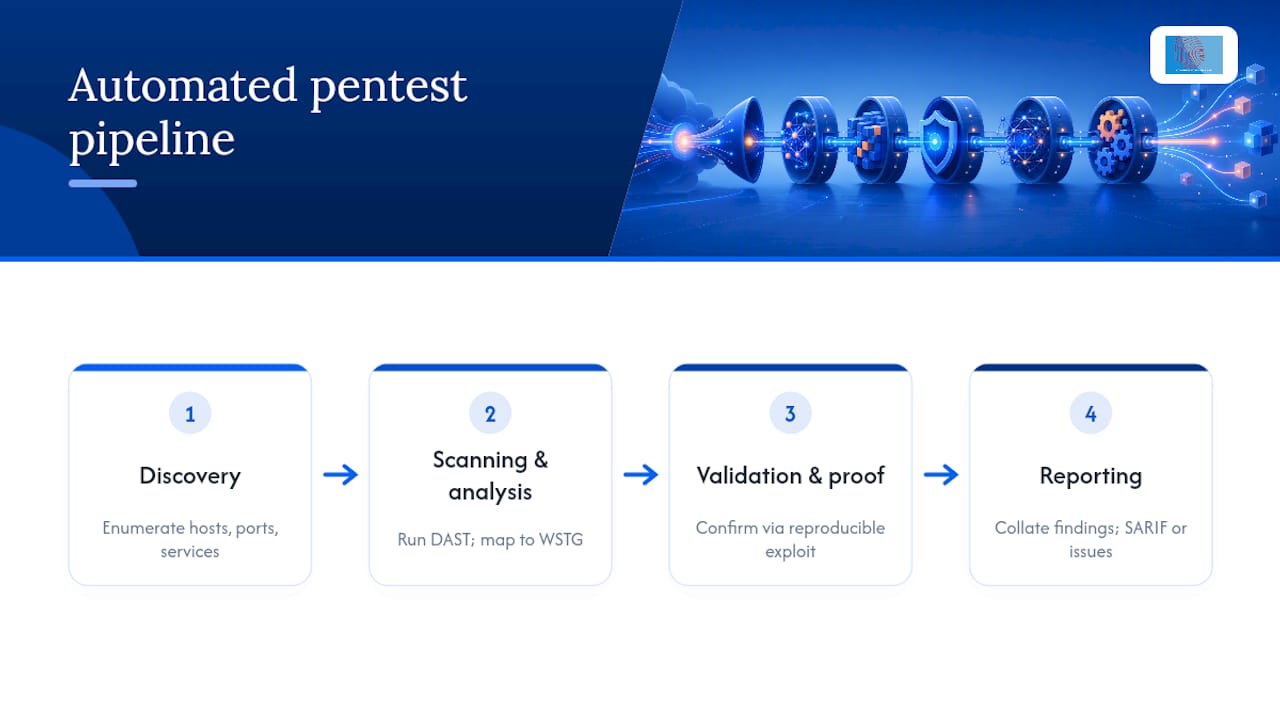

In a CI/CD context, this pipeline runs on every pull request or nightly build: a tool such as Strix attaches to the pipeline, scans the staging deployment, and gates the merge if validated PoCs are present. In an on-demand context, a security engineer configures scope, credentials, and scan depth, then reviews the consolidated report before triaging findings into a remediation backlog.
What automated tools do well and where they fall short
Automated penetration testing tools deliver consistent, repeatable coverage at a speed and scale no manual engagement can match, but their findings are bounded by what their payloads and logic trees can reach. Understanding that boundary is what separates a useful automated security programme from one that creates false confidence.
Strengths:
- Speed and scale: a scanner can assess hundreds of endpoints in the time a manual tester covers a handful.
- Repeatability: the same test suite runs identically on every build, producing comparable results over time.
- Continuous coverage: integrated into CI/CD, automated tools catch regressions the moment new code ships.
- Broad technique coverage: mature tools map findings to OWASP WSTG controls and PortSwigger technique guides, providing a structured evidence base.
- Audit trail: structured outputs (SARIF, JSON, PDF) support compliance reporting for PCI/DSS, ISO 27001, and SOC 2 audits.
Limitations:
- Business-logic gaps: automated tools cannot reason about what a transaction should do; they miss flaws where the vulnerability lies in the intended workflow rather than a technical weakness (for example, a price-manipulation flaw in a multi-step checkout).
- Authentication complexity: complex SSO flows, CAPTCHA, MFA, and OAuth consent screens frequently break automated crawlers, leaving large authenticated surfaces unscanned.
- False-positive noise: heuristic scanners routinely flag issues that do not reproduce under controlled conditions, consuming triage time and eroding trust in the tooling.
- Destructive payload risk: exploit-capable tools, particularly agentic projects, execute real payloads. Shannon’s documentation explicitly warns that tools must only be run against systems you own or have explicit authorisation to test, and that human review of findings remains necessary because LLM output can be incorrect or unsafe.
- Chained exploitation: multi-step attack chains that require contextual pivoting between systems remain largely beyond current automation.
Which technical features matter most when evaluating these tools
Proof quality is the single most important feature to demand from any automated pen testing tool. A finding backed by a reproducible, self-contained PoC is actionable; a heuristic flag with no evidence is noise that consumes developer time without improving security posture.
- OWASP WSTG and PortSwigger technique mapping — confirm the tool’s coverage aligns with the OWASP Web Security Testing Guide and PortSwigger’s technique library so findings carry a recognised, auditable reference.
- Authenticated scanning with deterministic login handling — the tool must handle session tokens, cookie-based auth, and ideally complex flows such as OAuth and SAML without breaking mid-crawl.
- Proof-by-exploit / reproducible PoC — require that confirmed findings include a self-contained reproduction script or request sequence, not just a confidence score.
- CI/CD integration and remediation exports — look for native SARIF output, GitHub/GitLab PR annotations, and Jira/Linear ticket creation so findings flow directly into the development workflow.
- WAF evasion intelligence — tools that rotate payloads, vary encoding, and apply timing controls surface findings that naive scanners miss behind perimeter defences.
- Customisability and scripting — the ability to write custom checks, extend payload libraries, or hook into the pipeline via API is critical for mature security programmes.
- Safe-mode and destructive-test controls — a clearly documented non-destructive mode, rate-limiting, and the ability to exclude specific endpoints prevent accidental data loss or service disruption.
- Self-hosting options — for organisations handling sensitive data or operating in regulated sectors, the ability to run the tool entirely on-premise or in an air-gapped environment is often a compliance requirement.
Pro Tip: When evaluating any automated pen testing tool, request a sample report from a known-vulnerable application (DVWA or Juice Shop) and check whether every high-severity finding includes a self-contained reproduction request. If the report contains only confidence percentages, treat every finding as unconfirmed until manually verified.
Representative tools and what each is best used for
The tools below span the major categories in use across UK security programmes, from established open-source staples to the emerging agentic generation. Each is available to UK-based engineers either as open-source software, a self-hosted deployment, or a SaaS platform.
DAST scanners and classic tools
OWASP ZAP is the standard open-source DAST scanner for web application testing and a fixture in automated CI/CD pipelines. Its role in dynamic scanning is well-documented across OWASP chapter materials. Self-hostable, free, and extensible via scripts and add-ons. Expect a moderate false-positive rate on complex SPAs without careful configuration.

Burp Suite (PortSwigger) is the de facto professional DAST platform, offering both a manual proxy and an automated scanner (Burp Suite Enterprise). Its technique coverage maps directly to PortSwigger’s own research library, making it the reference standard for web application security testing. The Enterprise edition supports CI/CD integration and scheduled scans; the Community edition is free but lacks automation features. False-positive rates are lower than many open-source alternatives due to active validation logic.
Nmap remains the foundational tool for host discovery and port/service enumeration, embedded in virtually every automated reconnaissance stage. It does not exploit vulnerabilities but provides the target map that feeds every downstream scanner.
Nessus (Tenable) is the dominant commercial vulnerability scanner for network and host-level assessments, with a large CVE-matched plugin library and compliance-reporting templates for PCI/DSS and ISO 27001. Available as a managed SaaS or self-hosted deployment. High plugin coverage comes with a corresponding false-positive burden on large, heterogeneous networks.
OpenVAS / Greenbone is the leading open-source alternative to Nessus for network vulnerability scanning, maintained by Greenbone Networks. Self-hostable and free under an open-source licence, it suits organisations that cannot send scan data to a third-party SaaS. Setup cost is higher than commercial alternatives.
sqlmap automates SQL injection detection and exploitation, covering a wide range of injection techniques and database back-ends. It is exploit-capable, not merely a detector, which makes authorisation and scoping controls mandatory before any run.
Metasploit (Rapid7) is the most widely used exploitation framework, providing a structured library of modules for post-discovery exploitation and PoC generation. The open-source Community edition and the commercial Pro edition both support automated scan-and-exploit workflows. Its power makes rules of engagement and sandboxing non-optional.
Agentic and AI-driven projects
PentestGPT documents multi-stage autonomous pipelines covering recon, exploitation, and report generation, with session persistence and multi-LLM orchestration as distinguishing features. Derived from USENIX research, it represents the academic leading edge of LLM-driven pentesting automation.
Strix positions itself as a developer-first autonomous pentesting tool with CI/CD integration, validated PoCs, and the option to trigger scans on pull requests. Its SARIF output and PR-check integration make it well-suited to engineering teams that want security gates embedded in the development workflow rather than bolted on afterwards.
Shannon (Keygraph) performs white-box, source-aware analysis, reading code to plan and execute attacks, then producing proof-by-exploitation findings. It operates as the proof engine within the broader Keygraph platform, which adds continuous analysis and remediation management. Human review of its output is explicitly required by the project’s own documentation.
VirtueWebAgent (Virtue Security) automates login discovery, drives a real browser through single-page applications, and produces two separate reports: one for confirmed exploits and one for leads requiring further investigation. Its real-browser approach gives it better SPA coverage than headless HTTP scanners.
Cyberstrike is an open-source, extensible AI pentesting platform built on an MCP architecture with agentic finding validation and self-hosting support for air-gapped or on-premise deployments. Its extensible agent architecture suits organisations that need to customise the toolchain or operate in environments where cloud-based SaaS is not permissible.
Nuclei (ProjectDiscovery) is a community-driven, template-based scanner that executes targeted checks against a defined scope. Its template library covers CVEs, misconfigurations, and exposed panels, and it integrates cleanly into CI/CD pipelines. Low setup cost and high signal-to-noise ratio for known-vulnerability checks.
Autopentest-AI is an agentic MCP server that claims coverage of 109 WSTG tests and 31 PortSwigger technique guides, with multi-agent roles and 27 integrated security tools. It represents the current ceiling of stated technique coverage among open-source agentic projects.
All tools listed are available to UK-based engineers. Self-hosted options (OpenVAS, Cyberstrike, Shannon, Autopentest-AI) are particularly relevant for organisations subject to UK data-residency requirements or operating in regulated sectors such as financial services or legal.
How to deploy automated pentesting safely and effectively
Obtain explicit written authorisation for every target scope before any scan runs; start in a staging or CI environment; and require a validated PoC before any finding is raised as a ticket. Those three rules prevent the majority of operational and legal incidents that arise from automated pentesting.
Operational controls checklist:
- Sandbox and isolate: run scans against staging or a dedicated test environment, never directly against production without a signed rules-of-engagement document.
- Rate-limit all scans: configure request throttling to avoid triggering availability incidents or WAF blocks that invalidate results.
- Define test windows: schedule scans during low-traffic periods and notify operations teams in advance.
- Manage credentials securely: store test account credentials in a secrets manager; never hard-code them in pipeline configuration files.
- Scope authenticated crawling: restrict the crawler to the defined target scope using allow-lists to prevent accidental testing of third-party services.
- Enable non-destructive mode: for exploit-capable tools (Metasploit, sqlmap, agentic projects), confirm that destructive payloads (data deletion, account takeover with persistence) are disabled unless explicitly required and authorised.
- Document rollback procedures: for any scan that may alter application state, define and test a rollback or mitigation procedure before the scan runs.
CI/CD integration guidance:
Integrate SARIF output into your GitHub Actions or GitLab CI pipeline so that validated PoC findings automatically annotate pull requests. Gate merges on critical or high-severity confirmed findings, not on heuristic flags, to avoid alert fatigue. Tools such as Strix and Cyberstrike support this pattern natively. Avoid running exploit-capable modules in CI against shared staging environments without isolated network segments.
UK legal considerations:
The Computer Misuse Act 1990 makes unauthorised access to computer systems a criminal offence. Running automated penetration testing tools against any system without explicit written authorisation from the system owner exposes the operator to prosecution regardless of intent. Key requirements for UK-based programmes include:
- Written rules of engagement signed by the system owner before any scan.
- GDPR compliance for scan logs and evidence: logs containing personal data must be handled under an appropriate lawful basis, stored securely, and retained only as long as necessary.
- Chain of custody for findings used in legal proceedings: if automated scan output may be presented as evidence, it must be collected, stored, and documented in a forensically sound manner. The penetration testing process guidance published by Computerforensicslab covers evidence-handling requirements in detail.
- A one-sentence caution: running exploit-capable scans against production systems, even with authorisation, carries a risk of service disruption or data loss that must be explicitly accepted in writing by the system owner.
For organisations operating under UK legal or regulatory frameworks, the cybersecurity guidance for legal professionals published by Computerforensicslab provides additional context on data-handling obligations during security assessments.
When to use in-house tools and when to hire a provider
The simplest decision rule: run automated tools continuously for broad coverage and regression detection, and commission a human-led engagement periodically for complex logic, chained exploitation, and regulatory-grade evidence.
Decision guidance by team profile:
- Small team, low-risk application: automated DAST (OWASP ZAP, Nuclei) in CI/CD plus an annual manual assessment from an external provider covers most requirements.
- Mid-size team, regulated sector (financial services, healthcare, legal): hybrid approach — automated scanning in CI/CD, quarterly scoped manual engagements, and a managed provider for compliance-grade reporting (PCI/DSS, ISO 27001, Cyber Essentials Plus).
- Large enterprise, high-risk or critical infrastructure: dedicated internal security engineering team running automated tools continuously, supplemented by red-team engagements and a managed provider for adversarial simulation. Gartner’s adversarial exposure validation market category captures the enterprise buying dimension here.
- Legal or forensic context: where findings may be used in litigation or regulatory proceedings, a managed provider with documented chain-of-custody procedures and expert witness capability is required. Automated tool output alone is rarely sufficient for evidential purposes.
| Approach | Coverage | Automation level | Proof quality | Integration | Legal/safety risk |
|---|---|---|---|---|---|
| DIY automated | Broad, surface-level | Full automation | Heuristic to PoC | CI/CD native | Moderate (operator-managed) |
| Hybrid (internal + vendor) | Broad + deep logic | Automation + human | PoC + manual validation | CI/CD + ticketing | Lower (shared governance) |
| Managed provider | Deep, scoped | Human-led, tool-assisted | Validated, evidential | Report-based | Lowest (provider liability) |
Organisations that need findings suitable for legal proceedings or regulatory submissions should engage a provider with forensic evidence-handling capability. Computerforensicslab’s professional penetration testing service delivers scoped engagements with documented methodology, chain-of-custody evidence handling, and expert witness support where required.
A practitioner’s perspective on where automated tools actually deliver
The most common mistake in deploying automated pen testing tools is treating a clean scan report as a security clearance. Automated tools are exceptionally good at finding what they are designed to find: known CVEs, common injection classes, misconfigured headers, and exposed administrative interfaces. They are structurally incapable of reasoning about whether your application’s business logic is sound, whether a sequence of legitimate API calls can be chained into a privilege escalation, or whether your authentication flow leaks session state in a way that only becomes visible after ten minutes of manual observation.
Two concrete recommendations for the coming week. First, if you are not already running a DAST scanner in your CI/CD pipeline, deploy OWASP ZAP or Nuclei against your staging environment on every pull request and configure it to fail the build only on findings with a validated PoC, not on heuristic flags. That single change eliminates a class of regressions that currently ship silently. Second, review your rules of engagement documentation before your next scan cycle. If you do not have a signed authorisation document that explicitly names the target scope, the test window, and the permitted payload classes, pause the scan until you do. The Computer Misuse Act 1990 does not distinguish between a well-intentioned security engineer and an attacker; authorisation is the only legal protection available.
At Computerforensicslab, engagements that begin with automated tooling and escalate to manual investigation consistently surface findings that neither approach would have reached alone. The digital forensics services available through the practice extend that capability to evidence-grade investigation when findings require legal handling.
Sources
For verification and further reading, the following resources provide authoritative coverage of the tools, standards, and legal frameworks discussed above.
- Automated penetration testing | PortSwigger
- OWASP ZAP presentation (OWASP Dorset)
- Nmap: the network mapper
- Strix
- Cyberstrike – AI-Powered Penetration Testing Agent