

TL;DR:
- Anti-forensics involve sophisticated techniques disrupting every phase of digital investigations.
- Detecting anti-forensic activity requires careful analysis, documentation, and expert corroboration.
- Maintaining a robust chain of custody and thorough records is essential for legal admissibility.
Digital evidence is often treated as the gold standard in modern litigation and criminal investigations, yet this confidence can be misplaced. Anti-forensic techniques, deliberately designed to obstruct, corrupt, or destroy digital evidence, are growing in sophistication and frequency. For solicitors and law enforcement agents in England, understanding these tactics is no longer optional. When evidence disappears, metadata is manipulated, or forensic tools fail unexpectedly, the integrity of an entire case can collapse. This article explains what anti-forensics really involves, how it disrupts investigations at every stage, what it means for admissibility under English law, and how investigators can detect and counter these techniques effectively.
Table of Contents
- Defining anti-forensics: more than just data deletion
- How anti-forensics disrupts the digital forensic process
- Legal context: anti-forensics and its implications for investigations in England
- Detecting and countering anti-forensic techniques: practical steps
- Why anti-forensics challenges require holistic, not just technical, solutions
- Expert assistance for complex anti-forensics cases
- Frequently asked questions
Key Takeaways
| Point | Details |
|---|---|
| Broad anti-forensics tactics | Anti-forensic methods go beyond simple deletion to include hiding, manipulating, or sabotaging digital evidence. |
| Legal defence depends on process | Chain of custody and audit trails are critical for withstanding anti-forensics challenges in English courts. |
| Detection requires context | Separating malicious intent from legitimate data handling needs both technical analysis and case-specific understanding. |
| Expert support is invaluable | Early engagement with digital forensic specialists improves outcomes when anti-forensics is suspected or active. |
Defining anti-forensics: more than just data deletion
When most people hear “anti-forensics,” they picture someone frantically deleting files before police arrive. That picture is dangerously incomplete. Modern anti-forensics is a sophisticated discipline that encompasses multiple methodologies including data deletion and destruction, data hiding through steganography or cryptography, and direct attacks on the forensic tools investigators rely upon.
Steganography, for example, conceals data within ordinary-looking files such as images or audio recordings. A suspect might embed incriminating communications inside a holiday photograph, making it invisible to a cursory review. Cryptography, meanwhile, renders data unreadable without the correct key, and strong modern encryption can make even court-ordered disclosure practically impossible to fulfil if the key is withheld or destroyed.
“Anti-forensics is best understood not as a single tool, but as adversarial pressure applied across the end-to-end forensic lifecycle.”
This framing matters enormously. It shifts the conversation from a single act of deletion to a sustained, strategic effort to undermine every phase of a forensic investigation. The adversary is not just hiding data. They are attacking the process itself.
Traditional versus advanced anti-forensic techniques
| Technique type | Example | Primary target |
|---|---|---|
| Basic data deletion | Recycle bin emptying, file shredding | Evidence availability |
| Encryption | Full-disk encryption, file-level encryption | Evidence readability |
| Steganography | Data hidden in image or audio files | Evidence discoverability |
| Log tampering | Altering or deleting system event logs | Audit trail integrity |
| Tool exploitation | Triggering bugs in forensic software | Investigator capability |
| Artefact planting | Creating misleading digital footprints | Analytical accuracy |
What makes this especially challenging is that not every anti-forensic action looks obviously malicious at first glance. Common anti-forensic methods include:
- Routine-looking file deletion that is actually timed to precede a device seizure
- Encryption applied post-incident rather than as an established security policy
- Log rotation or overwriting that mimics standard IT maintenance
- Partition manipulation to hide data in unallocated disk space
- Timestamp alteration to create false timelines
Each of these can be explained away as legitimate system behaviour without careful forensic scrutiny. That ambiguity is precisely what makes anti-forensics so powerful as a legal strategy, and why investigators must approach every anomaly with structured scepticism rather than assumption.
How anti-forensics disrupts the digital forensic process
With definitions established, it is important to see how these methods impact the practicalities of real investigations. A standard digital forensic investigation follows a recognisable sequence: identification, acquisition, examination, analysis, and reporting. Anti-forensic tactics can strike at every single one of these stages, and understanding where the vulnerabilities lie is the first step to protecting against them.
Forensic stage versus anti-forensic risk
| Forensic stage | Anti-forensic tactic | Investigative impact |
|---|---|---|
| Identification | Hidden partitions, encrypted volumes | Evidence overlooked entirely |
| Acquisition | Remote wiping, destructive malware | Evidence destroyed before imaging |
| Examination | Obfuscated file formats, steganography | Evidence missed during review |
| Analysis | Misleading artefacts, altered timestamps | False conclusions drawn |
| Reporting | Tool exploitation causing software failure | Findings challenged or invalidated |
Consider the acquisition stage. If a suspect activates remote wipe functionality on a device the moment law enforcement arrives, forensic imaging becomes impossible unless the device is immediately isolated from all networks. This is not a hypothetical. It is a documented tactic used in both corporate and criminal cases. Equally, anti-forensic approaches include attacking forensic tools by triggering bugs or causing failures in forensic software behaviour, which can invalidate findings or introduce doubt about the reliability of the entire examination.
The typical sequence of a digital forensic investigation, mapped against anti-forensic risks, looks like this:
- Scene assessment and device identification — Risk: hidden storage media or encrypted containers overlooked
- Device seizure and isolation — Risk: remote wipe or network-triggered destruction before imaging
- Forensic imaging — Risk: hardware-level encryption blocking acquisition of readable data
- File system examination — Risk: obfuscated or steganographically concealed files evading detection
- Log and artefact analysis — Risk: tampered or deleted logs creating false timelines
- Tool-based analysis — Risk: malformed files or crafted inputs crashing or corrupting forensic software
- Report compilation — Risk: contested tool reliability undermining court presentation
Understanding the legal applications of digital forensics also means understanding that a compromised step anywhere in this chain can render downstream findings inadmissible or open to serious challenge.


Pro Tip: Always document tool errors, unexpected software behaviour, and process anomalies during an investigation. These records can serve as evidence of anti-forensic interference and strengthen your position when findings are challenged in court.
Legal context: anti-forensics and its implications for investigations in England
Understanding the technical battle is one side of the problem. Anti-forensics also introduces significant challenges for court-admissible digital evidence, and the English legal system places particular demands on how that evidence is gathered, preserved, and presented.
In England, the admissibility of digital evidence is governed by principles including the Police and Criminal Evidence Act 1984 (PACE), the Criminal Procedure Rules, and guidance from the Crown Prosecution Service. At the heart of all of this is a single, non-negotiable requirement: demonstrable integrity. The chain of custody for digital evidence must be maintained without interruption, and every handling step must be documented and reproducible.
Anti-forensics complicates this in a specific and damaging way. When evidence is missing, altered, or demonstrably tampered with, investigators must not only explain what they found but also what they did not find, and why. Courts expect forensic experts to account for artefact loss and to demonstrate that any gaps in evidence are attributable to the suspect’s actions rather than investigator error or process failure.
Key legal principles governing digital evidence in England include:
- Integrity: Evidence must be shown to be unaltered from the point of seizure
- Auditability: Every action taken on digital evidence must be logged and reviewable
- Reproducibility: Findings must be capable of independent verification by a defence expert
- Proportionality: Forensic methods must be appropriate to the seriousness of the offence
- Continuity: The chain of custody must be unbroken from seizure to court presentation
When anti-forensic interference is suspected, legal considerations for digital forensics become considerably more complex. The defence may argue that missing evidence reflects investigator incompetence rather than deliberate destruction. Prosecutors must be prepared to counter this with detailed process documentation and expert testimony.
For England-focused legal and operational practice, countering anti-forensics depends on defensible process: preserving integrity, ensuring auditability and reproducibility, and building forensic visibility throughout the investigation. This is not simply good practice. It is a legal necessity.
Pro Tip: Invest in comprehensive, timestamped logging of every forensic action from the moment a device is seized. Routine chain of custody reviews, ideally conducted by a second qualified examiner, provide an independent check that strengthens evidential integrity in court.
Audit trail irregularities are increasingly subjected to heightened legal scrutiny in English courts. A missing log entry or an unexplained gap in timestamps can be seized upon by defence counsel as evidence of either investigator error or evidence contamination. The burden on investigators to demonstrate clean, documented process has never been higher.
Detecting and countering anti-forensic techniques: practical steps
With the unique legal challenges understood, the next priority is proactive defence. Detecting and neutralising anti-forensics in practice requires a combination of technical skill, procedural discipline, and contextual judgement.
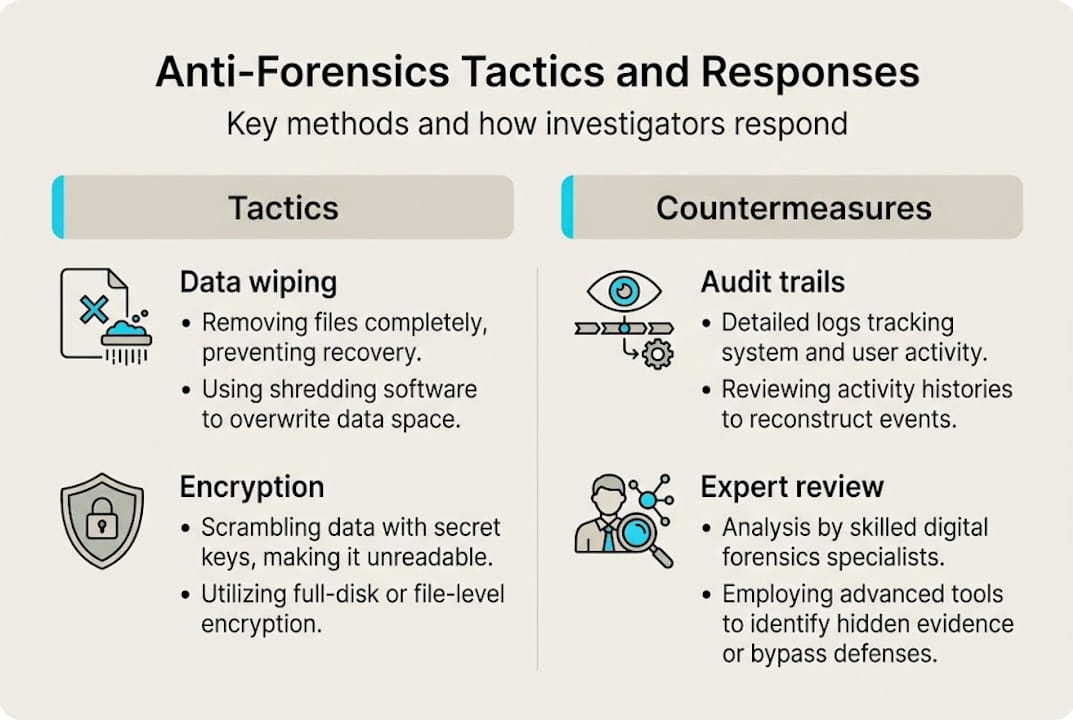

One of the most important starting points is recognising that not every apparent anti-forensic action is deliberate sabotage. Investigators and prosecutors may need expert framing about context, timeline, and the effort or intent behind observed actions, rather than treating every missing artefact as solely malicious. Routine IT sanitisation, for example, can produce results that look identical to deliberate evidence destruction. Intent must be established through corroborating evidence, not assumed.
Indicators that anti-forensics may be in play:
- Metadata inconsistencies, such as file creation dates that predate the operating system installation
- Unexplained gaps in system event logs or security logs
- Evidence of secure deletion tools in the application history
- Encrypted volumes or containers with no corresponding decryption key provided
- Unusual file extensions or files whose headers do not match their declared format
- Timestamps that do not align with network or server-side records
When these indicators appear, the following procedural steps should be followed:
- Preserve the original image immediately using write-blocking hardware to prevent further alteration
- Document all anomalies in detail, including tool errors, unexpected outputs, and process deviations
- Correlate multiple evidence sources such as network logs, cloud backups, and third-party server records to fill gaps left by local anti-forensic activity
- Engage a specialist examiner with experience in anti-forensic detection to conduct a secondary review
- Prepare expert testimony that contextualises missing or altered artefacts within the broader evidential picture
- Brief counsel early so that legal strategy accounts for potential challenges to evidence completeness
Counter strategies should also include preserving chain of custody through rigorous imaging protocols, using validated forensic tools with documented version histories, and maintaining contemporaneous notes throughout the examination.
Practical counter-forensic detection checklist:
- Cross-reference local file timestamps against server-side or cloud-based equivalents
- Use multiple forensic tools to validate findings, since a single tool failure may indicate targeted exploitation
- Examine unallocated disk space and slack space for remnants of deleted data
- Review Volume Shadow Copies and system restore points for earlier file versions
- Check for evidence of anti-forensic software such as file shredders, log cleaners, or steganography tools in the application registry
Pro Tip: When technical intent or legitimacy is genuinely unclear, bring in a domain expert before drawing conclusions. An experienced forensic specialist can distinguish between deliberate anti-forensic activity and routine IT behaviour, a distinction that can make or break a case in court.
Why anti-forensics challenges require holistic, not just technical, solutions
Here is the uncomfortable truth that the forensic community is slow to acknowledge: the best forensic software in the world cannot fully protect an investigation from a determined, technically sophisticated adversary. We have seen cases where impeccable technical execution still produced contested outcomes, not because the forensics were wrong, but because the surrounding process lacked the contextual framing to withstand legal challenge.
The real answer to anti-forensics is not a better tool. It is a better system. Investigations need total process visibility, meaning that every decision, every anomaly, and every deviation from standard procedure is recorded and explainable. Digital chain of custody best practices are the foundation, but they must be supported by cross-source verification, where local device evidence is always corroborated against network, cloud, and third-party records.
Legal professionals must also push back against the assumption that a missing artefact is automatically a weakness. Properly contextualised, evidence of deliberate destruction can itself become powerful evidence of consciousness of guilt. That requires close collaboration between technical examiners and legal teams from the very start of an investigation, not as an afterthought when the case reaches court. Judicial education matters too. Judges and juries who understand why evidence might be absent are far better equipped to evaluate what that absence actually means.
Expert assistance for complex anti-forensics cases
When an investigation encounters signs of anti-forensic interference, the margin for error narrows sharply. Early engagement with specialist support is not a luxury. It is a practical necessity that directly affects case outcomes. At Computer Forensics Lab, our team provides advanced digital forensics services specifically designed to detect, document, and counter anti-forensic activity across devices, networks, and cloud environments. From forensic imaging and artefact recovery through to expert witness reports that withstand cross-examination, we support solicitors and law enforcement at every stage of digital forensic investigations. The earlier you involve specialist examiners, the greater the chance of recovering evidence and building a case that holds up under scrutiny.
Frequently asked questions
What are the most common anti-forensic techniques encountered in England?
The most common are data wiping, encryption, steganography, and manipulation or destruction of system logs. Anti-forensics includes deletion, cryptography, steganography, and direct attacks on forensic tools, all of which appear regularly in English criminal and civil cases.
How can investigators demonstrate evidence integrity when anti-forensics is suspected?
They should use a defensible chain of custody and maintain robust audit trails documenting every evidence handling step. Countering anti-forensics depends on preserving integrity, auditability, and correlation with multiple independent sources.
Can legitimate data protection measures be mistaken for anti-forensics?
Yes. Routine sanitisation or encryption can produce results that are indistinguishable from deliberate evidence destruction. Some anti-forensic techniques mimic legitimate security practices, so context and demonstrable intent must be carefully assessed before conclusions are drawn.
Are there any warning signs that anti-forensics is in play?
Warning signs include missing or altered metadata, unexplained log gaps, unexpected tool errors, and inconsistent artefacts across devices. Anti-forensics acts across the forensic lifecycle, creating new forms of artefact loss or unreliability that experienced examiners are trained to recognise.